Have you ever paused while writing an email and wondered whether the correct phrase is “Answer TO, FOR, Or OF The Question?” It’s a surprisingly common issue in English usage, especially when accuracy matters. Whether you’re handling business communication, responding during meetings, or creating content for formal writing, choosing the right preposition can improve clarity, professionalism, and reader confidence.
Small grammar choices often have a bigger impact than people realize. In professional settings involving project management, scheduling, time management, online booking, broadcasting, or maintaining a shared calendar, precise language helps prevent misunderstandings. The difference between an answer to a question, an answer for someone, and an answer of something is not merely stylistic. It reflects important rules of grammar, context, and meaning while promoting consistency in written and spoken communication.
In this guide, you’ll learn the exact difference between “answer to,” “answer for,” and “answer of”, along with practical examples and usage tips. We’ll examine common mistakes, explain which form native speakers prefer, and show how each expression functions in real-world communication. By the end, you’ll have a stronger grasp of English usage, improved formal writing skills, and greater consistency in every professional or everyday conversation.
Understanding the Core Idea Behind “Answer TO vs FOR vs OF”
Before diving into rules, you need to understand one simple truth:
These phrases don’t compete. They serve different meanings.
Think of them like tools in a kitchen:
- A knife slices
- A spoon scoops
- A whisk blends
You don’t use a spoon to chop onions. Same logic applies here.
Each phrase attaches to “answer,” but changes what kind of relationship you describe.
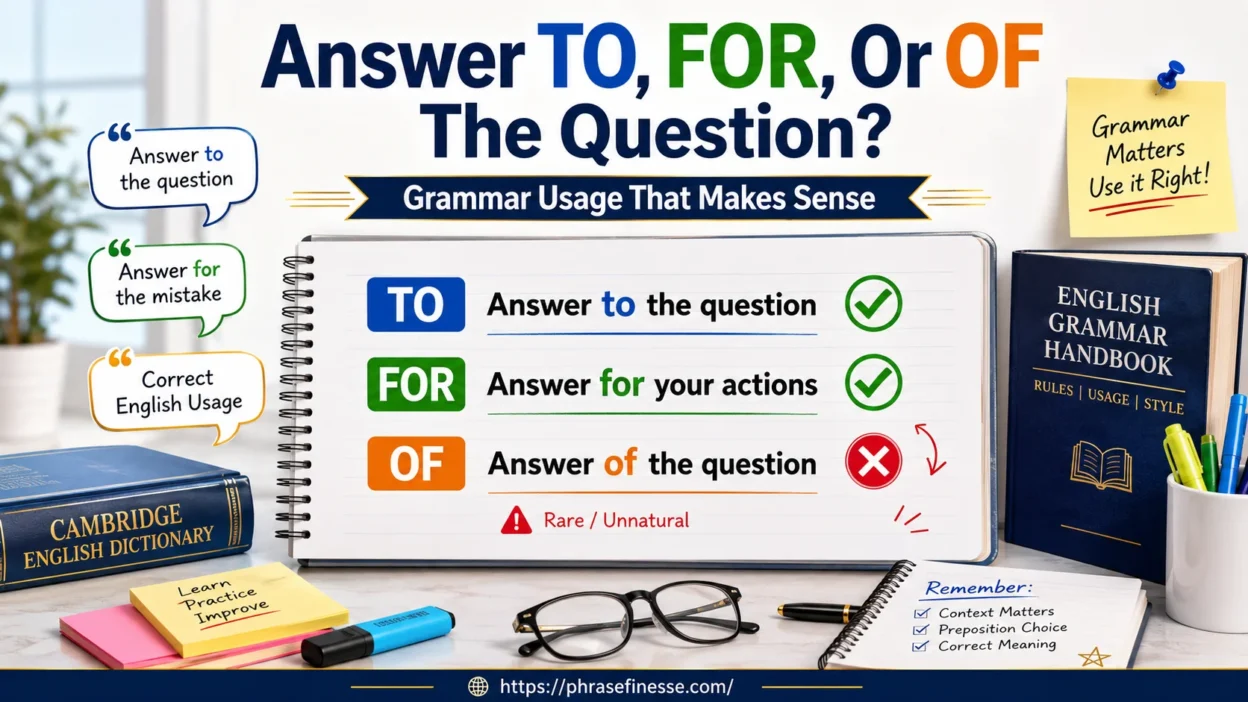
Answer TO vs Answer FOR vs Answer OF: Quick Meaning Map
Here’s a simple breakdown before we go deeper:
| Phrase | Meaning | Natural Use |
| answer to | respond to someone or something | authority, question, person |
| answer for | take responsibility or explain actions | accountability, blame |
| answer of | rarely used; refers to content or result of an answer | formal or archaic contexts |
Now let’s break each one down so it actually sticks.
When You Use “Answer TO” in Real English
The phrase “answer to” is the most common of the three. You’ll hear it in daily conversations, workplaces, and exams.
The basic idea
You use “answer to” when you respond to a person, authority, or question.
It shows direction. The answer moves toward something.
Simple examples
- I answered to the teacher during class.
- She answers to her manager at work.
- You must answer to this question carefully.
Notice how each sentence shows interaction or direction.
A deeper way to remember it
Think of it like this:
“TO = toward”
You always direct your response toward someone or something.
Common real-life situations
You’ll mostly use “answer to” in:
- School settings
- Workplace hierarchy
- Customer service
- Interviews
- Direct questions
Example scenario
A manager asks:
“Who do you answer to in this department?”
It means: Who gives you instructions?
When You Use “Answer FOR” in English
Now things get more interesting. “Answer for” has a completely different job.
It does NOT mean replying to someone.
It means taking responsibility.
Core meaning
You use “answer for” when you:
- explain actions
- accept blame
- take responsibility
Simple examples
- He will answer for his mistake.
- You must answer for your behavior.
- The company had to answer for the delay.
Think of it this way
“FOR = because of responsibility”
It often appears when consequences show up.
Real-life situations
You’ll see “answer for” in:
- Legal discussions
- Workplace accountability
- Moral responsibility
- Serious conversations
Example scenario
A parent says:
“You will answer for this behavior.”
It means: You will be held responsible for what you did.
Common mistake people make
Many learners confuse it with “answer to,” but here’s the difference:
- “answer to the teacher” = respond
- “answer for the mistake” = take blame
Mixing them changes meaning completely.
When You Use “Answer OF”
Here’s where things get tricky.
“Answer of” is not commonly used in modern English.
It appears in:
- older texts
- formal or philosophical writing
- fixed expressions in literature
Core idea
“Answer of” refers to:
- content of an answer
- result or formulation of an answer
Examples
- The answer of the riddle was surprising.
- He gave the answer of wisdom, not emotion.
These sound formal, almost poetic.
Modern usage reality
In everyday English, people usually say:
- “answer to the question” instead of “answer of the question”
So in most cases:
You should avoid “answer of” unless writing formally or stylistically.
Read More: Agencies or Agency’s or Agencies’? Choose Correct one!
Side-by-Side Comparison That Clears Everything Up
Let’s simplify this once more.
| Phrase | What it focuses on | Example |
| answer to | direction toward a person or question | I answered to the teacher |
| answer for | responsibility or blame | He answered for his mistake |
| answer of | content or result (rare) | The answer of the puzzle |
If you remember nothing else, remember this:
- TO = direction
- FOR = responsibility
- OF = form or content (rare)
Real-World Case Studies
Let’s make this practical.
Case Study 1: Office confusion
A new employee writes:
“I will answer of the manager.”
This sounds unnatural.
Correct version:
“I will answer to the manager.”
Why? Because the employee reports to a person, not describing content.
Case Study 2: Accountability issue
A team misses a deadline.
Wrong:
“We will answer to the delay.”
Correct:
“We will answer for the delay.”
Why? Because this involves responsibility, not direction.
Case Study 3: Academic writing confusion
A student writes:
“The answer of the question is simple.”
Better modern version:
“The answer to the question is simple.”
Why? Because English today prefers “to” for questions.
Common Mistakes People Make
Let’s clear up frequent errors.
Mistake 1: Mixing “to” and “for”
Wrong:
- I will answer to my mistake.
Correct:
- I will answer for my mistake.
Mistake 2: Overusing “of”
Wrong:
- The answer of the problem is clear.
Correct:
- The answer to the problem is clear.
Mistake 3: Using all three interchangeably
Each phrase changes meaning. You can’t swap them freely.
Quick Memory Tricks That Actually Work
If grammar rules feel heavy, use these shortcuts:
Trick 1: Direction test
Ask yourself:
- Am I pointing toward someone? → use TO
Trick 2: Blame test
Ask yourself:
- Am I taking responsibility? → use FOR
Trick 3: Formal tone test
Ask yourself:
- Am I writing something old or poetic? → maybe OF
Comparison Table for Fast Revision
| Situation | Correct Phrase |
| responding to teacher | answer to |
| reporting to boss | answer to |
| taking blame for mistake | answer for |
| legal responsibility | answer for |
| poetic or old text | answer of |
Why This Confusion Happens in English
English borrows patterns from Latin, French, and Old English. That mix creates overlapping prepositions.
Prepositions like:
- to
- for
- of
don’t translate cleanly into meaning. Instead, they show relationships.
That’s why learners struggle. You aren’t just memorizing words. You’re learning how English connects ideas.
Practice Section
Fill in the blanks:
- I will ______ the manager about this issue.
- She must ______ her actions.
- The ______ the riddle surprised everyone.
Answers:
- answer to
- answer for
- answer of (formal)
Expert Insight
Linguists often say preposition usage in English depends more on habit than logic. That means exposure matters more than memorization.
A useful quote captures it well:
“Prepositions are learned through patterns, not rules alone.”
So reading and listening to real English matters just as much as studying rules.
What You Should Remember
If you only remember a few things:
- Use answer to for people and questions
- Use answer for for responsibility
- Avoid answer of in modern writing
That alone will keep your English natural and correct in 95% of cases.
FAQs
1. Which is correct: “answer to the question” or “answer of the question”?
“Answer to the question” is the standard and grammatically correct expression in modern English usage. Native speakers, style guides, and professional writers overwhelmingly prefer this form when referring to a response or solution to a question.
2. When should I use “answer for”?
Use “answer for” when referring to responsibility, accountability, or acting on someone’s behalf. For example, “You will have to answer for your actions.” It does not usually mean a response to a question.
3. Is “answer of the question” ever correct?
“Answer of the question” is uncommon and generally sounds unnatural in modern English. In most situations, “answer to the question” is the preferred and accepted phrase.
4. Why is “answer to the question” more common?
The preposition “to” naturally indicates a response directed toward something. Since an answer responds to a question, English speakers use “answer to the question” as the standard construction in both speech and writing.
5. Can I use “answer to” in formal writing?
Yes. “Answer to” is appropriate for formal writing, academic papers, business documents, reports, and professional correspondence. It is widely accepted across formal and informal contexts.
6. How can I avoid mistakes with “answer to,” “answer for,” and “answer of”?
Focus on the meaning you want to convey. Use “answer to” for a response, “answer for” for responsibility or representation, and avoid “answer of” unless a very specific context requires it. Reading examples and practicing correct usage can improve grammar and consistency.
Conclusion
Understanding the difference between “answer to,” “answer for,” and “answer of” can make your writing clearer and more professional. In most situations, “answer to the question” is the correct and natural choice because it describes a response to a question. Meanwhile, “answer for” relates to responsibility or speaking on behalf of someone, while “answer of” rarely appears in modern English and often sounds awkward.
Whether you’re writing emails, preparing reports, participating in business communication, managing project management tasks, or improving your overall English usage, selecting the right preposition strengthens clarity and credibility. By applying these simple grammar rules consistently, you can communicate with greater confidence and a

Alyan Ashraf is an English language writer and editor at Phrase Finesse, where he specializes in grammar, vocabulary, spelling, word usage, and clear communication. Passionate about the English language, he creates practical, research-backed content that helps readers avoid common mistakes and write with greater accuracy and confidence.
Known for his clear writing style and attention to detail, Alyan simplifies complex language topics into easy-to-understand guides filled with real-world examples and actionable insights. His work covers confusing word pairs, grammar rules, idioms, punctuation, and everyday English usage, making learning both accessible and engaging for students, professionals, writers, and non-native English speakers.
Every article Alyan writes is carefully researched, fact-checked, and designed to meet high editorial standards. His goal is to help readers strengthen their English skills, expand their vocabulary, and communicate more effectively in academic, professional, and everyday settings.
Through Phrase Finesse, Alyan is committed to publishing trusted language resources that make mastering English simpler, clearer, and more enjoyable for learners around the world