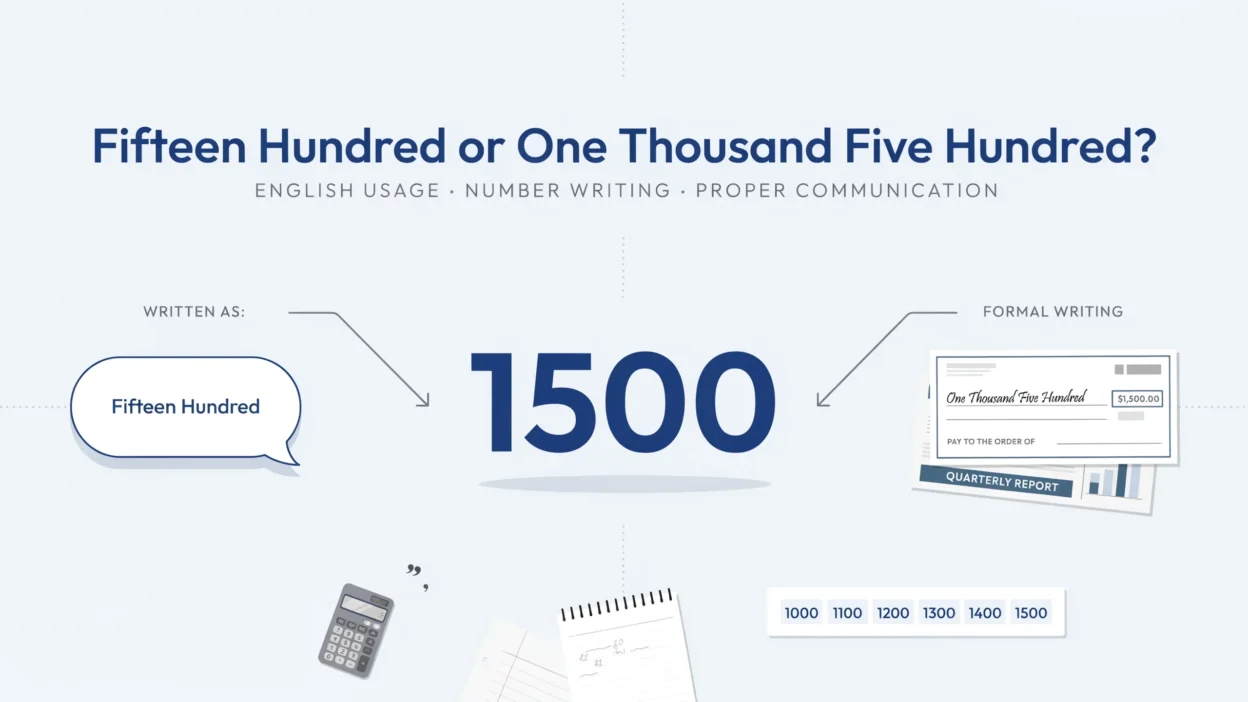
Have you ever paused while writing a number and wondered which wording sounds more appropriate? The question behind “1500 In Words: ‘Fifteen Hundred’ Or ‘One Thousand Five Hundred’?” is more common than many people realize. Whether you are preparing a document, filling out a form, writing a check, or improving your English usage, choosing the correct number expression can affect clarity, readability, and overall communication. Understanding when to use each version helps you write with greater confidence and precision.
In everyday conversations, “fifteen hundred” often sounds natural and concise, while “one thousand five hundred” is frequently preferred in formal writing, academic contexts, and official records. The choice depends on factors such as grammar, audience expectations, and the level of formality required. Maintaining consistency in number formatting is especially important in professional environments, where accurate wording supports effective business communication, documentation, and clear information exchange.
This article explores the differences between these two forms, explains which option fits specific situations, and highlights common usage patterns in modern English. You will also learn how number wording contributes to project management, meetings, calendar planning, scheduling, time management, online booking, and broadcasting contexts where accuracy matters. By the end, you will know exactly when to use each expression and how to ensure your writing remains clear, professional, and grammatically correct.
What Is 1500 in Words?
The number 1500 can be written in words in two common ways:
- One Thousand Five Hundred
- Fifteen Hundred
Both represent exactly the same numerical value.
Standard Written Form
The traditional and most widely accepted written form is:
One Thousand Five Hundred
This version directly reflects the structure of the number:
| Place Value | Number |
| Thousands | 1 |
| Hundreds | 5 |
| Tens | 0 |
| Ones | 0 |
Therefore:
1,000 + 500 = One Thousand Five Hundred
This format is commonly taught in schools and used in formal writing.
Alternative Spoken Form
The alternative form is:
Fifteen Hundred
Native English speakers use this version frequently in conversation because it is shorter and easier to say.
For example:
- Fifteen hundred dollars
- Fifteen hundred people
- Fifteen hundred tickets sold
The meaning remains exactly the same.
Is “Fifteen Hundred” Correct?
Yes.
Fifteen hundred is completely correct English.
Many learners assume that only “one thousand five hundred” is acceptable. That isn’t true.
English allows speakers to express certain numbers using a hundreds-based pattern.
Examples include:
| Number | Alternative Form |
| 1100 | Eleven Hundred |
| 1200 | Twelve Hundred |
| 1300 | Thirteen Hundred |
| 1400 | Fourteen Hundred |
| 1500 | Fifteen Hundred |
| 1600 | Sixteen Hundred |
| 1700 | Seventeen Hundred |
| 1800 | Eighteen Hundred |
| 1900 | Nineteen Hundred |
Because these expressions have existed for centuries, they are fully accepted in modern English.
Why People Use Fifteen Hundred
People often prefer shorter expressions.
Compare these two statements:
- One thousand five hundred people attended the event.
- Fifteen hundred people attended the event.
The second sentence feels quicker and more conversational.
That’s why you’ll hear it regularly in everyday speech.
Is “One Thousand Five Hundred” Correct?
Absolutely.
In fact, one thousand five hundred is considered the most formal and universally recognized version.
Whenever maximum clarity is important, this form is usually preferred.
Examples include:
- Legal contracts
- Government forms
- Academic papers
- Financial records
- Insurance documents
- Official correspondence
Because the wording mirrors the exact place-value structure of the number, there is little room for misunderstanding.
Fifteen Hundred vs. One Thousand Five Hundred: What’s the Difference?
Both forms mean exactly the same thing.
The difference lies in style and context.
Quick Comparison
| Feature | Fifteen Hundred | One Thousand Five Hundred |
| Meaning | 1500 | 1500 |
| Grammatically Correct | Yes | Yes |
| Formal Writing | Less Common | Preferred |
| Everyday Speech | Very Common | Less Common |
| Legal Documents | Usually Avoided | Recommended |
| Checks | Usually Avoided | Preferred |
| Academic Writing | Less Preferred | Preferred |
| Conversational Tone | Natural | More Formal |
The Key Difference
Think of it this way:
Fifteen hundred is how people often speak.
One thousand five hundred is how people often write formally.
Neither is wrong.
The best choice depends on your audience and purpose.
Read More: Universities or University’s or Universities’? Use Correct One!
Which Version Sounds More Natural?
If you walk into a coffee shop and hear someone discussing a price, they will probably say:
“The repair cost about fifteen hundred dollars.”
They probably won’t say:
“The repair cost one thousand five hundred dollars.”
The second sentence isn’t incorrect.
It simply sounds more formal.
Native speakers naturally choose shorter versions when speaking.
This pattern appears throughout English.
For example:
- Twenty-five instead of twenty and five
- Two grand instead of two thousand dollars
- A dozen instead of twelve
Language tends to favor efficiency.
When Should You Use “Fifteen Hundred”?
There are many situations where fifteen hundred sounds perfectly natural.
Everyday Conversations
Most people use fifteen hundred in casual speech.
Examples:
- We sold fifteen hundred tickets.
- The laptop costs fifteen hundred dollars.
- About fifteen hundred guests attended.
- The charity raised fifteen hundred dollars.
Informal Business Discussions
Businesses often use this form in meetings and conversations.
Examples:
- Our budget is fifteen hundred dollars.
- The campaign reached fifteen hundred customers.
- We need fifteen hundred units next month.
Sports and Fitness
Athletes and coaches frequently use hundreds-based numbers.
Examples:
- She ran fifteen hundred meters.
- The stadium welcomed fifteen hundred spectators.
- Fifteen hundred athletes registered.
Real Estate Discussions
Agents often use this style when discussing prices and square footage.
Examples:
- The apartment rents for fifteen hundred dollars monthly.
- The home has fifteen hundred square feet.
When Should You Use “One Thousand Five Hundred”?
Certain situations require a more formal approach.
Legal Documents
Precision matters in legal writing.
Examples include:
- Contracts
- Court filings
- Agreements
- Wills
Using the full written form reduces ambiguity.
Financial Records
Banks and accountants generally prefer the standard format.
Examples:
- Invoices
- Tax forms
- Financial statements
- Loan agreements
Academic Writing
Research papers and scholarly documents typically use more formal wording.
For example:
The survey included one thousand five hundred participants.
This style aligns with professional writing standards.
International Communication
Not every English speaker is familiar with every conversational shortcut.
Using “one thousand five hundred” improves clarity for global audiences.
How to Write 1500 on a Check
Writing numbers correctly on checks remains important.
Recommended Format
For a check worth $1,500:
One Thousand Five Hundred Dollars and 00/100
or
One Thousand Five Hundred Dollars Only
Example
| Check Field | Entry |
| Numeric Amount | $1,500.00 |
| Written Amount | One Thousand Five Hundred Dollars Only |
Why Banks Prefer the Full Form
Banks value consistency and clarity.
A longer written version helps prevent:
- Misinterpretation
- Alteration
- Fraudulent modifications
- Processing delays
Even though “fifteen hundred dollars” would likely be understood, financial institutions generally favor the traditional format.
How to Pronounce 1500 Correctly
There are two accepted pronunciations.
Common Pronunciation
Fifteen Hundred
Most common in everyday speech.
Formal Pronunciation
One Thousand Five Hundred
Common in formal presentations and educational settings.
Pronunciation Tips
People sometimes confuse:
- Fifteen
- Fifty
To avoid confusion:
- Stress the second syllable in fifteen.
- Speak clearly when discussing money.
For example:
- Fif-TEEN hundred
- Fif-TY hundred
The distinction matters.
Examples of 1500 in Sentences
Understanding real-world usage helps build confidence.
Everyday Examples
- The concert attracted fifteen hundred fans.
- We spent fifteen hundred dollars on renovations.
- Approximately fifteen hundred visitors arrived.
Business Examples
- The company generated fifteen hundred new leads.
- Our target is fifteen hundred monthly subscriptions.
Formal Examples
- The project required one thousand five hundred labor hours.
- The grant provided one thousand five hundred dollars in funding.
Academic Examples
- Researchers analyzed data from one thousand five hundred respondents.
- The sample consisted of one thousand five hundred students.
Numbers Similar to 1500 Written in Words
Many numbers follow the same pattern.
Number Conversion Table
| Number | Standard Form | Alternative Form |
| 1100 | One Thousand One Hundred | Eleven Hundred |
| 1200 | One Thousand Two Hundred | Twelve Hundred |
| 1300 | One Thousand Three Hundred | Thirteen Hundred |
| 1400 | One Thousand Four Hundred | Fourteen Hundred |
| 1500 | One Thousand Five Hundred | Fifteen Hundred |
| 1600 | One Thousand Six Hundred | Sixteen Hundred |
| 1700 | One Thousand Seven Hundred | Seventeen Hundred |
| 1800 | One Thousand Eight Hundred | Eighteen Hundred |
| 1900 | One Thousand Nine Hundred | Nineteen Hundred |
Interesting Pattern
Notice something?
English speakers commonly use the hundreds shortcut for numbers between 1100 and 1900.
However, people rarely say:
- Twenty hundred
- Twenty-one hundred
Although these expressions sometimes appear in military, aviation, and timekeeping contexts.
Why English Allows “Fifteen Hundred”
English evolved through centuries of influence from Germanic languages, French, and Latin.
Over time, speakers developed efficient ways to express numbers.
The “hundreds” system became popular because it reduced the number of words needed.
Compare:
- One thousand five hundred
- Fifteen hundred
The second version is faster to pronounce.
Language naturally favors convenience when meaning remains clear.
A Simple Analogy
Think about measurements.
Instead of saying:
Twelve inches
People often say:
One foot
Both mean the same thing.
Similarly:
- One thousand five hundred
- Fifteen hundred
Both communicate the same value.
Common Mistakes When Writing 1500 in Words
Several errors appear repeatedly.
Misspelling Hundred
Incorrect:
- Fifteen hundered
- One thousand five hundered
Correct:
- Fifteen hundred
- One thousand five hundred
Adding Unnecessary Hyphens
Incorrect:
- Fifteen-hundred dollars
- One-thousand-five-hundred
Correct:
- Fifteen hundred dollars
- One thousand five hundred
Mixing Styles
Avoid switching styles within the same document.
Example:
Incorrect:
The first payment was fifteen hundred dollars while the second payment was one thousand eight hundred dollars.
Choose one style and remain consistent.
British English vs. American English Usage
Both British and American English recognize the same number.
However, minor differences exist.
American English
Most writers use:
One Thousand Five Hundred
British English
Some writers may include:
One Thousand and Five Hundred
Example:
- British style: One thousand and five hundred
- American style: One thousand five hundred
Modern Trend
Today, many style guides favor the shorter version without “and.”
As a result:
One thousand five hundred has become widely accepted internationally.
Real-World Case Study: Writing 1500 in Business Communication
Imagine a marketing manager preparing two documents.
Internal Team Chat
The manager writes:
We generated fifteen hundred qualified leads this month.
This sounds natural and conversational.
Annual Investor Report
The manager writes:
The campaign generated one thousand five hundred qualified leads.
This sounds more formal and polished.
Lesson
The number never changes.
Only the writing style changes.
Good writers adapt their wording to fit the audience.
Quick Reference Guide
Use “Fifteen Hundred” When
- Speaking casually
- Having conversations
- Discussing prices informally
- Talking with colleagues
- Giving quick estimates
Use “One Thousand Five Hundred” When
- Writing checks
- Drafting contracts
- Preparing reports
- Creating academic papers
- Completing legal documents
- Writing official correspondence
Frequently Asked Questions
1. Is “fifteen hundred” the same as “one thousand five hundred”?
Yes, “fifteen hundred” and “one thousand five hundred” represent the same number: 1500. The difference lies in style and context rather than numerical value.
2. Which is more correct: “fifteen hundred” or “one thousand five hundred”?
Both forms are grammatically correct. However, “one thousand five hundred” is generally preferred in formal writing, legal documents, and academic settings, while “fifteen hundred” is common in everyday speech and informal communication.
3. How do you write 1500 in words on a check?
When writing a check, it is usually best to write “one thousand five hundred” because it provides greater clarity and follows the conventions of formal financial documents.
4. Why do people say “fifteen hundred” instead of “one thousand five hundred”?
People often use “fifteen hundred” because it is shorter, quicker to say, and sounds more natural in conversation. This form is widely accepted in spoken English.
5. Is “fifteen hundred” acceptable in professional communication?
Yes, “fifteen hundred” is acceptable in many professional conversations. However, for official reports, contracts, and formal correspondence, “one thousand five hundred” is often the preferred choice.
6. Are there regional differences in the use of 1500 in words?
Yes. In many English-speaking countries, particularly in casual speech, “fifteen hundred” is commonly used. Formal documents across regions typically favor “one thousand five hundred” for consistency and precision.
Conclusion
Understanding “1500 In Words: ‘Fifteen Hundred’ Or ‘One Thousand Five Hundred’?” is essential for clear and effective communication. While both expressions represent the same number, their usage depends on the context, audience, and level of formality. “Fifteen hundred” is concise and natural in everyday conversations, whereas “one thousand five hundred” is often the better choice for formal writing, financial records, academic work, and professional documents.
Choosing the appropriate form helps improve English usage, maintain consistency, and enhance the clarity of your message. By recognizing when each expression is most suitable, you can communicate numbers confidently and accurately in both personal and professional settings.

Emma Brooke is an English language specialist, editor, and content writer at Phrase Finesse, where she helps readers develop stronger writing and communication skills through clear, practical, and engaging content. With a passion for the English language, she specializes in simplifying grammar rules, vocabulary, spelling, punctuation, and word usage for learners at every level.
Emma has extensive experience creating educational content that is accurate, well-researched, and easy to understand. She is particularly skilled at explaining confusing word pairs, grammar concepts, idioms, sentence structure, and effective writing techniques, making complex topics approachable for students, professionals, educators, and English learners worldwide.