Have you ever shared an idea with someone, only to discover they were thinking the exact same thing? The phrase “Great Minds Think Alike” Meaning and Origin is often used in these moments of surprising agreement. This popular expression has become a familiar part of everyday conversation, helping people acknowledge shared thoughts, creativity, and similar perspectives.
Understanding its meaning and background can improve your English usage and make your communication sound more natural and confident.
Although the saying appears simple, many people are curious about its true definition, historical roots, and proper context. In this guide, you’ll learn the meaning, origin, and practical examples of “Great Minds Think Alike.” We’ll also explore how the expression is used in business communication, casual conversations, formal writing, and modern digital interactions.
By examining real-world examples, you’ll gain a clearer understanding of when and how to use this well-known phrase effectively.
Language is filled with expressions that add personality and depth to communication, and this proverb is no exception. Whether you work with project management, coordinate meetings, organize a calendar, handle scheduling, practice time management, use online booking systems, or communicate in professional broadcasting environments, recognizing common expressions improves clarity and consistency.
By the end of this article, you’ll know exactly what “Great Minds Think Alike” means, where it came from, and how to use it naturally in everyday and professional communication.
What Does “Great Minds Think Alike” Mean?
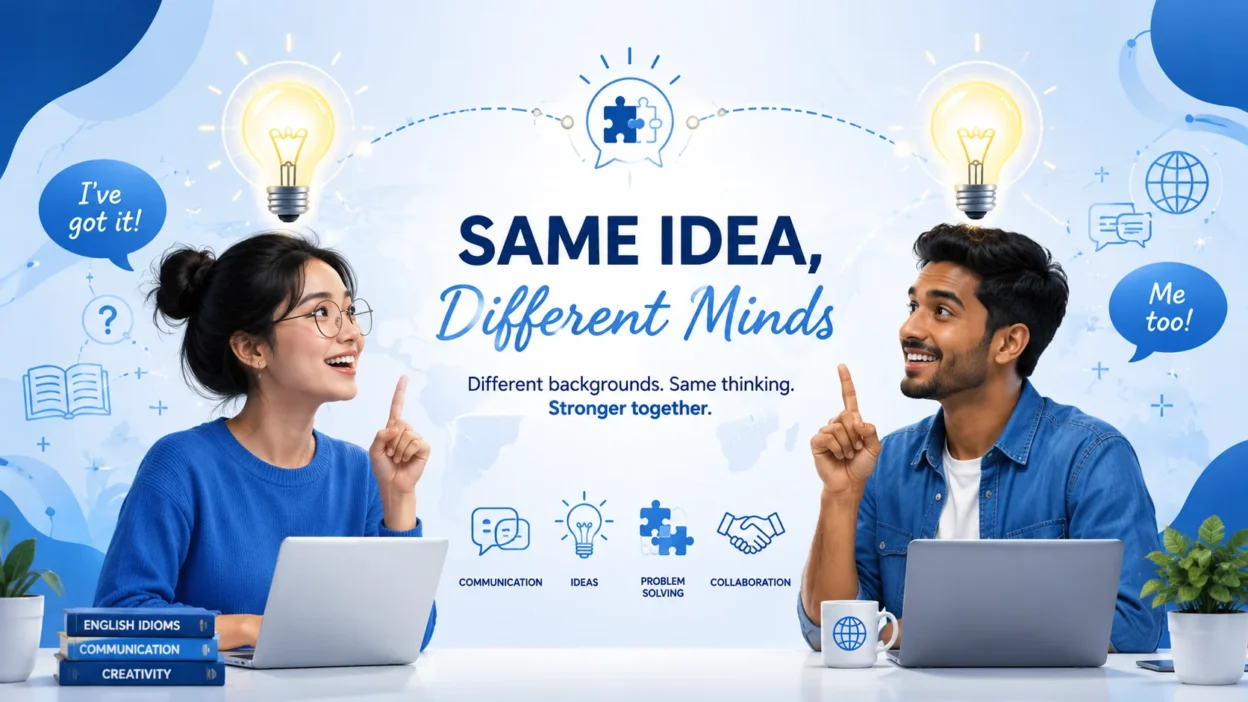
At its core, great minds think alike means that two or more people have reached the same idea, conclusion, or decision independently.
The phrase suggests that intelligent or capable people often arrive at similar thoughts because they use comparable reasoning processes.
Simple Definition
Great minds think alike is a saying used when people discover they share the same idea, opinion, choice, or solution.
What People Usually Mean When They Say It
Most people use the expression in everyday situations such as:
- Choosing the same restaurant
- Wearing similar clothes
- Recommending the same movie
- Developing identical business ideas
- Solving a problem the same way
- Thinking of the same joke
For example:
“I was going to suggest pizza tonight.”
“Really? So was I.”
“Great minds think alike!”
The phrase creates an instant sense of connection and shared understanding.
Is It Always a Compliment?
Usually, yes.
However, people often use it playfully rather than seriously. Someone who says it isn’t necessarily claiming they are a genius. They are simply acknowledging a shared thought.
Depending on tone, the expression can be:
| Usage Type | Meaning |
| Genuine | A sincere compliment |
| Humorous | A playful remark |
| Sarcastic | A joke about making the same mistake |
| Friendly | A way to build rapport |
The Full Expression: “Great Minds Think Alike, Though Fools Seldom Differ”
Many people don’t realize that the familiar phrase is actually a shortened version.
The complete expression is:
“Great minds think alike, though fools seldom differ.”
The Lesser-Known Second Half
While the first half praises shared thinking, the second half introduces irony.
It suggests that agreement alone doesn’t prove intelligence because foolish people can agree just as easily.
This creates a more balanced and humorous message.
How the Meaning Changes
Consider these versions:
Short version:
Great minds think alike.
Meaning: We had the same smart idea.
Full version:
Great minds think alike, though fools seldom differ.
Meaning: We agree, but agreement by itself doesn’t prove we’re brilliant.
This twist explains why language enthusiasts often find the complete saying more interesting than the abbreviated version.
Origin and History of “Great Minds Think Alike”
The phrase has deeper historical roots than many people realize.
Where Did the Saying Come From?
The modern version evolved gradually over several centuries.
Earlier forms appeared in English literature long before the current wording became common.
One early version appeared in the 17th century:
“Good wits do jump.”
This older expression meant that clever people often arrive at the same conclusions independently.
Over time, English speakers refined the idea until it became the phrase recognized today.
Evolution Through the Centuries
The saying did not appear overnight.
Instead, it evolved through several stages:
| Time Period | Similar Expression |
| 1600s | Good wits do jump |
| 1700s | Great wits jump |
| 1800s | Great minds think alike |
| Modern Era | Great minds think alike |
Language naturally changes as generations simplify and modernize expressions.
When Did It Become Popular?
The phrase gained popularity because it works in almost every social setting.
People began using it regularly in:
- Literature
- Newspapers
- Business discussions
- Academic settings
- Everyday conversation
Today, it remains one of the most widely recognized sayings in the English language.
Is “Great Minds Think Alike” an Idiom, Proverb, or Saying?
This question often creates confusion.
Understanding the Difference
| Type | Definition |
| Idiom | A phrase whose meaning differs from the literal words |
| Proverb | A traditional saying expressing wisdom |
| Common Saying | A widely used expression |
Which Category Fits Best?
Most language experts classify great minds think alike as a proverb.
Why?
Because it communicates a general observation about human behavior.
Unlike idioms such as “spill the beans,” the phrase remains relatively literal.
It expresses a piece of social wisdom rather than a hidden meaning.
How to Use “Great Minds Think Alike” Correctly
The expression works best in informal communication.
Common Situations
You can use it when:
- Two people make the same suggestion
- Friends choose identical gifts
- Coworkers propose similar solutions
- Family members have matching opinions
- Students reach the same conclusion
Sentence Structure Examples
As a Standalone Response
“Great minds think alike.”
At the Beginning of a Sentence
“Great minds think alike because I was about to suggest exactly that.”
At the End of a Sentence
“I picked the same answer. Great minds think alike.”
Formal vs. Informal Usage
| Context | Appropriate? |
| Casual Conversation | Yes |
| Social Media | Yes |
| Workplace Discussions | Usually |
| Friendly Emails | Yes |
| Academic Papers | No |
| Legal Documents | No |
In highly formal writing, the phrase can sound too conversational.
Examples of “Great Minds Think Alike” in Sentences
Examples help reveal how naturally the phrase fits into daily communication.
Everyday Conversation Examples
- We both ordered burgers. Great minds think alike.
- I bought the same book yesterday. Great minds think alike.
- We picked the exact same vacation destination.
- I was going to recommend that restaurant.
- We chose matching birthday gifts.
- We wore the same color without planning it.
- We both thought the movie ending was predictable.
- I had exactly the same idea.
- We reached the same conclusion independently.
- We selected identical team names.
Workplace Examples
- We proposed the same marketing strategy.
- Both departments recommended the same solution.
- We identified the same customer problem.
- We suggested identical budget improvements.
- We arrived at the same forecast.
Classroom Examples
- We used the same example in our presentations.
- We reached the same answer during the discussion.
- Both groups developed similar research questions.
- We interpreted the passage similarly.
- We proposed identical project ideas.
Social Media Examples
- Just posted the same meme you shared. Great minds think alike!
- We both predicted the outcome.
- Same recommendation. Great minds think alike.
- I was about to tweet that.
- Looks like we had the same thought today.
Read More: 5 Words for a Person Who Finds Fault in Everything: Meaning
Dialogue Examples
Friends Making Plans
Sarah: Let’s go hiking this weekend.
Emma: That’s exactly what I was thinking.
Sarah: Great minds think alike!
Coworkers Sharing an Idea
Jake: We should automate this process.
Mark: I was writing the same recommendation.
Jake: Great minds think alike.
Students Working Together
Liam: I chose renewable energy for my project.
Noah: So did I.
Liam: Great minds think alike.
Family Conversation
Mom: Let’s order Chinese food tonight.
Dad: I was about to suggest that.
Mom: Great minds think alike.
Why People Like Using This Expression
Some sayings disappear over time.
This one continues to thrive.
Why?
Because it serves several social functions simultaneously.
Creates Instant Connection
Shared ideas strengthen relationships.
When people realize they think similarly, they often feel closer.
Recognizes Shared Thinking
The phrase acknowledges common ground.
Humans naturally enjoy finding similarities with others.
Adds Humor
The saying often appears during lighthearted moments.
Its playful nature keeps conversations enjoyable.
Makes Interactions Feel Personal
Instead of simply saying “I agree,” people use a phrase that carries personality and warmth.
Similar Sayings and Expressions
English contains several expressions that communicate a similar idea.
Popular Alternatives
We’re on the Same Wavelength
Means people are thinking similarly.
Thinking Along the Same Lines
Suggests similar reasoning processes.
You Took the Words Right Out of My Mouth
Used when someone says exactly what another person intended to say.
We Had the Same Idea
A direct and simple alternative.
Great Brains Think Alike
A playful variation of the original phrase.
Comparison Table
| Expression | Meaning | Best Context |
| Great minds think alike | Shared idea | Casual conversation |
| Same wavelength | Similar thinking | Friendly discussion |
| Took the words out of my mouth | Said exactly what I intended | Conversation |
| Thinking along the same lines | Similar reasoning | Professional settings |
| Same idea | Direct agreement | Any setting |
Opposite Expressions and Contrasting Ideas
Not every situation involves agreement.
Several sayings emphasize differences instead.
Agree to Disagree
People accept differing opinions without conflict.
Different Strokes for Different Folks
People have different preferences.
Opposites Attract
Differences can create strong relationships.
Why Different Thinking Matters
While shared thinking feels satisfying, diverse perspectives often drive innovation.
Benefits include:
- Better problem-solving
- More creativity
- Reduced groupthink
- Stronger decision-making
- Increased adaptability
Many successful teams balance agreement with constructive disagreement.
Common Mistakes People Make
Even simple sayings can be misunderstood.
Assuming It Always Means Intelligence
The phrase doesn’t literally measure intelligence.
Most speakers use it playfully.
Using It in Formal Academic Writing
Scholarly writing typically avoids conversational expressions.
Forgetting the Complete Version
Many people never learn the second half of the proverb.
Overusing It
Repeating the phrase too often can weaken its impact.
Like seasoning in cooking, a little goes a long way.
Cultural and Social Relevance
The saying remains popular because it reflects something deeply human.
Why Shared Ideas Feel Meaningful
People naturally seek connection.
Discovering someone thinks similarly creates a sense of belonging.
Research in social psychology shows that perceived similarity often increases trust, cooperation, and likability.
The Psychology Behind Similar Thinking
People frequently reach identical conclusions because they share:
- Similar education
- Cultural influences
- Common experiences
- Access to the same information
- Comparable goals
As a result, independent but matching ideas occur more often than many people expect.
Why Unrelated People Often Have the Same Idea
History contains countless examples of simultaneous invention.
Several major innovations emerged independently around the same time because inventors worked with similar knowledge and faced similar problems.
This phenomenon demonstrates the deeper truth behind the saying.
Sometimes great minds really do think alike.
A Real-World Case Study: Simultaneous Innovation
One fascinating example comes from scientific discovery.
Throughout history, multiple researchers have independently developed similar theories and inventions.
Examples include:
| Innovation | Multiple Contributors |
| Calculus | Newton and Leibniz |
| Evolutionary Theory | Darwin and Wallace |
| Telephone Development | Several inventors pursued similar concepts |
| Light Bulb Improvements | Multiple inventors contributed simultaneously |
These examples reveal that when conditions are right, talented people often arrive at similar solutions.
The phrase “great minds think alike” reflects this reality remarkably well.
FAQs
What is the meaning of “Great Minds Think Alike”?
“Great Minds Think Alike” is an expression used when two or more people independently come up with the same idea, thought, or solution. It suggests that intelligent or creative people often reach similar conclusions.
Is “Great Minds Think Alike” a compliment?
Yes. The phrase is usually intended as a lighthearted compliment. By saying “Great Minds Think Alike,” a speaker implies that the other person’s thinking is insightful, clever, or worthy of praise.
What is the full version of “Great Minds Think Alike”?
The longer historical form is often quoted as “Great minds think alike, though fools seldom differ.” Today, the shorter version is far more common and is generally used in a positive and friendly way.
When should you use “Great Minds Think Alike”?
You can use the phrase when two people share the same opinion, make the same suggestion, or arrive at the same decision independently. It works well in casual conversations, business communication, team discussions, and even friendly social interactions.
Can “Great Minds Think Alike” be used in formal writing?
While the phrase is widely understood, it is generally considered informal. In formal writing, academic work, or professional reports, it is often better to use more precise language unless the tone allows for idiomatic expressions.
Are there similar expressions to “Great Minds Think Alike”?
Yes. Similar expressions include:
- We’re on the same wavelength
- We had the same idea
- You read my mind
- That was exactly what I was thinking
- We think alike
These alternatives convey a similar sense of shared thinking and agreement.
Conclusion
“Great Minds Think Alike” is a timeless expression that celebrates the moment when people arrive at the same idea independently. Its enduring popularity comes from its simple yet meaningful message: shared thoughts can be a sign of creativity, intelligence, and common understanding. Whether used humorously among friends or during professional discussions, the phrase remains a natural way to acknowledge agreement.
Exploring the meaning, origin, and practical examples of “Great Minds Think Alike” helps build a stronger understanding of English usage and idiomatic language. Knowing when and how to use the expression can enhance business communication, improve clarity in conversations, and add personality to your writing and speech.
As language continues to evolve, this classic proverb remains relevant because it reflects a universal human experience discovering that someone else has reached the very same conclusion. By understanding its history and proper usage, you can confidently incorporate “Great Minds Think Alike” into both everyday conversations and professional communication.

Mia Rose is an English language specialist and editorial writer at Phrase Finesse, where she helps readers master grammar, vocabulary, spelling, and effective communication. Passionate about making English simple and practical, she creates well-researched, reader-friendly content that explains complex language concepts in a clear and engaging way.
With extensive experience in English language education, content writing, and editorial review, Mia specializes in grammar, punctuation, word choice, idioms, confusing word pairs, and writing style. Her articles are carefully researched, fact-checked, and designed to help students, professionals, writers, and English learners build confidence in both written and spoken English.