Have you ever paused while writing a report or email and wondered whether “as of,” “as at,” or “as from” is the correct phrase to use? These expressions often appear in business communication, formal writing, contracts, announcements, and official documents, yet many writers use them interchangeably. In this guide, “As Of”, “As At”, “As From” – Difference Explained (Helpful Examples), you’ll learn the precise meaning of each expression, when to use it, and how to avoid common mistakes that can affect clarity and professionalism.
Understanding these time-related phrases is essential for accurate English usage and effective communication. Whether you’re discussing a project deadline, updating a calendar, confirming an online booking, preparing meeting notes, or managing timelines in project management, the right phrase helps convey the exact point or period in time. Small wording differences can influence consistency, improve readability, and ensure your message is interpreted correctly in both professional and everyday contexts.
In the sections ahead, we’ll break down the meanings of “as of,” “as at,” and “as from” with clear explanations, practical examples, and real-world scenarios. You’ll also see how these expressions appear in scheduling, time management, meetings, broadcasting, workplace correspondence, and other common situations. By the end, you’ll know which phrase fits each context and how to use them confidently in modern written and spoken English.
As Of, As At, As From – Difference Explained at a Glance
Let’s start with a clear snapshot before going deeper.
Each phrase connects to time. But each one connects in a different way.
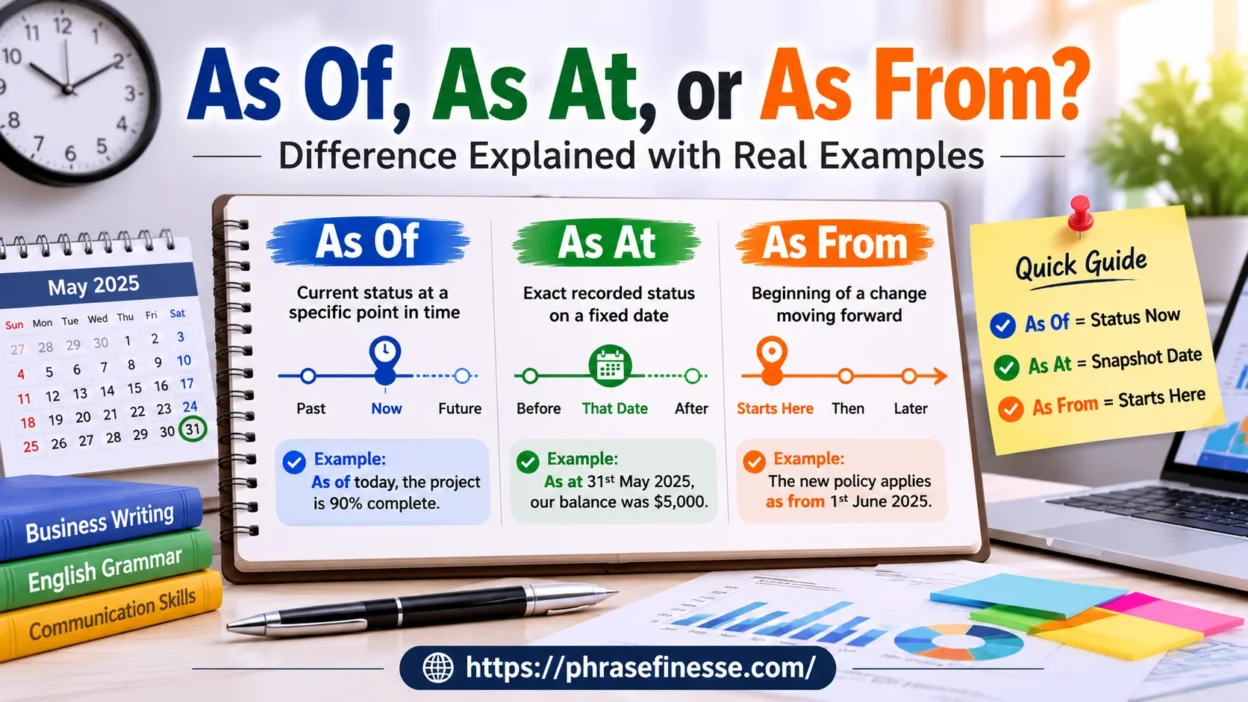
- As of → shows a condition or status at a specific time or starting point
- As at → shows an exact recorded status at a fixed date
- As from → shows the beginning of a change that continues forward
Simple memory trick
Think of time like a road:
- As of = where you are standing right now on the road
- As at = a photo taken at a specific mile marker
- As from = a new rule that starts from a signpost ahead
This mental picture helps you avoid confusion instantly.
What “As Of” Means in Real English Usage
Core meaning of “As of”
The phrase “as of” tells you the status of something at a specific point in time.
- It often describes conditions that are current or recently changed.
2. It does not just describe time. It anchors information to time.
3. That difference matters a lot in professional writing.
Where you see “As of” most often
You will find “as of” in:
- Business updates
- Project reports
- Software system notifications
- Legal summaries
- News announcements
- Financial dashboards
Real-world examples
- As of today, all systems are fully operational.
- As of June 2026, the company has expanded into three new markets.
- As of now, no delays have been reported.
What makes “As of” powerful
It gives readers a timestamp. That timestamp changes everything. Without it, the statement feels incomplete.
For example:
- “The system is active” → unclear timing
- “As of today, the system is active” → precise and trustworthy
That precision is why professionals rely on it.
Read More: Given vs. Gave: What’s the Difference?
What “As At” Means and Why It Feels More Formal
Core meaning of “As at”
The phrase “as at” refers to a precise status recorded at a specific date. It is more rigid than “as of.”
It does not describe movement or change. Instead, it captures a frozen snapshot.
Where “As at” is commonly used
This phrase dominates formal documentation, especially in:
- Accounting reports
- Financial audits
- Corporate balance sheets
- Legal disclosures
- Compliance documents
Real-world examples
- As at 31 March 2026, the company reported zero outstanding debt.
- As at the reporting date, all invoices were cleared.
- As at December 2025, revenue had reached record levels.
Why accountants prefer it
Accounting requires precision. Even a small ambiguity can distort financial interpretation.
“As at” removes that ambiguity by locking information to a fixed reporting date.
Think of it like a photograph. No movement. No interpretation. Just facts at a moment in time.
What “As From” Means in Practical Communication
Core meaning of “As from”
The phrase “as from” introduces the starting point of a change. Once that moment arrives, the new condition applies continuously.
It is forward-looking.
Where “As from” appears most often
You will usually find it in:
- Employment contracts
- Policy updates
- Legal notices
- Pricing changes
- Service announcements
Real-world examples
- As from 1 July 2026, remote work will become permanent.
- As from next week, new pricing will apply.
- As from Monday, the office will follow updated hours.
Why it feels authoritative
“As from” signals enforcement. It tells the reader something is not optional.
It is a boundary marker in language. Before the date, one rule applies. After it, a new rule begins.
Side-by-Side Comparison of All Three Phrases
Understanding differences becomes easier when you compare them directly.
Meaning comparison table
| Phrase | Core Function | Time Focus | Usage Style |
| As of | Current status reference | Present or reference point | General and business use |
| As at | Exact snapshot record | Fixed past date | Financial and legal |
| As from | Starting point of change | Future transition | Contracts and policies |
Key takeaway
Each phrase answers a different question:
- As of → “What is the situation now?”
- As at → “What was the situation on this exact date?”
- As from → “When does the new rule begin?”
Grammar Structure Behind Each Phrase
How “As of” works grammatically
Structure:
As of + time expression
Examples:
- As of today
- As of Monday
- As of January 2026
It acts like a time anchor.
How “As at” works grammatically
Structure:
As at + specific date
Examples:
- As at 31 December
- As at the reporting date
- As at year-end
It behaves like a formal timestamp marker.
How “As from” works grammatically
Structure:
As from + starting date
Examples:
- As from next week
- As from 1 June
- As from Monday
It defines a transition boundary.
Real Industry Usage Breakdown
Finance and Accounting
This is where precision matters most.
- “As at” dominates financial statements
- Ensures audit consistency
- Removes ambiguity in reporting periods
Example:
As at 30 June 2026, total assets increased by 12%.
Business Communication
Businesses rely heavily on “as of.”
Example:
As of today, customer satisfaction scores have improved significantly.
Legal Documents
Legal writing uses all three carefully.
- As from → contract changes
- As at → recorded facts
- As of → general reference statements
Example:
As from the effective date, the agreement shall be binding.
Government and Policy Writing
Government notices often use “as from.”
Example:
As from April 2026, new tax regulations will apply.
Everyday Communication
In casual English:
- “As of” is common
- “As at” sounds overly formal
- “As from” appears in announcements
Example:
As of now, everything looks fine.
Common Mistakes People Make
Mixing “as of” and “as at”
Incorrect:
- As at today, the system is updated
Correct:
- As of today, the system is updated
Using “as from” for past events
Incorrect:
- As from yesterday, the issue was fixed
Correct:
- As of yesterday, the issue was fixed
Using inconsistent phrasing in one document
Many writers switch between forms randomly. That reduces clarity and professionalism.
Consistency always matters more than variety here.
Regional Differences in Usage
American English
- Prefers “as of”
- Rarely uses “as at”
- Uses “as from” mainly in legal contexts
British English
- Uses all three forms
- “As at” is common in accounting
Commonwealth English
Countries like India, Australia, and Pakistan often use:
- “As at” in formal reports
- “As of” in general communication
Similar Expressions That Often Cause Confusion
“As on”
Common in South Asian English.
- Meaning: same as “as of”
- Example: As on Monday, the system was updated
“With effect from”
More formal version of “as from.”
- Example: With effect from July, new rules apply
“Starting from”
Simpler conversational version.
- Example: Starting from Monday, things will change
Case Study: Financial Report Usage
A multinational company prepared its quarterly report.
They used:
- As at 31 March 2026 → to present financial snapshot
- As of reporting date → to describe operational status
- As from 1 April 2026 → to announce new policy changes
Why it worked
Each phrase served a different purpose:
- Snapshot clarity
- Current accuracy
- Future transition
That separation avoided legal confusion and audit errors.
Quick Usage Cheat Sheet
- As of → current situation or reference time
- As at → exact recorded point in time
- As from → starting point of change
If you remember nothing else, remember this distinction.
FAQs
1. What is the difference between “as of” and “as from”?
“As of” refers to a specific point in time and describes a status, condition, or fact that is true at that moment. “As from” indicates the beginning of a period and means “starting from” a particular date or time.
Example:
- As of July 1, the company has 500 employees.
- As from July 1, the new policy will apply to all employees.
2. Is “as at” correct English?
Yes, “as at” is correct English, especially in British English, business reports, and financial documents. It is commonly used to refer to a precise date or time when information is recorded.
Example:
- The account balance as at December 31 was $10,000.
3. Which is more common: “as of” or “as at”?
“As of” is generally more common in American English, while “as at” is more frequently used in British English, particularly in accounting, finance, and formal reporting.
4. Can “as of” and “as at” be used interchangeably?
In many situations, they convey a similar idea, but regional preferences matter. “As of” is preferred in American English, whereas “as at” is often favored in British English and financial contexts.
5. When should I use “as from”?
Use “as from” when referring to the start of a new rule, policy, arrangement, or time period.
Example:
- As from Monday, all meetings will begin at 9 a.m.
- As from next month, online bookings will require verification.
6. Are these expressions commonly used in business communication?
Yes. “As of,” “as at,” and “as from” frequently appear in business communication, formal writing, contracts, reports, announcements, project management documents, and scheduling updates because they help define time-related information precisely.
Conclusion
Understanding the difference between “as of,” “as at,” and “as from” can significantly improve the accuracy of your writing. While “as of” and “as at” usually refer to a specific point in time, “as from” marks the beginning of a period or change. Choosing the correct expression helps maintain clarity, professionalism, and consistency in both personal and professional communication.
Whether you’re preparing reports, managing a calendar, sending updates, handling online booking information, or writing formal business documents, these phrases provide important time references that prevent confusion. By applying the examples and guidelines in this article, you can use each expression confidently and ensure your English usage remains precise, natural, and effective.