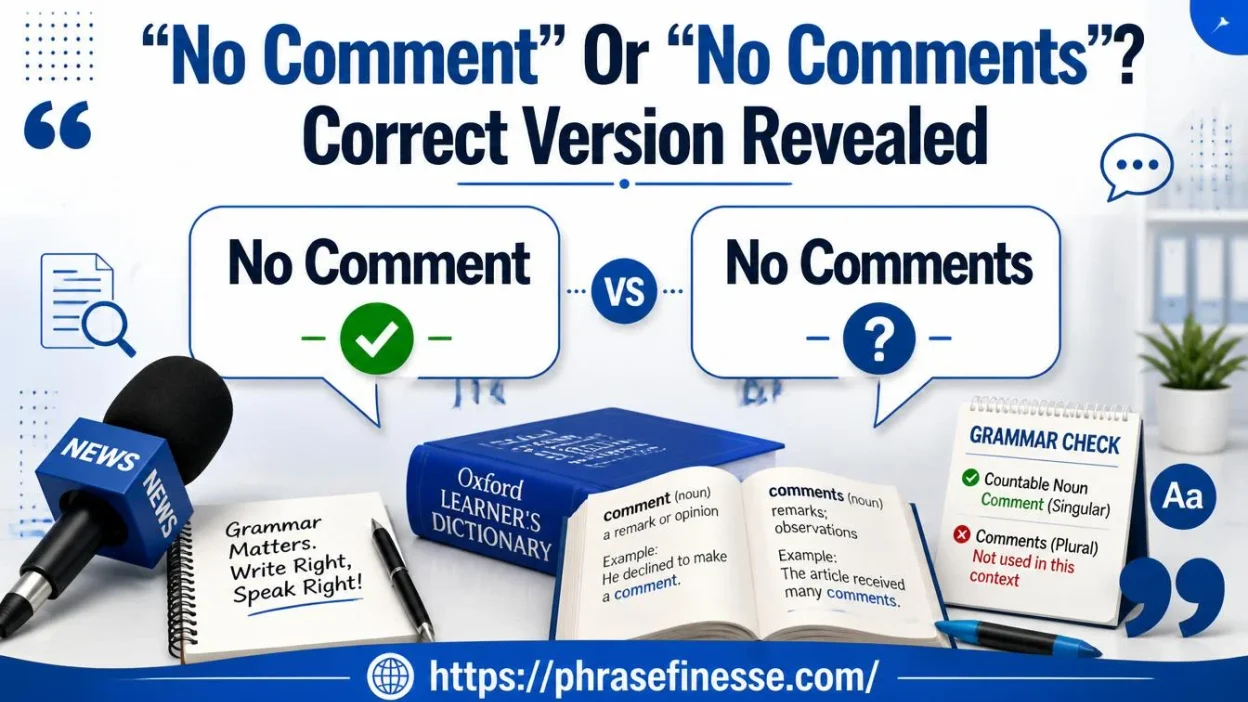
Have you ever paused before writing “No Comment” or “No Comments” and wondered which version is actually correct? The distinction may seem small, but choosing the right phrase can improve your English usage, grammar, and formal writing. In this guide, “No Comment” Or “No Comments”? Correct Version Revealed explains the correct form, when to use each expression, and why the difference matters in everyday and professional communication.
Whether you’re responding during meetings, speaking in broadcasting interviews, writing emails, or handling business communication, using the correct expression helps maintain consistency and credibility.
This article explores the grammatical rules behind both phrases, supported by practical examples from real-life conversations and professional writing. You’ll also discover common mistakes, usage tips, and context-based recommendations that make your writing more natural and precise.
Beyond grammar, clear language supports better communication in modern workplaces where project management, scheduling, time management, calendar planning, and even online booking systems rely on accurate written communication.
By the end of this guide, you’ll know exactly when “No Comment” is the preferred choice, whether “No Comments” is ever appropriate, and how to use both confidently in any personal or professional setting.
Quick Answer:
If you’re refusing to answer a question, the correct expression is:
“No comment.”
Examples:
- “Did you know about the merger?”
- “No comment.”
- “Are the rumors true?”
- “No comment.”
- “Will you discuss the ongoing investigation?”
- “No comment.”
In contrast, “no comments” usually refers to the absence of comments, opinions, or responses.
Examples:
- “The blog post received no comments.”
- “The proposal generated no comments from employees.”
- “There were no comments during the meeting.”
The Simple Rule
| Situation | Correct Phrase |
| Refusing to answer a question | No comment |
| Talking about a lack of comments | No comments |
This distinction may seem small, yet it changes the meaning completely.
What Does “No Comment” Mean?
The phrase “no comment” is a fixed expression used to decline answering a question.
Rather than providing information, the speaker deliberately chooses silence on the topic.
Definition
No comment means:
“I am choosing not to answer that question or discuss that subject.”
The phrase does not necessarily indicate guilt, disagreement, or ignorance. It simply signals a refusal to provide a statement.
Why People Use It
People say “no comment” for several reasons:
- Protecting confidential information
- Avoiding legal complications
- Maintaining privacy
- Preventing misunderstandings
- Waiting for more information
- Following company policy
For example, a CEO might refuse to discuss an upcoming acquisition. A celebrity may decline to discuss personal relationships. An attorney may advise a client not to answer specific questions.
In each case, “no comment” serves as a professional shield.
Why “No Comment” Is the Standard Expression
Many English expressions become fixed phrases over time.
Once they become established, speakers use them in a particular form even when other forms might appear logical.
“No comment” belongs to this category.
Similar Fixed Expressions
Consider these examples:
| Fixed Expression | Meaning |
| No problem | Everything is fine |
| No charge | Free of cost |
| No doubt | Certainly |
| No contest | Clear winner |
| No comment | Refusal to answer |
Notice something interesting.
The noun remains singular even though the idea may involve multiple possibilities.
Native speakers rarely say:
- “No problems” as a direct replacement for “No problem”
- “No doubts” instead of “No doubt”
- “No contests” instead of “No contest”
The same principle applies to “no comment.”
The phrase functions as a complete expression rather than a literal count of remarks.
The Grammar Behind “No Comment”
To fully understand the phrase, it helps to examine its grammar.
“Comment” as an Unspecified Statement
In this expression, comment refers to any statement, response, observation, or remark.
The speaker is essentially saying:
“I have no statement to provide.”
The emphasis is not on the number of comments.
Instead, it focuses on the absence of any official response.
That subtle distinction explains why the singular form became standard.
Understanding the Structure
Think of the phrase this way:
| Expression | Implied Meaning |
| No comment | No statement |
| No charge | No fee |
| No problem | No issue |
| No objection | No disagreement |
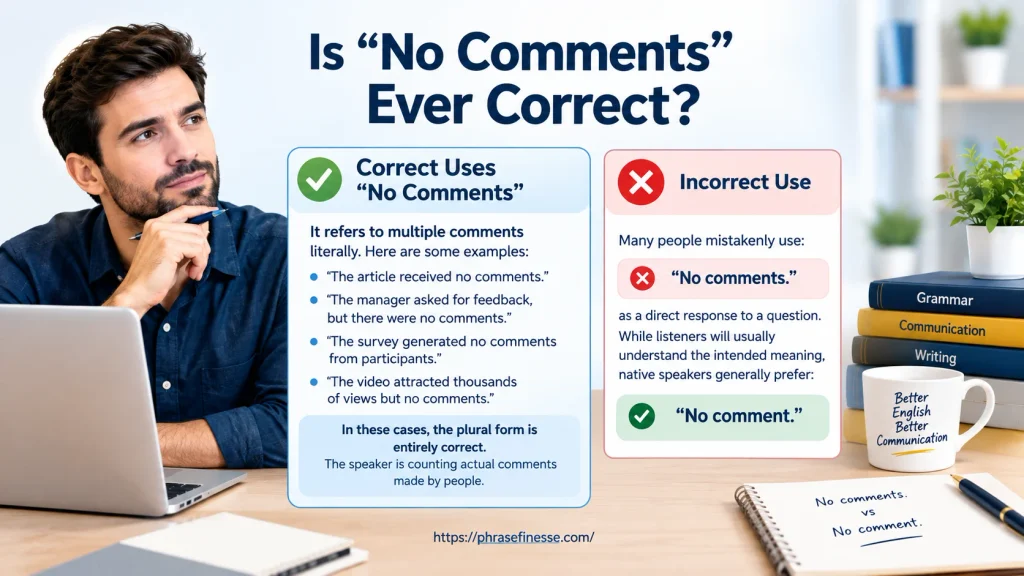
The noun represents a general concept rather than individual items.
Is “No Comments” Ever Correct?
Yes.
However, it is correct only in specific situations.
The key difference is that “no comments” refers to multiple comments literally.
Correct Uses of “No Comments”
Examples:
- “The article received no comments.”
- “The manager asked for feedback, but there were no comments.”
- “The survey generated no comments from participants.”
- “The video attracted thousands of views but no comments.”
In these cases, the plural form is entirely correct.
The speaker is counting actual comments made by people.
Incorrect Use
Many people mistakenly use:
❌ “No comments.”
as a direct response to a question.
While listeners will usually understand the intended meaning, native speakers generally prefer:
✅ “No comment.”
“No Comment” vs. “No Comments”: Side-by-Side Comparison
The difference becomes clearer when viewed together.
| Phrase | Meaning | Example |
| No comment | Refusal to answer | “No comment,” the spokesperson replied. |
| No comments | Absence of remarks | The article received no comments. |
| No comment | Fixed expression | “No comment” was his response. |
| No comments | Literal plural noun | The report generated no comments. |
One phrase declines discussion.
The other describes a lack of discussion.
How “No Comment” Became So Common
The expression gained popularity through journalism, politics, and public relations.
For decades, reporters have asked public figures difficult questions.
Sometimes the safest response is no response.
The Rise of Media Interviews
As newspapers, television, and radio expanded, journalists increasingly sought immediate reactions.
Politicians, executives, celebrities, and athletes needed a concise way to avoid answering sensitive questions.
“No comment” became the perfect solution.
It was:
- Short
- Clear
- Neutral
- Legally safe
- Easy to quote
Before long, the phrase became part of everyday language.
How Journalists Use “No Comment”
Reporters frequently encounter situations where sources refuse to provide information.
Consider these examples:
Example 1
Reporter:
“Did the company know about the issue before customers complained?”
Spokesperson:
“No comment.”
Example 2
Reporter:
“Will the mayor run for reelection?”
Official:
“No comment.”
In news articles, journalists often write:
“The company declined to comment.”
or
“The spokesperson responded with ‘no comment.’”
Both convey the same idea.
Why Lawyers Often Recommend “No Comment”
Legal professionals understand the risks associated with public statements.
Even innocent remarks can create problems.
A poorly chosen sentence may:
- Be misunderstood
- Be quoted out of context
- Influence legal proceedings
- Create public relations issues
Because of these risks, attorneys sometimes advise clients to avoid commenting publicly.
Legal Communication Principle
A common legal strategy is:
Say less until all facts are known.
In that environment, “no comment” becomes a protective tool rather than an admission of wrongdoing.
Does “No Comment” Mean Someone Is Guilty?
Many people assume that refusing to answer suggests guilt.
In reality, that conclusion isn’t always justified.
There are countless reasons why someone may choose not to comment.
Possible Reasons
- Ongoing investigation
- Confidential business matter
- Privacy concerns
- Legal advice
- Incomplete information
- Company policy
For example, if a corporation is negotiating a merger, executives may refuse to comment simply because disclosure rules prevent discussion.
Silence does not automatically equal guilt.
Read More :On the Train or In the Train? Which Preposition Is Correct?
“No Comment” in Business Communication
Businesses use this phrase regularly.
Large organizations often train employees on media communication.
When sensitive issues arise, designated spokespeople handle inquiries.
Common Corporate Situations
- Pending acquisitions
- Employee investigations
- Product recalls
- Financial announcements
- Litigation matters
Instead of speculating, companies often issue carefully prepared statements.
When information cannot yet be shared, they may respond:
“No comment at this time.”
That wording sounds professional and measured.
“No Comment” in Everyday Conversation
Although strongly associated with media interviews, the phrase also appears in ordinary conversations.
Example Conversations
Friend: “Did you eat the last cookie?”
You: “No comment.”
Coworker: “Who forgot to submit the report?”
You: “No comment.”
Sibling: “Did Mom buy me a birthday gift?”
You: “No comment.”
In casual settings, the phrase often carries a playful or humorous tone.

When “No Comment” Sounds Funny
People frequently use the expression jokingly.
Imagine someone asking:
“Did you spend three hours watching cat videos?”
A playful response might be:
“No comment.”
Everyone understands the joke.
The speaker is indirectly admitting something without confirming it outright.
This humorous use contributes to the phrase’s popularity.
Common Mistakes With “No Comment” and “No Comments”
Many English learners make similar errors.
Understanding them can help you avoid awkward wording.
Mistake: Using “No Comments” as a Direct Reply
Incorrect:
“No comments.”
Correct:
“No comment.”
Mistake: Assuming Both Mean the Same Thing
They don’t.
One declines discussion.
The other indicates an absence of remarks.
Mistake: Translating Directly From Another Language
Some languages use plural forms in similar situations.
English does not follow that pattern here.
The established expression remains singular.
Better Alternatives to “No Comment”
Sometimes you may want a more professional, polite, or detailed response.
Fortunately, English offers several alternatives.
Formal Alternatives
- I decline to comment.
- We cannot discuss that matter.
- We are not in a position to comment.
- I cannot provide information at this time.
- We have nothing further to add.
Neutral Alternatives
- I’d rather not discuss that.
- I prefer not to answer.
- That’s not something I can talk about.
- I’d rather keep that private.
Professional Alternatives
| Alternative | Tone |
| I decline to comment. | Formal |
| We cannot discuss that matter. | Corporate |
| I’d rather not say. | Casual |
| That’s private. | Direct |
| I cannot provide details. | Professional |
Choosing the right response depends on the situation.
Real-World Case Study: Corporate Crisis Communication
Imagine a technology company discovers a cybersecurity issue.
News outlets immediately begin asking questions.
At that moment:
- The investigation is incomplete.
- Facts remain unclear.
- Public statements could create liability.
The company spokesperson says:
“No comment at this time.”
Why?
Because accuracy matters.
Providing incomplete information may cause greater damage than temporarily withholding comment.
Once the investigation concludes, the company releases a detailed statement.
This illustrates why organizations sometimes choose silence before certainty.
Real-World Case Study: Celebrity Interviews
Celebrities face constant scrutiny.
Reporters often ask questions about:
- Relationships
- Family matters
- Finances
- Rumors
- Future projects
Suppose an actor is asked about an unannounced film.
Instead of revealing confidential information, the actor responds:
“No comment.”
That response protects contractual obligations while avoiding dishonesty.
American English vs. British English Usage
Both American English and British English overwhelmingly favor “no comment.”
The phrase functions similarly in both varieties.
Similarities
- Same meaning
- Same grammar
- Same media usage
- Same professional applications
Minor Differences
The differences relate more to style than grammar.
Regardless of location, the preferred expression remains:
“No comment.”
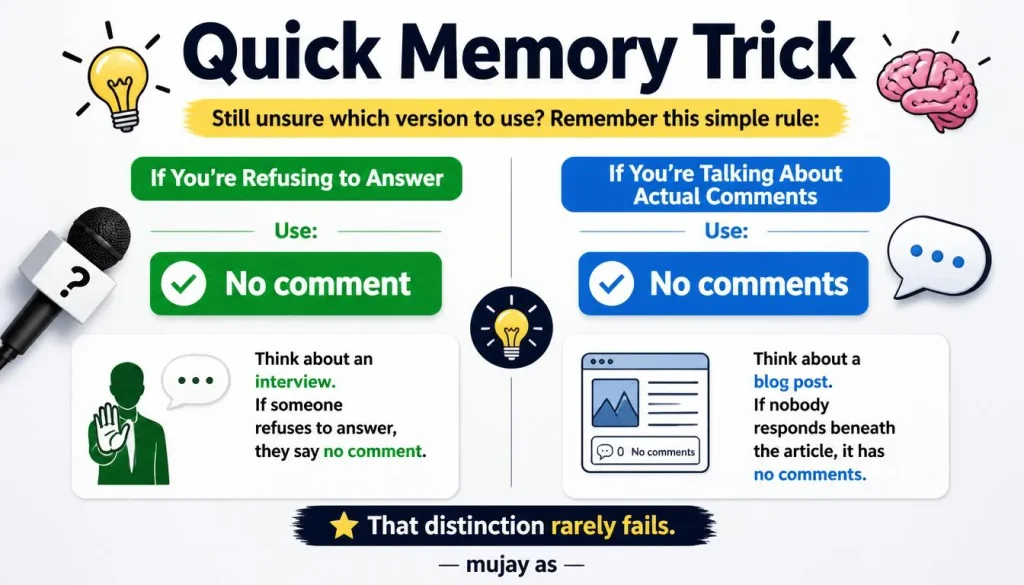
Quick Memory Trick
Still unsure which version to use?
Remember this simple rule:
If You’re Refusing to Answer
Use:
✅ No comment
If You’re Talking About Actual Comments
Use:
✅ No comments
Think about a blog post.
If nobody responds beneath the article, it has no comments.
Think about an interview.
If someone refuses to answer, they say no comment.
That distinction rarely fails.
Summary Table: “No Comment” vs. “No Comments”
| Feature | No Comment | No Comments |
| Standard expression | Yes | No |
| Refusal to answer | Yes | Usually no |
| Fixed phrase | Yes | No |
| Refers to multiple remarks | No | Yes |
| Common in interviews | Yes | Rare |
| Common in website discussions | No | Yes |
| Used by journalists | Yes | Sometimes |
| Used literally | Rarely | Yes |
FAQs
1. Is “No Comment” or “No Comments” grammatically correct?
Both phrases are grammatically possible, but “No Comment” is the standard fixed expression. It is the correct choice when refusing to give a statement. “No Comments” is only appropriate in specific contexts where you are referring to multiple comments.
2. Why is “No Comment” singular instead of plural?
The phrase functions as an idiomatic expression. Here, “comment” represents any statement or response, so the singular form has become the accepted standard in modern English.
3. Can I use “No Comments” in professional writing?
Generally, no. In most professional situations, including emails, interviews, and official statements, “No Comment” is the preferred expression. Use “No Comments” only when you literally mean there are multiple comments that do not exist.
4. Is “No Comment” appropriate in business communication?
Yes. “No Comment” is commonly used in business communication, legal matters, and public relations when someone chooses not to provide additional information or an opinion.
5. Are “No Comment” and “No Response” the same?
Not exactly. “No Comment” specifically means a person refuses to make a statement, while “No Response” simply means no reply was given. The two phrases are similar but are not always interchangeable.
6. How can I remember the correct version?
A simple rule is to remember that the fixed expression is “No Comment.” If you’re declining to answer a question or make a statement, always use the singular form. Save “No Comments” for rare situations where you’re literally talking about multiple comments.
Conclusion
Choosing between “No Comment” and “No Comments” is simpler once you understand how each phrase is used. In standard English grammar, “No Comment” is the accepted and most common expression. It is widely used in business communication, interviews, legal statements, media reports, and everyday conversations to politely decline making a statement. While “No Comments” may appear in certain contexts, it is far less common and usually refers to multiple remarks rather than serving as the fixed expression.
If your goal is to write naturally and professionally, “No Comment” is almost always the correct choice. Understanding this small grammatical difference improves your English usage, strengthens your formal writing, and helps you communicate with greater consistency across both personal and professional situations.

Alyan Ashraf is an English language writer and editor at Phrase Finesse, where he specializes in grammar, vocabulary, spelling, word usage, and clear communication. Passionate about the English language, he creates practical, research-backed content that helps readers avoid common mistakes and write with greater accuracy and confidence.
Known for his clear writing style and attention to detail, Alyan simplifies complex language topics into easy-to-understand guides filled with real-world examples and actionable insights. His work covers confusing word pairs, grammar rules, idioms, punctuation, and everyday English usage, making learning both accessible and engaging for students, professionals, writers, and non-native English speakers.
Every article Alyan writes is carefully researched, fact-checked, and designed to meet high editorial standards. His goal is to help readers strengthen their English skills, expand their vocabulary, and communicate more effectively in academic, professional, and everyday settings.
Through Phrase Finesse, Alyan is committed to publishing trusted language resources that make mastering English simpler, clearer, and more enjoyable for learners around the world