Have you ever encountered someone who ignores clear facts even when the evidence is right in front of them? Understanding this behavior can improve communication, critical thinking, and decision-making in both personal and professional settings.
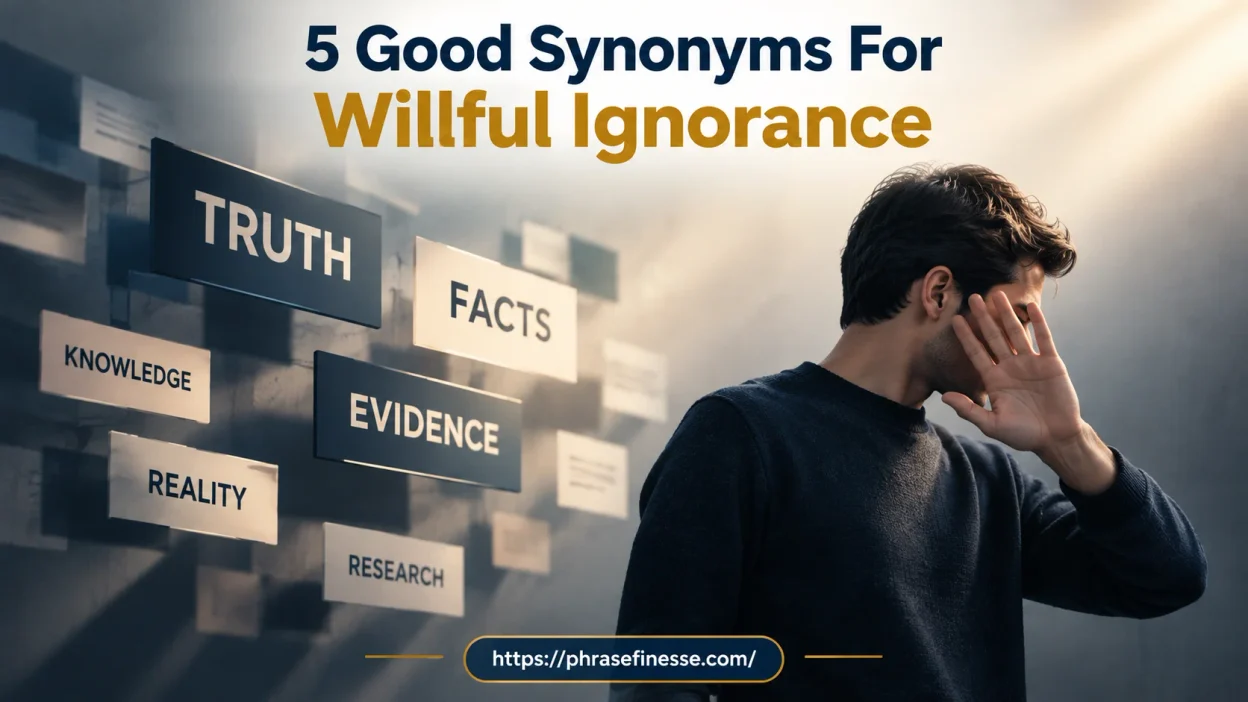
In this guide, we’ll explore 5 Good Synonyms For Willful Ignorance, helping you choose the most accurate word for different contexts while strengthening your English usage, grammar, and formal writing skills.
Language becomes more powerful when you can express subtle differences in meaning. Terms related to willful ignorance, deliberate avoidance, intentional unawareness, and conscious disregard of facts often appear in discussions about business communication, project management, broadcasting, workplace culture, and everyday conversations.
Whether you’re writing reports, participating in meetings, or improving professional correspondence, selecting the right synonym adds clarity and precision to your message.
This article breaks down the meaning, usage, and nuances of each synonym with practical examples and real-world applications.
You’ll learn when each term fits best and how these expressions relate to situations involving consistency, time management, scheduling, calendar planning, and even online booking processes where important information may be overlooked.
What Willful Ignorance Really Means in Real Life
Before swapping words, you need to understand what you’re actually replacing.
Willful ignorance means someone actively chooses not to know something, even when the truth sits right in front of them.
It’s different from simple ignorance. Simple ignorance says:
“I don’t know.”
Willful ignorance says:
“I don’t want to know.”
That difference matters because intent changes everything.
Real-world examples that make it obvious
You see willful ignorance in everyday situations like:
- A person ignoring medical advice because it feels uncomfortable
- A voter refusing to read credible sources and sticking to slogans
- Someone dismissing financial warnings while continuing harmful spending
- A student avoiding studying a topic they already know they will fail
In all these cases, information exists. The person just refuses to engage with it.
Psychologists often link this behavior to cognitive dissonance, where the brain avoids information that threatens beliefs or comfort zones.
A well-known behavioral insight puts it simply:
“People don’t always avoid truth because it is hidden. They avoid it because it is inconvenient.”
That’s the core of willful ignorance.
Why You Need Better Synonyms for Willful Ignorance
You might think, why not just keep using the phrase?
Here’s the issue. Tone changes meaning.
- In academic writing, “willful ignorance” can sound too judgmental
- In storytelling, it may feel repetitive
- In psychology writing, it may lack precision
- In debates, it may sound emotionally loaded
So choosing the right synonym helps you control:
- Tone
- Clarity
- Emotional weight
- Professionalism
Good writing isn’t just about meaning. It’s about precision.
What Makes a Good Synonym for Willful Ignorance
Not every related phrase actually works. Some are too soft. Some lose the idea of intention.
A strong synonym must include three elements:
Intentionality
The person chooses not to know.
Awareness
They either suspect or already know the truth.
Avoidance behavior
They actively block or ignore information.
If a phrase misses any of these, it weakens the meaning.
Deliberate Ignorance: The Most Direct Replacement
Deliberate ignorance comes closest to the original meaning without emotional exaggeration.
It clearly shows a conscious decision to avoid knowledge.
Where it works best
- Academic essays
- Legal writing
- Analytical reports
- Research papers
Example in real context
- “The company’s leadership showed deliberate ignorance of safety violations.”
This version feels structured and neutral. It doesn’t accuse emotionally. It simply states behavior.
Why it works
It keeps all three core elements:
- Intentional choice
- Awareness of potential knowledge
- Active avoidance
It’s clean, precise, and professional.
However, it can feel slightly clinical in emotional writing. That’s where other synonyms come in.
Intentional Blindness: When People Refuse to “See”
This phrase shifts from logic to imagery.
Intentional blindness describes someone who refuses to acknowledge what is clearly visible or obvious.
It carries a metaphorical tone. You’re not just ignoring facts. You’re acting like you cannot see them.
Where it fits best
- Opinion writing
- Political commentary
- Relationship analysis
- Narrative storytelling
Example usage
- “He showed intentional blindness toward the consequences of his actions.”
Why writers like it
It adds emotional weight without sounding overly technical.
Think of it like this:
You’re not turning off knowledge. You’re closing your eyes while it stands in front of you.
That image makes it powerful.
Cognitive Avoidance: The Psychological Lens
Now we step into psychology.
Cognitive avoidance refers to the mental habit of steering away from thoughts, ideas, or information that causes discomfort.
This one is less about moral judgment and more about mental behavior.
Where it’s commonly used
- Psychology articles
- Therapy discussions
- Behavioral studies
- Self-improvement content
Example in context
- “The patient demonstrated cognitive avoidance when discussing past trauma.”
Why it stands out
It removes blame and focuses on mechanism.
Instead of saying:
“You are ignoring reality.”
It says:
“Your mind is avoiding discomfort.”
That shift changes everything in tone.
Key insight
Cognitive avoidance often shows up unconsciously. People don’t always realize they’re doing it.
That makes it very different from deliberate ignorance, which is fully conscious.
Selective Ignorance: Choosing What to See
This synonym introduces nuance.
Selective ignorance describes situations where someone ignores certain facts while accepting others.
It’s not total rejection. It’s filtering.
Where it shows up in real life
- Social media consumption
- Political discussions
- Workplace bias
- News interpretation
Example sentence
- “Her selective ignorance of conflicting data shaped her argument.”
Why it matters
This phrase highlights bias rather than full denial.
It often appears when:
- People cherry-pick evidence
- Someone supports only convenient facts
- Arguments ignore contradictory information
Simple analogy
Think of it like eating at a buffet but only choosing dessert while ignoring vegetables. You still “see” everything, but you pick what fits your preference.
That’s selective ignorance in action.
Conscious Denial: The Strongest and Most Direct Term
Now we move into the most forceful synonym.
Conscious denial means a person fully knows the truth but rejects it anyway.
This is not subtle. It carries intensity.
Where it fits best
- Argumentative writing
- Ethical discussions
- Legal analysis
- Strong opinion pieces
Example in context
- “The witness showed conscious denial despite clear evidence.”
Why it hits hard
Unlike avoidance or blindness, denial here is active and aware.
It often appears in emotionally charged situations:
- Relationships
- Accountability debates
- Political disputes
- Personal responsibility conflicts
Important nuance
Conscious denial often carries emotional defense mechanisms like fear or pride. People reject truth because accepting it would force change.
That makes it powerful and complicated at the same time.
Comparison Table: Choosing the Right Synonym
Each synonym shifts tone and meaning slightly. This table helps you pick fast.
| Term | Tone | Intent Level | Best Use Case | Strength |
| Deliberate ignorance | Neutral, formal | High | Academic, legal | Very precise |
| Intentional blindness | Emotional, figurative | High | Narrative, commentary | Strong imagery |
| Cognitive avoidance | Clinical, psychological | Medium-High | Psychology, behavior | Analytical |
| Selective ignorance | Neutral, analytical | Medium | Media, bias analysis | Balanced |
| Conscious denial | Strong, critical | Very High | Debate, ethics | Intense |
This isn’t about “best word.” It’s about “best fit.”
See More :“Suits You Well” Meaning, Examples, Synonyms, and How to Use It
Case Studies: How These Synonyms Show Up in Real Situations
Let’s ground this in reality. Words matter more when you see them in context.
Case Study: Workplace Safety Failure
A manufacturing company receives repeated safety warnings. Management ignores reports.
- Report writers might call this deliberate ignorance
- Investigators might describe it as conscious denial
Why the difference?
Because intent matters. If leaders knew and ignored risks, denial fits. If they avoided reading reports, ignorance fits.
Case Study: Social Media Information Bias
A user only consumes content that supports their beliefs and ignores opposing views.
This is classic:
- Selective ignorance
They don’t reject all information. They filter it.
Case Study: Trauma Therapy Session
A patient avoids discussing painful events during treatment.
Therapist notes:
- Cognitive avoidance
No blame. Just behavior observation.
Case Study: Political Debate
A speaker refuses to acknowledge verified facts during discussion.
Observers describe it as:
- Intentional blindness or conscious denial
The tone depends on how strong the rejection appears.
How to Choose the Right Synonym in Your Writing
Choosing the right term isn’t random. You can follow a simple process.
Step 1: Identify intent
Ask:
- Did the person know the truth?
- Did they avoid learning it?
- Did they filter information?
Step 2: Choose tone
- Neutral → deliberate ignorance
- Emotional → intentional blindness
- Clinical → cognitive avoidance
- Analytical → selective ignorance
- Strong critique → conscious denial
Step 3: Match audience
- Academic readers prefer precision
- Casual readers prefer imagery
- Professional reports need neutrality
Quick decision shortcut
- Need precision? → deliberate ignorance
- Need psychology? → cognitive avoidance
- Need emotional impact? → intentional blindness
- Need bias analysis? → selective ignorance
- Need strong accusation? → conscious denial
Common Mistakes When Replacing Willful Ignorance
Writers often weaken meaning without realizing it.
Here are the most common mistakes.
Losing the “intentional” part
If the synonym removes choice, it no longer matches the idea.
Example mistake:
Using “lack of awareness” instead of willful ignorance.
That changes everything.
Overusing emotional terms
Words like “blindness” or “denial” can feel too strong in formal writing.
Use them carefully. Tone mismatch reduces credibility.
Mixing psychological and casual language
Don’t blend clinical terms with emotional phrasing in the same sentence.
Wrong:
- “He showed cognitive avoidance and intentional blindness in his report.”
Better:
- Choose one based on context.
Using synonyms as insults
These terms describe behavior, not character flaws.
Good writing separates action from identity.
Why Understanding These Synonyms Improves Your Writing
Precise language gives you control.
When you understand subtle differences, you can:
- Write sharper arguments
- Build stronger narratives
- Avoid emotional overreach
- Sound more credible
- Communicate complex behavior clearly
Language shapes perception. And perception shapes understanding.
FAQs
1. What does “willful ignorance” mean?
Willful ignorance refers to the deliberate choice to avoid learning or acknowledging facts, information, or evidence. A person practicing willful ignorance often prefers not to know something because the truth may be inconvenient, uncomfortable, or challenging.
2. Why are synonyms for willful ignorance important?
Using different synonyms helps improve vocabulary, English usage, and formal writing. It allows writers and speakers to express subtle differences in meaning and communicate ideas more precisely in academic, professional, and everyday contexts.
3. What is the difference between willful ignorance and simple ignorance?
Simple ignorance occurs when someone lacks knowledge unintentionally. Willful ignorance, however, involves consciously avoiding information or refusing to acknowledge facts that are available.
4. Which synonym is best for professional or business communication?
The best synonym depends on the context. In business communication, terms such as deliberate disregard, conscious avoidance, or intentional oversight often sound more professional and objective than stronger expressions that may appear accusatory.
5. Can willful ignorance affect workplace performance?
Yes. Willful ignorance can negatively impact project management, scheduling, time management, meetings, and overall team collaboration. Ignoring important information can lead to poor decisions, communication breakdowns, and reduced productivity.
6. How can I avoid sounding harsh when describing willful ignorance?
Choose context-appropriate language and focus on actions rather than personal criticism. In formal writing and professional settings, neutral terms such as conscious avoidance or intentional unawareness can communicate the idea effectively while maintaining professionalism.
Conclusion
Understanding the 5 Good Synonyms For Willful Ignorance can significantly improve your vocabulary and communication skills. While these terms share the common idea of intentionally avoiding facts or knowledge, each carries its own nuance and is suited to different situations.
Choosing the right synonym enhances clarity, consistency, and precision in English usage, whether you’re engaged in business communication, formal writing, academic work, or everyday conversations.
By recognizing the subtle differences between these expressions, you can communicate more effectively and describe complex behaviors with greater accuracy. A richer vocabulary not only strengthens your writing but also helps you convey ideas with confidence, professionalism, and impact.

Alyan Ashraf is an English language writer and editor at Phrase Finesse, where he specializes in grammar, vocabulary, spelling, word usage, and clear communication. Passionate about the English language, he creates practical, research-backed content that helps readers avoid common mistakes and write with greater accuracy and confidence.
Known for his clear writing style and attention to detail, Alyan simplifies complex language topics into easy-to-understand guides filled with real-world examples and actionable insights. His work covers confusing word pairs, grammar rules, idioms, punctuation, and everyday English usage, making learning both accessible and engaging for students, professionals, writers, and non-native English speakers.
Every article Alyan writes is carefully researched, fact-checked, and designed to meet high editorial standards. His goal is to help readers strengthen their English skills, expand their vocabulary, and communicate more effectively in academic, professional, and everyday settings.
Through Phrase Finesse, Alyan is committed to publishing trusted language resources that make mastering English simpler, clearer, and more enjoyable for learners around the world