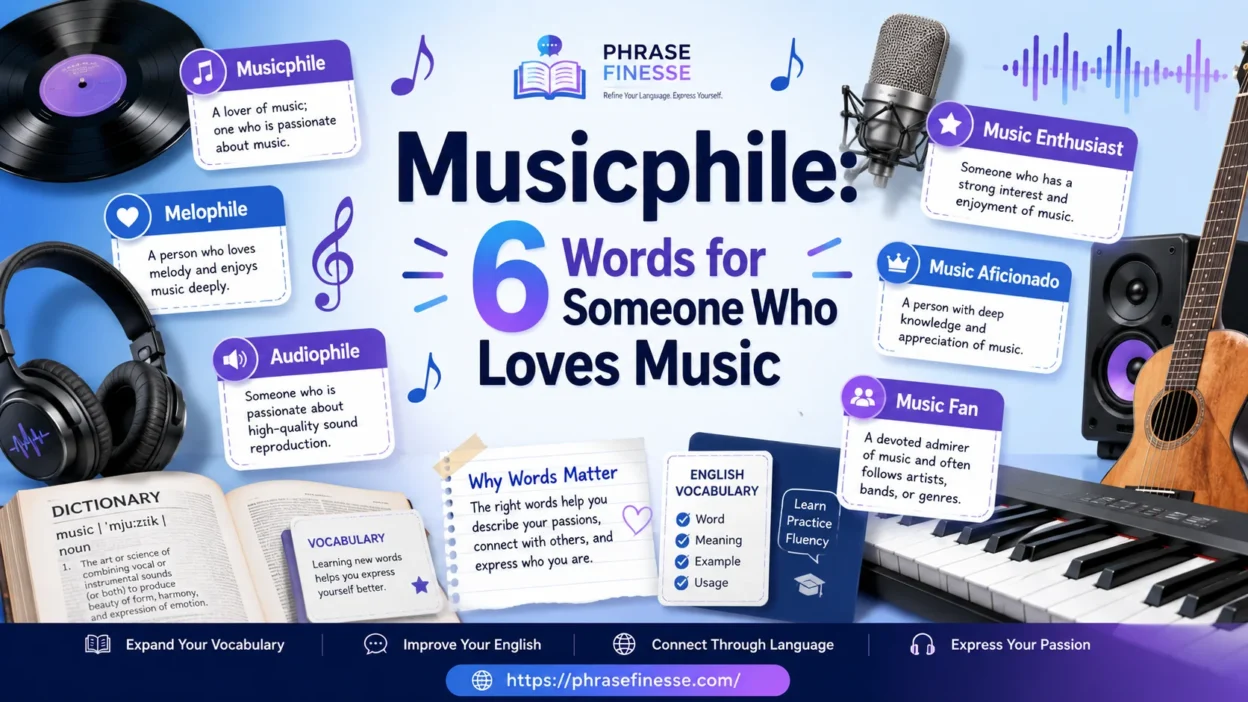
Have you ever met someone who seems to live and breathe music? Whether they spend hours discovering new songs, collecting albums, or discussing their favorite artists, finding the right word to describe a passionate music lover can be surprisingly useful. In this guide, “Musicphile” 6 Words For Someone Who Loves Music explores the most accurate and expressive terms used for people with a deep appreciation for music, musical culture, and sound artistry.
Language offers several ways to describe a devoted music enthusiast, but not every term carries the same meaning or tone. From musicphile and melophile to other lesser-known expressions, understanding these words can improve your English usage, strengthen grammar, and enhance formal writing.
Choosing the right vocabulary also helps maintain consistency and precision in both personal and professional communication.
This article breaks down six popular words for someone who loves music, explaining their meanings, origins, and practical usage. You’ll discover example sentences, subtle differences, and tips for selecting the most suitable term in different contexts.
While these expressions may appear in areas ranging from business communication and broadcasting to discussions about meetings, calendar planning, scheduling, time management, online booking, and project management, their primary value lies in helping you communicate your love of music with greater clarity and confidence.
What do you call someone who loves music?
Many people use the word music lover, but there are several other terms that describe different types of music enthusiasts. Some words focus on passion. Others emphasize expertise, listening habits, or appreciation for sound quality.
One term that has gained popularity online is musicphile. However, it’s not the only word available. Terms such as melophile, audiophile, music aficionado, and music enthusiast each carry slightly different meanings.
In this guide, you’ll learn exactly what these words mean, where they come from, and when to use them.
What Do You Call Someone Who Loves Music?
If someone enjoys listening to music, discovering new artists, discussing albums, or attending live performances, several words may fit.
Here’s a quick comparison.
| Word | Meaning | Common Usage | Formality |
| Musicphile | Person who loves music | Moderate | Informal |
| Melophile | Lover of music | Moderate | Formal |
| Audiophile | Loves high-quality sound reproduction | High | Technical |
| Music Enthusiast | Passionate about music | Very High | Neutral |
| Music Aficionado | Knowledgeable music lover | High | Formal |
| Music Fan | Person who enjoys music | Very High | Casual |
Although all these terms relate to music appreciation, they don’t mean exactly the same thing.
For example, someone may be a passionate listener who explores dozens of genres every year. That person might be a melophile.
Another person may spend thousands of dollars on speakers, amplifiers, and headphones. That individual is often considered an audiophile.
Understanding the difference helps you choose the most accurate word.
Is Musicphile a Real Word?
The term musicphile appears frequently online. Social media profiles, music blogs, forums, and online communities often use it to describe people who love music.
Definition of Musicphile
A musicphile is generally understood as a person who has a deep love, appreciation, or enthusiasm for music.
The word combines:
- Music
- -phile (meaning lover of or attracted to)
Together, they create a straightforward meaning:
A person who loves music.
The structure follows the same pattern as other well-known words:
| Word | Meaning |
| Bibliophile | Book lover |
| Cinephile | Film lover |
| Oenophile | Wine lover |
| Technophile | Technology lover |
| Musicphile | Music lover |
Because the construction follows established linguistic patterns, most people immediately understand its meaning.
Dictionary Recognition and Usage
Here’s where things get interesting.
While words like bibliophile and cinephile appear in major dictionaries, musicphile remains less common in formal language references.
That doesn’t mean the word is incorrect.
Language evolves constantly. Many terms gain widespread use before dictionaries formally recognize them.
In practice, millions of people understand exactly what “musicphile” means.
When to Use Musicphile
The word works best in casual and creative settings.
Examples include:
- Social media bios
- Music-focused communities
- Blog author profiles
- Podcast descriptions
- Personal websites
Example:
“Lifelong musicphile exploring everything from jazz to progressive rock.”
The term feels modern, expressive, and easy to understand.
Melophile: The Most Accurate Word for a Music Lover
Among language enthusiasts, melophile often receives the highest praise.
Many consider it the most precise word for someone who genuinely loves music.
What Does Melophile Mean?
A melophile is a person who loves music.
The word comes from Greek roots:
- Melo = song or music
- Phile = lover of
Unlike musicphile, which combines English and Greek elements, melophile derives directly from classical language roots.
That gives it a more traditional linguistic foundation.
Pronunciation
Melophile is commonly pronounced:
MEL-uh-file
The pronunciation resembles words like:
- Bibliophile
- Cinephile
- Francophile
Why Experts Prefer Melophile
Melophile specifically centers on music itself.
The word doesn’t imply:
- Technical expertise
- Professional training
- Expensive equipment
- Academic knowledge
Instead, it highlights pure appreciation.
Someone who feels emotionally connected to music often fits this description perfectly.
Signs You May Be a Melophile
You might be a melophile if:
- Music plays daily in your life.
- You explore unfamiliar genres.
- Songs trigger strong memories.
- You create playlists for every mood.
- Concerts feel unforgettable.
- Music helps shape your identity.
Many people never hear the term melophile until adulthood. Once they discover it, however, they often feel it describes them perfectly.
Example Sentences
- She is a devoted melophile who spends hours discovering independent artists.
- Every melophile understands the excitement of finding a hidden musical gem.
- As a melophile, he enjoys everything from classical symphonies to modern hip-hop.
Read More: First Pass Meaning: Definition, Usage and Examples
Audiophile: When Loving Music Isn’t the Same as Loving Sound
Many people mistakenly assume that audiophile means music lover.
The reality is more nuanced.
What Is an Audiophile?
An audiophile is someone passionate about high-quality sound reproduction.
Rather than focusing solely on music, audiophiles focus on how music sounds.
Their interests often include:
- Speakers
- Headphones
- Turntables
- Amplifiers
- Digital audio formats
- Acoustic treatment
An audiophile wants to hear every detail possible.
The Audiophile Experience
Imagine two people listening to the same song.
The first person enjoys the melody, lyrics, and emotional impact.
The second person notices:
- Instrument separation
- Dynamic range
- Frequency response
- Recording quality
- Soundstage width
That second listener is displaying classic audiophile behavior.
Audiophile vs Music Lover
| Audiophile | Music Lover |
| Focuses on sound quality | Focuses on music itself |
| Enjoys audio equipment | Enjoys songs and artists |
| Technical listening | Emotional listening |
| Studies recording quality | Studies musical content |
| May prefer certain formats | May enjoy any format |
Can Someone Be Both?
Absolutely.
Many passionate music lovers eventually become audiophiles.
Likewise, many audiophiles begin their journey because they love music deeply.
The two categories often overlap.
Think of it this way:
A music lover wants great music.
An audiophile wants great music played beautifully.
Music Enthusiast: The Most Widely Used Modern Term
Not everyone wants a specialized label.
That’s why music enthusiast remains one of the most popular expressions today.
What Is a Music Enthusiast?
A music enthusiast is someone who has strong interest, passion, and excitement for music.
The phrase feels natural because almost everyone understands it immediately.
No explanation required.
Why the Term Works So Well
Unlike melophile or musicphile, music enthusiast sounds familiar in professional settings.
You’ll often see it in:
- Online biographies
- Magazine articles
- Interview profiles
- Event promotions
- Music blogs
It communicates passion without sounding overly technical.
Situations Where Music Enthusiast Works Best
| Situation | Suitable? |
| LinkedIn Profile | Yes |
| Resume | Yes |
| Personal Blog | Yes |
| Academic Writing | Yes |
| Casual Conversation | Yes |
Few music-related terms offer this level of versatility.
Example Usage
- A music enthusiast who enjoys exploring emerging artists.
- Dedicated music enthusiast with interest in jazz and blues.
- Music enthusiast and concertgoer with a passion for live performances.
Because the phrase is so flexible, many writers prefer it over less familiar alternatives.
Music Aficionado: A Music Lover With Expertise
Some music lovers go beyond simple enjoyment.
They study genres, artists, history, production techniques, and cultural movements.
These individuals often earn the title music aficionado.
What Does Aficionado Mean?
The word aficionado comes from Spanish.
It refers to someone with deep knowledge and appreciation for a subject.
A music aficionado doesn’t just listen casually.
They understand context.
They know why an album mattered.
They know how genres evolved.
They recognize influential artists and groundbreaking recordings.
Characteristics of a Music Aficionado
Most music aficionados:
- Study music history.
- Explore niche genres.
- Understand influential albums.
- Follow industry trends.
- Analyze musical techniques.
- Discuss music critically.
Aficionados often become trusted sources of recommendations among friends and family.
Real-World Example
Imagine two people discussing jazz.
One enjoys listening occasionally.
The other can explain the differences between bebop, cool jazz, hard bop, and fusion.
That second person fits the description of a music aficionado.
Musicphile: 6 Words for Someone Who Loves Music
Music has a remarkable ability to shape emotions, trigger memories, and bring people together. A single song can transport you back to a specific moment in your life. A melody can lift your mood after a difficult day. A concert can create memories that last for decades.
Because music plays such an important role in human culture, many people wonder whether there’s a specific word for someone who loves music.
The answer is yes.
While most people simply say music lover, several other words describe individuals who have a deep appreciation for music. Some terms focus on emotional connection. Others highlight expertise, technical knowledge, or dedication to the art form.
One increasingly popular term is musicphile, though words such as melophile, audiophile, music enthusiast, and music aficionado also appear frequently.
If you’ve ever asked, “What do you call someone who loves music?” this guide covers everything you need to know.
What Do You Call Someone Who Loves Music?
The most accurate answer depends on the type of music lover you’re describing.
Someone who casually enjoys listening to songs may fit one category. Someone who studies music history or spends thousands of dollars on audio equipment may fit another.
Here’s a quick overview.
| Word | Meaning | Common Usage | Formality |
| Musicphile | Person who loves music | Moderate | Informal |
| Melophile | Lover of music | Moderate | Formal |
| Audiophile | Loves high-quality sound reproduction | High | Technical |
| Music Enthusiast | Passionate about music | Very High | Neutral |
| Music Aficionado | Knowledgeable music lover | High | Formal |
| Music Fan | Person who enjoys music | Very High | Casual |
Although these terms overlap, each carries a slightly different meaning.
A person who enjoys discovering new artists every week might identify as a melophile.
Someone who owns premium speakers, studio monitors, and high-end headphones might be an audiophile.
A person with extensive knowledge of music history may be considered a music aficionado.
Understanding these distinctions helps you choose the right word for the right situation.
Is Musicphile a Real Word?
One of the most common questions online is whether musicphile is actually a legitimate word.
The short answer is that people widely use it and understand its meaning. However, its usage differs from some older and more established terms.
Definition of Musicphile
A musicphile is a person who loves music or has a strong appreciation for it.
The word combines:
- Music
- The suffix -phile
The suffix -phile comes from Greek and means:
- Lover of
- Friend of
- Attracted to
As a result, the meaning of musicphile becomes very straightforward:
A person who loves music.
Why Musicphile Became Popular
The internet helped popularize the term.
Music bloggers, playlist curators, social media creators, and online communities began using musicphile because it sounds distinctive while remaining easy to understand.
The word also follows a familiar pattern.
Consider these examples:
| Word | Meaning |
| Bibliophile | Book lover |
| Cinephile | Film lover |
| Oenophile | Wine lover |
| Anglophile | Admirer of English culture |
| Musicphile | Music lover |
Because people already recognize similar words, musicphile feels natural.
Is Musicphile Better Than Music Lover?
Not necessarily.
The best choice depends on context.
Music lover remains the most universally understood phrase.
Musicphile feels more distinctive and expressive.
For example:
- Social media bio: Musicphile
- Professional profile: Music enthusiast
- Everyday conversation: Music lover
Each option serves a different purpose.
Melophile: The Most Accurate Word for a Music Lover
If language experts had to choose one word that specifically means “music lover,” many would select melophile.
What Does Melophile Mean?
A melophile is someone who loves music deeply.
The word comes from Greek roots:
| Root | Meaning |
| Melos | Song or music |
| Phile | Lover of |
Combined, they create a precise meaning:
Lover of music.
Unlike audiophile, which focuses on sound quality, melophile focuses entirely on music appreciation.
Why Melophile Is So Precise
Many words related to music carry additional meanings.
Audiophile implies interest in audio equipment.
Aficionado suggests expertise.
Fan can indicate casual enjoyment.
Melophile simply means someone who loves music.
Nothing more. Nothing less.
That precision makes it attractive to writers, linguists, and music communities.
Signs You’re a Melophile
You may be a melophile if you:
- Listen to music daily.
- Explore multiple genres.
- Feel emotionally connected to songs.
- Create playlists regularly.
- Enjoy discovering new artists.
- Associate songs with memories.
- Attend concerts whenever possible.
For many people, music becomes more than entertainment.
It becomes part of their identity.
Example Sentences
- She’s a lifelong melophile who enjoys everything from classical music to electronic dance music.
- Every melophile understands the thrill of discovering a new favorite song.
- As a melophile, he spends hours exploring independent artists.
Why Melophile Isn’t More Common
Despite its accuracy, melophile remains relatively uncommon.
Most people simply haven’t encountered the term.
When they do hear it, however, they usually understand it quickly because of its connection to other “-phile” words.
Audiophile: When Sound Quality Matters Most
Many people confuse audiophiles with music lovers.
While the two groups overlap, they aren’t identical.
What Is an Audiophile?
An audiophile is someone who values high-fidelity sound reproduction.
The focus isn’t only on music.
It’s on hearing music in the best possible quality.
Audiophiles often invest in:
- Premium headphones
- High-end speakers
- Amplifiers
- Turntables
- DACs
- Acoustic room treatments
For an audiophile, how music sounds matters just as much as the music itself.
The Audiophile Mindset
Imagine listening to your favorite song.
Most listeners focus on:
- Lyrics
- Melody
- Rhythm
- Emotional impact
Audiophiles often notice additional details:
- Instrument separation
- Vocal clarity
- Bass response
- Dynamic range
- Recording quality
- Stereo imaging
They pay attention to elements many listeners never consciously hear.
Audiophile vs Music Lover
| Audiophile | Music Lover |
| Prioritizes sound quality | Prioritizes music itself |
| Interested in equipment | Interested in artists and songs |
| Technical listening style | Emotional listening style |
| Studies audio formats | Studies music preferences |
| Often upgrades gear | Often expands playlists |
Can Someone Be Both?
Absolutely.
In fact, many audiophiles start as passionate music lovers.
Their appreciation for music eventually leads them toward better listening experiences.
Think of it this way:
A music lover wants great music.
An audiophile wants great music reproduced perfectly.
Music Enthusiast: The Most Versatile Modern Term
Not everyone wants a specialized label.
That’s where music enthusiast comes in.
What Is a Music Enthusiast?
A music enthusiast is someone with strong interest and passion for music.
The phrase sounds natural in nearly every setting.
Unlike melophile or musicphile, most people immediately understand it.
Why Music Enthusiast Is So Popular
The term works almost everywhere.
You’ll frequently see it in:
- Professional biographies
- Music blogs
- Event promotions
- Interviews
- LinkedIn profiles
- Personal websites
Because the phrase is clear and accessible, writers often prefer it.
Situations Where Music Enthusiast Works Best
| Situation | Recommended? |
| Resume | Yes |
| Professional Bio | Yes |
| Website About Page | Yes |
| Social Media | Yes |
| Academic Writing | Yes |
| Everyday Conversation | Yes |
Very few music-related terms offer this much flexibility.
Example Usage
- Music enthusiast with a passion for live performances.
- Dedicated music enthusiast who enjoys discovering emerging artists.
- Lifelong music enthusiast and vinyl collector.
The phrase may not sound as unique as musicphile, but it communicates exactly what most readers need to know.
Music Aficionado: A Music Lover With Deep Knowledge
Some people enjoy music.
Others study it.
Those individuals often earn the title music aficionado.
What Does Music Aficionado Mean?
A music aficionado is someone who possesses both passion and expertise.
They don’t just listen to songs.
They understand:
- Music history
- Genre development
- Influential artists
- Landmark albums
- Production techniques
- Cultural significance
The word suggests experience and knowledge.
Characteristics of a Music Aficionado
Music aficionados often:
- Research artists extensively.
- Follow industry trends.
- Explore obscure genres.
- Analyze albums critically.
- Compare recordings.
- Discuss music history confidently.
They tend to be the people friends consult for recommendations.
Example
Imagine two people discussing rock music.
One enjoys popular songs.
The other can explain the evolution of psychedelic rock, progressive rock, punk rock, and alternative rock.
The second person is likely a music aficionado.
Why the Word Matters
Aficionado recognizes dedication.
It distinguishes casual enjoyment from informed appreciation.
That’s why critics, collectors, journalists, and historians often fit this category.
Music Fan: The Universal Term Everyone Understands
Sometimes the simplest answer is the best answer.
What Is a Music Fan?
A music fan is someone who enjoys music.
The term is broad, flexible, and universally recognized.
Unlike melophile or musicphile, nobody needs an explanation.
Why Music Fan Remains Popular
The phrase works because it’s simple.
It covers:
- Casual listeners
- Dedicated followers
- Concert attendees
- Playlist creators
- Record collectors
Virtually anyone who enjoys music can be described as a music fan.
Example Sentences
- She’s a huge music fan.
- Music fans attended the festival from around the world.
- Every music fan has a favorite artist.
While the term lacks the precision of melophile or audiophile, its universal appeal keeps it relevant.
Other Lesser-Known Words Related to Music Lovers
Several additional terms appear occasionally in music communities.
Musicophile
Some people use musicophile instead of musicphile.
The meaning remains the same:
A lover of music.
However, musicphile tends to appear more frequently in modern online usage.
Concertgoer
A concertgoer specifically enjoys attending live performances.
Not every music lover attends concerts regularly.
Likewise, not every concertgoer has extensive music knowledge.
Record Collector
Record collectors focus on acquiring physical music releases.
Their collections may include:
- Vinyl records
- CDs
- Cassettes
- Rare editions
- Signed albums
Many collectors are also music aficionados.
Vinyl Enthusiast
Vinyl enthusiasts appreciate both music and the vinyl listening experience.
The resurgence of vinyl records has made this identity increasingly popular.
Music Buff
The word “buff” refers to someone with strong interest or expertise.
A music buff often possesses substantial knowledge about artists, albums, and genres.
The Origins of “-Phile” Words
Understanding the suffix -phile helps explain terms like musicphile and melophile.
What Does “-Phile” Mean?
The suffix comes from Greek and generally means:
- Lover of
- Attracted to
- Enthusiast of
Over time, English adopted many “-phile” words.
Common Examples
| Word | Meaning |
| Bibliophile | Book lover |
| Cinephile | Film lover |
| Francophile | Admirer of French culture |
| Oenophile | Wine lover |
| Technophile | Technology enthusiast |
| Musicphile | Music lover |
| Melophile | Music lover |
Why These Words Remain Popular
People enjoy labels that express identity.
A single word can communicate a lifelong passion.
Instead of saying:
“I really enjoy music and spend a lot of time listening to it.”
Someone can simply say:
“I’m a melophile.”
That’s efficient and memorable.
Which Word Should You Use?
The best choice depends entirely on context.
Quick Decision Guide
| Situation | Best Term |
| Casual conversation | Music lover |
| Professional bio | Music enthusiast |
| Academic discussion | Melophile |
| Social media profile | Musicphile |
| Audio equipment hobby | Audiophile |
| Expert music knowledge | Music aficionado |
Recommended Choice for Most People
For general audiences, music enthusiast and music lover remain the strongest options.
They’re clear, recognizable, and widely understood.
If you want something more distinctive, musicphile works well.
If you want linguistic precision, melophile is arguably the most accurate term available.
FAQs
1. What does “musicphile” mean?
A musicphile is a person who has a deep love, appreciation, and enthusiasm for music. The term combines the word “music” with the suffix “-phile,” which means a lover of or someone attracted to a particular thing.
2. Is “musicphile” a real word?
Yes, musicphile is a recognized term used to describe a passionate music lover. Although it is less common than words like music enthusiast or music lover, it is widely understood among people interested in music and language.
3. What is the difference between a musicphile and a melophile?
Both terms refer to someone who loves music. However, melophile comes from Greek roots and literally means “lover of melody or music,” while musicphile is a more straightforward English formation. In modern usage, the meanings are very similar.
4. What are some other words for someone who loves music?
Some common alternatives include melophile, music enthusiast, music lover, audiophile, concertgoer, and music aficionado. Each term carries slightly different meanings depending on the person’s level of involvement and interest.
5. Can “audiophile” and “musicphile” be used interchangeably?
Not always. An audiophile is primarily interested in high-quality sound reproduction and audio equipment, whereas a musicphile focuses on the enjoyment and appreciation of music itself. A person can be both, but the terms are not identical.
6. When should I use the word “musicphile”?
Use musicphile when you want a more distinctive or sophisticated way to describe someone who genuinely loves music. It works well in conversations, articles, social media posts, and other forms of writing where precise vocabulary is appreciated.
Conclusion
Finding the right word for a passionate music lover can add depth and accuracy to your writing. While musicphile is one of the most direct and expressive terms, it is not the only option. Words such as melophile, music enthusiast, audiophile, and music aficionado each highlight different aspects of a person’s relationship with music.
By understanding these distinctions, you can choose the term that best matches the context and communicate your ideas with greater clarity. Whether you’re improving your vocabulary, enhancing your English writing, or simply exploring interesting language, these six words offer valuable ways to describe a true lover of music.

Emma Brooke is an English language specialist, editor, and content writer at Phrase Finesse, where she helps readers develop stronger writing and communication skills through clear, practical, and engaging content. With a passion for the English language, she specializes in simplifying grammar rules, vocabulary, spelling, punctuation, and word usage for learners at every level.
Emma has extensive experience creating educational content that is accurate, well-researched, and easy to understand. She is particularly skilled at explaining confusing word pairs, grammar concepts, idioms, sentence structure, and effective writing techniques, making complex topics approachable for students, professionals, educators, and English learners worldwide.