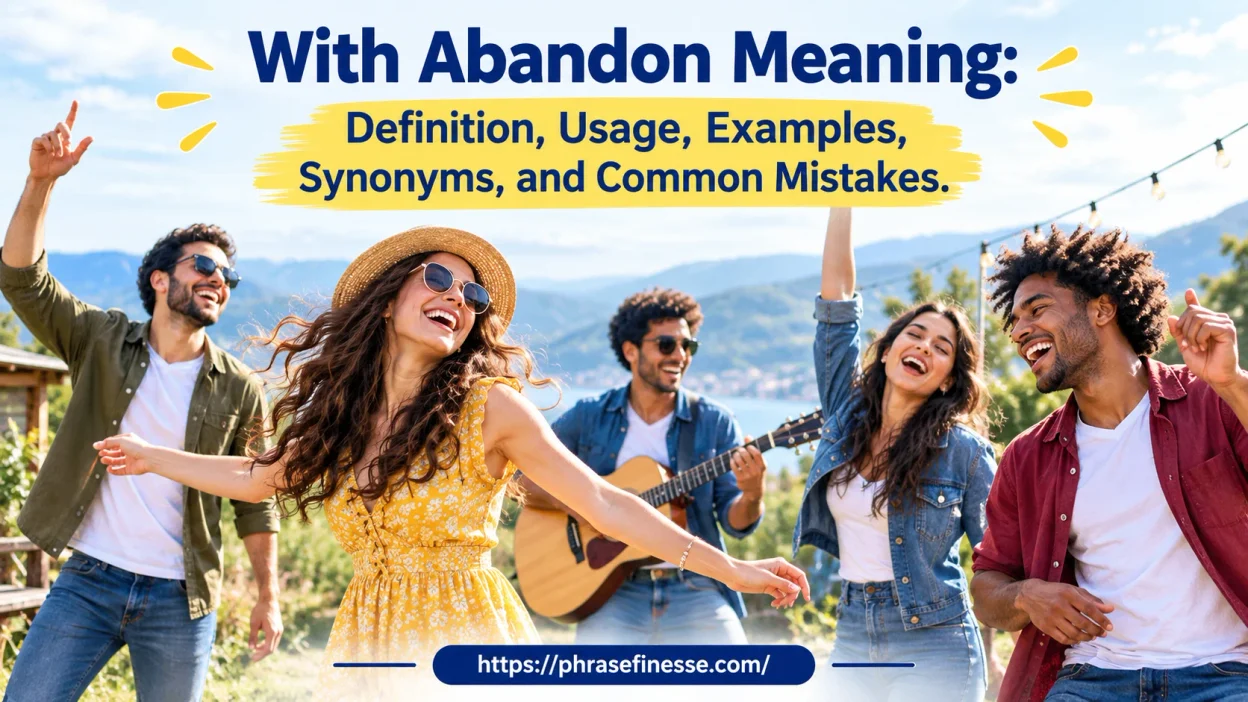
Have you ever heard someone say they danced, laughed, or celebrated with abandon and wondered what that expression really means? In “With Abandon” Meaning and Usage (Helpful Examples), you’ll discover how this vivid English phrase conveys acting with complete freedom, enthusiasm, and lack of restraint.
Understanding expressions like with abandon can strengthen your English usage, improve grammar, and help you communicate more naturally in both casual and professional settings.
Although the phrase often appears in literature, conversation, and media, many learners are unsure when and how to use it correctly. This guide breaks down the exact meaning, explores common usage patterns, and provides practical examples you can apply immediately.
Whether you’re improving your formal writing, refining your business communication, or simply expanding your vocabulary, mastering idiomatic expressions adds clarity and style to your language.
You’ll also learn how context influences meaning, common mistakes to avoid, and the situations where with abandon sounds most natural. From workplace discussions involving project management, meetings, and consistency to everyday topics such as time management, scheduling, calendar planning, online booking, and even broadcasting, recognizing nuanced expressions can make your communication more effective.
By the end of this article, you’ll know exactly how to use with abandon confidently and accurately in real-world English.
What Does “With Abandon” Mean?
The phrase with abandon means:
To act freely, enthusiastically, or without inhibition or restraint.
When someone does something with abandon, they stop worrying about judgment, appearances, or limitations. They simply immerse themselves in the action.
Simple Definition
With abandon = freely + enthusiastically + without self-consciousness
The expression often conveys:
- Joy
- Excitement
- Passion
- Freedom
- Energy
- Spontaneity
Quick Meaning Table
| Expression | Meaning |
| With abandon | Freely and without restraint |
| Dance with abandon | Dance without worrying about others |
| Laugh with abandon | Laugh openly and wholeheartedly |
| Sing with abandon | Sing enthusiastically and confidently |
| Celebrate with abandon | Celebrate freely and energetically |
Understanding the Idea
Imagine a child running through sprinklers on a hot summer day.
The child isn’t worried about getting wet.
The child isn’t concerned about appearance.
The child isn’t thinking about what others might say.
They’re simply enjoying the moment.
That is the essence of acting with abandon.
Why the Phrase Confuses Many English Learners
One reason learners struggle with this expression is that the word abandon has another common meaning.
For example:
- They abandoned the project.
- She abandoned her plans.
- The building was abandoned.
In these examples, abandon means to leave behind.
However, with abandon is an idiomatic expression with a different meaning.
English contains many expressions like this where the overall phrase develops a meaning that differs from the individual words.
Compare the Difference
| Expression | Meaning |
| Abandon a project | Leave it behind |
| Abandon a plan | Stop pursuing it |
| With abandon | Without restraint |
| Dance with abandon | Dance freely |
This distinction is essential for understanding the phrase correctly.
The Origin and History of “With Abandon”
Understanding where the phrase came from makes its meaning easier to remember.
The word abandon traces its roots to Old French.
Historically, it carried meanings related to surrendering, yielding, or giving oneself over completely.
Over time, English speakers began using the phrase with abandon to describe situations where people gave themselves over fully to an action or emotion.
Rather than holding back, they surrendered their restraint.
Eventually, the expression evolved into its modern meaning:
acting freely, wholeheartedly, and without inhibition.
Historical Development
| Time Period | Development |
| Old French origins | Surrender or yielding |
| Early English usage | Giving oneself over completely |
| Literary usage | Acting without restraint |
| Modern English | Acting freely and enthusiastically |
Why the Modern Meaning Makes Sense
When you think of with abandon as giving up restraint rather than leaving something behind, the expression becomes much easier to understand.
In other words:
- You abandon caution.
- You abandon self-consciousness.
- You abandon inhibition.
Then you act freely.
How Native English Speakers Use “With Abandon”
Native speakers typically use the phrase when describing actions filled with emotion, energy, enthusiasm, or spontaneity.
The expression often appears in:
- News articles
- Novels
- Sports reports
- Movie reviews
- Music criticism
- Lifestyle writing
- Personal storytelling
Common Pattern
The most common structure is:
Verb + with abandon
Examples:
- Laugh with abandon
- Dance with abandon
- Sing with abandon
- Celebrate with abandon
- Cheer with abandon
Typical Situations
Celebrations
People celebrate victories, birthdays, graduations, and achievements with abandon.
Music and Dance
Performers often sing or dance with abandon.
Sports
Fans cheer with abandon when their team wins.
Childhood Activities
Children naturally play with abandon because they rarely worry about judgment.
Artistic Expression
Artists create with abandon when they allow creativity to flow freely.
Common Examples of “With Abandon” in Everyday English
The best way to understand any expression is to see it in context.
Everyday Conversation Examples
- The children laughed with abandon during the puppet show.
- She danced with abandon at the wedding reception.
- We sang with abandon during the road trip.
- They celebrated with abandon after passing the exam.
- He threw himself into the game with abandon.
Workplace Examples
- The team celebrated the successful launch with abandon.
- Employees applauded with abandon after the announcement.
- The audience responded with abandon to the keynote speaker.
Sports Examples
- Fans cheered with abandon after the winning goal.
- The crowd celebrated with abandon as the championship ended.
- Supporters waved flags with abandon throughout the match.
Creative Writing Examples
- The river rushed downhill with abandon.
- Leaves danced across the street with abandon.
- The young artist painted with abandon, unconcerned by convention.
More Than 20 Example Sentences Using “With Abandon”
Here are additional examples covering different contexts.
Positive Examples
- The choir sang with abandon.
- The children played with abandon in the snow.
- She laughed with abandon at the comedian’s jokes.
- Friends celebrated with abandon after graduation.
- The crowd danced with abandon throughout the concert.
- The puppy ran through the yard with abandon.
- Guests enjoyed the party with abandon.
- The performers embraced the stage with abandon.
- Travelers explored the city with abandon.
- The audience applauded with abandon.
Literary Examples
- The wind swept through the valley with abandon.
- Wildflowers spread across the hillside with abandon.
- The character pursued adventure with abandon.
- He embraced life with abandon after retirement.
- She approached every challenge with abandon.
Advanced Examples
- Investors spent money with abandon during the economic boom.
- The company expanded with abandon before market conditions changed.
- Tourists photographed every landmark with abandon.
- Fans purchased merchandise with abandon.
- Social media users shared the video with abandon.
- The artist experimented with color with abandon.
Common Collocations With “With Abandon”
Certain verbs naturally pair with this phrase.
These combinations sound particularly natural to native speakers.
Most Common Collocations
| Verb | Example |
| Dance | She danced with abandon. |
| Laugh | They laughed with abandon. |
| Sing | The crowd sang with abandon. |
| Cheer | Fans cheered with abandon. |
| Celebrate | Students celebrated with abandon. |
| Play | Children played with abandon. |
| Shout | Supporters shouted with abandon. |
| Perform | The band performed with abandon. |
| Embrace | He embraced life with abandon. |
| Enjoy | They enjoyed the evening with abandon. |
Why These Collocations Work
All of these actions involve:
- Emotion
- Energy
- Freedom
- Expression
The phrase naturally amplifies those qualities.
See More :It’s Better to Ask for Forgiveness Than Permission
“With Abandon” Versus “With Reckless Abandon”
Many people encounter a slightly different version:
with reckless abandon
Although similar, the two expressions are not identical.
With Abandon
Suggests freedom and enthusiasm.
Example:
She danced with abandon.
With Reckless Abandon
Suggests freedom plus disregard for consequences.
Example:
He spent money with reckless abandon.
Comparison Table
| Phrase | Meaning |
| With abandon | Freely and enthusiastically |
| With reckless abandon | Wildly without considering consequences |
Examples
Positive:
- The children played with abandon.
Potentially Negative:
- The company hired employees with reckless abandon.
The addition of reckless changes the tone significantly.
Positive and Negative Connotations of “With Abandon”
Most of the time, the phrase has a positive meaning.
However, context matters.
Positive Uses
The phrase often communicates:
- Joy
- Passion
- Confidence
- Creativity
- Celebration
Examples:
- She laughed with abandon.
- They danced with abandon.
- The crowd sang with abandon.
Neutral Uses
Sometimes the phrase simply describes intensity.
Examples:
- He painted with abandon.
- The writer experimented with abandon.
Negative Uses
Occasionally, it can imply excess.
Examples:
- Investors spent with abandon.
- The company expanded with abandon.
- Shoppers purchased luxury goods with abandon.
Context Determines Meaning
Pay attention to:
- The verb used
- Surrounding words
- Overall tone
The phrase itself isn’t automatically positive or negative.
Synonyms of “With Abandon”
No synonym matches the expression perfectly, but several come close.
Common Synonyms
| Synonym | Meaning |
| Freely | Without restriction |
| Enthusiastically | With excitement |
| Wholeheartedly | With complete commitment |
| Passionately | With strong emotion |
| Unrestrainedly | Without limits |
| Spontaneously | Naturally and freely |
| Fearlessly | Without fear |
| Wildly | In an energetic manner |
Usage Comparison
| Phrase | Tone |
| With abandon | Expressive and natural |
| Enthusiastically | Positive and direct |
| Wholeheartedly | Emotionally committed |
| Unrestrainedly | Formal |
| Wildly | Highly energetic |
Example Rewrites
Original:
She danced with abandon.
Alternative versions:
- She danced enthusiastically.
- She danced freely.
- She danced wholeheartedly.
- She danced without restraint.
Each sentence carries a slightly different nuance.
Antonyms of “With Abandon”
Antonyms help clarify meaning through contrast.
Common Opposites
| Antonym | Meaning |
| Carefully | With caution |
| Cautiously | With restraint |
| Hesitantly | Without confidence |
| Reservedly | With emotional control |
| Conservatively | In a controlled manner |
| Deliberately | With careful thought |
Comparison Examples
| With Abandon | Opposite |
| She danced with abandon. | She danced cautiously. |
| The crowd cheered with abandon. | The crowd responded reservedly. |
| Children played with abandon. | Children played carefully. |
The contrast highlights the phrase’s energetic nature.
How “With Abandon” Appears in Literature
Writers love this expression because it instantly creates vivid imagery.
Instead of saying:
She danced enthusiastically.
A novelist might write:
She danced with abandon.
The second version paints a richer picture.
Readers imagine:
- Movement
- Emotion
- Freedom
- Confidence
Why Authors Use It
The phrase efficiently communicates:
- Character personality
- Emotional state
- Scene atmosphere
- Energy level
In just two words, it creates a memorable image.
Literary Effect
Consider these examples:
The children ran through the meadow with abandon.
The crowd sang with abandon beneath the summer sky.
Both sentences create motion and emotion simultaneously.
How Journalists and Media Writers Use the Phrase
Journalists frequently use this expression when describing events.
Sports Reporting
Examples:
- Fans celebrated with abandon.
- Supporters cheered with abandon.
Entertainment Reviews
Examples:
- The band performed with abandon.
- The actor embraced the role with abandon.
Lifestyle Articles
Examples:
- Travelers explored the destination with abandon.
- Guests enjoyed the festival with abandon.
The phrase adds energy while remaining professional.
Common Mistakes and Misunderstandings
Many learners misuse this expression.
Avoid these common errors.
Mistake: Thinking It Means Leaving Something Behind
Incorrect understanding:
With abandon means abandoning something.
Correct understanding:
With abandon means acting freely without restraint.
Mistake: Using It With Routine Activities
Some actions don’t naturally fit the phrase.
Awkward:
- She filed paperwork with abandon.
- He completed taxes with abandon.
Natural:
- She danced with abandon.
- He celebrated with abandon.
Mistake: Assuming It Is Always Positive
Sometimes it implies excess.
Example:
Investors spent with abandon.
The sentence may suggest irresponsible behavior.
Mistake: Confusing It With Carelessness
Acting with abandon doesn’t always mean being careless.
Someone can:
- Sing with abandon.
- Dance with abandon.
- Laugh with abandon.
None of those actions are necessarily reckless.
Real-Life Case Studies of “With Abandon” in Context
Case Study: A Championship Victory
Imagine a soccer team winning a championship after a decade-long drought.
What happens?
- Fans jump up and down.
- People hug strangers.
- Songs fill the streets.
- Flags wave everywhere.
A reporter might write:
Fans celebrated with abandon long into the night.
The phrase perfectly captures the scene.
Case Study: A Music Festival
Thousands gather to hear their favorite band.
As the headline act begins:
- People sing every lyric.
- Arms wave in the air.
- The crowd dances together.
A reviewer could write:
The audience sang with abandon from the opening song to the encore.
Again, the expression conveys excitement instantly.
Case Study: Children at Play
Watch children on a playground.
Most:
- Run freely.
- Laugh loudly.
- Invent games.
- Ignore self-consciousness.
That’s why educators and psychologists often view unstructured play as valuable.
Children naturally play with abandon because they haven’t yet developed many social inhibitions.
Should You Use “With Abandon” in Formal Writing?
The answer depends on the situation.
Academic Writing
Usually avoid it.
Academic writing values precision over imagery.
Business Writing
Use sparingly.
Appropriate:
Customers embraced the campaign with abandon.
Less appropriate:
Quarterly reports were reviewed with abandon.
Journalism
Often appropriate.
Creative Writing
Highly effective.
Marketing Content
Can add emotional appeal when used carefully.
Quick Reference Cheat Sheet
| Question | Answer |
| What does with abandon mean? | Freely and without restraint |
| Is it an idiom? | Yes |
| Is it commonly used? | Yes, especially in writing |
| Is it positive? | Usually |
| Can it be negative? | Sometimes |
| Common verbs? | Dance, laugh, sing, cheer, celebrate |
| Formal or informal? | Neutral to slightly literary |
| Alternative phrase? | Without restraint |
FAQs
1. What does “with abandon” mean?
With abandon means acting freely, enthusiastically, and without restraint or hesitation. It often describes someone expressing emotions, enjoying an activity, or doing something with complete confidence and energy.
2. Is “with abandon” a positive or negative expression?
It can be either, depending on the context. Most often, it has a positive meaning, such as dancing or laughing with abandon. However, it can also suggest reckless behavior if someone acts without considering consequences.
3. How do you use “with abandon” in a sentence?
Here are a few examples:
- The children played with abandon in the park.
- She sang with abandon, captivating the audience.
- He spent money with abandon, ignoring his budget.
4. Is “with abandon” formal or informal?
The phrase works well in both formal and informal English. You may find it in literature, journalism, business writing, and everyday conversation, making it a versatile expression.
5. What is the difference between “with abandon” and “abandoned”?
With abandon is an idiomatic phrase meaning “freely and without restraint.” Abandoned is an adjective or verb that usually means something has been left behind or deserted. Although they share the same root word, their meanings are very different.
6. What are some synonyms for “with abandon”?
Common synonyms include:
- Freely
- Unreservedly
- Wholeheartedly
- Enthusiastically
- Without inhibition
- Without restraint
- Passionately
The best synonym depends on the tone and context of the sentence.
Conclusion
The phrase with abandon is a powerful and expressive idiom that describes doing something with complete freedom, enthusiasm, and little or no restraint. Whether you encounter it in literature, conversation, business communication, or formal writing, understanding its meaning can improve both your vocabulary and overall English usage.
By learning the correct contexts, studying real-life examples, and avoiding common mistakes, you can use with abandon naturally and confidently. The next time you want to describe someone acting wholeheartedly or without hesitation, this versatile expression may be exactly the phrase you need.

Mia Rose is an English language specialist and editorial writer at Phrase Finesse, where she helps readers master grammar, vocabulary, spelling, and effective communication. Passionate about making English simple and practical, she creates well-researched, reader-friendly content that explains complex language concepts in a clear and engaging way.
With extensive experience in English language education, content writing, and editorial review, Mia specializes in grammar, punctuation, word choice, idioms, confusing word pairs, and writing style. Her articles are carefully researched, fact-checked, and designed to help students, professionals, writers, and English learners build confidence in both written and spoken English.