Have you ever struggled to find the right word for a person who constantly takes advantage of others for personal gain? Understanding the 7 Words For Someone Who Uses Other People can help you describe these behaviors more accurately in conversations, formal writing, workplace discussions, and everyday English usage. Choosing the correct term adds clarity, improves communication, and helps maintain consistency in your writing.
The English language offers several nuanced words that describe people who manipulate, exploit, or benefit from others without genuine concern for their well-being. While some terms emphasize selfish motives, others focus on emotional manipulation, opportunism, or unethical behavior. Knowing these distinctions can strengthen business communication, improve grammar choices, and help you express complex ideas with greater precision.
In this guide, you’ll discover seven effective words, their meanings, usage examples, and the subtle differences between them. Whether you are improving your vocabulary, enhancing formal writing, or simply looking for the most accurate expression, this article will help you select the right term for the right context while maintaining clarity, professionalism, and linguistic accuracy.
What do you call someone who uses other people?
The answer depends on their behavior.
Someone who manipulates emotions differs from someone who exploits generosity. Likewise, a selfish person isn’t always calculating, and an opportunist isn’t necessarily manipulative.
That’s why choosing the right word matters.
In this guide, you’ll discover 7 words for someone who uses other people, what each term really means, how they differ, and when each one fits best. You’ll also learn the warning signs of people who use others and how to protect yourself from one-sided relationships.
What Do You Call Someone Who Uses Other People?
Several words can describe a person who uses others for personal gain.
Some are formal. Others are casual. Some describe emotional manipulation while others focus on selfish behavior.
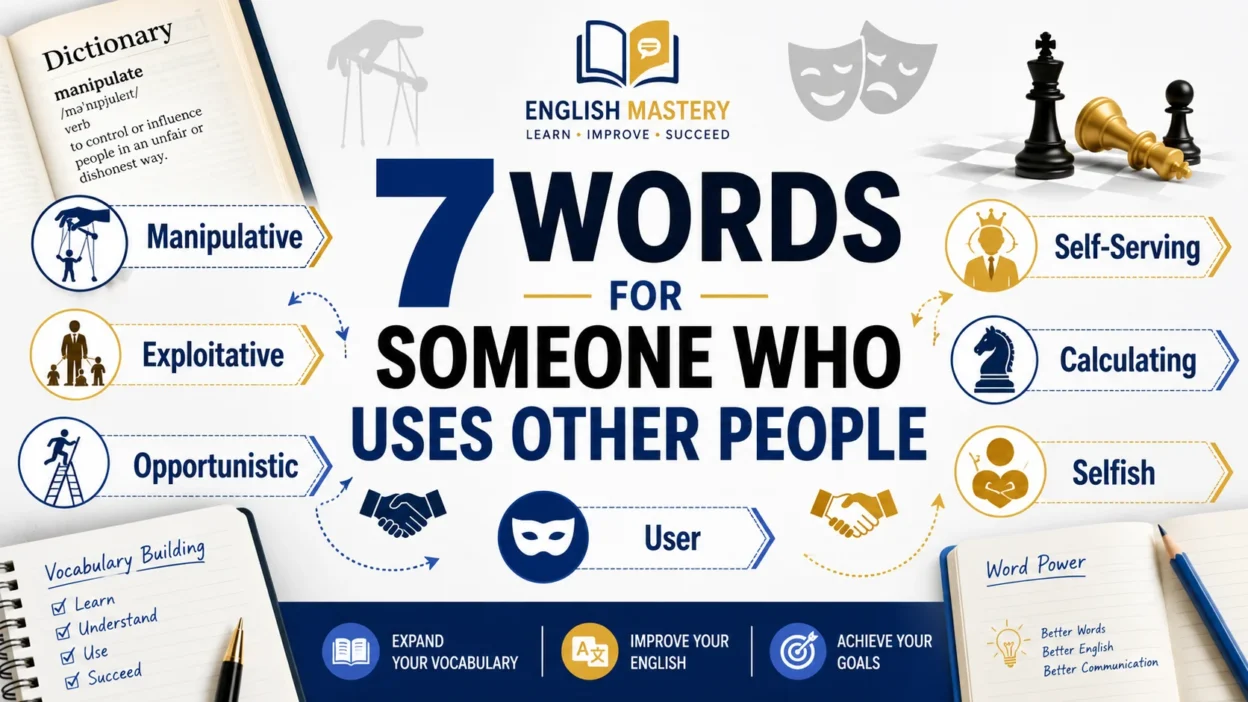
Here are the seven most accurate terms:
| Word | Meaning | Severity | Common Use |
| Manipulative | Controls or influences others for personal gain | High | Relationships, workplace |
| Exploitative | Takes unfair advantage of others | High | Personal and professional settings |
| Opportunistic | Uses situations or people when beneficial | Medium | Social and career situations |
| Self-Serving | Focused mainly on personal benefit | Medium | Everyday interactions |
| Calculating | Strategically uses people to achieve goals | Medium-High | Professional and social environments |
| Selfish | Prioritizes personal needs above others | Medium | General behavior |
| User | Informal term for someone who takes advantage of people | High | Casual conversations |
Although these words overlap, each one highlights a different behavior.
Let’s examine them in detail.
Manipulative
Among all the words for someone who uses other people, manipulative may be the most common.
A manipulative person influences others in subtle ways to get what they want. Instead of making direct requests, they often use emotions, guilt, pressure, or deception.
What Makes Someone Manipulative?
Manipulative people often:
- Twist conversations
- Create guilt
- Shift blame
- Play the victim
- Hide their true intentions
- Use emotional pressure
At first, their behavior may seem harmless.
Over time, however, patterns begin to emerge.
Example
Imagine a friend who constantly says:
“I guess I’ll just do it alone since nobody cares.”
They’re not directly asking for help.
Instead, they’re creating guilt so others feel obligated to step in.
That’s manipulation.
Example Sentence
“His manipulative behavior made everyone feel responsible for solving his problems.”
Key Traits of Manipulative People
| Trait | Description |
| Guilt-tripping | Makes others feel guilty |
| Emotional pressure | Uses feelings as leverage |
| Blame shifting | Refuses accountability |
| Deception | Hides motives |
| Control | Influences decisions indirectly |
Exploitative
If someone regularly benefits at another person’s expense, exploitative may be the most accurate description.
Unlike manipulation, exploitation focuses on taking advantage of resources, kindness, trust, or vulnerability.
Think of it as an unbalanced exchange.
One person keeps giving.
The other keeps taking.
Signs of Exploitative Behavior
- Borrowing money without repayment
- Taking credit for others’ work
- Using someone’s generosity repeatedly
- Exploiting emotional vulnerabilities
- Creating one-sided relationships
Real-Life Example
Consider a coworker who constantly asks for help with projects.
You spend hours assisting them.
When recognition arrives, they claim all the credit.
That’s exploitative behavior.
Example Sentence
“The relationship became exploitative because one partner gave everything while receiving very little in return.”
Exploitative vs Manipulative
People often confuse these terms.
Here’s the difference:
| Manipulative | Exploitative |
| Focuses on controlling people | Focuses on benefiting from people |
| Uses emotional tactics | Uses unfair advantage |
| Influences decisions | Extracts resources or benefits |
| Often subtle | Can be obvious or hidden |
Many exploitative individuals are also manipulative.
However, not all manipulative people are exploitative.
Opportunistic
Some people don’t actively seek to use others.
Instead, they take advantage whenever an opportunity appears.
That’s where the word opportunistic comes in.
An opportunistic person acts based on personal advantage rather than loyalty or principle.
Common Opportunistic Behaviors
- Networking only for personal gain
- Switching allegiances when beneficial
- Forming convenient friendships
- Supporting people only when useful
Example
Imagine someone who ignores you for months.
Suddenly, they discover you can help them get a job.
Now they’re texting every day.
That behavior may appear opportunistic.
Example Sentence
“He seemed opportunistic because he only contacted influential people when he needed something.”
Is Opportunistic Always Negative?
Interestingly, no.
In business, opportunistic behavior can sometimes be positive.
Entrepreneurs often seize opportunities.
Investors do too.
The negative meaning usually appears when people use others rather than circumstances.
Quick Comparison
| Positive Opportunism | Negative Opportunism |
| Taking advantage of market opportunities | Taking advantage of people |
| Adapting quickly | Abandoning loyalty |
| Recognizing potential | Using relationships selfishly |
Self-Serving
A self-serving person places personal interests above collective interests.
Their actions primarily benefit themselves.
While they may appear helpful, their motives often reveal a different story.
Common Characteristics
- Prioritizes personal gain
- Supports causes selectively
- Helps when rewards exist
- Focuses on self-interest
Example
Suppose a manager publicly supports an employee’s idea.
Later, they present the same idea as their own.
That behavior could be described as self-serving.
Example Sentence
“Many employees viewed the decision as self-serving rather than beneficial for the team.”
Why This Word Matters
Unlike manipulation or exploitation, self-serving behavior isn’t always malicious.
Sometimes it simply reflects excessive self-interest.
Still, it can damage trust over time.
Calculating
Some people don’t act impulsively.
Instead, they carefully plan every move.
The word calculating describes someone who strategically uses relationships or situations to achieve specific goals.
Characteristics of a Calculating Person
- Thinks several steps ahead
- Evaluates relationships strategically
- Focuses on outcomes
- Hides intentions well
- Makes decisions logically rather than emotionally
Example
A calculating individual may build friendships exclusively with influential people.
They’re not seeking connection.
They’re seeking advantage.
Example Sentence
“His calculating nature made others question whether his friendships were genuine.”
Manipulative vs Calculating
Although similar, these terms aren’t identical.
| Manipulative | Calculating |
| Emotion-focused | Strategy-focused |
| Influences feelings | Plans outcomes |
| Often reactive | Usually deliberate |
| Uses emotional pressure | Uses careful planning |
A calculating person resembles a chess player.
Every move serves a purpose.
Selfish
The word selfish remains one of the simplest and most widely used terms.
A selfish person consistently prioritizes their own wants, needs, and comfort above everyone else’s.
Common Signs of Selfishness
- Rarely compromises
- Expects favors
- Ignores others’ needs
- Takes more than gives
- Focuses on personal benefit
Everyday Example
Imagine a roommate who constantly leaves messes for others to clean.
They enjoy the benefits of a clean home without contributing.
Most people would call that selfish behavior.
Example Sentence
“Her selfish attitude made teamwork nearly impossible.”
Why Selfish Doesn’t Always Mean Manipulative
A selfish person may not actively use people.
Sometimes they’re simply focused on themselves.
That’s an important distinction.
User
If you’re looking for a casual term, user is probably the most direct answer.
A user is someone who forms relationships mainly to gain benefits.
The term appears frequently in everyday conversations.
Common Signs of a User
- Calls only when needing help
- Rarely reciprocates favors
- Disappears after receiving benefits
- Maintains transactional relationships
- Values usefulness over connection
Example
A person who constantly borrows money, asks for rides, and requests favors but never helps others might be described as a user.
Example Sentence
“Eventually everyone realized he was a user who only showed up when he needed something.”
Why the Word “User” Resonates
The term feels powerful because it’s simple.
Everyone understands what it means.
A user sees relationships as tools rather than genuine connections.
Other Words for Someone Who Uses Other People
The English language offers many alternatives.
Depending on the situation, these words may fit even better.
Additional Terms
| Word | Meaning |
| Exploiter | Someone who takes advantage of others |
| Parasitic | Lives off others without contributing |
| Conniving | Secretly plots for personal gain |
| Scheming | Constantly planning self-serving actions |
| Narcissistic | Excessively self-focused |
| Deceitful | Uses dishonesty |
| Mercenary | Motivated mainly by personal gain |
| Two-Faced | Acts differently depending on circumstances |
| Insincere | Not genuine |
| Freeloader | Benefits from others without contributing |
| Predator | Targets vulnerable people |
Each term highlights a different aspect of exploitative behavior.
Which Word Is the Most Accurate?
The best word depends on the behavior.
If They Use Emotions
Use:
- Manipulative
- Conniving
If They Take Advantage of Kindness
Use:
- Exploitative
- User
- Parasitic
If They Focus Only on Themselves
Use:
- Selfish
- Self-Serving
If They Strategically Use Relationships
Use:
- Calculating
- Opportunistic
If They Benefit Financially
Use:
- Exploiter
- Freeloader
- Mercenary
Signs Someone Is Using Other People
Words matter.
However, recognizing behavior matters even more.
Here are common warning signs.
They Contact You Only When They Need Something
Healthy relationships involve mutual interest.
Users often appear only when benefits exist.
They Rarely Return Favors
Notice patterns.
Do they constantly ask for help?
Do they help when you need support?
If the answer is no, the relationship may be one-sided.
Every Interaction Feels Transactional
Friendship shouldn’t feel like a business contract.
When every conversation revolves around their needs, pay attention.
They Disappear When Benefits End
This is one of the strongest indicators.
Once resources disappear, so does their interest.
They Use Guilt as a Tool
Manipulative people often weaponize guilt.
Instead of making reasonable requests, they pressure others emotionally.
They Ignore Boundaries
Healthy individuals respect limits.
People who use others often push past them.
Why Do Some People Use Other People?
Understanding the reasons doesn’t excuse the behavior.
However, it can provide insight.
Personal Gain
Many simply want benefits.
Money.
Status.
Connections.
Resources.
The motive is straightforward.
Lack of Empathy
Some individuals struggle to understand how their actions affect others.
As a result, they prioritize personal goals.
Desire for Control
Power can become addictive.
Using people may create feelings of control or superiority.
Insecurity
Surprisingly, insecurity often drives exploitative behavior.
Some people fear rejection or failure.
They use others as shortcuts to achieve goals.
Learned Behavior
Children often model behavior they observe.
Someone raised in highly transactional environments may develop similar habits.
Read More: 5 Words for a Person Who Finds Fault in Everything: Meaning
Case Study: The One-Sided Friendship
Sarah always helped her friend Emma.
She provided rides.
She listened to problems.
She offered emotional support.
Whenever Sarah needed help, Emma was unavailable.
At first, Sarah assumed Emma was busy.
Years later, the pattern remained unchanged.
Emma appeared whenever she needed something.
Then she vanished again.
What Was Happening?
The relationship showed several warning signs:
- One-sided effort
- Lack of reciprocity
- Transactional behavior
- Selective communication
The most accurate descriptions would likely be:
- User
- Self-serving
- Exploitative
This example highlights an important lesson:
Patterns reveal character more accurately than isolated incidents.
How to Respond to Someone Who Uses People
Recognizing the behavior is only half the battle.
You also need a strategy.
Set Clear Boundaries
Define what you will and won’t accept.
Then stick to those limits.
Learn to Say No
Many users target people who struggle to refuse requests.
A simple “No” often reveals someone’s true intentions.
Watch Actions Instead of Words
Promises are easy.
Patterns tell the real story.
Stop Over-Explaining
You don’t need lengthy justifications.
Clear boundaries are enough.
Limit Access to Your Time and Resources
Not everyone deserves unlimited access to your energy.
Protect it wisely.
End the Relationship When Necessary
Some relationships improve.
Others don’t.
If a relationship consistently harms your well-being, walking away may be the healthiest choice.
Common Mistakes When Labeling Someone
Avoid rushing to conclusions.
Context matters.
Being Selfish Doesn’t Always Mean Someone Is Manipulative
A selfish person focuses on themselves.
A manipulative person actively influences others.
Those aren’t always the same.
Opportunistic Doesn’t Always Mean Exploitative
Some people simply recognize opportunities.
That alone doesn’t make them harmful.
One Mistake Doesn’t Define Someone
Everyone occasionally acts selfishly.
Patterns matter more than isolated incidents.
Intent and Impact Both Matter
A person’s intentions may be harmless.
Their actions may still hurt others.
Consider both.
FAQs
1. What do you call someone who uses other people for personal gain?
A person who uses others for personal benefit may be called an opportunist, manipulator, exploiter, or user, depending on the situation. Each word carries a slightly different meaning and level of intensity.
2. Is “user” a negative term?
Yes, in this context, user is generally a negative term. It refers to someone who takes advantage of other people’s kindness, resources, emotions, or efforts without offering genuine support or reciprocity.
3. What is the difference between a manipulator and an exploiter?
A manipulator influences others through psychological tactics, persuasion, or emotional pressure. An exploiter, on the other hand, benefits unfairly from another person’s work, vulnerability, or resources.
4. Which word is most appropriate in professional writing?
The best choice depends on the context. In formal writing, words such as opportunist, exploiter, or self-serving individual are often more professional and precise than informal terms.
5. Are there polite ways to describe someone who uses others?
Yes. Instead of using strongly negative labels, you can use terms such as opportunistic, self-interested, or self-serving when a more neutral or professional tone is needed.
6. Why is it important to know different words for someone who uses other people?
Understanding these terms improves English usage, strengthens vocabulary, and helps you communicate ideas more accurately. It also allows you to match the word to the specific behavior being described.
Conclusion
The English language offers several effective ways to describe a person who takes advantage of others. While words like user, manipulator, exploiter, and opportunist may seem similar, each carries its own nuance and implication. Understanding these distinctions helps you choose the most accurate term for conversations, formal writing, and professional communication.
By learning these 7 words for someone who uses other people, you can express your ideas with greater precision, improve your vocabulary, and communicate more confidently in any context.

Alyan Ashraf is an English language writer and editor at Phrase Finesse, where he specializes in grammar, vocabulary, spelling, word usage, and clear communication. Passionate about the English language, he creates practical, research-backed content that helps readers avoid common mistakes and write with greater accuracy and confidence.
Known for his clear writing style and attention to detail, Alyan simplifies complex language topics into easy-to-understand guides filled with real-world examples and actionable insights. His work covers confusing word pairs, grammar rules, idioms, punctuation, and everyday English usage, making learning both accessible and engaging for students, professionals, writers, and non-native English speakers.
Every article Alyan writes is carefully researched, fact-checked, and designed to meet high editorial standards. His goal is to help readers strengthen their English skills, expand their vocabulary, and communicate more effectively in academic, professional, and everyday settings.
Through Phrase Finesse, Alyan is committed to publishing trusted language resources that make mastering English simpler, clearer, and more enjoyable for learners around the world