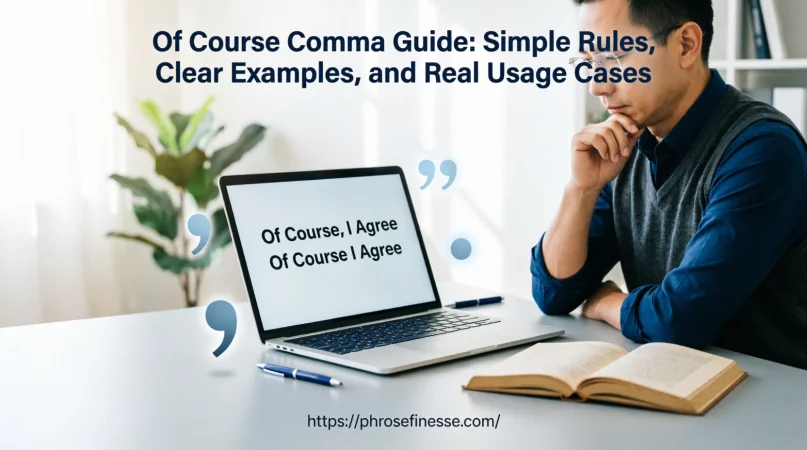
“Of Course” Easy Comma Guide and Examples shows why comma placement can feel tricky at first when you read a sentence aloud. The school of punctuation that says to stick a comma wherever you hear a pause can help, but it isn’t always enough. When you read aloud, hear how the first “of course” has a lack of pause, while the second “of course” creates an obvious pause.
Go back to the previous sentences and notice how the comma changes the rhythm. These two previous sentences make the difference between the first and second uses correct punctuation clear. This easy guide explains how commas work before and after the phrase, helping you understand comma placement without worry.
The article also shows why you shouldn’t subscribe to one school of thought without checking the sentence structure. Think about the phrase, its role, and whether it interrupts the sentence or fits naturally. A useful simple rule is to use punctuation according to meaning, usage, and sound, rather than relying on every pause.
In my writing, I find that checking the placement first helps prevent mistakes. The blog post can end by reminding you to check the comma before “of course” and comma after “of course” when needed. This guide supports avoiding and making mistakes, improving writing, and learning the relevant punctuation rules. It also explains when a comma or commas keep a sentence natural and punctuation clear, helping you avoid mistakes with confidence.
Quick Answer:
“Of course” does not always need a comma.
When it acts as an introductory or parenthetical expression, commas are often appropriate:
- Of course, I understand your concern.
- You can, of course, ask questions.
- She will be there, of course.
However, you can also write:
- Of course I understand your concern.
- Of course you can ask questions.
- Of course I will.
The choice can affect the sentence’s rhythm, emphasis, and conversational tone.
The Chicago Manual of Style explains that the comma after introductory “of course” is often optional. Setting the phrase off with a comma emphasizes “of course” itself. Omitting the comma can shift more emphasis toward the words that follow.
The easiest rule to remember
Think of “of course” as either an aside or an integrated part of the sentence.
| Use of “of course” | Example | Comma? |
| Introductory aside | Of course, I agree. | Commonly used |
| Integrated opening | Of course I agree. | Can be omitted |
| Parenthetical middle | I, of course, agree. | Usually set off |
| Integrated middle | I of course agree. | Possible in some contexts |
| Sentence ending | I agree, of course. | Often used |
| Standalone response | Of course! | No comma needed |
The important point is simple: don’t treat “of course” as a comma-triggering phrase in every sentence.
What Does “Of Course” Mean?
Before dealing with punctuation, it helps to understand the phrase itself.
“Of course” generally tells the reader that something is obvious, expected, accepted, or already understood. Cambridge Dictionary gives several uses, including referring to information known to the speaker and listener and giving permission.
For example:
Of course, the store is closed on Sunday.
Here, the speaker presents the store’s closing as something expected or obvious.
Compare that with:
Of course, you can borrow my book.
Here, “of course” expresses agreement or permission.
The phrase can also reinforce an obvious conclusion:
It was raining, so of course we took an umbrella.
In this sentence, “of course” connects the rain with an expected response.
That meaning matters because punctuation often follows function rather than the words alone.
When to Use a Comma After “Of Course”
“Of Course” at the Beginning of a Sentence
When “of course” introduces a sentence as a separate comment, a comma commonly follows it.
Examples:
- Of course, you can join us.
- Of course, I remember her.
- Of course, the deadline matters.
- Of course, we should check the figures first.
- Of course, nobody expected the meeting to last three hours.
The comma gives the reader a small break before the main statement.
You can think of it like opening a door before entering the main idea:
Of course, + main statement
The phrase announces the speaker’s attitude. The rest of the sentence delivers the information.
Why the comma works
In “Of course, I agree,” the phrase can stand apart from the main clause.
Remove it:
I agree.
The sentence remains complete.
That doesn’t automatically mean the comma is mandatory. Instead, it shows that “of course” can function as an additional comment.
The Canadian government’s English writing guidance similarly notes that short introductory expressions can sometimes appear without commas, while expressions used to mark transitions or personal comments are commonly set off.
Examples in context
With comma:
Of course, you deserve an explanation.
This presentation gives “of course” its own slight emphasis.
Without comma:
Of course you deserve an explanation.
This version feels more tightly connected and conversational.
Both can work. The intended rhythm matters.
When “Of Course” Does Not Need a Comma
“Of Course” as an Integrated Expression
Here’s where many grammar explanations become too rigid.
You don’t always need:
Of course, I know.
You can also write:
Of course I know.
The second version is particularly natural when the speaker wants to emphasize the entire thought.
For example:
Do you know how important this is?
Of course I know!
Adding a comma creates a different rhythm:
Of course, I know.
That version can sound more measured. It may also make “of course” feel like a separate response before the actual statement.
The Chicago Manual of Style directly addresses this distinction. It says that punctuation can change the emphasis, with the comma emphasizing “of course” while omission can emphasize the words that follow.
A useful comparison
Consider these two sentences:
Of course, you want to save money.
Of course you want to save money.
The first sentence places more weight on the speaker’s certainty or aside.
The second flows more naturally as one complete thought.
Neither construction should be treated as automatically wrong.
“Of Course” as a Parenthetical Expression
A parenthetical expression adds information or commentary without forming the essential grammatical structure of the sentence.
When “of course” works this way in the middle of a sentence, writers commonly set it off with two commas.
For example:
The answer is, of course, obvious.
Remove “of course”:
The answer is obvious.
The sentence still works.
That’s a strong clue that the phrase functions as an aside.
More examples include:
- She is, of course, welcome to stay.
- The results are, of course, important.
- You can, of course, change your password later.
- The company will, of course, review the proposal.
- This approach is, of course, not suitable for everyone.
The University of Twente’s English style guidance describes commas as a way to mark off optional “aside” material that isn’t essential to the main statement.
Don’t use only one comma
When you clearly set “of course” off as a parenthetical expression, use both commas.
Incorrect for a parenthetical construction:
You can, of course attend the meeting.
Better:
You can, of course, attend the meeting.
The first comma opens the parenthetical phrase. The second closes it.
This principle applies to many other interrupting expressions, too.
“Of Course” at the End of a Sentence
You can also place “of course” at the end of a sentence.
In that position, a comma often separates it from the main statement:
- You can come with us, of course.
- I remember him, of course.
- She knew the answer, of course.
- We’ll help you, of course.
- That’s what happened, of course.
The phrase works almost like a final nod from the speaker.
It’s similar to saying:
“That was obvious, naturally.”
But the comma isn’t an automatic requirement
Context can change the construction.
For example:
If that’s what you mean, well then of course.
Here, “of course” functions differently from a simple sentence-final parenthetical. The Chicago-style principle remains useful: punctuation depends on how the expression functions within the sentence.
So, don’t memorize “comma before final of course” as an absolute law.
“Of Course” in Direct Responses
Some of the most common examples appear in everyday conversation.
Permission
Can I use your phone?
Of course.
Here, “of course” stands alone. It doesn’t need a comma.
You could also write:
Of course!
The exclamation mark adds warmth or enthusiasm.
Cambridge Dictionary specifically identifies this use of “of course” as a way to give permission.
Agreement
You agree that we need more time?
Of course.
Again, no comma is necessary because the phrase stands alone.
Strong emphasis
Do you think I forgot?
Of course I didn’t!
Here, omitting the comma creates a strong, continuous expression.
Compare:
Of course, I didn’t.
This sounds calmer and more deliberate.
The difference isn’t merely cosmetic. Punctuation can shape the voice of the sentence.
“Of Course” With Questions
Questions require a little more care.
Consider:
You knew about the change, of course?
This sentence uses “of course” as a tag-like addition. The question mark applies to the entire sentence.
Another example:
Of course, you’re coming with us?
This can sound surprised or uncertain because the speaker isn’t simply stating that the person is coming.
Now compare:
Of course you’re coming with us!
That’s no longer a neutral question. It expresses strong expectation.
Why context matters
“Of course” can sometimes carry an unintended edge.
Cambridge Dictionary warns that using “of course” to answer a question about information the listener doesn’t already know can sound impolite. For example, answering an unfamiliar-information question with “Of course” may suggest that the question was foolish or unnecessary.
That matters in professional communication.
Instead of:
Of course. We had three meetings.
you might simply say:
Yes. We had three meetings.
The second response avoids implying that the answer should have been obvious.
“Of Course” With Exclamation Marks
When “of course” stands alone, an exclamation mark often works naturally:
Of course!
This is especially common when someone asks for permission.
Can I come along?
Of course!
The exclamation mark replaces the need for a comma because there isn’t another clause immediately following the phrase.
You can also combine the expression with a longer sentence:
Of course, I’ll help!
Here, the comma separates the introductory expression from the main clause.
The punctuation does two jobs:
- The comma separates the introductory phrase.
- The exclamation mark closes the entire sentence.
“Of Course” in Professional Writing
The phrase appears frequently in emails, workplace conversations, reports, and business communication.
For example:
Of course, we can review the proposal before Friday.
Or:
We can, of course, review the proposal before Friday.
Both are grammatical. Yet they don’t sound exactly alike.
The first version puts “of course” at the front. It feels direct and conversational.
The second inserts it into the sentence as a parenthetical comment. It sounds slightly more measured.
Business examples
Email response:
Of course, I’ll send the revised document this afternoon.
Client communication:
We can, of course, discuss the pricing options during the call.
Formal report:
The results are, of course, subject to further review.
Customer service:
Of course, we’d be happy to help.
Use the phrase thoughtfully, though. Repeating “of course” in every response can make your writing sound dismissive or overly certain.
“Of Course” in Formal Writing
Formal writing often benefits from precise punctuation.
Consider:
The policy is, of course, subject to change.
The commas clearly frame “of course” as an aside.
However, if the expression belongs closely to the statement, you can omit the commas:
Of course the policy may change over time.
The best choice depends on the intended emphasis and the surrounding prose.
A good editor doesn’t add commas simply because a phrase appears on a memorized list. Punctuation should clarify structure and meaning.
Common “Of Course” Comma Mistakes
Automatically Adding a Comma Every Time
One of the biggest mistakes is believing that “of course” always needs a comma.
That rule is too broad.
For example:
Of course, I understand.
is fine.
But:
Of course I understand!
is also fine.
Chicago’s guidance specifically rejects the idea that a comma must always follow “of course.”
Removing Every Comma
The opposite mistake causes problems, too.
Consider:
The answer is of course obvious.
This can be grammatically workable, but many readers will find the parenthetical version clearer:
The answer is, of course, obvious.
The commas make the phrase’s role immediately visible.
Using Only One Comma
When “of course” interrupts a sentence as a parenthetical, don’t use only one comma.
Avoid:
The answer is, of course obvious.
Use:
The answer is, of course, obvious.
The paired commas clearly mark the beginning and end of the aside.
Treating Every Introductory Phrase the Same Way
Not every short introductory expression follows an identical comma rule.
English punctuation often allows stylistic flexibility with short adverbial expressions. Canada’s language guidance notes that commas may be omitted after some short introductory adverbs or phrases when clarity doesn’t require them.
That is why rigid “always comma” rules can create more confusion than clarity.
Does the Comma Change the Meaning?
Sometimes the basic meaning stays the same, but the emphasis changes.
Compare:
Of course, I remember you.
with:
Of course I remember you.
The first version gives “of course” a little more separation.
The second version creates a stronger connection between the phrase and the statement.
Now consider:
Of course, she knew the answer.
This can sound like the speaker is commenting on the obviousness of her knowledge.
Compare:
Of course she knew the answer.
This can sound more emphatic. The entire statement receives the force of the expression.
Chicago’s guidance makes essentially this distinction: setting off “of course” can emphasize the phrase itself, while leaving out the comma can place more emphasis on what follows.
A simple way to hear the difference
Read these aloud:
Of course, I knew.
Pause slightly after “course.”
Now read:
Of course I knew.
Keep the phrase flowing into the rest.
That difference in rhythm often reveals which version better matches your intended voice.
See More :Comma Before “Like”: Explained for Beginners
A Practical Test for “Of Course” Commas
When you’re unsure, try these steps.
Remove “Of Course”
First, remove the phrase.
The meeting is, of course, tomorrow.
becomes:
The meeting is tomorrow.
If the sentence remains complete, “of course” may function as a parenthetical aside.
Try Brackets
Mentally replace the phrase with brackets:
The meeting is [of course] tomorrow.
If that sounds like an inserted comment, commas are often appropriate:
The meeting is, of course, tomorrow.
This test isn’t an absolute grammar rule. It’s a useful way to identify the phrase’s function.
Read the Sentence Aloud
Listen for the intended rhythm.
If you naturally pause after “of course,” a comma may represent that separation.
If the phrase flows directly into the following words, omitting the comma may work better.
Still, don’t rely on pauses alone. Punctuation isn’t simply a transcript of breathing. Sentence structure and meaning matter, too.
“Of Course” Comma Rules at a Glance
| Sentence | Recommended treatment | Why |
| Of course, I agree. | Comma commonly used | Introductory expression |
| Of course I agree. | No comma can work | Phrase integrates with statement |
| I, of course, agree. | Two commas | Parenthetical expression |
| I of course agree. | No commas possible | Integrated expression |
| I agree, of course. | Comma commonly used | Sentence-final aside |
| Of course! | No comma | Standalone response |
| Of course, I will! | Comma | Introductory expression |
| I will, of course. | Comma | Final parenthetical |
| Of course you can. | No comma possible | Strongly integrated response |
| You can, of course, come. | Two commas | Parenthetical interruption |
“Of Course” vs. “Certainly”
The two expressions overlap, but they don’t always create the same tone.
Compare:
Of course, we can help.
Certainly, we can help.
“Certainly” often sounds more formal or deliberate.
“Of course” can feel warmer and more conversational.
The punctuation follows the same broad principle: introductory usage can take a comma, while integrated usage may not require one.
“Of Course” vs. “Naturally”
“Naturally” can replace “of course” in some contexts:
Naturally, she was disappointed.
Of course, she was disappointed.
However, the tone differs slightly.
“Naturally” often presents something as an expected consequence. “Of course” can carry agreement, obviousness, permission, or shared knowledge.
That distinction becomes important in professional writing because tone can matter as much as grammar.
“Of Course” vs. “Obviously”
These expressions are even less interchangeable.
Of course, we need more time.
Obviously, we need more time.
The second sentence can sound more forceful. Depending on the context, “obviously” may suggest that anyone who disagrees has missed something clear.
“Of course” often sounds softer, although tone depends heavily on delivery and context.
For workplace communication, that nuance matters.
Case Study: Choosing the Right Version
Imagine a manager receives this message:
Can I submit the report tomorrow?
Here are three possible responses.
Warm and straightforward
Of course, you can submit it tomorrow.
This sounds natural and reassuring.
More measured
Of course, you can submit it tomorrow.
The comma creates a slight pause after “of course.”
Strong emphasis
Of course you can submit it tomorrow!
This version sounds more enthusiastic and emphatic.
Now imagine the employee asks:
Did the client approve the proposal?
Responding:
Of course.
could sound as though the answer should have been obvious.
A more neutral response would be:
Yes, the client approved it yesterday.
This small distinction illustrates why “of course” punctuation and usage cannot be separated completely from context.
Common Sentence Patterns You Can Copy
Introductory “Of Course”
- Of course, I understand your point.
- Of course, you can contact us again.
- Of course, the situation deserves attention.
- Of course, we need to verify the information.
- Of course, everyone has a different opinion.
Integrated “Of Course”
- Of course I understand your point.
- Of course you can contact us again.
- Of course she knew about the change.
- Of course we need to verify the information.
- Of course everyone wants a clear answer.
Parenthetical “Of Course”
- I, of course, understand your point.
- She is, of course, aware of the issue.
- We can, of course, discuss the matter later.
- The result was, of course, unexpected.
- They will, of course, receive an update.
Sentence-Final “Of Course”
- I understand, of course.
- You can stay, of course.
- She knew about it, of course.
- We’ll help, of course.
- That’s possible, of course.
A Few Style Tips for Better Writing
Punctuation solves only part of the problem. Word choice and tone matter, too.
If you use “of course” repeatedly, your writing may start to sound predictable.
For example:
Of course, we’ll help. Of course, we’ll respond. Of course, we’ll review it.
That repetition quickly becomes stale.
Instead, vary your phrasing when the meaning allows:
- Certainly, we’ll help.
- Yes, we’ll review it.
- Absolutely.
- We’d be happy to help.
- Naturally, we’ll keep you updated.
You don’t need to eliminate “of course.” Just give it room to work.
Final Rule: Don’t Memorize “Always” and “Never”
The safest rule for the comma after “of course” is this:
Use commas when “of course” functions as a parenthetical or clearly separated introductory comment. Omit the comma when the phrase is integrated into the sentence and the intended emphasis flows into what follows.
That rule explains why both of these can be correct:
Of course, I know the answer.
Of course I know the answer.
It also explains why this construction commonly uses two commas:
I, of course, know the answer.
And why this one commonly uses a comma before the phrase:
I know the answer, of course.
The goal isn’t to sprinkle commas around “of course.” The goal is to show the reader how the phrase functions.
When the expression acts like an aside, set it apart. When it belongs tightly with the statement, you can let it flow.
FAQs
1.Should you always put a comma after “of course”?
No. The comma depends on how “of course” functions in the sentence. If it works as an introductory or interrupting phrase, commas often separate it from the rest of the sentence.
2.Do you need a comma before “of course”?
Not always. A comma before “of course” may be needed when the phrase interrupts the sentence. However, some sentences use “of course” naturally without a comma.
3.Is “of course” always set off by commas?
No. “Of course” doesn’t always need commas. Its position, purpose, and relationship with the surrounding words determine the correct punctuation.
4.Can you use a comma after “of course” at the beginning?
Yes. When “of course” introduces a sentence as an aside or introductory expression, a comma after it is usually appropriate. For example: “Of course, you can join us.”
5.How can I tell if “of course” needs a comma?
Read the sentence aloud, then check its meaning and structure. A natural pause can help, but don’t rely on sound alone. Look at whether “of course” interrupts the main thought.
6.What is the easiest rule for punctuating “of course”?
Treat “of course” according to its role in the sentence. If it acts as an interruption or introductory expression, commas can separate it. If it fits directly into the sentence, commas may not be necessary.
Conclusion
Understanding comma placement with “of course” becomes easier when you look at the phrase’s role rather than simply listening for a pause. Sometimes commas separate it from the main thought, while other uses flow naturally without them.
When you’re unsure, read the sentence aloud and check its structure. Then consider whether “of course” adds an interruption or forms part of the sentence’s natural flow. With practice, these punctuation choices will become much easier to spot.

Emma Brooke is an English language specialist, editor, and content writer at Phrase Finesse, where she helps readers develop stronger writing and communication skills through clear, practical, and engaging content. With a passion for the English language, she specializes in simplifying grammar rules, vocabulary, spelling, punctuation, and word usage for learners at every level.
Emma has extensive experience creating educational content that is accurate, well-researched, and easy to understand. She is particularly skilled at explaining confusing word pairs, grammar concepts, idioms, sentence structure, and effective writing techniques, making complex topics approachable for students, professionals, educators, and English learners worldwide.