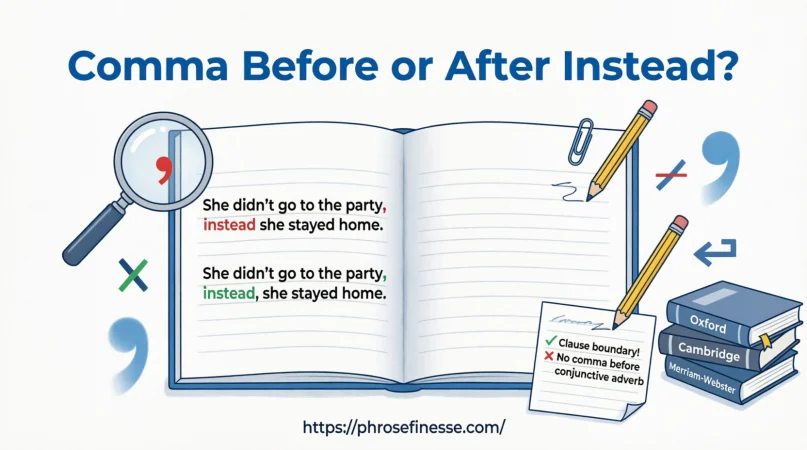
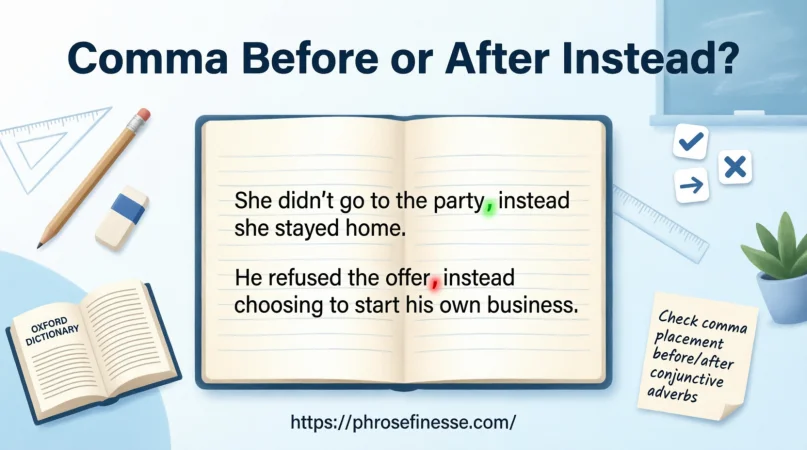
Have you ever stopped mid-sentence and wondered whether a comma should come before or after “instead”? It’s a surprisingly common punctuation question, especially in professional and everyday writing.
This Comma Before Or After “Instead”? Easy Guide will help you understand the correct placement of commas, avoid common mistakes, and improve your grammar, English usage, and overall writing clarity.
Correct punctuation plays a key role in formal writing, business communication, emails, reports, and digital content.
Whether you are discussing scheduling, time management, online booking, meetings, broadcasting, calendar updates, or project management tasks, knowing how to punctuate words like “instead” can make your message more precise and professional. Small punctuation choices often have a big impact on readability and meaning.
In this guide, you’ll learn when to place a comma before “instead,” when a comma belongs after it, and when no comma is needed at all.
We’ll break down the rules with clear explanations, practical examples, and common usage patterns. By the end, you’ll have greater consistency in your writing and a stronger understanding of how “instead” functions in different sentence structures.
Do You Need a Comma Before or After “Instead”?
The short answer is: it depends on how “instead” functions in the sentence.
There isn’t one universal punctuation rule that applies to every use of the word. The correct comma placement depends on:
- The position of instead
- The sentence structure
- Whether it interrupts the sentence
- Whether it acts as an introductory element
- Whether it forms part of the phrase instead of
Here’s a quick overview.
| Position of “Instead” | Comma Usage | Example |
| Beginning | Usually after | Instead, we stayed home. |
| Middle | Sometimes before and after | We decided, instead, to wait. |
| End | Usually no comma | We stayed home instead. |
| Before “instead of” | Usually none | We walked instead of driving. |
| Parenthetical use | Often both sides | She chose, instead, to leave early. |
The key principle is simple:
Use commas when “instead” creates a pause or interruption. Skip commas when it flows naturally as part of the sentence.
What Does “Instead” Mean?
Before discussing punctuation, it helps to understand what instead actually does.
Instead means:
- As an alternative
- In place of something else
- Rather than another option
- As a substitute
It signals a replacement or contrast between two choices.
Examples
- We ordered pizza instead.
- She stayed home instead of traveling.
- Instead, they chose a different solution.
- The company expanded overseas instead.
In every example, one action replaces another.
Think of instead as a linguistic road sign. It tells readers:
“Don’t go down that path. Take this one instead.”
Comma After “Instead” at the Beginning of a Sentence
One of the most common uses occurs when instead begins a sentence.
The Rule
When instead introduces the entire sentence, place a comma after it.
Examples
- Instead, we postponed the meeting.
- Instead, she accepted a different offer.
- Instead, the team focused on customer retention.
- Instead, they invested the money in research.
The comma signals that instead functions as an introductory adverb.
Why the Comma Matters
Without the comma, readers may stumble.
Compare:
❌ Instead we postponed the meeting.
✅ Instead, we postponed the meeting.
The second version creates a natural pause and improves readability.
Professional Writing Examples
Business emails frequently use this structure:
The original plan was canceled. Instead, we’ll launch the campaign next month.
Academic writing also favors the introductory comma:
Previous researchers reached different conclusions. Instead, this study focuses on behavioral factors.
Quick Tip
Whenever instead starts a sentence, ask yourself:
“Would I naturally pause after saying it aloud?”
The answer is almost always yes.
Comma Before “Instead” in the Middle of a Sentence
Things become more interesting when instead appears in the middle of a sentence.
When Commas Are Needed
If instead interrupts the sentence as a parenthetical expression, surround it with commas.
Examples
- We decided, instead, to continue the project.
- The company, instead, expanded into international markets.
- The committee, instead, voted to delay the decision.
Here, the sentence remains grammatically complete even if you remove instead.
Example:
- We decided to continue the project.
Because the word interrupts rather than forms an essential part of the structure, commas help mark that interruption.
Why Writers Use This Construction
Middle-position instead adds emphasis.
Compare:
- We decided to continue the project instead.
- We decided, instead, to continue the project.
The second version places more attention on the alternative choice.
When Commas Improve Readability
Long sentences often benefit from parenthetical commas.
Example:
- The marketing department, instead, focused its resources on customer loyalty programs and retention strategies.
Without commas, the sentence feels less balanced.
Using “Instead” Without Commas
Many sentences don’t require any commas around instead.
In fact, this is one of the most common uses in everyday English.
Examples
- I’ll drive instead.
- Use this method instead.
- She chose tea instead.
- They stayed home instead.
In these examples, instead directly modifies the action.
No interruption occurs.
No pause is needed.
No comma belongs there.
Why Many Writers Make Mistakes
Some people assume that every transition word requires punctuation.
That’s not true.
Unlike words such as however or therefore, instead often integrates naturally into the sentence.
Correct vs. Incorrect
| Incorrect | Correct |
| I’ll drive, instead. | I’ll drive instead. |
| Use this method, instead. | Use this method instead. |
| She stayed home, instead. | She stayed home instead. |
When instead appears naturally at the end of a sentence, commas are usually unnecessary.
Comma Before “Instead Of”
The phrase instead of follows different rules.
Understanding “Instead Of”
Instead of functions as a prepositional phrase.
Examples:
- We walked instead of driving.
- She chose coffee instead of tea.
- They invested instead of spending.
In these sentences, the phrase directly connects two alternatives.
Standard Rule
Do not place a comma before instead of.
Correct:
- He bought apples instead of oranges.
- We worked instead of relaxing.
- She studied instead of watching television.
Incorrect:
- He bought apples, instead of oranges.
- We worked, instead of relaxing.
Why No Comma Is Needed
The phrase forms an essential part of the sentence.
Removing it changes the meaning.
Therefore, commas are unnecessary.
Comma After “Instead Of”
Most of the time, you won’t place a comma after instead of either.
Correct Examples
- Instead of buying a new car, she repaired the old one.
- Instead of arguing, they discussed the issue calmly.
- Instead of quitting, he improved his strategy.
Notice something important here.
The comma isn’t actually separating instead of.
It’s separating the introductory phrase from the main clause.
Formula
Introductory phrase + comma + main clause
Example:
- Instead of driving, we walked.
The comma follows the entire introductory phrase.
Incorrect Usage
❌ Instead of, driving we walked.
❌ Instead of, buying a new laptop she upgraded the existing one.
These constructions interrupt the phrase unnecessarily.
“Instead” at the End of a Sentence
Ending a sentence with instead is extremely common.
Examples
- I’ll stay home instead.
- Use the newer version instead.
- They hired an expert instead.
- We chose quality instead.
Should You Add a Comma?
Usually, no.
The word fits naturally into the sentence.
Compare
Incorrect:
- I’ll stay home, instead.
Correct:
- I’ll stay home instead.
The second version sounds smoother because the adverb remains attached to the action it modifies.
Rare Exceptions
A comma might appear if additional punctuation or unusual sentence structure requires it.
For example:
- We could have expanded overseas; instead, we focused on local markets.
Here, the comma follows introductory instead, not sentence-ending instead.
See More: Of Course Comma Guide: Rules & Examples
“Instead” Between Two Independent Clauses
This is where many punctuation mistakes occur.
Important Fact
Instead is not a coordinating conjunction.
Words such as:
- and
- but
- so
- yet
- or
can connect independent clauses.
Instead cannot.
Incorrect Example
❌ We planned to travel, instead we stayed home.
This creates a comma splice.
Correct Option: Period
✅ We planned to travel. Instead, we stayed home.
Correct Option: Semicolon
✅ We planned to travel; instead, we stayed home.
Correct Option: Rewrite
✅ Rather than traveling, we stayed home.
Why This Matters
Comma splices weaken professional writing.
Editors routinely correct them because they disrupt sentence structure.
Common Mistakes With “Instead” and Commas
Understanding mistakes can often teach grammar faster than memorizing rules.
Adding Unnecessary Commas
Incorrect:
- I’ll call tomorrow, instead.
Correct:
- I’ll call tomorrow instead.
Why It’s Wrong
The comma creates a pause that doesn’t belong.
Forgetting the Introductory Comma
Incorrect:
- Instead we hired a consultant.
Correct:
- Instead, we hired a consultant.
Why It’s Wrong
Readers expect a pause after introductory adverbs.
Confusing “Instead” and “Instead Of”
Incorrect:
- We stayed home, instead of.
Correct:
- We stayed home instead.
- We stayed home instead of traveling.
Why It’s Wrong
The phrase remains incomplete.
Creating Comma Splices
Incorrect:
- The plan failed, instead we created a new one.
Correct:
- The plan failed. Instead, we created a new one.
Correct:
- The plan failed; instead, we created a new one.
Real-World Examples From Everyday Writing
Grammar becomes easier when you see it in action.
Business Communication
Correct:
Sales declined during the first quarter. Instead, management focused on customer retention.
Correct:
The company postponed expansion instead.
Why It Works
The punctuation creates clarity while maintaining a professional tone.
Academic Writing
Correct:
Earlier studies focused on demographics. Instead, this research examines consumer behavior.
Academic writers frequently place instead at the beginning of a sentence because it clearly signals contrast.
Marketing Content
Correct:
Rather than reducing prices, the company improved product quality instead.
This structure emphasizes the chosen alternative.
Everyday Conversation
Examples:
- I’ll order pasta instead.
- Instead, let’s try something different.
- We stayed home instead of going out.
These patterns appear constantly in spoken English.
Style Guide Recommendations
Major style guides generally agree on one principle:
Punctuation should improve clarity, not create unnecessary pauses.
Professional editors typically focus on:
- Readability
- Consistency
- Natural rhythm
- Grammatical correctness
Editorial Preference
Most editors prefer:
✅ Instead, we chose another option.
Over:
❌ Instead we chose another option.
They also prefer:
✅ I’ll choose the second option instead.
Over:
❌ I’ll choose the second option, instead.
The goal is always smooth reading.
Quick Reference Chart for Comma Before or After “Instead”
| Situation | Comma Needed? | Example |
| Beginning of sentence | Yes, after | Instead, we left early. |
| Middle interruption | Usually both sides | We chose, instead, to wait. |
| End of sentence | Usually no | I’ll stay home instead. |
| Before “instead of” | Usually no | Tea instead of coffee. |
| After introductory “instead of” phrase | Yes | Instead of driving, we walked. |
| Between independent clauses | Use semicolon or period | We planned to travel; instead, we stayed home. |
How to Decide Whether “Instead” Needs a Comma
If you’re unsure, use this simple three-step method.
Identify the Position
Ask:
- Beginning?
- Middle?
- End?
Position often reveals the answer immediately.
Check Whether It Interrupts the Sentence
Can you remove instead without damaging the grammar?
Example:
- We decided, instead, to wait.
Removing instead still leaves:
- We decided to wait.
That means commas may be appropriate.
Read the Sentence Aloud
Your ear often catches punctuation issues.
If a natural pause occurs, a comma may help.
If no pause exists, skip the comma.
Example
Read aloud:
- I’ll take the train instead.
No pause.
No comma.
Read aloud:
- Instead, I’ll take the train.
Natural pause.
Comma needed.
Practical Sentence Transformations
Understanding patterns helps you recognize correct punctuation faster.
| Incorrect Sentence | Correct Sentence |
| Instead we stayed home. | Instead, we stayed home. |
| We planned a vacation, instead we renovated the house. | We planned a vacation; instead, we renovated the house. |
| I’ll use this option, instead. | I’ll use this option instead. |
| We drove, instead of flying. | We drove instead of flying. |
| Instead of driving we walked. | Instead of driving, we walked. |
Memory Trick for Using Commas With “Instead”
Remember this simple phrase:
Beginning = comma.
Interruption = commas.
Ending = usually no comma.
This rule won’t cover every sentence ever written, but it correctly handles the vast majority of situations you’ll encounter.
FAQs
1. Do you always need a comma before “instead”?
No. A comma before “instead” depends on how the word functions in the sentence. If “instead” introduces a contrasting idea or acts as an interrupter, a comma is often needed. However, when it naturally flows within the sentence, no comma may be required.
Example:
- I decided to stay home instead of going out. ❌ No comma needed.
- I didn’t take the train; I drove instead. ✅ Comma or semicolon may be appropriate depending on sentence structure.
2. When should you put a comma after “instead”?
Use a comma after “instead” when it appears at the beginning of a sentence as an introductory word or phrase.
Example:
- Instead, we postponed the meeting until next week.
- Instead, the company chose a different strategy.
3. Can “instead” be used without any commas?
Yes. Many sentences use “instead” without commas, especially when it is part of the phrase “instead of.”
Example:
- She chose tea instead of coffee.
- We used an online calendar instead of a paper planner.
4. Is “instead of” treated differently from “instead”?
Yes. The phrase “instead of” usually does not require commas unless the surrounding sentence structure calls for them.
Example:
- They scheduled a virtual meeting instead of an in-person session.
- He focused on time management instead of multitasking.
5. Does comma placement around “instead” affect meaning?
Sometimes. Incorrect comma placement can make a sentence sound awkward or change the intended emphasis. Proper punctuation improves clarity, readability, and professional communication.
Example:
- Instead, we launched the project early.
- We launched the project early instead.
Both are correct but place emphasis differently.
6. Is using commas with “instead” important in formal writing?
Absolutely. Correct punctuation helps maintain professionalism and consistency in business communication, academic writing, reports, and other forms of formal writing. It ensures readers understand your intended meaning without confusion.
Conclusion
Understanding where to place a comma with “instead” is easier once you know its role in a sentence. In general, use a comma after “instead” when it begins a sentence, consider a comma before “instead” when it introduces a contrasting thought, and use no comma when it appears naturally within phrases such as “instead of.”
Mastering this small but important punctuation rule strengthens your grammar, improves English usage, and helps you write with greater clarity, consistency, and confidence. Whether you are drafting emails, handling business communication, managing project management documents, or writing everyday messages, correct comma placement ensures your ideas are communicated effectively.