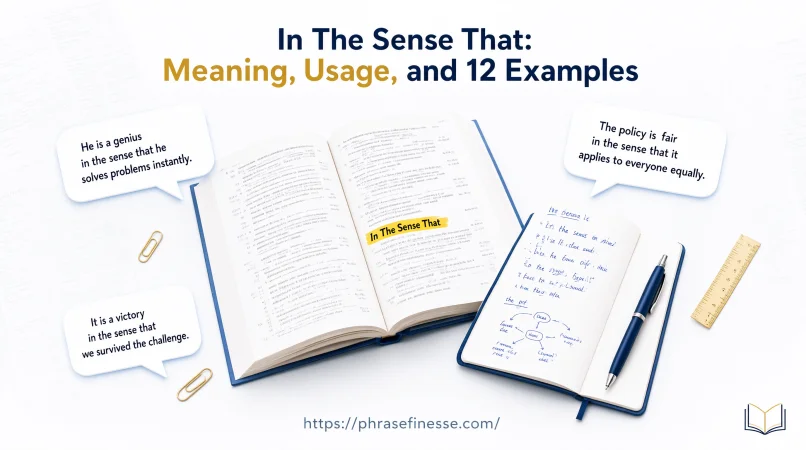
Have you ever used “in the sense that” and wondered whether you’re using it correctly? Understanding In The Sense That: Meaning, Usage, and 12 Examplescan help you express ideas with greater precision, especially when explaining what you mean by a particular statement.
This phrase often appears in formal writing, business communication, academic discussions, and everyday English usage. Although it looks simple, its meaning can shift slightly depending on the context and the relationship between two ideas.
In most cases, “in the sense that” introduces a specific explanation, qualification, or interpretation of a previous statement. It helps you clarify how something is true without completely restating your original idea.
You might encounter it while discussing scheduling, time management, meetings, project management, or even online booking and broadcasting. Learning how the phrase connects ideas can strengthen your grammar, improve sentence flow, and help you communicate more consistently.
In this guide, you’ll discover the meaning and correct usage of “in the sense that,” along with 12 clear example sentences. We’ll explain how the phrase works, where it fits naturally, and how to avoid common usage mistakes.
Whether you’re improving your English for professional communication, academic writing, or everyday conversations, these examples will give you a practical understanding you can apply immediately.
In The Sense That Meaning: What Does “In The Sense That” Mean?
The phrase “in the sense that” means “meaning that,” “because of the particular way something is true,” or “according to a specific interpretation.”
People use this expression when they want to explain one specific aspect of an idea rather than describe the entire situation.
Think of it like adjusting a camera lens. A broad statement shows the whole picture, while “in the sense that” zooms in on one detail.
Example:
“The restaurant was successful in the sense that it attracted many new customers.”
This sentence does not necessarily mean the restaurant made a huge profit, received perfect reviews, or became famous.
It only explains one measure of success:
- It attracted new customers.
The phrase narrows the meaning and prevents confusion.
Simple Definition of “In The Sense That”
| Phrase | Meaning |
| In the sense that | In the specific way that something is true |
| Meaning that | Explaining what something means |
| Because | Giving a reason why something happened |
| In terms of | Looking at one particular category or area |
The expression focuses on interpretation.
When you use it, you are basically saying:
“This statement is true, but let me explain exactly what I mean.”
Breaking Down the Phrase “In The Sense That”
Understanding each word makes the expression easier.
| Word | Function | Meaning |
| In | Preposition | Within a particular condition or way |
| The | Article | Refers to a specific idea |
| Sense | Noun | Meaning, interpretation, or understanding |
| That | Connector | Introduces the explanation |
The important word here is “sense.”
A sense is not only one of the five abilities humans have, such as sight or hearing. In English, sense also means:
- Meaning
- Understanding
- Interpretation
- Importance
- Reason
Examples of different meanings of “sense”:
Physical meaning:
“My sense of smell is very strong.”
Meaning:
- Ability to smell.
Interpretation meaning:
“I understand the sense of your argument.”
Meaning:
- I understand your meaning.
Specific explanation meaning:
“The plan worked in the sense that we saved money.”
Meaning:
- The plan worked according to one specific result.
Why Do People Use “In The Sense That”?
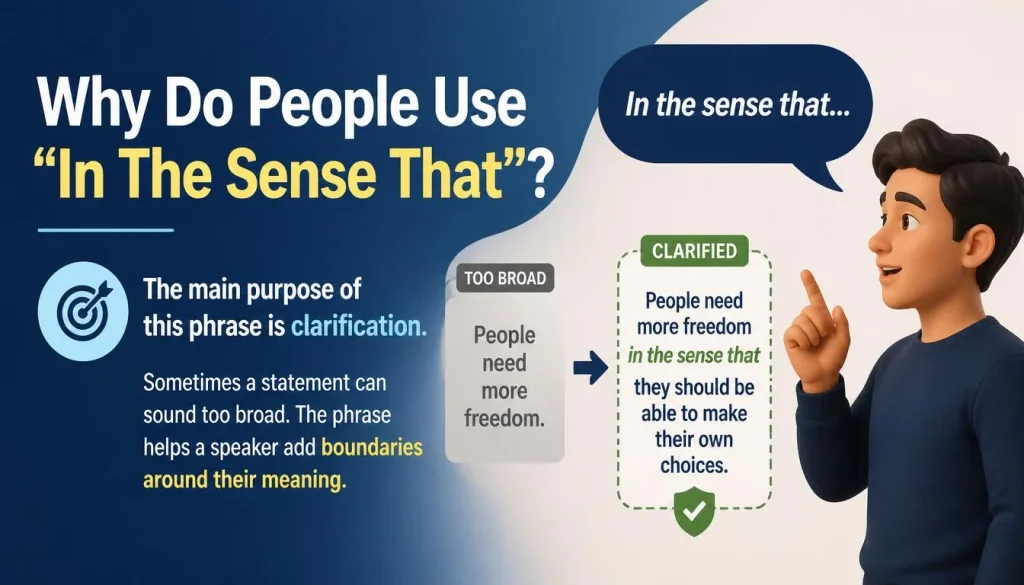
The main purpose of this phrase is clarification.
Sometimes a statement can sound too broad. The phrase helps a speaker add boundaries around their meaning.
For example:
“He is successful.”
This statement raises questions:
- Is he financially successful?
- Is he happy?
- Is he respected?
- Has he achieved his goals?
Now compare:
“He is successful in the sense that he built a profitable company.”
The second sentence gives a clearer meaning.
The success refers specifically to business achievement.,
When Should You Use “In The Sense That”?
The phrase works best in situations where you need to explain, qualify, or define an idea.
Using “In The Sense That” to Explain a Specific Meaning
One of the most common uses is explaining what you mean by a statement.
Example:
“The book was educational in the sense that it introduced readers to different cultures.”
The speaker is not saying the book taught every possible subject.
The educational value came from one specific feature:
- Learning about cultures.
This usage appears often in:
- Reviews
- Essays
- Academic writing
- Discussions
Using “In The Sense That” to Add a Qualification
Sometimes something is true, but only under certain conditions.
The phrase allows you to acknowledge that limitation.
Example:
“The project was successful in the sense that it increased public awareness, although it did not increase sales.”
Here, the speaker gives a balanced view.
The project succeeded in one area:
✅ Awareness increased
However, it failed in another:
❌ Sales did not improve
This makes the statement more precise.
Using “In The Sense That” to Define an Idea
The phrase also helps explain abstract concepts.
Example:
“Freedom is important in the sense that people need the ability to make personal choices.”
Freedom can mean many things.
The sentence focuses on one interpretation:
- Personal decision-making.
This makes complex ideas easier to understand.
In The Sense That Grammar Structure
The most common structure looks like this:
Formula:
Statement + in the sense that + explanation
Examples:
“The device is innovative in the sense that it uses artificial intelligence to solve problems.”
“She is generous in the sense that she always helps others.”
“The decision was reasonable in the sense that it reduced unnecessary costs.”
How “In The Sense That” Works in a Sentence
The phrase usually connects:
- A general statement
- A specific explanation
Structure Example:
General idea:
“The training was useful.”
Specific explanation:
“It improved employee communication.”
Combined:
“The training was useful in the sense that it improved employee communication.”
The second part explains the first part.
12 Example Sentences Using “In The Sense That”
Example: Work and Career
“The job is flexible in the sense that employees can choose their working hours.”
Explanation:
The word flexible could mean many things.
The sentence explains that flexibility comes from:
- Choosing work schedules
- Managing time independently
It does not necessarily mean employees can work from anywhere or change every company rule.
See More : Does Not vs. Do Not: The Correct Usage Guide
Example: Education
“The course was valuable in the sense that it improved my writing skills.”
Explanation:
The course had value because it created a specific benefit:
- Better writing ability
The sentence does not claim the course improved every area of learning.
Example: Technology
“The smartphone was revolutionary in the sense that it changed how people communicate.”
Explanation:
The revolution refers to communication changes.
The sentence highlights one major impact rather than every feature of the device.
Example: Relationships
“She is supportive in the sense that she always listens when people need advice.”
Explanation:
Support can appear in many forms.
Here, support means:
- Listening
- Providing emotional encouragement
Example: Business
“The marketing campaign was successful in the sense that it increased brand recognition.”
Explanation:
Success does not always mean higher revenue.
In this example, success means:
- More people recognized the brand.
Example: Personal Growth
“The experience was challenging in the sense that it forced me to leave my comfort zone.”
Explanation:
The difficulty came from personal development.
The sentence explains what made the experience challenging.
Example: Travel
“The trip was affordable in the sense that we spent very little money on transportation.”
Explanation:
The word affordable can refer to many things:
- Hotel prices
- Food expenses
- Activities
- Transportation
In this sentence, the speaker explains that affordability mainly came from low transportation costs.
The phrase helps avoid a misunderstanding. Someone might assume the entire trip was cheap, but the sentence only refers to one specific area.
Example: Health
“The treatment was effective in the sense that it reduced the patient’s symptoms.”
Explanation:
The word effective does not always mean a complete cure.
Here, effectiveness means:
- Symptoms became less severe.
- The patient experienced improvement.
The phrase creates a more accurate explanation.
Example: Literature
“The novel is historical in the sense that it reflects real events from the past.”
Explanation:
A historical novel may not describe every event exactly as it happened.
Instead, this sentence explains that the book connects with history because it includes:
- Real events
- Historical settings
- Past experiences
Example: Personality
“He is confident in the sense that he trusts his own decisions.”
Explanation:
Confidence can appear in different ways.
Some people show confidence through:
- Speaking openly
- Taking risks
- Leading others
In this sentence, confidence means trusting personal judgment.
Example: Communication
“The message was clear in the sense that everyone understood the main idea.”
Explanation:
A message can be clear because:
- It uses simple words.
- It has good organization.
- It explains details.
Here, clarity refers specifically to understanding the main point.
Example: Daily Life
“My hometown is quiet in the sense that there is very little traffic.”
Explanation:
Quiet does not always mean completely silent.
The speaker defines quiet in a specific way:
- Fewer vehicles
- Less road noise
- A slower environment
In The Sense That vs. Similar Expressions
Many English learners confuse “in the sense that” with other phrases that seem similar.
Although these expressions overlap, they do not always work in the same situations.
Understanding the differences will help you choose the right phrase.
In The Sense That vs. Meaning That
Both expressions explain an idea, but they have slightly different purposes.
| Phrase | Main Purpose | Example |
| In the sense that | Explains one specific interpretation | “The plan worked in the sense that it saved time.” |
| Meaning that | Gives a direct explanation or result | “The plan worked, meaning that we finished early.” |
Compare:
“The movie was successful in the sense that it received positive reviews.”
This focuses on one measurement of success.
Positive reviews = the specific sense of success.
Now:
“The movie was successful, meaning that many people enjoyed it.”
This simply explains what success means.
In The Sense That vs. Because
Many people think these phrases are interchangeable, but they serve different purposes.
“Because” Gives a Reason
Example:
“I stayed home because I was sick.”
The reason is illness.
Simple and direct.
“In The Sense That” Explains Interpretation
Example:
“The vacation was relaxing in the sense that we had no strict schedule.”
The phrase does not explain why the vacation happened.
Instead, it explains why the vacation can be described as relaxing.
Quick Comparison Table
| Phrase | Purpose | Example |
| Because | Gives a cause | “She left because she was tired.” |
| In the sense that | Explains a specific meaning | “She was successful in the sense that she achieved her goal.” |
In The Sense That vs. In Terms Of
These phrases sometimes appear similar, but they highlight different ideas.
“In Terms Of” Focuses on a Category
Example:
“The company improved in terms of customer service.”
This means customer service is the area being discussed.
“In The Sense That” Focuses on Meaning
Example:
“The company improved in the sense that customers received faster responses.”
This explains what improvement means.
Is “In The Sense That” Formal or Informal?
The phrase works in both formal and informal situations.
However, you will see it more often in careful explanations rather than casual conversations.
Common Places You’ll Find It:
- Academic essays
- Research papers
- Business reports
- Presentations
- Interviews
- Professional discussions
- Opinion articles
Example in Academic Writing:
“The study was successful in the sense that it provided new information about consumer behavior.”
Example in Conversation:
“I’m lucky in the sense that I have friends who support me.”
Both examples sound natural.
Common Mistakes When Using “In The Sense That”
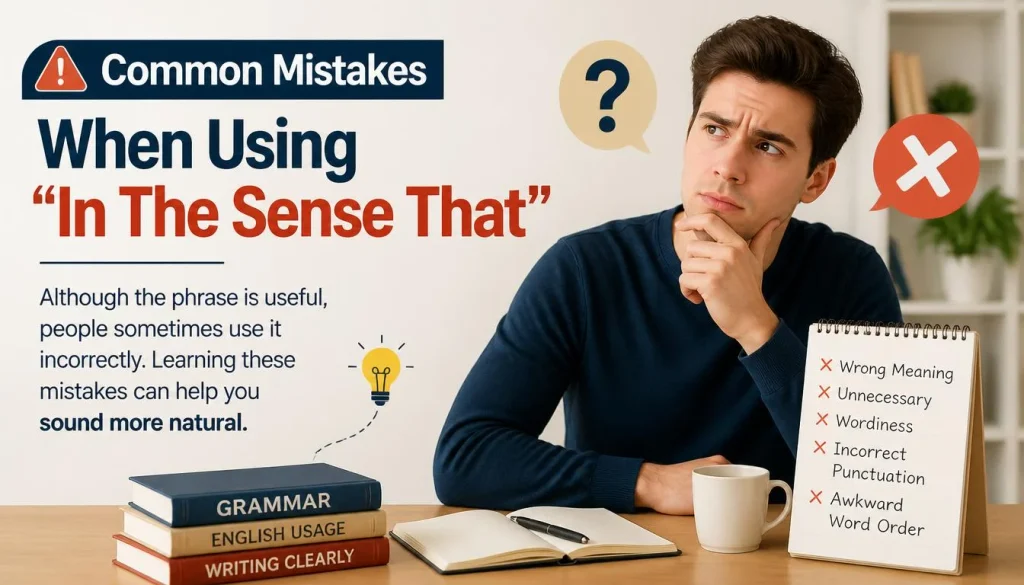
Although the phrase is useful, people sometimes use it incorrectly.
Learning these mistakes can help you sound more natural.
Mistake: Ending the Phrase Without an Explanation
Incorrect:
“The decision was good in the sense that.”
This sentence feels incomplete.
Why?
Because the reader expects an explanation after “that.”
Correct:
“The decision was good in the sense that it helped everyone save time.”
The explanation completes the idea.
Mistake: Using It When a Simpler Word Works Better
Sometimes writers use “in the sense that” when they only need a basic connector.
Example:
Unnatural:
“I was tired in the sense that I needed sleep.”
Better:
“I was tired because I needed sleep.”
Why?
The second sentence sounds more natural because it gives a direct reason.
Mistake: Making the Phrase Too Complicated
Some writers create overly long sentences with this expression.
Example:
“The system was beneficial in the sense that it provided multiple advantages that were valuable in different areas of organizational improvement.”
This sounds heavy.
A clearer version:
“The system was beneficial in the sense that it improved workplace efficiency.”
Simple writing often communicates better.
Mistake: Confusing “In The Sense That” With “In Any Sense”
These phrases have different meanings.
In The Sense That
Means:
- In one specific way
- According to one interpretation
Example:
“The idea was practical in the sense that it saved money.”
In Any Sense
Means:
- In any possible way
- Under any interpretation
Example:
“The plan was not successful in any sense.”
Meaning:
The plan failed completely.
Can You Start a Sentence With “In The Sense That”?
Yes, but it is less common.
Most people place the phrase after a main statement.
Natural:
“The project was successful in the sense that it improved teamwork.”
Less common:
“In the sense that it improved teamwork, the project was successful.”
The second version is grammatically correct, but it sounds more formal.
You may see this structure in:
- Academic writing
- Analytical articles
- Formal discussions
Alternatives to “In The Sense That”
Sometimes another phrase may sound clearer.
Here are useful alternatives:
| Alternative | When to Use It | Example |
| Meaning that | When explaining directly | “The rule changed, meaning that everyone had to adjust.” |
| In other words | When simplifying an idea | “The project failed. In other words, it did not reach its goal.” |
| Specifically | When highlighting details | “The program helps, specifically by improving communication.” |
| Because | When giving a reason | “The event mattered because it brought people together.” |
| In terms of | When discussing a category | “The company improved in terms of customer service.” |
Real-Life Case Study: How “In The Sense That” Improves Communication
Imagine a manager saying:
“The new training program was successful.”
Employees may wonder:
- Did productivity increase?
- Did employees enjoy it?
- Did sales improve?
- Did mistakes decrease?
The statement is too broad.
Now consider:
“The new training program was successful in the sense that it reduced workplace errors by 30%.”
The second statement is stronger because it defines success.
It gives:
- A measurement
- A specific outcome
- A clearer interpretation
This is why professionals often use phrases like “in the sense that” when explaining results.
FAQs
1. What does “in the sense that” mean?
“In the sense that” means “in the particular way that” or “in the specific respect that.” You use it to clarify or explain the exact meaning of a previous statement. It often introduces a reason, qualification, or specific interpretation.
Example:
The project was successful in the sense that we completed it on time.
2. Is “in the sense that” grammatically correct?
Yes, “in the sense that” is grammatically correct and widely used in English. It works particularly well when you want to explain how a statement should be understood. You’ll commonly find it in formal writing, academic English, professional communication, and everyday speech.
3. What is another way to say “in the sense that”?
Depending on the context, you can replace “in the sense that” with phrases such as “in the way that,” “in the respect that,” “meaning that,” “because,” or “specifically because.” However, these alternatives don’t always have exactly the same meaning, so choose one that fits your sentence naturally.
4. Can you use “in the sense that” in formal writing?
Yes. “In the sense that” works well in formal and professional writing because it allows you to qualify an idea precisely. It can make complex explanations easier to understand without repeating the original statement.
Example:
The policy is effective in the sense that it reduces unnecessary administrative work.
5. What comes after “in the sense that”?
A clause usually follows “in the sense that.” This clause explains the particular meaning, condition, or respect being discussed.
Example:
The meeting was productive in the sense that we reached an agreement.
Here, “we reached an agreement” explains the specific sense in which the meeting was productive.
6. Is “in the sense that” the same as “meaning that”?
They can sometimes communicate a similar idea, but they aren’t always interchangeable. “Meaning that” often introduces a direct explanation or consequence, while “in the sense that” usually specifies the particular way in which something is true.
Example:
The plan worked in the sense that everyone followed it.
This sentence focuses on the specific respect in which the plan worked.
Conclusion
Understanding “in the sense that” becomes much easier once you recognize its purpose. The phrase helps you clarify, qualify, or specify an idea without repeating your entire statement. It’s especially useful when you need to explain the particular way something is true.
As the examples in this guide show, “in the sense that” fits naturally into formal writing, professional communication, academic English, and everyday conversations. Pay attention to the clause that follows it, and make sure that clause clearly explains the intended sense.
With regular practice, you’ll be able to use “in the sense that” confidently and naturally. The key is simple: use it when you want to tell your reader or listener exactly in what respect your statement is true.

Alyan Ashraf is an English language writer and editor at Phrase Finesse, where he specializes in grammar, vocabulary, spelling, word usage, and clear communication. Passionate about the English language, he creates practical, research-backed content that helps readers avoid common mistakes and write with greater accuracy and confidence.
Known for his clear writing style and attention to detail, Alyan simplifies complex language topics into easy-to-understand guides filled with real-world examples and actionable insights. His work covers confusing word pairs, grammar rules, idioms, punctuation, and everyday English usage, making learning both accessible and engaging for students, professionals, writers, and non-native English speakers.
Every article Alyan writes is carefully researched, fact-checked, and designed to meet high editorial standards. His goal is to help readers strengthen their English skills, expand their vocabulary, and communicate more effectively in academic, professional, and everyday settings.
Through Phrase Finesse, Alyan is committed to publishing trusted language resources that make mastering English simpler, clearer, and more enjoyable for learners around the world