Have you ever wondered whether someone should say “recommend me” or “recommend to me” in everyday conversation and professional writing? The distinction may seem small, but understanding “Recommend Me” vs. “Recommend To Me”: Which Is Correct? can improve your English usage, strengthen your grammar, and help you communicate with greater consistency.
These phrases frequently appear in emails, workplace discussions, and casual conversations, making it important to know which form sounds natural in different contexts.
Choosing the correct expression is especially valuable in modern business communication, where clarity matters. Whether you are discussing project management tools, asking for suggestions during meetings, managing a calendar, improving time management, or requesting advice about online booking platforms, the wording you choose can affect how professional and polished your message sounds.
Small grammar choices often make a noticeable difference in formal writing and professional interactions.
In this guide, you will learn the key differences between “recommend me” and “recommend to me”, discover when each phrase is appropriate, and explore practical examples that reflect real-world communication.
From workplace conversations and scheduling discussions to recommendations in broadcasting and customer service settings, these examples will help you use both expressions accurately and confidently in any situation.
Quick Answer:
Here’s the short version.
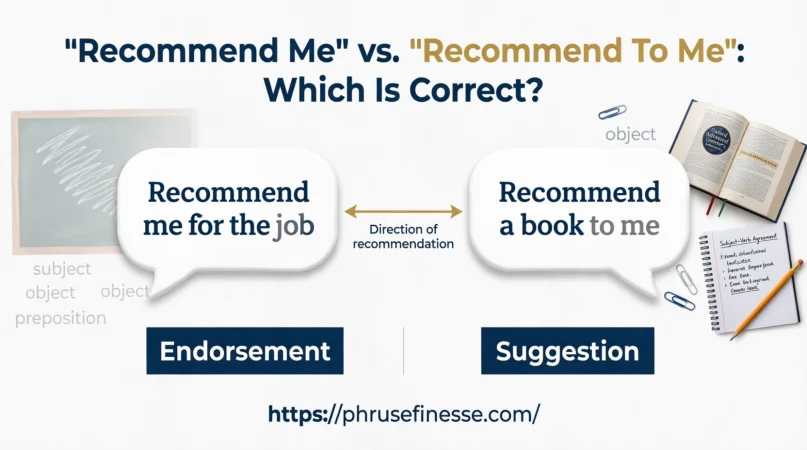
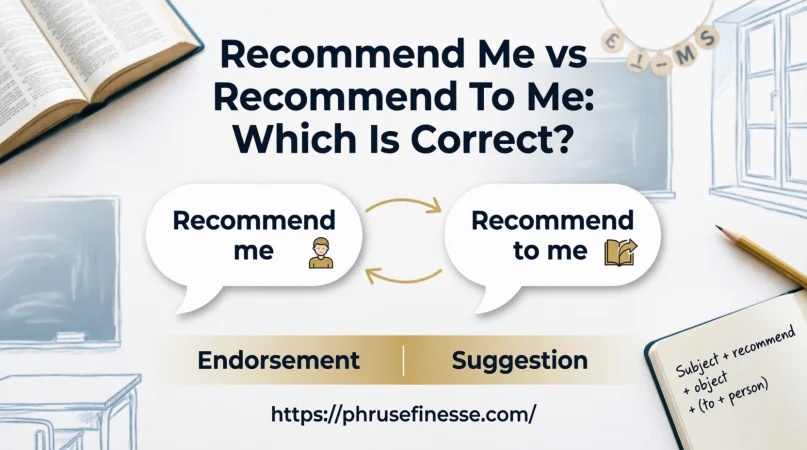
Use “recommend me” when someone is endorsing you.
Examples:
- My supervisor recommended me for promotion.
- She recommended me as a project leader.
- The professor recommended me for the scholarship.
Use “recommend to me” when someone is suggesting something to you.
Examples:
- Can you recommend a restaurant to me?
- My friend recommended that movie to me.
- The consultant recommended several tools to me.
Think of it this way:
| Question | Correct Phrase |
| Is someone supporting or endorsing you? | Recommend me |
| Is someone suggesting something for you? | Recommend to me |
That single distinction solves most confusion.
Understanding the Difference Between “Recommend Me” and “Recommend To Me”
Before diving into grammar rules, it’s important to understand what the verb recommend means.
According to standard English usage, recommend means:
To suggest something as suitable, valuable, or worthy of consideration.
It can also mean:
To praise or endorse someone for a position, opportunity, or responsibility.
These two meanings create two different sentence patterns.
| Structure | Meaning | Example |
| Recommend someone | Endorse a person | I recommend Sarah for the role. |
| Recommend something to someone | Suggest something | I recommend this book to you. |
| Recommend someone to someone | Endorse a person to another person | I recommended Sarah to the manager. |
The key distinction is simple:
- Recommend me = endorse me.
- Recommend to me = suggest something to me.
Once you understand this difference, choosing the correct phrase becomes much easier.
Understanding the Verb “Recommend”
The verb recommend is surprisingly flexible.
English speakers commonly use it in three main ways.
Recommending a Person
In this structure, someone receives support or endorsement.
Examples:
- I recommend John for the position.
- They recommended her as team leader.
- Our manager recommended him for promotion.
Here, the focus is the person being endorsed.
Recommending Something
In this structure, someone suggests an item, service, place, or action.
Examples:
- I recommend this restaurant.
- She recommended the book.
- They recommended a different strategy.
The focus is the thing being suggested.
Recommending Something to Someone
This is one of the most common structures in English.
Examples:
- I recommend this course to beginners.
- She recommended the hotel to us.
- They recommended the software to their clients.
This structure clearly identifies who receives the recommendation.
When “Recommend Me” Is Correct
Many learners mistakenly think recommend me is always wrong.
It isn’t.
In fact, it’s perfectly correct when you’re talking about someone endorsing you.
Job Applications
One of the most common situations involves employment.
Examples:
- Can you recommend me for the position?
- My previous manager recommended me for the role.
- She recommended me as a strong candidate.
In each sentence, the speaker receives professional support.
Academic Recommendations
Universities frequently require recommendations.
Examples:
- The professor recommended me for the scholarship.
- My advisor recommended me for the research program.
- The dean recommended me as an exchange student.
These recommendations help students gain opportunities.
Professional Referrals
Referrals happen daily in business.
Examples:
- My colleague recommended me to a client.
- The director recommended me for the consulting project.
- They recommended me as an industry expert.
Notice that recommend me focuses on the person receiving the endorsement.
Example Scenario
Imagine you’re applying for a new job.
You might ask a former supervisor:
“Would you be willing to recommend me for this position?”
You are not asking for a suggestion.
You are asking for support.
That’s why recommend me is correct.
When “Recommend To Me” Is Correct
Now let’s look at the opposite situation.
Use recommend to me when you’re receiving a suggestion.
Asking for Suggestions
Examples:
- Can you recommend a good hotel to me?
- Could you recommend a reliable mechanic to me?
- Would you recommend a beginner course to me?
The recommendation moves toward you.
You are the recipient.
Receiving Advice
Examples:
- My friend recommended a podcast to me.
- The doctor recommended a specialist to me.
- The teacher recommended several books to me.
The focus is the thing being suggested.
Travel Recommendations
Travel conversations often use this structure.
Examples:
- The guide recommended several attractions to me.
- The concierge recommended a local restaurant to me.
- The travel agent recommended Greece to me.
Here, the recommendation involves destinations or experiences.
Why “Recommend Me a Book” Sounds Different
This expression causes significant confusion.
Consider these two sentences:
- Recommend me a book.
- Recommend a book to me.
Both appear in spoken English.
However, they aren’t equally preferred.
The Traditional Grammar Preference
Many grammar experts favor:
Recommend a book to me.
This version clearly follows the standard structure:
recommend + object + to + person
Example:
- Recommend a restaurant to me.
- Recommend a movie to me.
- Recommend a course to me.
Why Native Speakers Still Say “Recommend Me a Book”
Language evolves.
Many native speakers use:
- Recommend me a movie.
- Recommend me a restaurant.
- Recommend me a book.
This structure resembles verbs such as:
- Give me a book.
- Send me a message.
- Show me a photo.
Although common in conversation, it appears less often in formal writing.
Formal vs. Informal Comparison
| Informal | Formal |
| Recommend me a movie. | Recommend a movie to me. |
| Recommend me a book. | Recommend a book to me. |
| Recommend me a course. | Recommend a course to me. |
If you’re writing professionally, choose the formal version.
“Recommend Me” vs. “Recommend Me To”
These expressions look similar but mean different things.
Recommend Me
Examples:
- Recommend me for the promotion.
- Recommend me as a consultant.
The destination isn’t stated.
Recommend Me To
Examples:
- Recommend me to the hiring manager.
- Recommend me to your supervisor.
- Recommend me to the client.
The destination is explicitly stated.
Comparison Table
| Expression | Meaning |
| Recommend me | Endorse me |
| Recommend me to someone | Endorse me to a specific person |
| Recommend something to me | Suggest something to me |
This distinction becomes especially important in professional communication.
Common Situations Where Native Speakers Use “Recommend”
Understanding real-life usage helps more than memorizing rules.
Let’s examine common situations.
Workplace Communication
Examples:
- My boss recommended me for promotion.
- The director recommended me to the board.
- Our consultant recommended a new workflow to us.
These examples demonstrate both endorsement and suggestion.
Education
Examples:
- My teacher recommended me for the award.
- The professor recommended additional reading to me.
- The department recommended several electives to students.
Academic settings frequently use both structures.
Healthcare
Examples:
- The doctor recommended physical therapy to me.
- The specialist recommended a treatment plan to me.
- My physician recommended daily exercise.
Medical professionals often recommend actions rather than people.
Business Services
Examples:
- The accountant recommended new software to us.
- The agency recommended me for the contract.
- The consultant recommended cost-saving measures.
Again, context determines the correct structure.
Common Mistakes English Learners Make
Even advanced learners make mistakes with recommend.
Here are the most frequent ones.
Mistake: Confusing Endorsement With Suggestion
Incorrect:
❌ Recommend me a lawyer for court.
Better:
✅ Recommend a lawyer to me.
Why?
You want a suggestion.
You don’t want someone to endorse you.
See More :Hands-On Experience on a Resume: 4 Better Alternatives
Mistake: Reversing the Direction
Incorrect:
❌ She recommended me the restaurant.
Preferred:
✅ She recommended the restaurant to me.
The restaurant is being recommended.
Not you.
Mistake: Missing the Object
Incorrect:
❌ She recommended to me.
Correct:
✅ She recommended several books to me.
The recommendation needs an object.
Mistake: Using the Wrong Preposition
Incorrect:
❌ She recommended me for her friend.
Correct:
✅ She recommended me to her friend.
The friend receives the recommendation.
Real-Life Examples in Context
Learning grammar through context improves retention.
Here are realistic examples.
Job Interview Scenario
Hiring manager:
“How did you hear about this opportunity?”
Applicant:
“My previous supervisor recommended me for the role.”
The supervisor endorsed the applicant.
Restaurant Conversation
Friend:
“Can you recommend a good Italian restaurant?”
Response:
“I’d recommend Luigi’s downtown.”
Or:
“I’d recommend Luigi’s downtown to you.”
Both communicate a suggestion.
University Recommendation
Student:
“How did you receive the scholarship?”
Response:
“My professor recommended me to the scholarship committee.”
This is an endorsement.
Travel Planning
Traveler:
“How did you discover that destination?”
Response:
“A travel agent recommended it to me.”
This is a suggestion.
British vs. American English Usage
Both British and American English generally follow the same grammar principles.
However, usage patterns vary slightly.
American English
American speakers often use:
- Recommend a movie to me.
- Recommend me for the position.
Both structures sound natural.
British English
British speakers frequently prefer:
- Recommend a book to me.
- Recommend someone for a role.
Many British style guides favor the more traditional structure when suggesting something.
Shared Preference
Across both varieties, formal writing typically favors:
Recommend something to someone.
This structure remains the clearest.
How Native Speakers Usually Say It
Grammar books provide rules.
Native speakers provide reality.
Here are expressions commonly heard in everyday English.
Asking for Suggestions
- Can you recommend a good movie?
- Can you recommend any restaurants?
- What would you recommend?
- Could you recommend a podcast?
Interestingly, native speakers often omit to me because it’s already understood.
Giving Suggestions
- I’d recommend this book.
- I’d definitely recommend that restaurant.
- I highly recommend visiting Chicago.
These forms sound natural and conversational.
Giving Endorsements
- I’d recommend Sarah for the position.
- We recommend him as a consultant.
- I recommended her to our management team.
These examples focus on supporting people.
Case Study: One Verb, Two Completely Different Meanings
Consider these two sentences:
Sentence One
The professor recommended me.
Meaning:
The professor endorsed me.
Sentence Two
The professor recommended a book to me.
Meaning:
The professor suggested a book.
A Quick Rule You Can Remember
When you’re unsure, ask yourself one question:
Who Is Being Recommended?
If YOU are being endorsed:
Use:
Recommend me
Examples:
- Recommend me for the position.
- Recommend me as a candidate.
If SOMETHING is being suggested:
Use:
Recommend something to me
Examples:
- Recommend a book to me.
- Recommend a hotel to me.
This simple rule works almost every time.
Summary Table
| Situation | Correct Structure | Example |
| Someone endorses you | Recommend me | They recommended me for promotion. |
| Someone endorses you to another person | Recommend me to | She recommended me to the client. |
| Someone suggests something | Recommend something to me | Recommend a movie to me. |
| Professional writing | Recommend something to someone | The consultant recommended the software to us. |
| Casual conversation | Recommend me a movie | Common but less formal. |
FAQs
Is “recommend me” grammatically correct?
Yes, “recommend me” can be grammatically correct when it means recommending a person to someone else. For example, “Can you recommend me for the position?” In this case, me is the person being recommended.
Is “recommend to me” correct?
Yes, “recommend to me” is correct when someone is suggesting something for your consideration. For example, “Can you recommend a good restaurant to me?” This structure is common in both spoken and written English.
Which is more common: “recommend me” or “recommend to me”?
“Recommend to me” is generally more common when asking for suggestions. Native speakers often say, “Can you recommend a book to me?” or simply, “Can you recommend a book?” Meanwhile, “recommend me” is usually reserved for situations where a person is being recommended.
Can I say “recommend me a book”?
In informal English, some native speakers use “recommend me a book.” However, many style guides and grammar experts prefer “recommend a book to me” because it is clearer and more widely accepted in formal writing.
When should I use “recommend me”?
Use “recommend me” when you are the person being recommended. For example:
- “Please recommend me for the scholarship.”
- “My manager recommended me for promotion.”
In these examples, me is the recipient of the recommendation.
Is “recommend to me” suitable for formal writing?
Absolutely. “Recommend to me” is widely accepted in formal writing, business communication, academic contexts, and professional emails. It provides clarity and helps avoid ambiguity.
Conclusion
Understanding the difference between “recommend me” and “recommend to me” can significantly improve your grammar, English usage, and overall communication skills. While “recommend me” is used when a person is being recommended to someone else, “recommend to me” is used when asking for or receiving suggestions.
Knowing this distinction helps you write with greater clarity, maintain consistency, and communicate more effectively in both casual conversations and professional settings. By studying the examples in this guide, you can confidently choose the correct phrase every time.

Mia Rose is an English language specialist and editorial writer at Phrase Finesse, where she helps readers master grammar, vocabulary, spelling, and effective communication. Passionate about making English simple and practical, she creates well-researched, reader-friendly content that explains complex language concepts in a clear and engaging way.
With extensive experience in English language education, content writing, and editorial review, Mia specializes in grammar, punctuation, word choice, idioms, confusing word pairs, and writing style. Her articles are carefully researched, fact-checked, and designed to help students, professionals, writers, and English learners build confidence in both written and spoken English.