Comma Before or After “Unfortunately”? Wondering whether to put a Comma Before or After “Unfortunately”Examples and Rules? This simple guide explains the basic rule clearly.
For English learners, unfortunately can cause confusion because its position affects comma usage and punctuation. The basic rule is that when unfortunately comments on the whole sentence, it often acts as a sentence adverb or parenthetical adverb.
For example, Unfortunately, I missed the bus uses a comma to mark the introductory idea, while Unfortunately I missed the bus appears without one.
In my experience, this small comma placement choice makes writing clearer and easier to read, especially in emails, school assignments, business writing, social media posts, and everyday English. The meaning stays the same, but punctuation changes how the pieces of a sentence fit together.
When unfortunately appears inside a sentence, you may use two commas, as in I, unfortunately, missed the bus. The commas separate the adverb from the rest of the sentence and show its grammatical role. However, no comma may be needed when the word functions more closely with the verb.
These different positions explain the use of a comma before unfortunately, comma after unfortunately, or commas on both sides.
The same punctuation rules connect with English grammar, including conjunction use, such as comma before but and comma after but, although but follows its own conjunction rules. Think of punctuation marks as flags that indicate a new, related idea and reveal sentence relationships, thought, and rhythm.
The comma remains one of the most used and misused marks, so understanding its function, placement, and rules can prevent common errors in academic writing and written communication.
What Does “Unfortunately” Mean?
Before learning the comma rules, it helps to understand what “unfortunately” actually means.
Unfortunately is an adverb that means something happened in an undesirable, disappointing, unlucky, or regrettable way.
It shows that the speaker or writer feels negative about a situation.
For example:
Unfortunately, the restaurant closed before we arrived.
The sentence does not simply state that the restaurant closed. The word “unfortunately” adds the writer’s reaction. It tells the reader that the closure was disappointing.
Compare these examples:
| Sentence | Meaning |
| The flight was delayed. | A simple fact |
| Unfortunately, the flight was delayed. | The delay caused disappointment |
| The flight was delayed, unfortunately. | The writer adds regret afterward |
The basic information stays the same, but “unfortunately” changes the emotional tone.
Think of it like adding a reaction sticker to a message. The sentence gives the information, while the adverb shows how the writer feels about that information.
Is “Unfortunately” an Adverb?
Yes. “Unfortunately” is an adverb, specifically a sentence adverb.
A sentence adverb does not usually describe a single verb. Instead, it modifies the entire sentence by showing the speaker’s opinion, attitude, or judgment.
Common sentence adverbs include:
- Fortunately
- Sadly
- Surprisingly
- Luckily
- Regrettably
- Unfortunately
Examples:
- Fortunately, we found the missing documents.
- Sadly, the old building was demolished.
- Unfortunately, the application was rejected.
In each example, the adverb gives context about the entire situation.
Do You Put a Comma After “Unfortunately”?
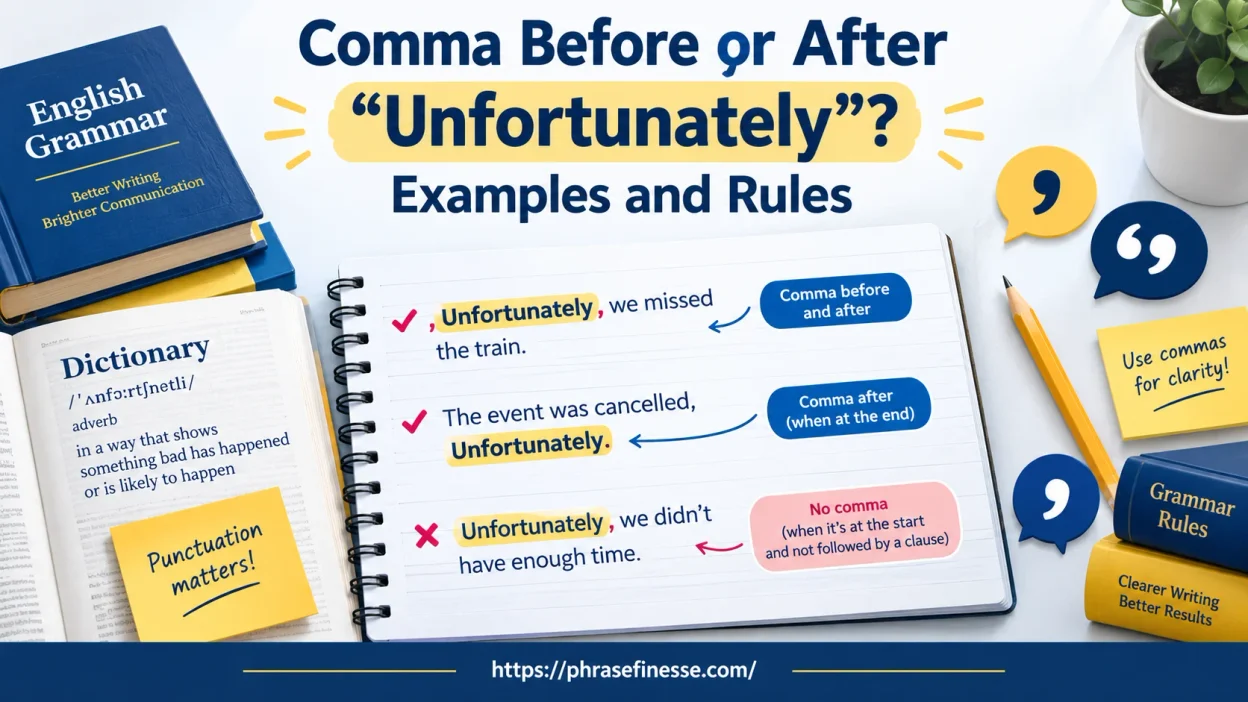
When “unfortunately” starts a sentence, you normally place a comma after it.
This happens because the word acts as an introductory element.
Correct examples:
1.✅ Unfortunately, I cannot attend the event.
2.✅ Unfortunately, the store has already closed.
3.✅ Unfortunately, we missed the deadline.
The comma creates a small pause between the introductory word and the main message.
Without the comma:
❌ Unfortunately I cannot attend the event.
The sentence may still be understandable, but it looks incomplete and less polished.
Why Does “Unfortunately” Need a Comma at the Beginning?
When a sentence begins with an introductory adverb, the comma helps readers identify the structure quickly.
Look at this example:
Unfortunately, the project failed.
The reader immediately understands:
- Unfortunately = the writer’s reaction
- The project failed = the actual information
The punctuation creates a clear separation between emotion and fact.
This pattern appears frequently in:
Professional emails
Unfortunately, we cannot approve your request at this time.
Customer service messages
Unfortunately, your order has been delayed.
Academic writing
Unfortunately, the research lacked sufficient evidence.
Do You Put a Comma Before “Unfortunately”?
When “unfortunately” comes at the end of a sentence, place a comma before it.
At the end of a sentence, the word often acts like an afterthought.
Correct examples:
- ✅ I won’t be able to join the meeting, unfortunately.
2.✅ The event was canceled, unfortunately.
3.✅ She missed the opportunity, unfortunately.
In these sentences, removing “unfortunately” leaves a complete sentence:
I won’t be able to join the meeting.
The event was canceled.
She missed the opportunity.
That’s a sign that the word adds extra commentary rather than essential information.
Why Does the Comma Come Before “Unfortunately” at the End?
The comma signals that the writer is adding a final comment.
It works similarly to phrases like:
- to be honest
- sadly
- unfortunately
- of course
Example:
The plan didn’t work, unfortunately.
The sentence first delivers the fact:
The plan didn’t work.
Then the writer adds:
Unfortunately.
It is almost like saying:
The plan didn’t work. That’s disappointing.
The comma helps create that natural pause.
Using Commas Around “Unfortunately” in the Middle of a Sentence
When “unfortunately” appears in the middle of a sentence, you usually place commas on both sides.
Correct examples:
- ✅ The project, unfortunately, failed after several delays.
2.✅ She was, unfortunately, unable to continue.
3.✅ The company has, unfortunately, decided to close the branch.
The commas show that the word is additional information.
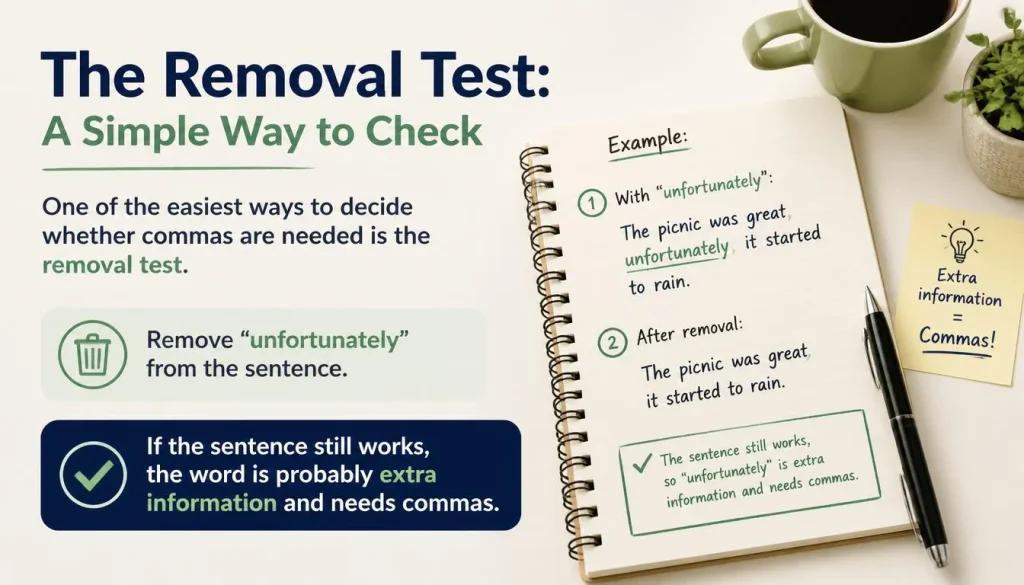
The Removal Test: A Simple Way to Check
One of the easiest ways to decide whether commas are needed is the removal test.
Remove “unfortunately” from the sentence.
If the sentence still works, the word is probably extra information and needs commas.
Example:
Original:
The team, unfortunately, lost the final match.
Remove the word:
The team lost the final match.
The sentence remains complete.
Therefore:
✅ The team, unfortunately, lost the final match.
When Should You Avoid Commas With “Unfortunately”?
Although commas often appear with “unfortunately,” they are not required in every situation.
Sometimes the word connects more closely with the verb or action.
Examples:
✅ He unfortunately chose the wrong answer.
✅ She unfortunately missed the deadline.
These sentences focus more directly on the action.
The writer is not always making a separate comment. Instead, “unfortunately” modifies how the action happened.
Compare These Two Sentences
Sentence 1:
She unfortunately missed the interview.
This version emphasizes the action.
Meaning:
- She missed the interview.
- The situation was unfortunate.
Sentence 2:
She, unfortunately, missed the interview.
This version emphasizes the speaker’s reaction.
Meaning:
- The writer pauses to express disappointment.
Both can be correct.
The difference is subtle. The comma changes the rhythm and emphasis.
Comma Rules for “Unfortunately” at a Glance
| Position of “Unfortunately” | Comma Rule | Example |
| Beginning of sentence | Add comma after it | Unfortunately, the flight was delayed. |
| Middle of sentence | Add commas around it | The flight, unfortunately, was delayed. |
| End of sentence | Add comma before it | The flight was delayed, unfortunately. |
| Before a verb in some cases | Comma may be optional | She unfortunately forgot the password. |
Key takeaway:
The position of “unfortunately” usually determines the comma placement. Beginning, middle, and end positions follow different patterns.
Common Mistakes When Using Commas With “Unfortunately”
Even experienced writers sometimes struggle with comma placement before or after “unfortunately.” The confusion usually happens because the word can appear in different parts of a sentence, and each position follows a slightly different pattern.
Understanding these common mistakes will help you avoid punctuation errors and write with more confidence.
See More : “Plan To Do” vs. “Plan On Doing”Difference Explained
Mistake 1: Forgetting the Comma After “Unfortunately” at the Beginning
One of the most common errors happens when writers forget to add a comma after an introductory “unfortunately.”
Incorrect:
❌ Unfortunately we cannot process your request.
Correct:
✅ Unfortunately, we cannot process your request.
The comma separates the introductory comment from the main sentence.
Without the comma, the opening feels rushed because the reader has to figure out where the introductory phrase ends.
This small punctuation mark improves readability.
More examples:
❌ Unfortunately the product is no longer available.
✅ Unfortunately, the product is no longer available.
❌ Unfortunately our team missed the deadline.
✅ Unfortunately, our team missed the deadline.
Mistake 2: Adding Unnecessary Commas Around Every “Unfortunately”
Some writers assume that “unfortunately” always needs commas on both sides.
That is not true.
The word only needs commas when it functions as an interruption or extra comment.
Incorrect:
❌ He, unfortunately chose the wrong answer.
Correct:
✅ He unfortunately chose the wrong answer.
or
✅ He, unfortunately, chose the wrong answer.
Both versions can work, but they create different emphasis.
The first sentence focuses more on the action:
He chose the wrong answer.
The second sentence highlights the speaker’s disappointment:
Sadly, he chose the wrong answer.
Mistake 3: Treating Every Sentence the Same Way
Another common mistake is using one punctuation rule for every situation.
For example:
Some writers learn:
“Always put a comma after unfortunately.”
That rule only works when “unfortunately” begins the sentence.
Compare these examples:
| Sentence | Correct? | Reason |
| Unfortunately, we lost the file. | ✅ | Introductory word |
| We lost the file, unfortunately. | ✅ | Final comment |
| We, unfortunately, lost the file. | ✅ | Interrupting phrase |
| We lost, unfortunately the file. | ❌ | Incorrect placement |
The word’s location controls the punctuation.
“Unfortunately” vs Similar Words: Do They Follow the Same Comma Rules?
Many words work like “unfortunately” because they express the writer’s attitude toward a situation.
These words often follow similar comma patterns.
Fortunately
Fortunately shows a positive outcome.
Examples:
✅ Fortunately, we found the missing documents.
✅ We found the missing documents, fortunately.
The structure matches “unfortunately.”
Sadly
Sadly expresses disappointment, sorrow, or regret.
Examples:
✅ Sadly, the old building was destroyed.
✅ The event ended early, sadly.
Regrettably
Regrettably is a more formal alternative to “unfortunately.”
You often see it in business communication.
Examples:
✅ Regrettably, we cannot offer a refund.
✅ We cannot offer a refund, regrettably.
Luckily
Luckily introduces a fortunate situation.
Examples:
✅ Luckily, nobody was injured.
✅ Nobody was injured, luckily.
Comparison Table: Sentence Adverbs and Comma Placement
| Word | Meaning | Beginning Example | Ending Example |
| Unfortunately | Shows disappointment | Unfortunately, the plan failed. | The plan failed, unfortunately. |
| Fortunately | Shows a positive outcome | Fortunately, we arrived early. | We arrived early, fortunately. |
| Sadly | Shows sadness | Sadly, the store closed. | The store closed, sadly. |
| Luckily | Shows good fortune | Luckily, we found help. | We found help, luckily. |
These words all work similarly because they comment on the entire sentence.
How to Use “Unfortunately” in Formal Writing
The word “unfortunately” appears frequently in professional, academic, and business writing.
However, using it correctly involves more than punctuation. You also need to consider tone.
A well-placed “unfortunately” can soften negative information and make your message sound more considerate.
Using “Unfortunately” in Professional Emails
In workplace communication, directly delivering bad news can sound harsh.
Compare these examples:
Too direct:
We cannot approve your request.
More polite:
Unfortunately, we cannot approve your request at this time.
The second version acknowledges the disappointment before presenting the decision.
This technique is common in:
- Customer support emails
- Workplace announcements
- Business responses
- Service updates
Example: Customer Service Message
Less friendly:
Your refund request was denied.
Better:
Unfortunately, your refund request does not meet our current policy requirements.
The second sentence keeps the message professional while showing understanding.
Using “Unfortunately” in Academic Writing
Academic writing requires a careful balance.
Although “unfortunately” is acceptable, writers should use it only when expressing a genuine limitation, problem, or unexpected result.
Example:
Unfortunately, the study included only a small number of participants.
This works because the limited sample size creates a real research challenge.
However, academic writing should avoid emotional opinions without evidence.
Less effective:
Unfortunately, this theory is wrong.
A stronger academic approach would explain the evidence:
Unfortunately, the available data does not support this theory.
The second sentence focuses on facts rather than personal judgment.
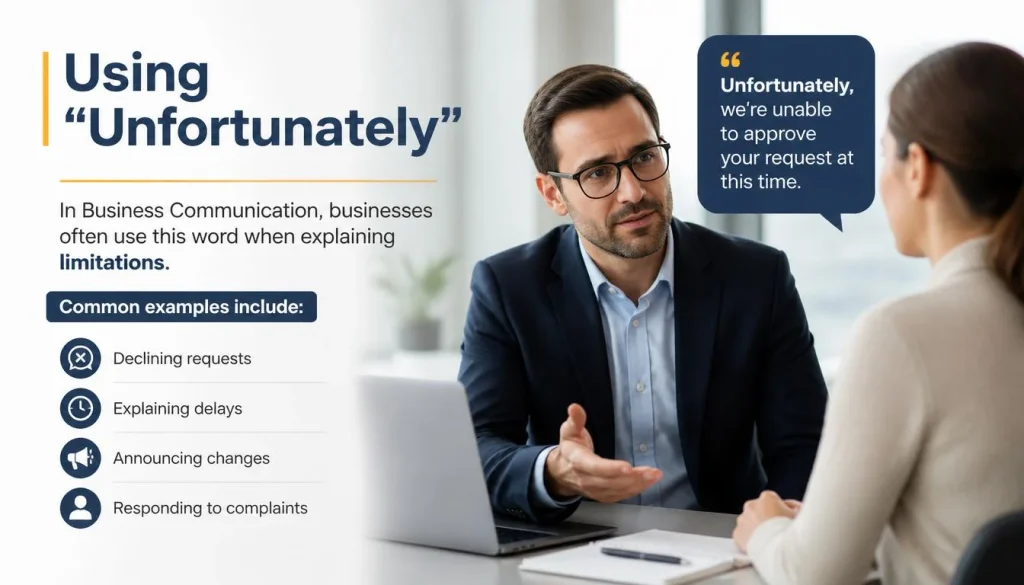
Using “Unfortunately” in Business Communication
Businesses often use this word when explaining limitations.
Common examples include:
- Declining requests
- Explaining delays
- Announcing changes
- Responding to complaints
Examples:
1.Unfortunately, shipping delays have affected your order.
Unfortunately, we are unable to extend the deadline.
2.Unfortunately, the service will be unavailable during maintenance.
3.The word helps maintain professionalism without sounding cold.
Real-World Examples of “Unfortunately” Comma Usage
Example 1: Workplace Email
Unfortunately, the meeting needs to be postponed until next week.
Why it works:
- “Unfortunately” introduces disappointing information.
- The comma separates the introduction from the main message.
Example 2: Casual Conversation
I missed the concert, unfortunately.
Why it works:
- The word appears as an afterthought.
- The comma creates a natural pause.
Example 3: News Writing
The company, unfortunately, experienced significant losses during the quarter.
Why it works:
- The writer inserts an opinion about the event.
- The commas show that the word is additional information.
Practice Examples: Add the Correct Commas to “Unfortunately”
Test your understanding with these sentences.
Example 1
❌ Unfortunately I forgot to save the document.
Correct:
✅ Unfortunately, I forgot to save the document.
Explanation:
Because “unfortunately” begins the sentence, add a comma after it.
Example 2
❌ The results were unfortunately inaccurate.
Correct:
✅ The results were unfortunately inaccurate.
or
✅ The results were, unfortunately, inaccurate.
Explanation:
Both can work.
The first version treats “unfortunately” as closely connected to the result.
The second version adds stronger emphasis.
Example 3
❌ The flight was delayed unfortunately.
Correct:
✅ The flight was delayed, unfortunately.
Explanation:
At the end of the sentence, the word acts as an afterthought.
Example 4
❌ Unfortunately the company changed its policy.
Correct:
✅ Unfortunately, the company changed its policy.
Explanation:
An introductory “unfortunately” requires a comma.
Quick Test: Should “Unfortunately” Have Commas?
Use these questions:
Question 1:
Does “unfortunately” come at the beginning?
If yes:
➡ Add a comma after it.
Example:
Unfortunately, we cannot continue.
Question 2:
Does “unfortunately” interrupt the sentence?
If yes:
➡ Add commas around it.
Example:
The decision was, unfortunately, final.
Question 3:
Does “unfortunately” appear at the end?
If yes:
➡ Add a comma before it.
Example:
We missed the deadline, unfortunately.
Question 4:
Is it closely connected to the verb?
If yes:
➡ A comma may not be necessary.
Example:
She unfortunately forgot her password.
FAQs
1. Do you put a comma after “unfortunately”?
Yes. When “unfortunately” starts a sentence and comments on the whole statement, a comma usually follows it: “Unfortunately, I missed the bus.”
2. Do you need a comma before “unfortunately”?
It depends on its position and grammatical role. When “unfortunately” appears in the middle of a sentence as a parenthetical adverb, commas can appear on both sides: “I, unfortunately, missed the bus.”
3. Can you write “Unfortunately I missed the bus”?
Yes, but “Unfortunately, I missed the bus” is generally clearer and more common in modern English writing.
4. Do you always need two commas around “unfortunately”?
No. Two commas are common when “unfortunately” interrupts the main sentence: “She was, unfortunately, unavailable.” However, punctuation depends on how the adverb functions within the sentence.
5. Is “unfortunately” a sentence adverb?
Yes. “Unfortunately” often works as a sentence adverb because it expresses the speaker’s attitude toward the entire statement rather than modifying only one word.
6. Does the comma change the meaning of “unfortunately”?
Usually, no. The meaning generally stays the same. The comma mainly helps show sentence structure, improve clarity, and make the writing easier to read.
Conclusion
Understanding the comma before or after unfortunately becomes much easier when you look at the word’s position and function. Use a comma after introductory “unfortunately,” and consider commas on both sides when it interrupts a sentence. When in doubt, read the sentence aloud and check whether the punctuation clearly separates the extra thought from the main idea.

Alyan Ashraf is an English language writer and editor at Phrase Finesse, where he specializes in grammar, vocabulary, spelling, word usage, and clear communication. Passionate about the English language, he creates practical, research-backed content that helps readers avoid common mistakes and write with greater accuracy and confidence.
Known for his clear writing style and attention to detail, Alyan simplifies complex language topics into easy-to-understand guides filled with real-world examples and actionable insights. His work covers confusing word pairs, grammar rules, idioms, punctuation, and everyday English usage, making learning both accessible and engaging for students, professionals, writers, and non-native English speakers.
Every article Alyan writes is carefully researched, fact-checked, and designed to meet high editorial standards. His goal is to help readers strengthen their English skills, expand their vocabulary, and communicate more effectively in academic, professional, and everyday settings.
Through Phrase Finesse, Alyan is committed to publishing trusted language resources that make mastering English simpler, clearer, and more enjoyable for learners around the world