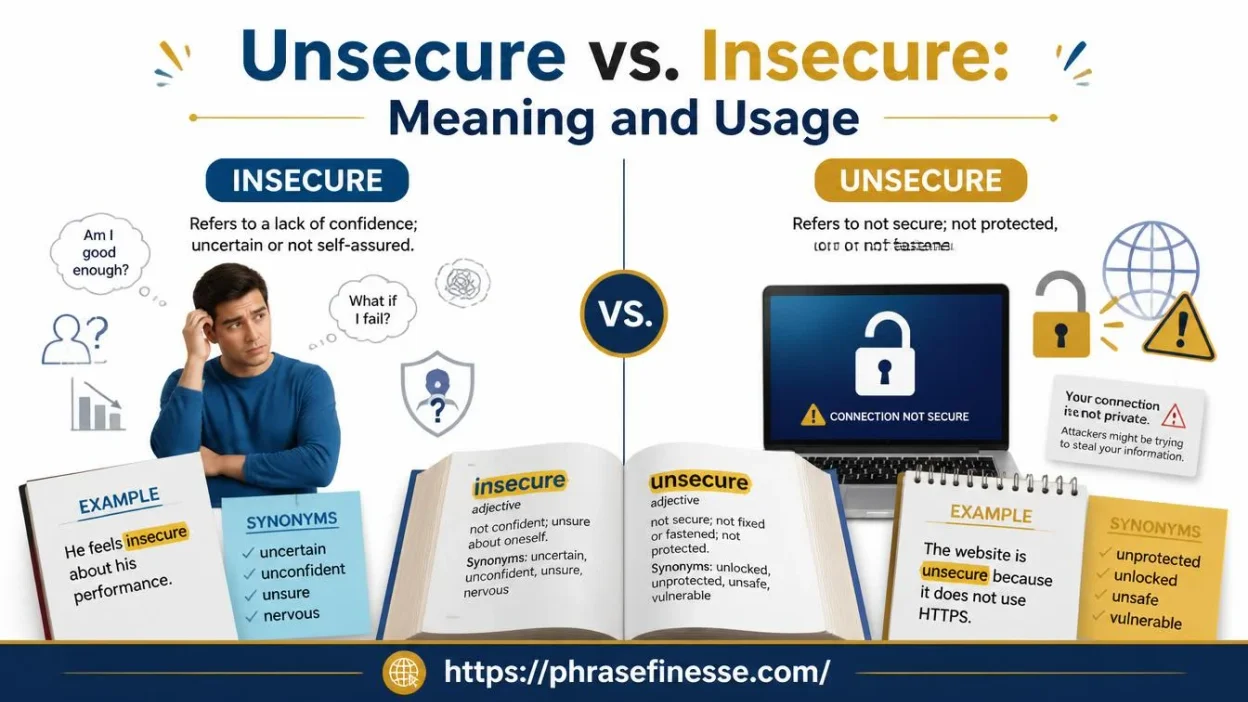
Unsecure vs. Insecure: Meaning and Usage This guide explains their meaning, usage, and difference in everyday English for clear writing. Unsecure and Insecure often cause confusion because they are similar words with the same root meaning, secure
. However, their usage and meaning are different, so it’s important to highlight the difference when you explore the topic. In most contexts, insecure is the correct choice. It can describe a person who feels unsure or lacks confidence, as well as emotional, technical, and general usage involving safety issues.
An unsafe door or network may raise concerns about security, while an insecure person may struggle with confidence. Unsecure is rarely used and is often considered incorrect in standard English, even when it may look right.
From my experience with English learning, writers, students, and professionals often make this word-choice mistake because both forms seem similar. This can make a sentence sound odd or unclear in emails, articles, and reports, especially during checking with grammar tools or editors. The better approach is to focus on proper usage instead of choosing what simply looks right.
Learning and improving your English vocabulary can help you understand these subtle differences, write clearly, and avoid grammar mistakes in the future. With time, you’ll notice fewer repeated errors, stronger language skills, and a clearer understanding of word choice. Google searches may show both forms, but common usage still makes the distinction worth remembering.
Unsecure vs. Insecure: The Quick Difference
The easiest way to understand unsecure vs. insecure is to look at what type of problem each word describes.
| Word | Meaning | Common Use | Example |
| Insecure | Lacking confidence, safety, stability, or certainty | People, emotions, situations, technology | “He feels insecure about his public speaking skills.” |
| Unsecure | Not secured, protected, or made safe | Objects, locations, systems, information | “The door was left unsecure overnight.” |
| Unsecured | Not protected or guaranteed | Finance, security, legal, technology | “She applied for an unsecured loan.” |
In simple terms:
- Insecure usually describes a feeling, condition, or lack of stability.
- Unsecure describes something that has not been protected or secured.
- Unsecured is often the preferred word when talking about formal security matters.
Think of it this way:
An insecure person doubts themselves. An unsecured door allows unwanted access.
The difference comes down to the type of “security” that is missing.
What Does Insecure Mean?
The word insecure is one of the most common words in modern English. It describes something that lacks confidence, safety, stability, or certainty.
The word comes from the Latin roots in- meaning “not” and secure meaning “safe or free from danger.” Over time, English speakers expanded its meaning beyond physical safety.
Today, insecure has several common uses.
Insecure Meaning: Lacking Confidence or Self-Assurance
The most familiar meaning of insecure relates to emotions and personal confidence.
When someone feels insecure, they lack confidence in themselves or worry about how others see them.
For example:
- “She feels insecure about her writing skills.”
- “He became insecure after comparing himself with his coworkers.”
- “Many teenagers feel insecure about their appearance.”
In these examples, insecure does not mean unsafe in a physical way. It describes an internal feeling.
A person who feels insecure may:
- doubt their abilities
- worry about criticism
- constantly compare themselves with others
- seek approval from people around them
Example Scenario
Imagine two employees preparing for a presentation.
The first employee thinks:
“I’ve prepared well, and I can handle this.”
The second employee thinks:
“Everyone will notice my mistakes. I’m probably not good enough.”
The second employee feels insecure about their presentation skills.
The issue is not a lack of physical safety. The issue is confidence.
Insecure Meaning: Unsafe or Unstable
Although many people associate insecure with emotions, the word also describes situations that lack stability or protection.
Examples:
- “Many workers face insecure employment.”
- “The region has an insecure political situation.”
- “The company’s financial future remains insecure.”
Here, insecure means uncertain or unreliable.
A job can be insecure because employees do not know whether they will keep it.
A financial situation can be insecure because future income is uncertain.
A relationship can feel insecure when trust and stability are missing.
Insecure Meaning in Technology and Cybersecurity
The word insecure also appears frequently in technology.
Cybersecurity experts often use insecure to describe systems, software, or connections that have weaknesses.
Examples:
- “The website uses an insecure connection.”
- “Weak passwords create insecure accounts.”
- “The application stores data in an insecure way.”
In technology, insecure means vulnerable to problems such as:
- unauthorized access
- data leaks
- hacking attempts
- privacy risks
For example, a password like 123456 creates an insecure account because it does not provide strong protection.
What Does Unsecure Mean?
The word unsecure means something has not been secured, protected, or made safe.
Although unsecure is a real English word, it appears much less frequently than insecure.
Most people use unsecure when they want to describe something that lacks physical or digital protection.
Examples:
- “The storage room was left unsecure.”
- “The website was marked as unsecure.”
- “The package was placed in an unsecure location.”
The focus is usually on an external object or system.
Is Unsecure a Correct Word?
Yes, unsecure is grammatically acceptable. It appears in dictionaries and has been used in English for many years.
However, many writers avoid it because it can sound less natural than alternatives like:
- insecure
- unsecured
- not secured
- not protected
For example:
Less natural:
“The building entrance was unsecure.”
More natural:
“The building entrance was unsecured.”
Even though both sentences communicate a similar idea, the second version sounds more polished.
Unsecure vs. Unsecured: Which One Should You Use?
Many people confuse unsecure with unsecured. They are related, but they do not always work in the same situations.
| Word | Meaning | Example |
| Unsecure | Not secured or protected | “The area remained unsecure after the inspection.” |
| Unsecured | Not protected, guaranteed, or backed by security | “The bank approved an unsecured loan.” |
In professional writing, unsecured is usually the stronger choice.
You will often see it in:
- banking
- cybersecurity
- legal documents
- insurance
- business writing
Common examples include:
- unsecured loan
- unsecured debt
- unsecured network
- unsecured device
- unsecured account
Why “Unsecured” Often Sounds Better Than “Unsecure”
English often prefers adjectives ending in -ed when describing a condition caused by something missing.
Compare:
- locked → unlocked
- protected → unprotected
- secured → unsecured
Because of this pattern, unsecured feels more natural to many native speakers.
For example:
✅ “The customer used an unsecured payment method.”
This sounds professional and clear.
Although:
✅ “The customer used an unsecure payment method.”
is understandable, it sounds less common.
Key Differences Between Unsecure and Insecure
Understanding the difference becomes easier when you compare their main purposes.
Difference Between Unsecure and Insecure: Meaning
The biggest difference is what type of “security” is missing.
| Situation | Correct Word | Reason |
| Someone lacks confidence | Insecure | Describes emotions |
| A person doubts their abilities | Insecure | Describes self-confidence |
| A job is uncertain | Insecure | Describes stability |
| A password is weak | Insecure | Describes security risk |
| A door is not locked | Unsecure/Unsecured | Describes lack of protection |
| A loan has no collateral | Unsecured | Describes financial security |
Difference Between Unsecure and Insecure: Context
Context decides which word fits.
Consider these sentences:
Sentence 1:
“Maria feels insecure before interviews.”
Meaning:
- Maria lacks confidence.
Sentence 2:
“Maria left her laptop unsecure at the office.”
Meaning:
- The laptop was not properly protected.
The subject changes the meaning.
A person can feel insecure.
A device can be unsecured.
Common Uses of Insecure
The word insecure appears in many areas of life.
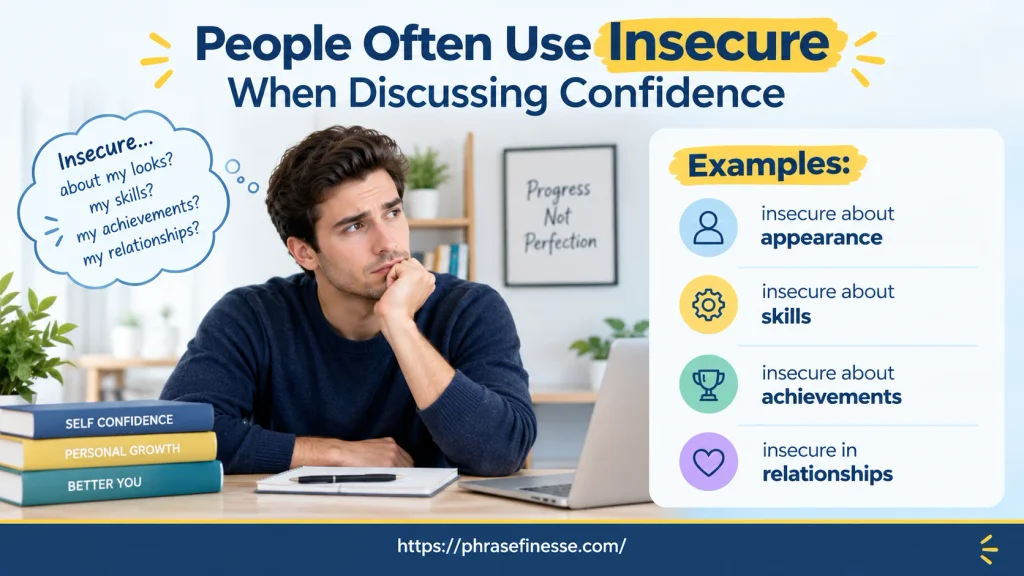
Personal Development
People often use insecure when discussing confidence.
Examples:
- insecure about appearance
- insecure about skills
- insecure about achievements
- insecure in relationships
A person may become insecure after receiving criticism or experiencing failure.
However, insecurity does not always reflect reality. Someone may have excellent skills but still feel insecure because of self-doubt.
Relationships
The word also appears frequently in relationship discussions.
Examples:
- “He feels insecure when his partner spends time with friends.”
- “An insecure attachment style can affect relationships.”
In these cases, insecure describes uncertainty, fear, or a lack of emotional safety.
Work and Career
In professional settings, insecure often describes uncertainty.
Examples:
- “Many workers worry about insecure employment.”
- “The company operates in an insecure market.”
A job becomes insecure when employees cannot predict long-term stability.
Common Mistakes People Make With Unsecure and Insecure
Even though unsecure vs. insecure seems like a small grammar issue, using the wrong word can create confusion. The mistake usually happens because both words relate to the idea of “security.”
However, English depends heavily on context. The same word that works for emotions may sound strange when describing an object.
Let’s look at the most common mistakes and how to fix them.
Mistake 1: Using Unsecure to Describe Feelings
One of the biggest mistakes is using unsecure when talking about emotions.
Incorrect:
“I feel unsecure about my writing skills.”
Correct:
“I feel insecure about my writing skills.”
Why?
Because feelings, confidence, and self-image connect with insecure.
When you describe a person’s thoughts or emotions, use insecure.
Examples:
1.✅ “She feels insecure about her appearance.”
2.✅ “He became insecure after receiving negative feedback.”
3.✅ “Many students feel insecure before important exams.”
Not:
❌ “She feels unsecure about her appearance.”
❌ “He became unsecure after receiving criticism.”
See More : “Support Of” vs. “Support For”: Meaning and Usage
Mistake 2: Using Insecure When You Mean Something Is Not Protected
Another common error happens when people describe physical objects or security systems.
Incorrect:
“The door was insecure because nobody locked it.”
Better:
“The door was unsecured because nobody locked it.”
The first sentence may suggest that the door itself is unreliable, weak, or unstable.
The second sentence clearly explains that someone failed to secure it.
This small difference matters.
Compare:
| Sentence | Meaning |
| “The employee feels insecure.” | The employee lacks confidence. |
| “The employee left the computer unsecured.” | The computer lacked protection. |
Mistake 3: Assuming Unsecure Is Always Wrong
Many people believe unsecure is incorrect English. That is not true.
Unsecure is a valid word, but it is less common than other choices.
For example:
“The area remained unsecure.”
This sentence is understandable.
However, many writers would prefer:
“The area remained unsecured.”
or:
“The area was not secured.”
The choice depends on the style and context.
In everyday writing, unsecured often sounds more natural.
Mistake 4: Confusing Insecure With Uncertain
Sometimes people use insecure when they really mean uncertain.
These words overlap, but they are not identical.
Compare:
Insecure:
“She feels insecure about her leadership skills.”
Meaning:
- She lacks confidence.
Uncertain:
“She feels uncertain about the project deadline.”
Meaning:
- She does not know what will happen.
A person can feel uncertain without feeling insecure.
For example:
You might not know whether a flight will leave on time. That makes you uncertain.
You might believe you are not good enough to give a presentation. That makes you insecure.
Unsecure vs. Insecure Examples in Everyday Sentences
Seeing these words in real examples makes the difference much clearer.
Examples Using Insecure
Personal Confidence
“The new employee felt insecure during the first week.”
The employee lacked confidence in a new environment.
Appearance
“Many people feel insecure when they compare themselves with others online.”
The issue involves self-image.
Relationships
“Constant doubt can make someone feel insecure in a relationship.”
The issue involves emotional safety.
Job Stability
“Temporary workers often experience insecure employment.”
The issue involves uncertainty about future work.
Technology
“Using the same password everywhere creates an insecure online environment.”
The issue involves weak protection.
Examples Using Unsecure
Physical Security
“The warehouse door remained unsecure after closing time.”
The door was not properly protected.
Digital Protection
“The device connected to an unsecure network.”
The network lacked proper protection.
Storage and Access
“The documents were kept in an unsecure location.”
The location was not safe enough.
Unsecure vs. Insecure in Technology and Cybersecurity
Technology creates one of the most confusing areas for these words.
You may see both insecure and unsecure used when discussing websites, apps, networks, and data.
However, cybersecurity professionals usually prefer insecure or unsecured.
Insecure Technology Meaning
In cybersecurity, insecure usually means a system has weaknesses that attackers could exploit.
Examples:
- insecure website
- insecure password
- insecure software
- insecure connection
- insecure network
A system may be insecure because it has:
- outdated software
- weak encryption
- poor authentication
- exposed information
- unsafe settings
Example:
“The website uses an insecure connection, which may expose user information.”
The problem is not simply that someone forgot to secure it. The system itself has a security weakness.
Unsecure Technology Meaning
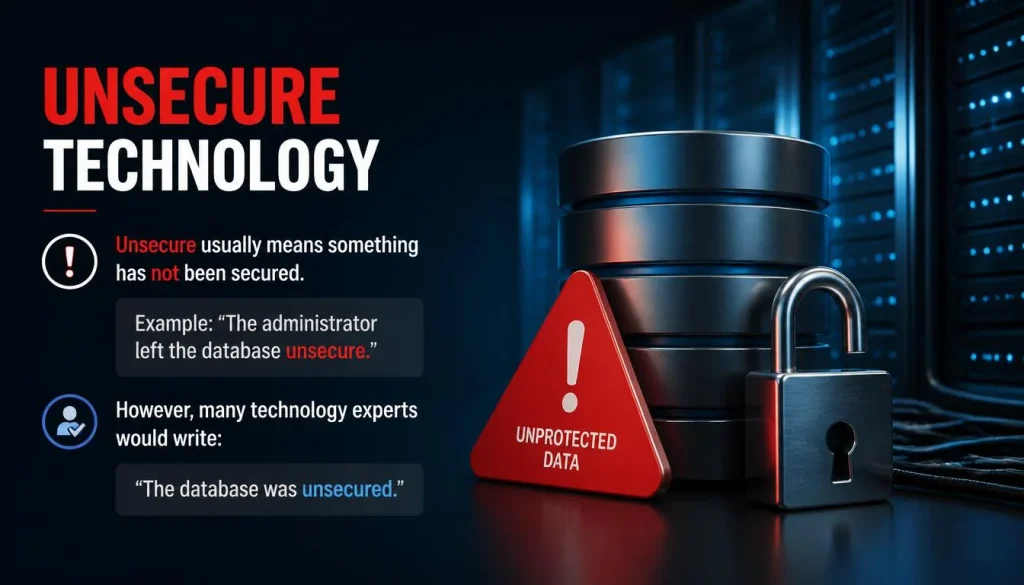
Unsecure usually means something has not been secured.
Example:
“The administrator left the database unsecure.”
This suggests someone failed to apply protection.
However, many technology experts would write:
“The database was unsecured.”
or:
“The database lacked proper security controls.”
These options sound more professional.
Case Study: Choosing the Right Word in Real Situations
Imagine a company launches a new online shopping platform.
During testing, the developers discover several issues.
Situation One: Weak Security
The website allows easy password guessing.
Correct wording:
“The website has an insecure authentication system.”
Why?
The system has a weakness.
Situation Two: Missing Protection
The developers forgot to activate security settings.
Correct wording:
“The website was left unsecured.”
Why?
The protection was not applied.
Situation Three: Employee Confidence
A new customer service representative worries about making mistakes.
Correct wording:
“The employee feels insecure about handling customer calls.”
Why?
The issue involves confidence, not technology.
How to Remember the Difference Between Insecure and Unsecure
A simple memory trick can help you choose the right word.
Ask yourself:
Is the problem inside someone’s confidence or outside in the protection?
If the problem involves confidence, emotions, or stability:
➡️ Use insecure
Examples:
- insecure person
- insecure feelings
- insecure job
- insecure situation
If the problem involves missing protection:
➡️ Use unsecure or unsecured
Examples:
- unsecure door
- unsecured account
- unsecured loan
- unsecured device
A quick comparison:
Insecure describes doubt. Unsecured describes a lack of protection.
Which Word Should You Use in Formal Writing?
When writing professionally, word choice matters.
Business documents, academic writing, and technical reports usually benefit from precise language.
Here is a practical guide:
| Situation | Best Choice |
| Describing emotions | Insecure |
| Describing confidence | Insecure |
| Describing unstable conditions | Insecure |
| Describing cybersecurity risks | Insecure |
| Describing loans | Unsecured |
| Describing missing protection | Unsecured |
| Describing something not locked or guarded | Unsecured |
In most formal situations, unsecured sounds more polished than unsecure.
For example:
Less common:
“The company stored data in an unsecure system.”
Better:
“The company stored data in an unsecured system.”
Best for cybersecurity writing:
“The company stored data in an insecure system.”
The final choice depends on whether you mean missing protection or existing vulnerability.
Unsecure vs. Insecure: Quick Comparison Chart
| Feature | Insecure | Unsecure |
| Main meaning | Lacking confidence, safety, or stability | Not secured or protected |
| Common frequency | Very common | Less common |
| Used for people | Yes | No |
| Used for emotions | Yes | No |
| Used for technology | Yes | Sometimes |
| Used for physical objects | Sometimes | Yes |
| Professional preference | Common | Often replaced by unsecured |
FAQs
1. Is “unsecure” a correct word?
Yes, “unsecure” is a correct word, but it’s less common than “insecure.” It usually describes something that isn’t safe, protected, or firmly secured.
2. Is “insecure” the same as “unsecure”?
Not always. Insecure commonly describes a lack of confidence, certainty, or safety. Unsecure generally focuses on something that isn’t secured or protected. Although they can overlap when discussing safety, they aren’t interchangeable in every context.
3. Should I say “insecure” or “unsecure”?
Choose “insecure” in most situations. It’s much more common and works naturally when describing emotional uncertainty, a lack of confidence, or something unsafe. Use “unsecure” when you specifically mean that something has not been secured.
4. Is it correct to say “an unsecure website”?
It can be understood, but “an insecure website” is more natural and widely accepted. In technical writing, however, “unsecured website” may be even clearer when you mean that the website lacks adequate security measures.
5. Can “insecure” describe a person?
Yes. Insecure frequently describes someone who lacks confidence or feels uncertain about themselves. For example, you might say, “He feels insecure about his appearance.”
6. What is the opposite of “insecure”?
The opposite depends on the context. For a person, confident or self-assured works well. For something related to safety or protection, secure or safe is usually the appropriate opposite.
Conclusion
Although “unsecure” and “insecure” can overlap in meaning, they aren’t always interchangeable. Insecure is far more common and can describe a person who lacks confidence, a situation that creates uncertainty, or something that isn’t safe. Unsecure more specifically suggests that something has not been secured.
When you’re unsure which word to choose, “insecure” is usually the safer choice. However, consider the context carefully. If you’re describing something that simply hasn’t been secured, “unsecured” may be the clearest option.