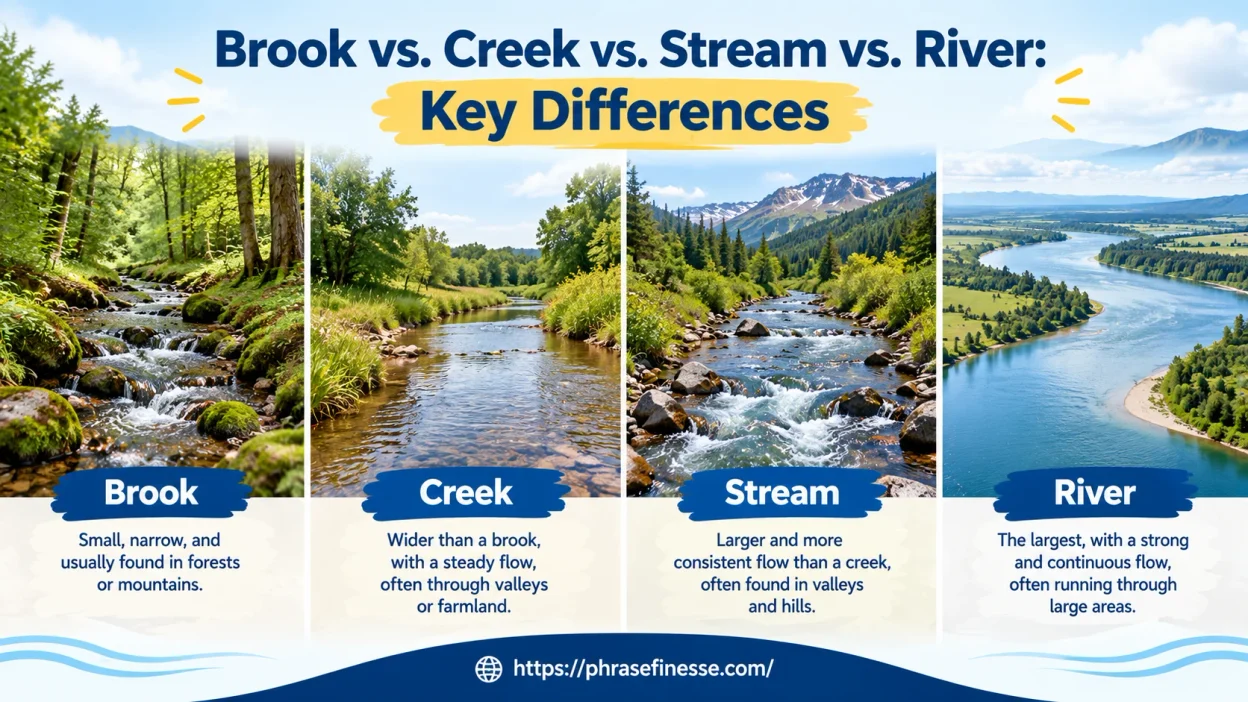
Have you ever stood near a flowing waterway and wondered whether it was a brook, creek, stream, or river? Understanding these terms can be surprisingly confusing because they are often used interchangeably in everyday conversation. In this guide, Brook vs. Creek vs. Stream vs. River: Key Differences , you’ll discover the key differences, defining characteristics, and real-world examples that help distinguish each type of watercourse with confidence.
Although these terms describe flowing bodies of water, factors such as water flow, channel size, depth, width, watershed, tributaries, and geography often determine which label is most appropriate.
This article breaks down the meaning of each term in clear, practical language while exploring how they are used in different regions. You’ll also see visual comparisons that make identifying a brook, creek, stream, or river much easier.
Whether you’re a student, nature enthusiast, writer, or simply curious about English usage, this comprehensive guide will help you understand the distinctions without confusion. We’ll examine definitions, examples, regional variations, and common misconceptions, giving you a complete reference for these important geographical features.
By the end, you’ll know exactly what sets a brook, creek, stream, and river apart and when each term should be used.
Quick Comparison: Brook vs. Creek vs. Stream vs. River
Before diving into detailed explanations, here’s a quick overview.
| Feature | Brook | Creek | Stream | River |
| Typical Size | Very small | Small to medium | Any size | Large |
| Water Flow | Gentle | Moderate | Varies | Strong |
| Scientific Classification | Informal | Informal | Scientific term | Scientific term |
| Width | Narrow | Narrow to moderate | Varies | Wide |
| Tributaries | Rare | Sometimes | Can have tributaries | Usually many tributaries |
| Navigation | No | Rarely | Sometimes | Often |
| Common Regions | UK, Northeastern US | US, Canada, Australia | Worldwide | Worldwide |
Key Takeaway
The simplest way to remember these terms is:
A brook is usually the smallest, a creek is slightly larger, a stream is a general term for flowing water, and a river is typically the largest watercourse.
However, nature doesn’t always follow neat categories.
What Is a Stream?
A stream is the broadest and most widely accepted term used in hydrology.
Simply put, a stream is any body of flowing water that moves within a defined channel. The channel consists of a stream bed and banks that guide the water’s movement.
Because the term is so broad, a brook, creek, and river can all be considered streams.
Characteristics of Streams
Most streams share several features:
- Flowing freshwater
- Defined banks and channel
- Gravity-driven movement
- Continuous or seasonal flow
- Connection to a larger drainage system
Streams can range from tiny mountain channels only a few feet wide to massive waterways stretching hundreds of miles.
Why Scientists Prefer the Term “Stream”
Hydrologists often use the word stream because it avoids regional confusion.
For example:
- One community may call a waterway a creek.
- Another community may call a similar waterway a brook.
- Scientists can simply classify both as streams.
This creates consistency when studying watersheds and ecosystems.
Examples of Streams
Famous streams include:
- Mountain streams in the Rocky Mountains
- Forest streams in the Appalachian Mountains
- Alpine streams in the European Alps
- Tropical rainforest streams in the Amazon Basin
What Is a Brook?
A brook is generally considered a very small natural stream.
The word originated from Old English and remains especially common in the United Kingdom and parts of the northeastern United States.
When people imagine a peaceful woodland waterway with crystal-clear water trickling over rocks, they’re often picturing a brook.
Characteristics of Brooks
Brooks usually have:
- Shallow water
- Narrow channels
- Gentle current
- Clear water
- Limited drainage area
Many brooks are only a few feet wide.
Typical Brook Environment
You’ll commonly find brooks:
- In forests
- Near hillsides
- In mountain valleys
- Across rural landscapes
Because of their small size, brooks often support delicate ecosystems filled with insects, amphibians, and small fish species.
Example of a Brook
A classic New England brook may be only 3 to 10 feet wide and flow quietly through dense woodland before joining a larger stream.
What Is a Creek?
A creek is a small-to-medium-sized flowing waterway.
In many regions, a creek is larger than a brook but smaller than a river.
However, this definition isn’t universal.
Characteristics of Creeks
Most creeks have:
- Greater water volume than brooks
- Wider channels
- Faster current
- Larger drainage basins
- Seasonal fluctuations
Some creeks flow year-round. Others may shrink significantly during dry seasons.
Regional Differences in the Meaning of Creek
The meaning of creek varies depending on location.
United States
In the United States, a creek is usually a smaller watercourse that eventually feeds a stream or river.
Australia
In Australia, creeks may be intermittent waterways that flow only during rainy periods.
United Kingdom
In parts of the UK, the term creek can refer to narrow tidal inlets rather than freshwater channels.
Examples of Well-Known Creeks
Examples include:
- Battle Creek (Michigan)
- Cherry Creek (Colorado)
- Coal Creek (Washington)
- Canning Creek (Australia)
Some creeks are surprisingly large despite their name.
What Is a River?
A river is a large natural watercourse that carries substantial amounts of water across the landscape.
Rivers serve as the primary transportation routes of water within Earth’s hydrological cycle.
Characteristics of Rivers
Rivers generally feature:
- Significant water volume
- Wide channels
- Large watersheds
- Multiple tributaries
- Continuous flow
Many rivers eventually empty into:
- Oceans
- Seas
- Lakes
- Larger rivers
Components of a River System
Understanding rivers becomes easier when you break them into parts.
Source
The source is where the river begins.
Sources may include:
- Springs
- Glaciers
- Lakes
- Snowmelt
Tributaries
Tributaries are smaller streams that feed the main river.
Channel
The channel carries flowing water downstream.
Floodplain
Floodplains are flat areas that rivers periodically flood.
Mouth
The mouth is where the river empties into another body of water.
Famous Rivers
Some of the world’s most famous rivers include:
| River | Approximate Length |
| Nile | 4,132 miles |
| Amazon | 4,000+ miles |
| Mississippi | 2,340 miles |
| Yangtze | 3,915 miles |
| Danube | 1,770 miles |
Brook vs. Creek: What’s the Difference?
Many people use these terms interchangeably.
In practice, several differences usually exist.
| Feature | Brook | Creek |
| Size | Smaller | Larger |
| Water Volume | Lower | Higher |
| Width | Very narrow | Wider |
| Flow Strength | Gentle | Moderate |
| Watershed Size | Small | Larger |
Visualizing the Difference
Imagine pouring water through two garden hoses.
The smaller hose represents a brook.
The larger hose represents a creek.
Both move water. One simply handles more of it.
Ecosystem Differences
Brooks often support:
- Salamanders
- Aquatic insects
- Small trout
Creeks may support:
- Larger fish populations
- Greater biodiversity
- More complex aquatic habitats
Creek vs. Stream: What’s the Difference?
This comparison creates the most confusion.
That’s because every creek can technically be considered a stream.
However, not every stream is called a creek.
Stream Is the Broader Category
Think of the relationship this way:
Stream
├── Brook
├── Creek
└── River
A stream is the umbrella term.
Creek is one specific type of stream.
Why Names Overlap
Many waterways received their names centuries before modern hydrology developed.
As a result:
- Similar waterways may have different names.
- Large creeks may exceed small rivers in size.
- Historical usage often overrides scientific logic.
Stream vs. River: What’s the Difference?
The distinction between streams and rivers usually comes down to scale.
Water Volume
Rivers carry substantially more water.
A small stream may transport only a few gallons per second.
Major rivers transport millions of gallons every second.
See More :Comma Before “If”? A Complete Guide to Correct Punctuation
Drainage Basin
Rivers drain enormous geographic areas.
Streams drain smaller watersheds.
Tributary Networks
Rivers often receive water from dozens or hundreds of tributaries.
Streams usually have fewer tributaries.
Navigation
Many rivers support:
- Commercial shipping
- Fishing boats
- Recreational boating
Most streams do not.
Comparison Table
| Feature | Stream | River |
| Water Volume | Lower | Higher |
| Width | Smaller | Larger |
| Watershed | Smaller | Larger |
| Tributaries | Few | Many |
| Navigation | Limited | Common |
Brook vs. River: The Biggest Contrast
If brook and river sit at opposite ends of the spectrum, the differences become obvious.
Size
A brook may measure only a few feet across.
A river may span several miles in width.
Flow Strength
Brooks flow gently.
Rivers can generate immense force capable of reshaping landscapes.
Human Importance
Rivers have historically supported:
- Cities
- Agriculture
- Transportation
- Trade routes
- Hydroelectric power
Brooks mainly contribute to local ecosystems and feed larger waterways.
Comparison Table
| Feature | Brook | River |
| Width | Few feet | Hundreds or thousands of feet |
| Water Volume | Low | Extremely high |
| Tributaries | Rare | Numerous |
| Navigation | Impossible | Often possible |
| Economic Importance | Local | Regional and global |
How Hydrologists Classify Flowing Water
Scientists use a more precise method than names alone.
That method is called the stream order system.
What Is Stream Order?
Stream order ranks waterways based on how tributaries connect.
The most common method is the Strahler Stream Order System.
First-Order Streams
These are the smallest channels.
They have no tributaries feeding them.
Second-Order Streams
When two first-order streams join, they create a second-order stream.
Third-Order Streams
Two second-order streams create a third-order stream.
The process continues upward.
Why Stream Order Matters
Stream order helps scientists:
- Predict water flow
- Study habitats
- Manage watersheds
- Monitor flooding
- Understand ecosystem health
Interestingly, a waterway named “Creek” may have a higher stream order than one named “River.”
Why Naming Conventions Vary Around the World
Waterway names often reflect history rather than science.
Historical Influences
Many names date back centuries.
Early settlers named waterways based on local traditions.
Those names remained even as scientific understanding improved.
Language Differences
Different languages developed unique terms.
Examples include:
| Language | Common Waterway Term |
| English | Stream |
| German | Bach |
| French | Ruisseau |
| Spanish | Arroyo |
| Italian | Ruscello |
Geographic Influences
Climate also affects naming.
Arid regions may use terms for seasonal waterways.
Wet regions often use names for permanently flowing channels.
Can a Creek Be Larger Than a River?
Surprisingly, yes.
The name alone doesn’t determine size.
Real-World Examples
Several waterways called creeks are larger than nearby rivers.
This happens because:
- Names were assigned historically.
- Early explorers lacked modern surveying tools.
- Communities preserved traditional names.
Case Study: Naming vs. Reality
A waterway might be called a creek because settlers named it that centuries ago.
Over time, scientists measured it and discovered it carries more water than nearby rivers.
Yet the original name remained.
This illustrates an important principle:
Waterway names often reflect history, not hydrology.
The Ecology of Brooks, Creeks, Streams, and Rivers
Each waterway supports different forms of life.
Brook Ecosystems
Common species include:
- Salamanders
- Mayflies
- Stoneflies
- Small trout
Creek Ecosystems
Creeks often support:
- Bass
- Frogs
- Crayfish
- Water birds
River Ecosystems
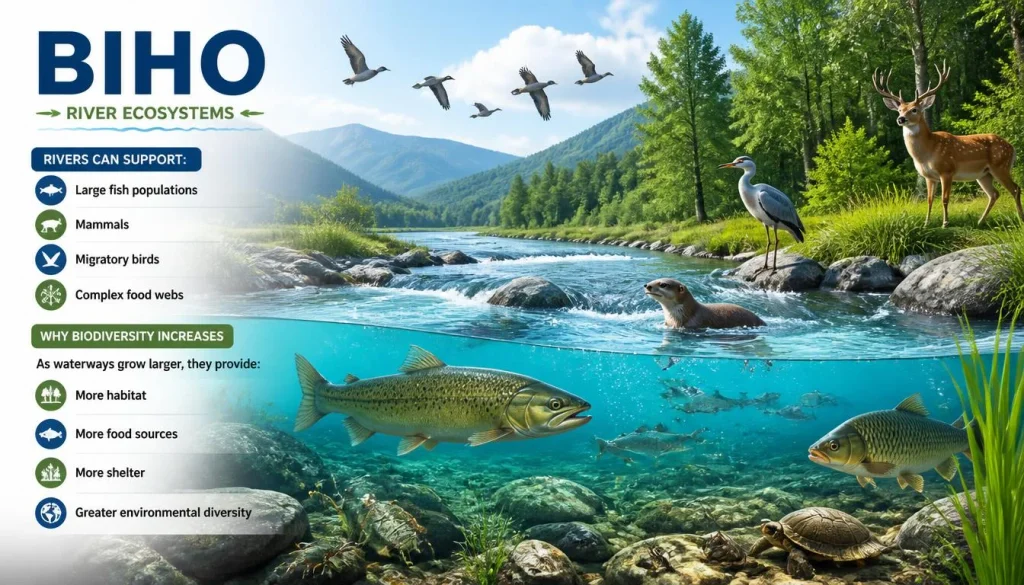
Rivers can support:
- Large fish populations
- Mammals
- Migratory birds
- Complex food webs
Why Biodiversity Increases
As waterways grow larger, they provide:
- More habitat
- More food sources
- More shelter
- Greater environmental diversity
Why These Waterways Matter to Humans
Flowing water shapes civilization.
For thousands of years, people have relied on waterways for survival.
Water Supply
Freshwater systems provide drinking water worldwide.
Agriculture
Farmers depend on rivers and streams for irrigation.
Transportation
Major rivers have served as trade highways throughout history.
Recreation
Popular activities include:
- Fishing
- Kayaking
- Canoeing
- Hiking
- Wildlife observation
Energy Production
Many rivers power hydroelectric facilities.
Visual Size Hierarchy of Waterways
In general, waterways often follow this pattern:
Smallest
↓
Brook
↓
Creek
↓
Stream
↓
River
Largest
Important Note
Nature doesn’t always obey this hierarchy.
Local naming traditions frequently create exceptions.
Common Mistakes People Make
Understanding waterways becomes easier when you avoid several common misconceptions.
Assuming Names Follow Exact Scientific Rules
Names are often historical rather than scientific.
Judging by Width Alone
Width matters, but water volume matters too.
Ignoring Seasonal Changes
A creek during spring floods may appear larger than a river during drought conditions.
Assuming All Streams Are Small
Some streams can be enormous.
The word stream simply describes flowing water.
FAQs
1: What is the main difference between a brook, creek, stream, and river?
The primary difference is size and water flow. A brook is usually the smallest flowing waterway, followed by a creek and a stream. A river is generally the largest, carrying a greater volume of water and often flowing into another river, a lake, or the ocean.
2: Is a creek bigger than a brook?
In most cases, yes. A creek is typically larger than a brook, although the exact distinction can vary by region. Brooks are often narrow, shallow, and gently flowing, while creeks tend to carry more water and cover a wider channel.
3: Is a stream the same as a creek?
Not always. A stream is a broad term for any naturally flowing body of water. A creek is a specific type of stream, usually larger than a brook but smaller than many rivers. Regional naming traditions can also affect how these terms are used.
4: Can a stream become a river?
Yes. As a stream receives water from additional tributaries, it may increase in size, depth, and flow. Once it becomes large enough, it is often classified as a river.
5: Why do different countries use these terms differently?
The naming of waterways is influenced by local geography, history, and language traditions. For example, a waterway called a creek in one country might be referred to as a stream in another, even if their physical characteristics are similar.
6: Which is the largest among a brook, creek, stream, and river?
A river is generally the largest of the four. Rivers usually have the greatest water volume, width, and length, and they often serve as major drainage channels within a watershed.
Conclusion
Understanding the differences between a brook, creek, stream, and river becomes much easier when you focus on their size, water flow, and geographical characteristics. While a brook is usually the smallest and most delicate watercourse, a creek and stream occupy the middle range, with a river representing the largest and most powerful type of flowing water. However, regional naming conventions can sometimes blur these distinctions.
By learning the defining features of each waterway and comparing real-world examples, you can identify them more accurately and understand how they fit into larger drainage systems, watersheds, and natural ecosystems.
Whether you’re studying geography, improving your English vocabulary, or exploring nature, knowing the difference between these terms helps you describe the world around you with greater precision and confidence.

Mia Rose is an English language specialist and editorial writer at Phrase Finesse, where she helps readers master grammar, vocabulary, spelling, and effective communication. Passionate about making English simple and practical, she creates well-researched, reader-friendly content that explains complex language concepts in a clear and engaging way.
With extensive experience in English language education, content writing, and editorial review, Mia specializes in grammar, punctuation, word choice, idioms, confusing word pairs, and writing style. Her articles are carefully researched, fact-checked, and designed to help students, professionals, writers, and English learners build confidence in both written and spoken English.