Have you ever paused while writing and wondered whether Forbade or Forbidden? is the correct word to use? This common point of confusion affects many writers, students, and professionals. Understanding the difference between forbade and forbidden is essential for accurate English usage, strong grammar, and clear formal writing, especially when precision matters.
The distinction becomes even more important in professional settings. Whether you’re handling business communication, managing meetings, organizing a calendar, working on project management tasks, or creating content for broadcasting, choosing the correct verb form helps maintain consistency and credibility. Small grammar mistakes can distract readers and weaken your message.
In this guide, you’ll learn when to use forbade and when forbidden is the right choice. We’ll break down their meanings, grammatical functions, and real-world examples. You’ll also see how correct usage applies to everyday situations involving scheduling, time management, online booking, workplace communication, and professional writing. By the end, you’ll be able to use both forms confidently and avoid one of the most common verb-form mistakes in English.
Forbade or Forbidden?
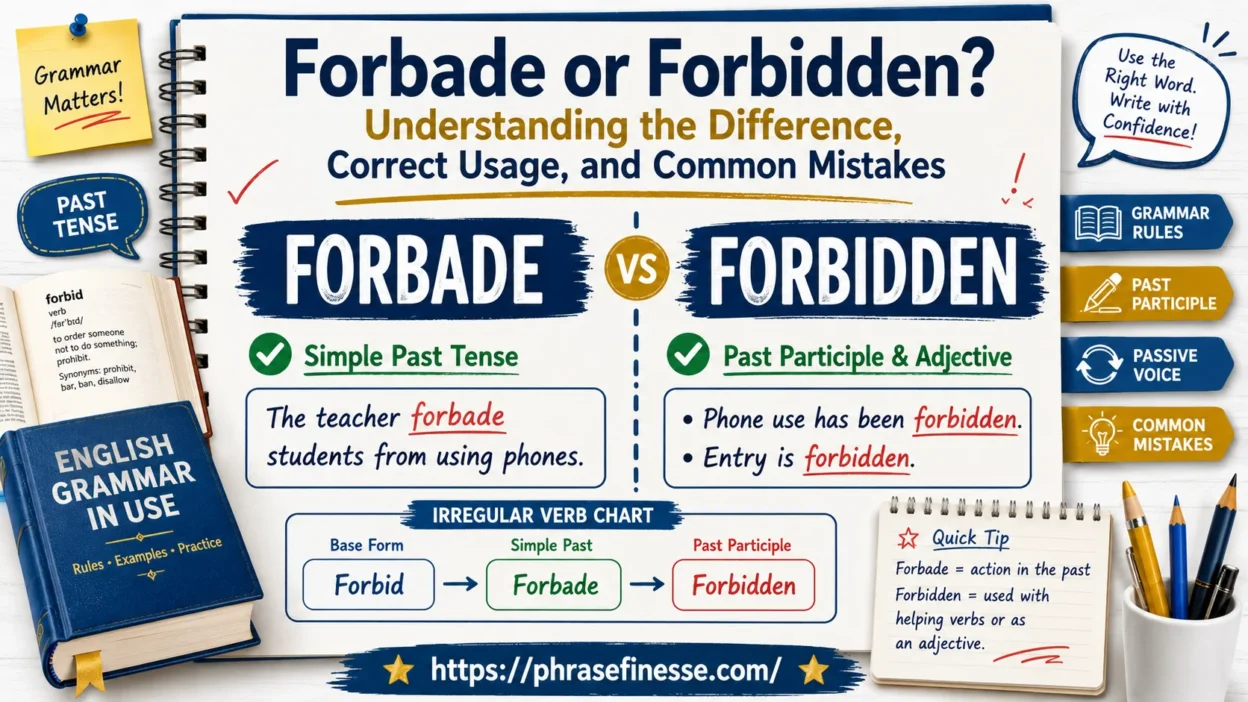
Both forbade and forbidden are correct words.
The difference lies in their grammatical function.
| Word | Grammar Role | Example |
| Forbade | Past tense | She forbade him from entering. |
| Forbidden | Past participle and adjective | Entry is forbidden. |
Simple Rule
- Use forbade for an action that happened in the past.
- Use forbidden with helping verbs such as has, have, had, was, were, and been.
- Use forbidden as an adjective to describe something prohibited.
For example:
✅ 1. The principal forbade students from using phones.
✅ 2. The principal has forbidden phone use.
✅ 3. Phone use is forbidden.
❌ 4. The principal has forbade phone use.
❌ 5. Phone use was forbade.
Those last two examples are incorrect because they use the wrong verb form.
Understanding the Verb “Forbid”
To understand the difference between forbade and forbidden, you first need to understand the verb forbid.
The word forbid means:
To refuse permission for something or to order someone not to do something.
Examples:
- Parents forbid dangerous behavior.
- Governments forbid certain activities.
- Schools forbid cheating.
- Employers forbid unauthorized access.
The word comes from Old English and has existed in the language for more than a thousand years.
Like many older English verbs, forbid is irregular.
That means it doesn’t simply add “-ed” to form the past tense.
The Complete Verb Forms of Forbid
Here is the full conjugation of the verb.
| Verb Form | Word |
| Base Form | Forbid |
| Third-Person Singular | Forbids |
| Present Participle | Forbidding |
| Past Tense | Forbade |
| Past Participle | Forbidden |
Understanding this table instantly clears up most confusion.
Think of it like other irregular verbs.
| Base Verb | Past Tense | Past Participle |
| Write | Wrote | Written |
| Speak | Spoke | Spoken |
| Break | Broke | Broken |
| Choose | Chose | Chosen |
| Forbid | Forbade | Forbidden |
Notice the pattern.
The past tense and past participle are different forms.
That’s exactly why forbade and forbidden exist
What Does Forbade Mean?
Forbade is the simple past tense of the verb forbid.
It describes something that happened and ended in the past.
Definition of Forbade
Forbade means that someone prohibited, banned, or refused permission for something in the past.
Examples of Forbade
- The teacher forbade talking during the exam.
- My parents forbade me from staying out late.
- The king forbade travel outside the city.
- The company forbade employees from sharing passwords.
- Doctors forbade him from returning to work too soon.
Each sentence describes a completed action.
Someone prohibited something.
The action happened in the past.
When to Use Forbade
You should use forbade whenever you need the simple past tense.
Past Actions
Examples:
- She forbade visitors after surgery.
- The coach forbade junk food during training camp.
- The government forbade public gatherings.
- The judge forbade communication between witnesses.
Common Sentence Patterns
The word often appears in these structures:
Subject + Forbade + Object + From + Verb
Examples:
- She forbade him from driving.
- The manager forbade employees from smoking.
- The teacher forbade students from cheating.
Subject + Forbade + Object + Noun
Examples:
- The school forbade cell phones.
- The company forbade personal devices.
- The city forbade fireworks.
These patterns appear frequently in both formal and informal writing.
What Does Forbidden Mean?
Forbidden serves two different roles.
It can be:
- A past participle
- An adjective
This dual function makes it more common than forbade in everyday English.
Definition of Forbidden
As a past participle, forbidden helps create perfect and passive verb constructions.
As an adjective, it describes something that is prohibited, banned, or not allowed.
Using Forbidden as a Past Participle
Past participles typically appear with helping verbs.
Examples
- Smoking has been forbidden.
- Access was forbidden.
- The activity had been forbidden for years.
- Certain substances are forbidden.
- The use of phones has been forbidden.
Notice how each sentence contains a helping verb.
Words such as:
- Has
- Have
- Had
- Is
- Are
- Was
- Were
- Been
signal that forbidden should be used.
Read More: 5 Ways to Describe the Sound of Rain: Words, Examples, and Tips
Using Forbidden as an Adjective
This is where the word becomes especially common.
When used as an adjective, forbidden describes a noun.
Examples
- Forbidden knowledge
- Forbidden love
- Forbidden territory
- Forbidden fruit
- Forbidden magic
- Forbidden books
In these examples, forbidden acts exactly like any other adjective.
Compare:
- Red apple
- Tall building
- Forbidden fruit
The adjective simply describes the noun.
Why Forbidden Appears More Often Than Forbade
If you read books, newspapers, websites, or novels, you’ll probably encounter forbidden more often.
There are several reasons.
It Functions as Both a Verb and an Adjective
Forbade only works as a past tense verb.
Forbidden works as:
- Past participle
- Adjective
That gives it more opportunities to appear.
It Appears in Fixed Expressions
Common phrases include:
- Forbidden fruit
- Forbidden love
- Forbidden city
- Forbidden knowledge
- Forbidden zone
These expressions appear frequently in literature, movies, and popular culture.
It Appears in Rules and Regulations
Signs often say:
- Entry forbidden
- Photography forbidden
- Parking forbidden
You rarely see forbade used this way.
Forbade vs Forbidden: Side-by-Side Comparison
| Feature | Forbade | Forbidden |
| Verb Form | Past tense | Past participle |
| Used Alone | Yes | Usually no |
| Used With Helping Verbs | No | Yes |
| Works as Adjective | No | Yes |
| Common in Signs | No | Yes |
| Describes Past Action | Yes | Sometimes |
| Describes Prohibited Things | No | Yes |
This table summarizes the core distinction.
A Simple Memory Trick
If you’re unsure which word to use, try this quick test.
Test One
Can you place has, have, had, was, or were before the word?
If yes, use forbidden.
Examples:
- Has forbidden
- Had forbidden
- Was forbidden
All correct.
Test Two
Are you describing a completed action in the past?
If yes, use forbade.
Examples:
- The teacher forbade talking.
- The judge forbade discussion.
- The coach forbade shortcuts.
This simple trick solves most usage problems instantly.
Common Mistakes People Make
Many errors come from mixing past tense and past participle forms.
Let’s examine the most common mistakes.
Mistake: Using Forbidden as a Simple Past Verb
Incorrect:
❌ She forbidden him from leaving.
Correct:
✅ She forbade him from leaving.
✅ She has forbidden him from leaving.
Mistake: Using Forbade After a Helping Verb
Incorrect:
❌ The activity was forbade.
Correct:
✅ The activity was forbidden.
Mistake: Using Forbade as an Adjective
Incorrect:
❌ A forbade book.
Correct:
✅ A forbidden book.
Only forbidden functions as an adjective.
Mistake: Mixing Verb Forms
Incorrect:
❌ They had forbade entry.
Correct:
✅ They had forbidden entry.
The helping verb had requires the past participle.
Real-World Examples of Forbade
Seeing words in context helps them stick.
Education
- The principal forbade students from using calculators.
- Teachers forbade conversations during testing.
Workplace
- Management forbade unauthorized software.
- The company forbade personal data transfers.
Government
- Officials forbade large gatherings.
- Authorities forbade construction near the river.
Sports
- Coaches forbade late-night outings.
- The league forbade performance-enhancing substances.
In each case, someone prohibited something in the past.
Real-World Examples of Forbidden
Now let’s examine forbidden.
Public Signs
- Photography forbidden.
- Smoking forbidden.
- Entry forbidden.
Legal Contexts
- Certain actions are forbidden by law.
- The practice has been forbidden nationwide.
Literature
- Forbidden love
- Forbidden secrets
- Forbidden powers
Religion
Many religious texts contain references to forbidden acts, foods, places, or behaviors.
The adjective form appears particularly often in these contexts.
Case Study: Why “Forbidden Fruit” Is Correct
One of the most famous expressions in English is forbidden fruit.
Many people understand the phrase but never stop to think about its grammar.
Why Not “Forbade Fruit”?
Because forbidden functions as an adjective.
The phrase means:
Fruit that is prohibited.
The word describes the fruit.
It does not describe a past action.
That’s why forbidden fruit is correct and forbade fruit sounds wrong.
Modern Meaning
Today, the phrase often refers to:
- Something tempting
- Something restricted
- Something people want because they cannot have it
The phrase survives because it captures a universal human experience.
Restrictions often increase desire.
Case Study: School Policy Example
Imagine a school introduces a new rule.
Announcement Day
“The principal forbade cellphone use during exams.”
This sentence describes what happened.
The principal took action.
Policy Description
“Cellphone use is forbidden during exams.”
Now the focus shifts to the rule itself.
Both sentences are correct.
Each serves a different grammatical purpose.
This example perfectly illustrates the distinction.
Why English Uses Different Verb Forms
English inherited many irregular verbs from earlier stages of the language.
Words such as:
- Write → Wrote → Written
- Speak → Spoke → Spoken
- Break → Broke → Broken
- Forbid → Forbade → Forbidden
follow patterns that developed centuries ago.
Although they may seem complicated, they often become intuitive through repeated exposure.
The key is recognizing that English frequently separates:
- Past tense
- Past participle
into different forms.
What Dictionaries Say About Forbade and Forbidden
Major dictionaries consistently define:
Forbade
- The simple past tense of forbid.
Forbidden
- The past participle of forbid.
- An adjective meaning prohibited or not allowed.
Grammar authorities agree on this distinction.
There is no serious disagreement among modern style guides.
Formal Writing vs Informal Writing
The good news is that the rules remain identical.
Whether you’re writing:
- Academic papers
- Business emails
- News articles
- Social media posts
- Legal documents
the distinction never changes.
Formal Example
The court forbade disclosure of confidential information.
Informal Example
My parents forbade me from staying out late.
Formal Example
The activity was forbidden under company policy.
Informal Example
That area is forbidden after dark.
The grammar stays exactly the same.
Quick Reference Cheat Sheet
| Situation | Correct Word |
| Completed action in the past | Forbade |
| After has | Forbidden |
| After have | Forbidden |
| After had | Forbidden |
| After was | Forbidden |
| After were | Forbidden |
| Describing a noun | Forbidden |
| Creating a passive sentence | Forbidden |
| Simple past narrative | Forbade |
Save this chart if you frequently mix the two forms.
FAQs
Is it “forbade” or “forbidden”?
Both are correct, but they serve different grammatical functions. Forbade is the simple past tense of forbid, while forbidden is the past participle used with auxiliary verbs or in passive voice constructions.
When should I use “forbade”?
Use forbade when describing a completed action in the past.
Example:
The teacher forbade students from using their phones during class.
When should I use “forbidden”?
Use forbidden with helping verbs such as has, have, had, is, are, or was.
Example:
Mobile phone use has been forbidden in the examination hall.
Is “forbidden” an adjective?
Yes. Forbidden can function as an adjective to describe something that is not allowed.
Example:
They entered a forbidden area.
Which is more common in formal writing: “forbade” or “forbidden”?
Both appear frequently in formal writing, but they are used in different contexts. Forbade is used for simple past actions, while forbidden commonly appears in passive and perfect-tense constructions.
How can I easily remember the difference between “forbade” and “forbidden”?
A simple trick is to remember:
- Forbade = Past tense (something happened in the past)
- Forbidden = Past participle (used with helping verbs or as an adjective)
Example:
The manager forbade unauthorized access.
Unauthorized access is forbidden.
Conclusion
Understanding the difference between forbade and forbidden is essential for correct English usage and effective communication. While forbade serves as the simple past tense of forbid, forbidden functions as the past participle and typically appears with helping verbs such as has, have, had, is, or was. Knowing when to use each form helps you write with greater accuracy and confidence.
Whether you’re preparing formal writing, handling business communication, managing project management documents, or sending everyday messages, using the correct verb form improves clarity and maintains consistency. Grammar may seem like a small detail, but it plays a significant role in how readers perceive your professionalism and credibility.
By remembering the simple rule forbade for past actions and forbidden for perfect and passive constructions you can avoid common mistakes and communicate more effectively in any setting.