Have you ever paused while writing and wondered whether you should use forgot or forgotten? It’s a common question, even among fluent English speakers. In this guide, “Forgot or Forgotten? Difference Explained”, you’ll learn the exact difference between these two verb forms, when to use each one, and how they fit into correct English usage.
Understanding this distinction can improve your grammar, strengthen your formal writing, and help you communicate with greater consistency in both professional and everyday situations.
The difference becomes especially important in real-world contexts where clear language matters. Whether you’re managing business communication, organizing meetings, updating a calendar, handling project management tasks, or sending messages related to online booking, choosing the correct word helps your writing sound polished and accurate. Small grammar mistakes can create confusion, while proper usage builds credibility and clarity. That’s why mastering commonly confused verb forms remains an essential part of effective communication.
In the sections ahead, you’ll discover the grammatical roles of forgot and forgotten, explore practical examples, learn common mistakes to avoid, and see how native speakers use these forms in everyday conversations.
We’ll also examine their use in contexts such as scheduling, time management, broadcasting, workplace communication, and professional correspondence. By the end of this article, you’ll have a clear understanding of when each word belongs in a sentence and how to use them confidently in any writing situation.
Forgot vs. Forgotten: What’s the Difference?
The difference is surprisingly simple:
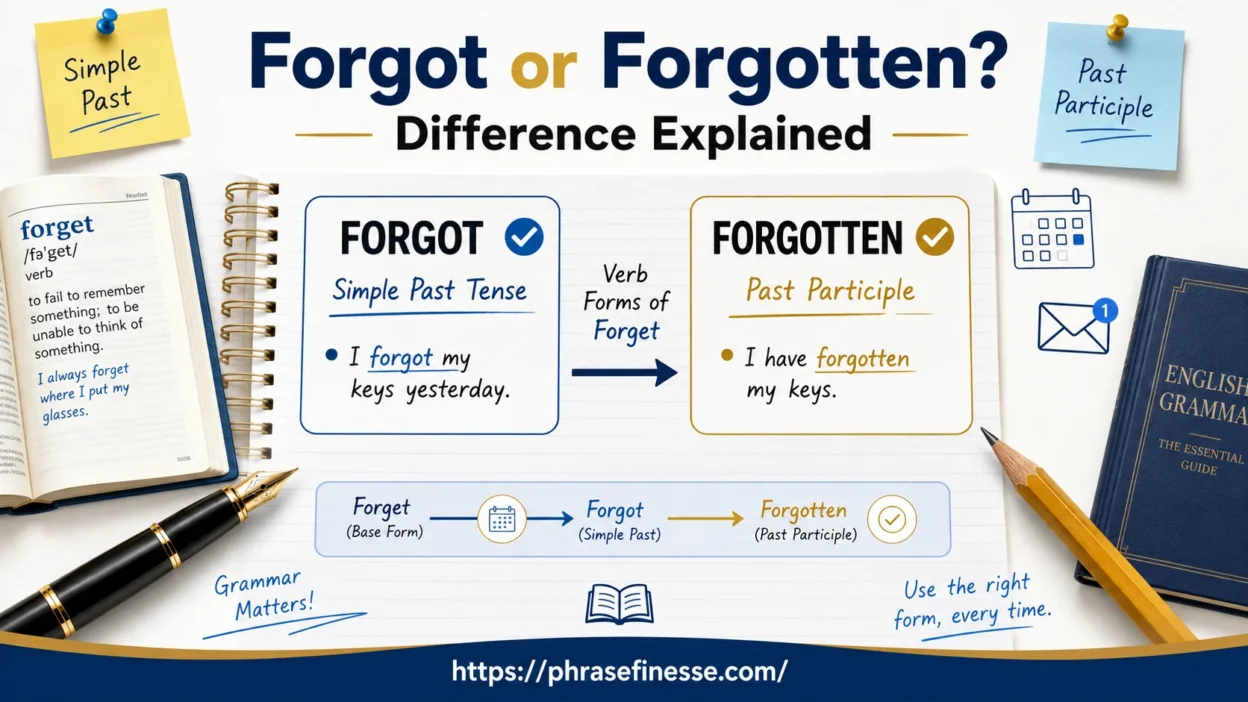
- Forgot is the simple past tense of forget.
- Forgotten is the past participle of forget.
Here’s the quickest way to remember it:
| Word | Verb Form | Example |
| Forgot | Simple past tense | I forgot my umbrella. |
| Forgotten | Past participle | I have forgotten my umbrella. |
The word forgot can stand alone as the main verb in a sentence.
The word forgotten usually needs a helping verb such as have, has, had, or been.
Quick Examples
✅ 1. I forgot her birthday.
✅ 2. She forgot to lock the door.
✅ 3. I have forgotten her birthday.
✅ 4. They had forgotten the appointment.
Understanding the Verb Forms of “Forget”
English verbs change form depending on tense. The verb forget follows an irregular pattern.
Complete Conjugation Chart
| Verb Form | Word |
| Base Form | Forget |
| Simple Present | Forget / Forgets |
| Simple Past | Forgot |
| Past Participle | Forgotten |
| Present Participle | Forgetting |
Unlike regular verbs that simply add -ed, irregular verbs change form entirely.
For example:
| Base Verb | Past Tense | Past Participle |
| Forget | Forgot | Forgotten |
| Speak | Spoke | Spoken |
| Break | Broke | Broken |
| Freeze | Froze | Frozen |
| Write | Wrote | Written |
Notice a pattern?
Many irregular verbs use a different past participle than their simple past tense. That’s exactly why people confuse forgot and forgotten.
Why English Uses Past Participles
A past participle helps create more complex verb tenses.
Think of it as a building block.
You combine it with helping verbs to express timing and relationships between events.
Examples
Simple Past
- I forgot my password.
Present Perfect
- I have forgotten my password.
Past Perfect
- I had forgotten my password before logging in.
Future Perfect
- By tomorrow, I will have forgotten all about it.
Without the helping verb, the past participle usually cannot function correctly.
When to Use “Forgot”
The word forgot is used when talking about something that happened and ended in the past.
The action is complete.
No helping verb is necessary.
Signs You Need “Forgot”
Look for time expressions such as:
- Yesterday
- Last week
- Last year
- Earlier today
- Two hours ago
- In 2024
Examples
- I forgot my wallet yesterday.
- She forgot the meeting last week.
- We forgot his address.
- They forgot to submit the report.
- He forgot my name.
In each example, the action occurred in the past and is already finished.
Everyday Examples of “Forgot”
1. At Work
- I forgot to attach the document.
- She forgot the client meeting.
- We forgot to update the spreadsheet.
2. At School
- He forgot his homework.
- They forgot the exam date.
- I forgot my textbook.
3. At Home
- Mom forgot the grocery list.
- Dad forgot where he parked.
- I forgot to feed the cat.
Notice how natural these sentences sound without any helping verb.
Common Sentence Patterns With “Forgot”
1. Forgot + Noun
- I forgot my keys.
- She forgot the address.
2. Forgot + Infinitive
- I forgot to call him.
- We forgot to lock the door.
3. Forgot + Question Word
- I forgot where I put it.
- She forgot how to solve the problem.
These structures appear constantly in everyday English.
When to Use “Forgotten”
The word forgotten functions as a past participle.
Most of the time, it appears alongside a helping verb.
The Most Common Helping Verbs
- Have
- Has
- Had
- Been
- Will have
Examples
- I have forgotten your name.
- She has forgotten the password.
- We had forgotten the reservation.
- They have forgotten the rules.
Notice that forgotten never appears alone as the main verb in these examples.
Read More: Forbade or Forbidden? Understanding the Difference
Using “Forgotten” in Perfect Tenses
Perfect tenses connect different points in time.
This is where forgotten shines.
Present Perfect: Have Forgotten
The present perfect links a past action to the present.
Structure
Subject + Have/Has + Forgotten
Examples
- I have forgotten my phone.
- She has forgotten her keys.
- They have forgotten the instructions.
The forgetting happened in the past, but its effect continues now.
For example:
I have forgotten my password.
The problem still exists in the present.
Past Perfect: Had Forgotten
Past perfect describes an action completed before another past event.
Structure
Subject + Had + Forgotten
Examples
- I had forgotten the appointment before she reminded me.
- They had forgotten the deadline.
- He had forgotten my birthday until he saw the reminder.
Timeline:
Forgot → Reminder → Realization
The forgetting occurred first.
Future Perfect: Will Have Forgotten
Future perfect refers to actions completed before a future point.
Structure
Subject + Will Have + Forgotten
Examples
- By next month, I will have forgotten the incident.
- She will have forgotten the details.
- They will have forgotten the argument.
This tense is less common but still important.
Forgot vs. Forgotten in a Sentence
One of the easiest ways to learn is through comparison.
Side-by-Side Examples
| Incorrect | Correct |
| I have forgot my keys. | I have forgotten my keys. |
| She has forgot the address. | She has forgotten the address. |
| We had forgot the meeting. | We had forgotten the meeting. |
| I forgotten my wallet. | I forgot my wallet. |
| He forgotten the answer. | He forgot the answer. |
The Golden Rule
Ask yourself:
Do I have a helping verb?
If yes, use forgotten.
If no, use forgot.
Common Mistakes People Make
Many grammar errors come from mixing these forms.
Let’s look at the most frequent ones.
Mistake: Using “Forgot” After Have, Has, or Had
Incorrect:
❌ 1. I have forgot.
❌ 2. She has forgot.
❌ 3. They had forgot.
Correct:
✅1. I have forgotten.
✅2. She has forgotten.
✅ 3. They had forgotten.
Whenever you see have, has, or had, the correct choice is almost always forgotten.
Mistake: Using “Forgotten” Without a Helping Verb
Incorrect:
❌ I forgotten my keys.
❌ He forgotten the answer.
Correct:
✅ I forgot my keys.
✅ He forgot the answer.
The word forgotten generally needs support from a helping verb.
Mistake: Translating Directly From Another Language
Many languages don’t separate simple past and past participles the same way English does.
As a result, learners often transfer grammar patterns incorrectly.
The solution is practice and exposure to real English examples.
Forgot vs. Forgotten in American and British English
Both forms exist in American and British English.
The grammar rules remain the same.
However, subtle usage differences appear.
American English
American speakers frequently use:
- I forgot.
- I’ve forgotten.
The simple past often dominates casual speech.
Example
- I forgot where I parked.
This sounds perfectly natural.
British English
British speakers tend to use the present perfect slightly more often.
Example
- I’ve forgotten where I parked.
This usage emphasizes the present consequence.
Despite this tendency, both versions remain grammatically correct.
Real-Life Examples From Everyday Situations
Grammar becomes easier when connected to real situations.
At Work
Imagine you’re sending an email.
Simple Past
- I forgot to include the attachment.
Present Perfect
- I have forgotten to include the attachment.
The second sentence emphasizes the ongoing problem.
During Travel
Simple Past
- I forgot my passport at home.
Present Perfect
- I have forgotten my passport.
The second version highlights the current issue you’re facing.
At School
Simple Past
- She forgot her homework yesterday.
Present Perfect
- She has forgotten her homework again.
Both work, but they communicate slightly different ideas.
In Relationships
Examples
- He forgot our anniversary.
- She has forgotten what happened.
- They had forgotten their first meeting story.
Real conversations often switch naturally between both forms.
Memory Trick to Never Mix Them Up Again
Here’s an easy shortcut.
The Helping Verb Test
Ask:
Is there a helping verb before the word?
If Yes
Use forgotten.
Examples:
- Have forgotten
- Has forgotten
- Had forgotten
- Will have forgotten
If No
Use forgot.
Examples:
- Forgot yesterday
- Forgot the keys
- Forgot to call
Visual Formula
No Helping Verb
↓
FORGOT
Helping Verb
(Have/Has/Had)
↓
FORGOTTEN
This simple formula solves most confusion instantly.
Similar Verb Pairs That Follow the Same Pattern
Learning patterns helps you master grammar faster.
Common Examples
| Base Verb | Past Tense | Past Participle |
| Forget | Forgot | Forgotten |
| Speak | Spoke | Spoken |
| Freeze | Froze | Frozen |
| Break | Broke | Broken |
| Write | Wrote | Written |
| Drive | Drove | Driven |
| Choose | Chose | Chosen |
| Wake | Woke | Woken |
Notice the recurring structure.
The past participle often ends differently than the simple past tense.
Why Learners Confuse These Forms
Several factors contribute to confusion.
Similar Appearance
The words look related.
Many learners assume they can substitute one for the other.
They can’t.
Irregular Verb Patterns
English contains hundreds of irregular verbs.
Unfortunately, there isn’t a single rule that covers all of them.
Memorization and exposure help.
Spoken English Shortcuts
In casual speech, people sometimes use incorrect grammar.
For example:
“I have forgot.”
You may hear it occasionally.
However, standard English considers it incorrect.
Always use:
“I have forgotten.”
Practice Quiz: Test Your Understanding
Choose the correct word.
Questions
- I _____ my wallet yesterday.
- She has _____ her phone.
- We had _____ the reservation.
- He _____ to lock the door.
- They have _____ the instructions.
Answers
- Forgot ✅
- Forgotten ✅
- Forgotten ✅
- Forgot ✅
- Forgotten ✅
Explanation
Questions 2, 3, and 5 contain helping verbs.
Therefore, they require forgotten.
Questions 1 and 4 do not contain helping verbs.
Therefore, they require forgot.
Quick Reference Table
| Situation | Correct Word |
| Simple past action | Forgot |
| After have | Forgotten |
| After has | Forgotten |
| After had | Forgotten |
| After will have | Forgotten |
| Completed past event | Forgot |
| Present perfect tense | Forgotten |
| Past perfect tense | Forgotten |
Bookmark this table if you often mix them up.
Expert Tip: Focus on the Auxiliary Verb
Professional editors often check auxiliary verbs first.
Why?
Because the helping verb reveals the correct form immediately.
Consider these examples:
- Have → forgotten
- Has → forgotten
- Had → forgotten
No helping verb?
Use forgot.
This method works nearly every time.
Key Takeaways
Before finishing, remember these essential points:
- Forget is the base verb.
- Forgot is the simple past tense.
- Forgotten is the past participle.
- Use forgot for completed past actions.
- Use forgotten with helping verbs.
- The helping verb test quickly identifies the correct choice.
- Both American and British English follow the same grammar rules.
Master this distinction and you’ll avoid one of the most common English grammar mistakes.
FAQs
1. What is the difference between forgot and forgotten?
Forgot is the simple past tense of the verb forget, while forgotten is the past participle. You use forgot by itself to describe a past action, but forgotten usually requires a helping verb such as have, has, or had.
Example:
- I forgot my keys yesterday.
- I have forgotten my keys.
2. Is it correct to say “I forgotten”?
No, “I forgotten” is grammatically incorrect in standard English. You need a helping verb before forgotten.
Correct examples:
- I have forgotten my password.
- I had forgotten the meeting time.
3. Can forgot and forgotten be used interchangeably?
No. Although both come from the verb forget, they serve different grammatical functions. Replacing one with the other can make a sentence incorrect.
Incorrect: I have forgot my wallet.
Correct: I have forgotten my wallet.
4. Why do some people say “have forgot” instead of “have forgotten”?
In some regional dialects and informal speech, people may say “have forgot.” However, in standard English and formal writing, “have forgotten” is considered the correct form.
5. Which form is more common in professional writing?
Professional documents, academic papers, and business communication generally follow standard grammar rules. Therefore, forgotten is used after helping verbs, while forgot is used as the simple past tense.
Examples:
- She forgot the attachment.
- She has forgotten the attachment.
6. How can I remember when to use forgotten?
A simple rule is to look for a helping verb. If the sentence contains have, has, had, or had been, you will usually need forgotten. If you’re simply describing a completed action in the past, use forgot.
Quick tip:
- Past action → forgot
- Perfect tense → forgotten
Conclusion
Understanding the difference between forgot and forgotten is essential for accurate English usage and effective communication. While forgot is the simple past tense of forget, forgotten is the past participle and typically appears with helping verbs such as have, has, or had. Although the distinction seems small, using the correct form improves grammar, strengthens formal writing, and ensures greater consistency in both spoken and written English.
Whether you’re drafting emails, managing business communication, organizing meetings, updating a calendar, or handling project management tasks, proper verb usage helps your message remain clear and professional. By learning when to use forgot and when to use forgotten, you can avoid common mistakes and write with greater confidence. The more you practice these forms in everyday situations, the more natural they will become.

Mia Rose is an English language specialist and editorial writer at Phrase Finesse, where she helps readers master grammar, vocabulary, spelling, and effective communication. Passionate about making English simple and practical, she creates well-researched, reader-friendly content that explains complex language concepts in a clear and engaging way.
With extensive experience in English language education, content writing, and editorial review, Mia specializes in grammar, punctuation, word choice, idioms, confusing word pairs, and writing style. Her articles are carefully researched, fact-checked, and designed to help students, professionals, writers, and English learners build confidence in both written and spoken English.