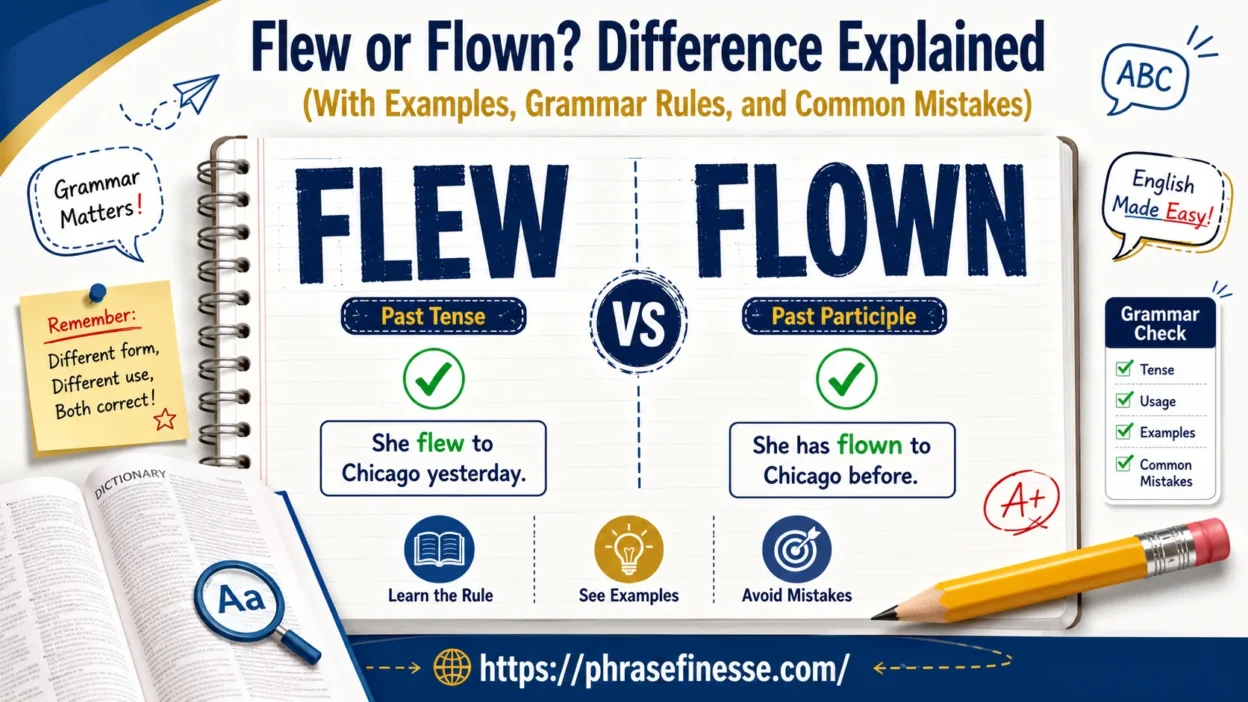
Have you ever paused while writing and wondered whether you should use “flew” or “flown”? If so, you’re not alone. Flew or Flown? Difference Explained is a common grammar question that affects both everyday conversations and professional communication. Understanding the correct form improves English usage, strengthens formal writing, and helps you communicate with greater consistency and confidence.
Although both words come from the verb “fly,” they serve different grammatical purposes. “Flew” is the simple past tense, while “flown” is the past participle used with helping verbs. Knowing when to use each form can make a noticeable difference in business communication, broadcasting, emails, reports, and other professional documents. It also helps prevent mistakes that may affect clarity and credibility.
In this guide, you’ll learn the exact difference between flew and flown, along with practical examples and easy-to-follow rules. We’ll also explore how correct grammar supports effective communication in areas such as scheduling, time management, online booking, meetings, calendar planning, and project management. By the end, you’ll know which word fits each situation and how to use both naturally in spoken and written English.
Flew vs. Flown: The Quick Difference
The simplest way to understand the difference is this:
| Word | Verb Form | Example |
| Flew | Simple Past Tense | We flew to Texas yesterday. |
| Flown | Past Participle | We have flown to Texas several times. |
Quick Rule
- Use flew when talking about a completed action in the past.
- Use flown with helping verbs such as has, have, had, is, was, were, be, been, or being.
Examples
✅ She flew to Chicago last weekend.
✅ They have flown across the Atlantic many times.
❌ She has flew to Chicago.
❌ They flown across the Atlantic.
The distinction may seem small, yet it plays a major role in proper English grammar.
What Does “Fly” Mean?
Before comparing flew and flown, it helps to understand the base verb itself.
Definition of Fly
The verb fly generally means:
To move through the air using wings, aircraft, or other means of aerial travel.
However, English uses the word in several related ways.
Common Meanings of Fly
| Meaning | Example |
| Travel through the air | The plane will fly to Paris. |
| Move using wings | Birds fly south for winter. |
| Move quickly | The baseball flew over the fence. |
| Display a flag | They fly the national flag daily. |
| Pass rapidly | Time flies when you’re having fun. |
Because the verb appears in many contexts, understanding all its forms becomes especially important.
Understanding the Verb Forms of “Fly”
Like many frequently used English verbs, fly is an irregular verb.
That means it doesn’t follow the typical pattern of simply adding -ed to form the past tense.
Complete Verb Forms of Fly
| Verb Form | Word |
| Base Form | Fly |
| Third-Person Singular | Flies |
| Present Participle | Flying |
| Simple Past | Flew |
| Past Participle | Flown |
Example of Every Form
- I fly to New York every month.
- She flies internationally for work.
- They are flying over the mountains.
- We flew to California yesterday.
- We have flown to California many times.
Notice how flew and flown each have a unique grammatical role.
Why English Learners Confuse Flew and Flown
Many learners struggle because both words refer to past actions.
Consider these examples:
- I flew to Boston.
- I have flown to Boston.
Both describe travel that happened before now.
However, the sentence structures differ.
The first uses the simple past tense.
The second uses the present perfect tense.
Because English contains several past-related tenses, learners often accidentally swap the two forms.
When to Use “Flew”
The word flew is the simple past tense form of fly.
Use it when discussing an action that happened and finished at a specific point in the past.
Rule for Using Flew
Use flew when:
- The action is complete.
- A specific past time is mentioned or implied.
- No helping verb appears.
Examples
- We flew to Miami last week.
- She flew home after graduation.
- The eagle flew across the canyon.
- They flew over the city yesterday.
- A drone flew above the stadium.
Time Expressions Commonly Used with Flew
You will often see flew alongside phrases such as:
- Yesterday
- Last night
- Last year
- Last month
- Earlier today
- In 2024
- Two weeks ago
Examples
✅ 1. I flew to Seattle last month.
✅ 2.The bird flew away yesterday.
✅ 3. They flew across Europe in 2026.
These time markers signal that the simple past tense is required.
How Flew Works in Sentences
A useful pattern is:
Subject + flew + remainder of sentence
Examples
- The pilot flew the aircraft safely.
- Sarah flew to Toronto for a conference.
- We flew over the Grand Canyon.
In every example, the action occurred in the past and ended.
When to Use “Flown”
The word flown is the past participle form of fly.
Unlike flew, it cannot usually stand alone as the main verb.
Instead, it works with helping verbs.
Rule for Using Flown
Use flown with:
- Has
- Have
- Had
- Is
- Are
- Was
- Were
- Be
- Been
- Being
Examples
- I have flown to Japan twice.
- She has flown on that airline before.
- They had flown home before the storm arrived.
- The aircraft was flown by an experienced pilot.
- The flag has been flown every year.
Why Helping Verbs Matter
The helping verb creates a complete verb phrase.
For example:
✅ 1. have flown
✅ 2. had flown
✅3. was flown
Without a helping verb, the sentence becomes incorrect.
❌ I flown to Chicago.
❌ She flown home yesterday.
Understanding Present Perfect with Flown
One of the most common places you’ll encounter flown is the present perfect tense.
Structure
Subject + has/have + flown
Examples
- I have flown internationally.
- We have flown together before.
- She has flown first class twice.
The present perfect links a past action to the present.
Example
“I have flown to London.”
This means the experience happened sometime before now and remains relevant.
Understanding Past Perfect with Flown
The past perfect tense describes an action completed before another past event.
Structure
Subject + had + flown
Examples
- They had flown home before the airport closed.
- She had flown several missions before retiring.
- We had flown to New York before moving there.
This tense establishes a sequence of past events.
Flew vs. Flown: Side-by-Side Comparison
Sometimes seeing both words together makes the distinction crystal clear.
| Situation | Correct Form |
| Action completed yesterday | Flew |
| Action with have/has | Flown |
| Action with had | Flown |
| Passive voice | Flown |
| Specific past date mentioned | Flew |
| Present perfect tense | Flown |
Example Pairs
Simple Past
- She flew to Denver yesterday.
Present Perfect
- She has flown to Denver many times.
Simple Past
- The bird flew away.
Present Perfect
- The bird has flown away.
Simple Past
- We flew across the country.
Past Perfect
- We had flown across the country before the weather changed.
Common Grammar Mistakes With Flew and Flown
Even advanced English speakers occasionally make errors.
Here are the most common ones.
Using Flew After Have, Has, or Had
Incorrect
❌ I have flew there before.
Correct
✅ I have flown there before.
Why?
Present perfect requires a past participle.
The past participle of fly is flown.
Read More: Is It Correct To Say “Thank You All”? Usage, and Alternatives
Using Flown Without a Helping Verb
Incorrect
❌ She flown to Atlanta yesterday.
Correct
✅ She flew to Atlanta yesterday.
Why?
Simple past requires flew, not flown.
Mixing Multiple Tenses
Incorrect
❌ We had flew before the storm started.
Correct
✅ We had flown before the storm started.
The past perfect tense always uses a past participle.
Assuming All Past Forms End in -ed
Many learners expect:
- Fly → Flyed
This is incorrect.
The correct forms are:
- Fly → Flew → Flown
Because fly is irregular, memorization helps.
Real-Life Examples of Flew and Flown
Let’s explore practical examples from different situations.
Travel Examples
Flew
- We flew to Hawaii for our honeymoon.
- She flew to Boston for a meeting.
Flown
- We have flown with that airline before.
- She has flown internationally for years.
Aviation Examples
Flew
- The pilot flew through difficult weather.
- Amelia Earhart flew across the Atlantic.
Flown
- The aircraft has flown thousands of hours.
- The helicopter had flown several rescue missions.
Bird Examples
Flew
- The hawk flew over the valley.
- The sparrow flew into the garden.
Flown
- The birds have flown south for winter.
- The eagle had flown away before sunrise.
Business Travel Examples
Flew
- The executive flew to Singapore yesterday.
- The consultant flew between offices regularly.
Flown
- The executive has flown over one million miles.
- The consultant had flown to ten countries that year.
Flew and Flown in Different English Tenses
Understanding tenses helps you use both words correctly.
| Tense | Example |
| Simple Present | I fly often. |
| Present Continuous | I am flying now. |
| Simple Past | I flew yesterday. |
| Present Perfect | I have flown before. |
| Past Perfect | I had flown earlier. |
| Future Perfect | I will have flown by then. |
Future Perfect Example
- By next year, I will have flown to twenty countries.
Notice that future perfect also requires flown.
Special Case: Flown in Passive Voice
One area where learners often encounter flown is passive voice.
Examples
- The aircraft was flown by a skilled pilot.
- The flag was flown at half-staff.
- The rescue helicopter was flown during the operation.
Why Flown Appears Here
Passive constructions require:
be + past participle
Since flown is the past participle, it naturally appears in passive voice.
Idioms and Expressions Using “Fly”
English contains many expressions involving fly.
Understanding them improves fluency.
Time Flies
Meaning:
Time seems to pass quickly.
Example
- Time flies when you’re enjoying yourself.
Fly High
Meaning:
To achieve great success.
Example
- Her career continues to fly high.
Fly Off the Handle
Meaning:
To become suddenly angry.
Example
- He flew off the handle during the argument.
On the Fly
Meaning:
Done quickly without preparation.
Example
- We made the decision on the fly.
Fly Under the Radar
Meaning:
Avoid attention.
Example
- The startup flew under the radar before becoming successful.
Memory Trick to Remember Flew vs. Flown
Many learners need a simple shortcut.
Here’s one that works remarkably well.
The Two-Step Rule
Ask Yourself:
Is there a helping verb?
If YES → use flown
If NO → use flew
Examples
Helping Verb Present
- Have flown
- Has flown
- Had flown
- Was flown
Use flown.
Helping Verb Absent
- Flew yesterday
- Flew home
- Flew across town
Use flew.
Quick Reference Chart
| Sentence Pattern | Correct Word |
| Yesterday I ___ home. | Flew |
| I have ___ home before. | Flown |
| They had ___ already. | Flown |
| The bird ___ away. | Flew |
| The plane was ___ by a veteran pilot. | Flown |
Practice Quiz: Flew or Flown?
Choose the correct answer.
Questions
- She has ______ to Canada twice.
- The bird ______ over the lake.
- We had ______ home before sunset.
- They ______ to Rome last month.
- The flag was ______ during the ceremony.
- I have never ______ first class.
- The pilot ______ through the storm.
- The helicopter had ______ several missions.
Answers
- Flown
- Flew
- Flown
- Flew
- Flown
- Flown
- Flew
- Flown
If you answered most correctly, you’ve mastered the difference.
FAQs
1. What is the difference between “flew” and “flown”?
Flew is the simple past tense of the verb fly, while flown is the past participle. You use flew without a helping verb, but flown must be used with words such as has, have, had, was, or has been.
Example:
- She flew to New York yesterday.
- She has flown to New York many times.
2. Is “I have flew” grammatically correct?
No. “I have flew” is incorrect because the present perfect tense requires the past participle form. The correct sentence is “I have flown.”
Correct: I have flown across the country several times.
3. Can “flown” be used without a helping verb?
Generally, no. Flown is a past participle and typically needs a helping verb.
Correct: The plane had flown safely through the storm.
Incorrect: The plane flown safely through the storm.
4. When should I use “flew” in a sentence?
Use flew when describing an action that happened and ended in the past.
Examples:
- The bird flew out of the window.
- We flew to London last summer.
5. Why do people confuse “flew” and “flown”?
Many English learners confuse them because both words come from the same verb, fly, and both refer to past actions. However, they belong to different grammatical forms and are used in different sentence structures.
6. What is the correct verb form sequence of “fly”?
The verb forms of fly are:
| Base Form | Past Tense | Past Participle |
| Fly | Flew | Flown |
Remember this pattern to avoid common grammar mistakes in writing and speaking.
Conclusion
Understanding the difference between flew and flown is essential for accurate English usage and clear communication. While flew functions as the simple past tense, flown serves as the past participle and requires a helping verb. Using the correct form improves grammar, enhances formal writing, and promotes greater consistency in both professional and everyday communication.
Whenever you’re unsure, remember this simple rule: use flew for a completed past action and flown with helping verbs such as has, have, or had. Mastering this distinction will help you write more confidently, avoid common mistakes, and communicate with greater precision in every context.

Alyan Ashraf is an English language writer and editor at Phrase Finesse, where he specializes in grammar, vocabulary, spelling, word usage, and clear communication. Passionate about the English language, he creates practical, research-backed content that helps readers avoid common mistakes and write with greater accuracy and confidence.
Known for his clear writing style and attention to detail, Alyan simplifies complex language topics into easy-to-understand guides filled with real-world examples and actionable insights. His work covers confusing word pairs, grammar rules, idioms, punctuation, and everyday English usage, making learning both accessible and engaging for students, professionals, writers, and non-native English speakers.
Every article Alyan writes is carefully researched, fact-checked, and designed to meet high editorial standards. His goal is to help readers strengthen their English skills, expand their vocabulary, and communicate more effectively in academic, professional, and everyday settings.
Through Phrase Finesse, Alyan is committed to publishing trusted language resources that make mastering English simpler, clearer, and more enjoyable for learners around the world