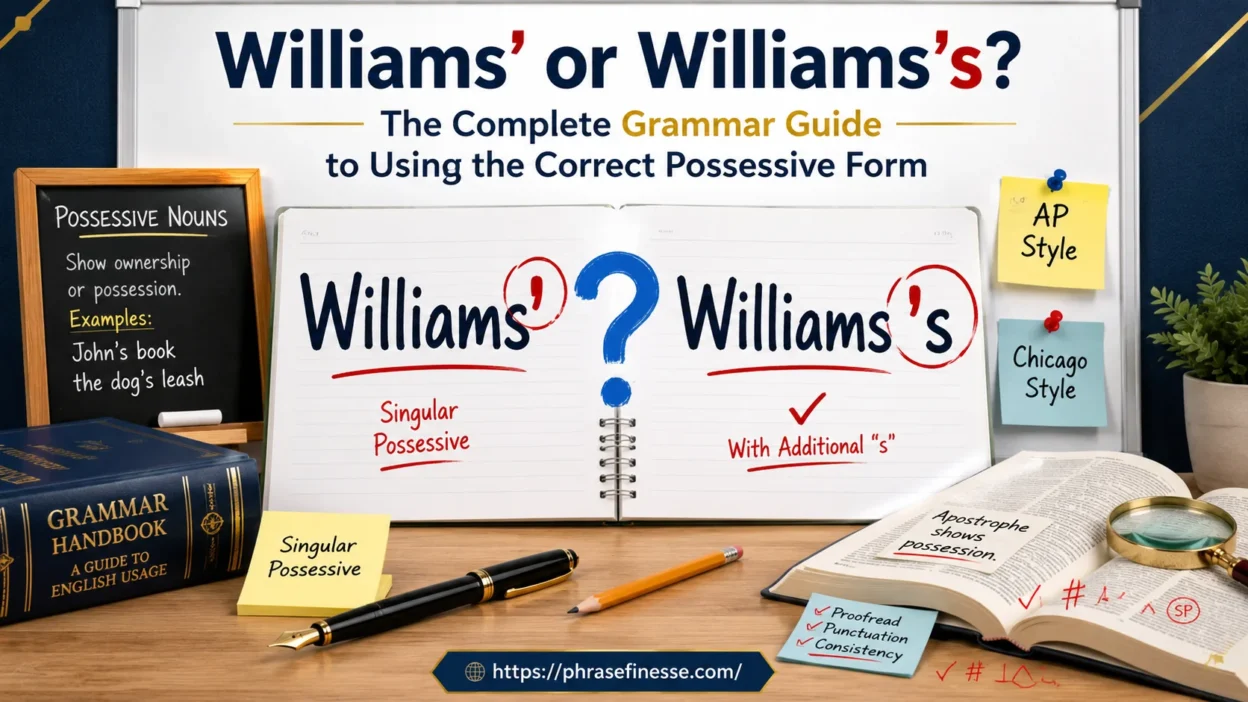
Have you ever paused while writing a name like Williams and wondered which possessive form is correct? The question behind “Williams’ Or Williams’s? Here’s The Possessive Form (Helpful Examples)” confuses many writers, students, and professionals. Whether you’re working on formal writing, improving English usage, or aiming for greater grammar accuracy, understanding the correct possessive form helps you communicate with confidence and consistency.
Possessive nouns appear in everyday communication more often than you might think. You may encounter them in business communication, meetings, project management documents, calendar entries, scheduling notes, time management resources, online booking systems, and even broadcasting content. A small punctuation choice can affect clarity, professionalism, and reader trust. That’s why knowing when to use Williams’ and when to use Williams’s matters.
In this guide, you’ll learn the key differences between these possessive forms, the grammar rules behind them, and the style-guide preferences that influence their usage. We’ll also explore practical examples, common mistakes, and real-world applications to help you choose the correct form in any context. By the end, you’ll have a clear understanding of this often-confusing grammar rule and know how to apply it with confidence in both casual and professional writing.
Quick Answer
If you’re looking for the short answer, here it is:
Williams’s is the preferred possessive form in most modern writing.
Examples
- Williams’s car
- Williams’s office
- Williams’s presentation
- Williams’s research
However, some style guides, most notably AP Style, prefer:
- Williams’ car
- Williams’ office
- Williams’ presentation
For most writers, editors, bloggers, students, and businesses, Williams’s is the safest and most widely accepted choice.
Why Writers Get Confused About Williams’ vs. Williams’s
The confusion comes from a unique feature of English grammar.
Most possessive nouns follow a simple rule:
Add an apostrophe and the letter s.
For example:
| Singular Noun | Possessive Form |
| John | John’s |
| Sarah | Sarah’s |
| Michael | Michael’s |
| Emma | Emma’s |
Simple enough.
Problems begin when a singular noun already ends with s.
Names such as:
- Williams
- James
- Charles
- Harris
- Jones
- Chris
create uncertainty because many writers wonder whether another s should be added.
As a result, you’ll see both forms used in books, newspapers, websites, magazines, and academic papers.
Understanding Possessive Nouns
Before discussing style guides, it’s important to understand what a possessive noun actually does.
A possessive noun shows:
- Ownership
- Association
- Relationship
- Origin
Examples
- Sarah’s laptop
- James’s jacket
- Williams’s proposal
- The company’s strategy
The possessive form answers the question:
Who owns it?
or
Who is it associated with?
In the phrase:
Williams’s presentation
the presentation belongs to or was created by Williams.
The Standard Grammar Rule for Names Ending in S
Modern grammar authorities generally follow one straightforward rule.
Rule
For singular nouns ending in s, add:
apostrophe + s
This produces:
- James’s book
- Charles’s speech
- Harris’s office
- Williams’s report
Most grammar experts consider this approach clearer and more consistent.
Why This Rule Exists
English pronunciation often includes an additional iz sound when forming possessives.
Consider these examples:
- James’s
- Charles’s
- Williams’s
Most speakers naturally pronounce that extra syllable.
Because the pronunciation contains the additional sound, many grammar authorities argue that the spelling should reflect it.
What Major Style Guides Say About Williams’s
Different style guides have developed their own recommendations.
Understanding these differences helps explain why you encounter both forms.
Chicago Manual of Style
The Chicago Manual of Style is one of the most influential editorial guides in the world.
Chicago recommends adding:
apostrophe + s
to nearly all singular nouns.
Therefore:
Williams’s
is correct.
Examples
- Williams’s research paper
- Williams’s recommendation
- Williams’s vehicle
Chicago’s approach emphasizes consistency.
MLA Style
The Modern Language Association (MLA) follows a similar principle.
Writers using MLA style should generally write:
- Williams’s argument
- Williams’s interpretation
- Williams’s analysis
This style is common in:
- Literature studies
- Humanities research
- College essays
APA Style
APA Style also favors:
Williams’s
Examples include:
- Williams’s study
- Williams’s findings
- Williams’s theory
Because APA dominates social sciences, many students encounter this form throughout their academic careers.
AP Style
The Associated Press Stylebook takes a different approach.
For singular proper names ending in s, AP typically recommends adding only an apostrophe.
This creates:
- Williams’
- Harris’
- Jones’
- Charles’
As a result, newspapers frequently use Williams’ rather than Williams’s.
Examples
- Williams’ statement
- Williams’ report
- Williams’ testimony
This difference explains why readers often see conflicting versions online.
Read More: United States’ or United State’s or United States’s? Choose one!
Style Guide Comparison Table
| Style Guide | Recommended Form |
| Chicago Manual of Style | Williams’s |
| MLA Style | Williams’s |
| APA Style | Williams’s |
| Oxford Style | Williams’s |
| AP Style | Williams’ |
This table reveals an important trend.
Most major style authorities support Williams’s.
AP Style remains the most notable exception.
Why Williams’s Is Becoming More Common
Language evolves constantly.
Over the past several decades, many publishers and editors have shifted toward Williams’s.
Several factors explain this change.
Consistency
Using apostrophe + s creates a rule that works across nearly all singular nouns.
Writers don’t need special exceptions.
Clarity
Readers immediately recognize possession.
Pronunciation
Many speakers naturally pronounce the additional syllable.
For example:
- Williams’s
- James’s
- Charles’s
The spelling mirrors everyday speech.
Williams’s in Academic Writing
Academic institutions generally prefer precision and consistency.
For that reason, most colleges and universities recommend:
Williams’s
Example Sentences
- Williams’s research influenced subsequent studies.
- Williams’s methodology improved data collection.
- Williams’s theory remains widely discussed.
Professors, researchers, and editors often expect this format.
Using AP-style possessives in academic work may appear inconsistent with standard academic conventions.
Williams’s in Business Writing
Business communication values clarity above all else.
When preparing:
- Reports
- Presentations
- Contracts
- Proposals
- Internal documents
most organizations use:
Williams’s
Example
- Williams’s proposal exceeded expectations.
- Williams’s department achieved record growth.
- Williams’s recommendations reduced costs.
The additional s leaves little room for ambiguity.
Williams’s in Digital Content
Website content follows different priorities.
Online readers scan quickly.
Search engines also reward clarity and consistency.
For blogs and website articles, most editors choose:
Williams’s
Why?
Because it aligns with:
- Modern grammar standards
- Reader expectations
- Academic conventions
- Publishing standards
Consistency across content improves readability.
Real-World Examples of Williams’s Used Correctly
Let’s examine examples that sound natural in everyday writing.
Workplace Examples
- Williams’s presentation impressed the executive team.
- Williams’s report identified several growth opportunities.
- Williams’s strategy increased customer retention.
Academic Examples
- Williams’s findings challenged previous assumptions.
- Williams’s article received significant attention.
- Williams’s analysis remains relevant today.
Everyday Examples
- Williams’s car is parked outside.
- Williams’s dog enjoys long walks.
- Williams’s house overlooks the lake.
In all of these examples, the possessive relationship is instantly clear.
Real-World Examples of Williams’ Used Correctly
When following AP Style, these sentences are acceptable.
Media Examples
- Williams’ comments sparked debate.
- Williams’ statement appeared in yesterday’s article.
- Williams’ testimony influenced the jury.
Newsroom Examples
- Williams’ proposal received approval.
- Williams’ campaign attracted attention.
- Williams’ report was released Monday.
The key point is consistency.
If a publication follows AP Style, every possessive name ending in s should follow the same pattern.
The article continues with:
- Williams Family vs. Williamses vs. Williamses’
- Common Grammar Mistakes
- Case Studies From Publishing and Journalism
- Historical Evolution of Possessives
- Expert Grammar Opinions
- Quick Decision Charts
- FAQ Section
- Final Verdict
- Feature Image Prompt
- Alt Text
- Caption
FAQs
1. Is it correct to write Williams’ or Williams’s?
Both Williams’ and Williams’s can be correct. The preferred form depends on the style guide you follow. Most modern style guides, including The Chicago Manual of Style, recommend Williams’s, while some journalism styles may prefer Williams’.
2. Why do some writers use Williams’s instead of Williams’?
Many grammar authorities recommend adding ’s to singular nouns, even when they already end in s. Following this rule, the possessive form of Williams becomes Williams’s.
3. Is Williams a singular or plural noun?
Williams is typically a singular proper noun when referring to one person with the surname Williams. In that case, the possessive form is usually Williams’s according to most modern style guides.
4. How do I show possession for the Williams family?
When referring to the entire family, use the Williamses as the plural form. To show possession, write the Williamses’ house, the Williamses’ car, or the Williamses’ vacation photos.
5. Which possessive form should I use in formal writing?
For formal writing, academic papers, and most professional documents, Williams’s is generally the safest choice because it aligns with widely accepted grammar conventions and promotes consistency.
6. Are Williams’ and Williams’s pronounced differently?
In most cases, Williams’s is pronounced with an extra syllable, similar to “Williams-iz.” Some writers prefer Williams’ for stylistic reasons, but pronunciation often remains similar in everyday speech.
Conclusion
Choosing between Williams’ and Williams’s can seem confusing at first, but the rule becomes much simpler once you understand the context. Most modern grammar and English usage guides recommend Williams’s for the possessive form of the singular name Williams, while Williams’ may appear in certain style guides or editorial preferences. The key is to follow the guidelines relevant to your audience and maintain consistency throughout your writing.
Whether you’re creating formal writing, handling business communication, preparing project management documents, or drafting everyday content, using the correct possessive form improves clarity and professionalism. When in doubt, remember that Williams’s is the preferred choice in most modern writing situations, making it a reliable option for clear and accurate communication.

Emma Brooke is an English language specialist, editor, and content writer at Phrase Finesse, where she helps readers develop stronger writing and communication skills through clear, practical, and engaging content. With a passion for the English language, she specializes in simplifying grammar rules, vocabulary, spelling, punctuation, and word usage for learners at every level.
Emma has extensive experience creating educational content that is accurate, well-researched, and easy to understand. She is particularly skilled at explaining confusing word pairs, grammar concepts, idioms, sentence structure, and effective writing techniques, making complex topics approachable for students, professionals, educators, and English learners worldwide.