Have you ever paused while writing a sentence and wondered whether Louis’ or Louis’s is correct? That small apostrophe can create surprising confusion, even for experienced writers. If you’ve searched for “Louis’ Or Louis’s? Here’s The Possessive Form (Helpful Examples)”, you’re not alone. Understanding the correct possessive form, English usage, and grammar rules helps you write with greater accuracy and confidence.
The answer often depends on the style guide, context, and audience. In formal writing, some authorities prefer Louis’s, while others accept Louis’ in certain situations. Knowing when to use each form improves consistency across emails, reports, academic work, and everyday communication. Whether you’re handling business communication, preparing documents for meetings, or creating professional content, mastering possessives strengthens your writing credibility.
In this guide, you’ll learn the difference between Louis’ and Louis’s, discover the most widely accepted grammar conventions, and explore practical examples that remove uncertainty. We’ll also connect these rules to real-world writing scenarios, including project management, calendar entries, scheduling, time management, online booking, and broadcasting, where clear language prevents misunderstandings and keeps communication precise.
Quick Answer
If you’re looking for the short answer, here it is:
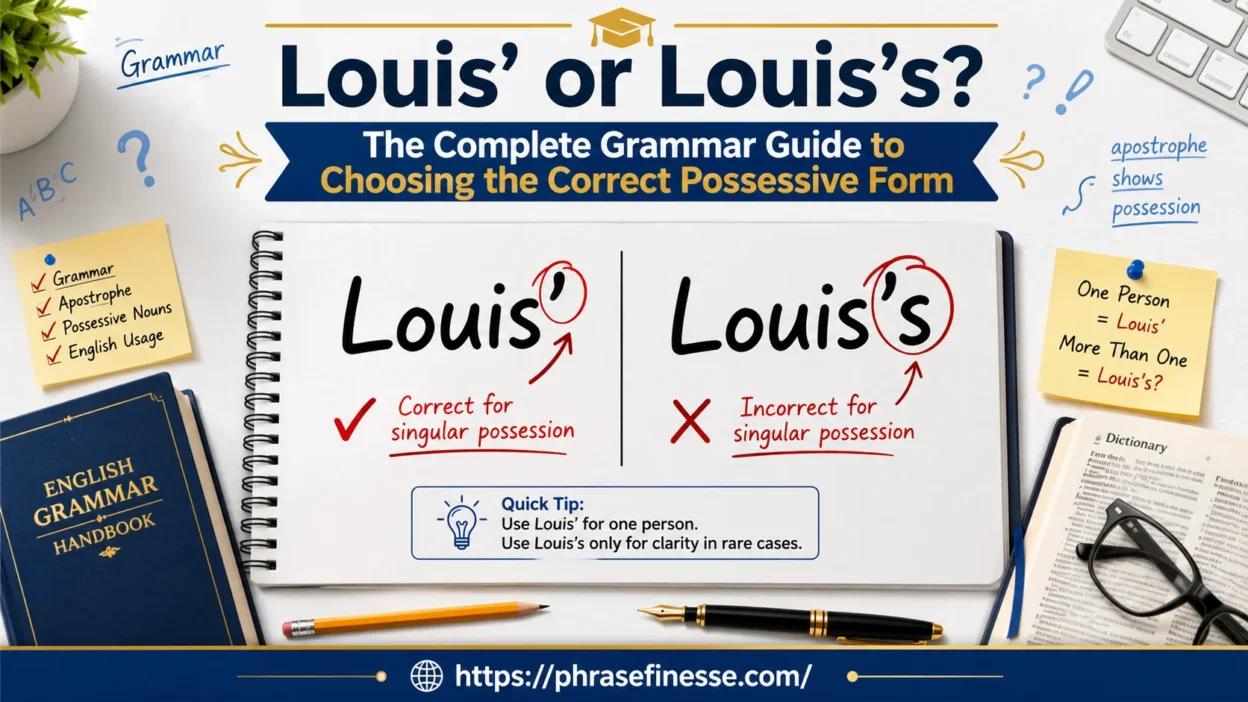
Louis’s is generally preferred in modern English and most major style guides.
Louis’ is also correct in certain contexts, particularly when following AP Style guidelines.
Examples
✅ 1. Louis’s car is parked outside.
✅ 2. Louis’s presentation impressed the board.
✅ 3. Louis’ statement was released yesterday. (AP Style)
✅ 4. Louis’ report received national attention. (AP Style)
Louis’ vs. Louis’s at a Glance
| Form | Grammatically Correct? | Common Usage |
| Louis’s | Yes | Most modern writing |
| Louis’ | Yes | AP Style and some traditional usage |
| Louiss | No | Incorrect |
| Louiss’ | No | Incorrect |
For most writers, Louis’s is the safest choice.
Understanding Possessive Nouns in English
Before examining the debate surrounding Louis’ and Louis’s, it helps to understand how possessive nouns work.
A possessive noun shows ownership, association, or connection.
For example:
- Sarah’s laptop
- Michael’s office
- The company’s headquarters
- The teacher’s lesson plan
In English, the standard rule for forming a possessive singular noun is simple:
Add an apostrophe followed by the letter s.
Standard Singular Possessive Examples
| Singular Noun | Possessive Form |
| Dog | Dog’s |
| Teacher | Teacher’s |
| Student | Student’s |
| Manager | Manager’s |
| Louis | Louis’s |
Following this rule, Louis’s is the natural possessive form.
However, names ending in s introduce an additional layer of complexity.
Why Louis Creates So Much Confusion
Many writers hesitate when dealing with names such as:
- Louis
- James
- Charles
- Thomas
- Harris
- Chris
The issue stems from pronunciation and historical grammar conventions.
Some people feel that adding another s after a word already ending in s looks awkward.
Consider these examples:
- Louis’s house
- James’s bicycle
- Charles’s office
Although grammatically sound, some writers prefer:
- Louis’ house
- James’ bicycle
- Charles’ office
This preference eventually influenced certain editorial style guides.
As a result, modern English contains two accepted approaches.
What Major Style Guides Say About Louis’s and Louis’
One reason the debate continues is that respected style guides don’t always agree.
Let’s examine what the major authorities recommend.
Chicago Manual of Style
The Chicago Manual of Style follows a straightforward rule:
Add apostrophe + s to singular nouns, including names ending in s.
Examples:
- Louis’s book
- James’s car
- Charles’s speech
Chicago prioritizes consistency over appearance.
Because Louis is singular, Chicago treats it like every other singular noun.
MLA Style
The Modern Language Association follows the same approach.
Examples:
- Louis’s research paper
- Thomas’s argument
- Harris’s analysis
This style is commonly used in humanities and academic writing.
APA Style
The American Psychological Association also recommends adding apostrophe + s to singular proper nouns ending in s.
Examples:
- Louis’s experiment
- James’s findings
- Charles’s study
APA values grammatical consistency and clarity.
AP Style
The Associated Press takes a different route.
AP Style generally adds only an apostrophe to singular proper names ending in s.
Examples:
- Louis’ speech
- James’ report
- Charles’ statement
This style is widely used in journalism and news publications.
Style Guide Comparison Table
| Style Guide | Recommended Form |
| Chicago Manual of Style | Louis’s |
| MLA Style | Louis’s |
| APA Style | Louis’s |
| Oxford Style | Louis’s |
| Most Academic Writing | Louis’s |
| AP Style | Louis’ |
Which Style Is Most Common Today?
Across books, websites, academic papers, and business writing, Louis’s appears more frequently than Louis’.
The trend in modern publishing favors consistency.
As a result, many editors automatically choose Louis’s unless a publication specifically follows AP Style.
Why Most Modern Editors Prefer Louis’s
The popularity of Louis’s isn’t random.
Several strong reasons support this preference.
It Reflects Natural Pronunciation
Most English speakers naturally pronounce the possessive with an extra syllable.
Consider:
- Louis’s car
- James’s jacket
- Charles’s office
In speech, people commonly say:
“LOO-eez-iz”
rather than stopping after the apostrophe.
Because pronunciation includes the extra sound, many style guides prefer the written form that reflects speech.
It Creates Consistency
Imagine applying one possessive rule to all singular nouns.
You would write:
- Student’s notebook
- Teacher’s desk
- Manager’s office
- Louis’s car
The rule remains predictable.
Consistency reduces confusion for readers and writers alike.
It Matches Modern Grammar Trends
Modern grammar increasingly favors logical, uniform rules.
Rather than creating special exceptions for names ending in s, many editors simply apply the standard possessive rule.
That approach makes writing easier to teach and easier to understand.
When Louis’ Is Acceptable
Although Louis’s dominates modern usage, Louis’ remains perfectly acceptable in specific situations.
AP Style Journalism
If you’re writing for a newspaper, magazine, or media outlet that follows AP Style, use:
Louis’
Example:
Louis’ remarks drew national attention.
Journalists often follow AP Style because it promotes brevity and consistency across news organizations.
House Style Requirements
Many companies maintain their own editorial guidelines.
If your employer, publisher, university, or client specifies Louis’, follow that requirement.
Consistency matters more than personal preference.
Traditional Usage
Older publications frequently used a lone apostrophe after names ending in s.
You may encounter Louis’ in:
- Historical documents
- Older books
- Traditional publications
- Archived newspapers
This usage remains grammatically recognized.
Examples of Louis’s Used Correctly
Seeing examples in context often makes grammar rules easier to understand.
Everyday Examples
- Louis’s phone keeps ringing.
- Louis’s dog loves swimming.
- Louis’s coffee is getting cold.
- Louis’s jacket is hanging by the door.
- Louis’s garden looks beautiful this year.
Business Examples
- Louis’s proposal received approval.
- Louis’s department exceeded quarterly goals.
- Louis’s leadership improved productivity.
- Louis’s report highlighted key opportunities.
Academic Examples
- Louis’s research challenged previous assumptions.
- Louis’s thesis received top honors.
- Louis’s analysis supported the findings.
Creative Writing Examples
- Louis’s footsteps echoed through the hallway.
- Louis’s expression revealed his concern.
- Louis’s voice carried across the room.
Examples of Louis’ Used Correctly
These examples follow AP Style conventions.
Journalism Examples
- Louis’ comments sparked debate.
- Louis’ interview aired Tuesday morning.
- Louis’ announcement surprised investors.
News Reporting Examples
- Louis’ campaign attracted national attention.
- Louis’ proposal generated strong support.
- Louis’ office released a statement.
Corporate Communications
- Louis’ remarks were included in the press release.
- Louis’ recommendations influenced the decision.
The important point is this:
The context determines which version is preferred.
Louis vs. Louis’s vs. Louis’
Understanding the distinction prevents many writing mistakes.
| Form | Meaning | Example |
| Louis | Name only | Louis arrived early. |
| Louis’s | Possessive | Louis’s car is new. |
| Louis’ | Alternative possessive | Louis’ car is new. |
Quick Memory Trick
Ask yourself:
Does Louis own something?
If yes, you need a possessive form.
Then choose:
- Louis’s for most writing
- Louis’ for AP Style
Read More: Forgot or Forgotten? Difference Explained
Similar Names That Follow the Same Rule
Louis isn’t unique.
Many names ending in s create identical questions.
James’s or James’?
Most style guides:
✅ James’s
AP Style:
✅ James’
Charles’s or Charles’?
Most style guides:
✅ Charles’s
AP Style:
✅ Charles’
Thomas’s or Thomas’?
Most style guides:
✅ Thomas’s
AP Style:
✅ Thomas’
Harris’s or Harris’?
Most style guides:
✅ Harris’s
AP Style:
✅ Harris’
Chris’s or Chris’?
Most style guides:
✅ Chris’s
AP Style:
✅ Chris’
The Special Case of Classical and Religious Names
English grammar contains a few traditional exceptions.
Examples include:
- Jesus’ teachings
- Moses’ laws
- Socrates’ philosophy
- Achilles’ heel
These forms developed through centuries of usage and remain widely accepted.
Classical Exception Table
| Name | Traditional Possessive |
| Jesus | Jesus’ |
| Moses | Moses’ |
| Achilles | Achilles’ |
| Socrates | Socrates’ |
Many style guides preserve these historical exceptions even while recommending apostrophe + s for most other names.
Common Mistakes Writers Make
Even experienced writers occasionally make possessive errors.
Omitting the Apostrophe
Incorrect:
❌ Louis car
Correct:
✅ Louis’s car
Adding Multiple Apostrophes
Incorrect:
❌ Louis’’s car
Correct:
✅ Louis’s car
Confusing Plurals with Possessives
A plural noun is not automatically possessive.
Incorrect:
❌ The Louis’s arrived.
Correct:
✅ The Louises arrived.
Possessive:
✅ Louis’s car
Switching Styles Mid-Article
This mistake appears surprisingly often.
Example:
❌ Louis’s report was impressive. Later, Louis’ findings confirmed the results.
Choose one style and use it consistently.
Case Study: How Different Publications Handle Louis’s
Consider the same sentence written under different style guidelines.
Academic Journal
Louis’s findings contributed significantly to the study.
News Article
Louis’ findings contributed significantly to the study.
Business Report
Louis’s recommendations improved operational efficiency.
Book Publisher Following Chicago Style
Louis’s observations revealed a deeper pattern.
Each version may be correct because each follows a different editorial framework.
How to Choose the Right Form Every Time
If you’re still uncertain, use this simple decision process.
Determine Your Audience
Ask yourself:
- Are you writing for school?
- Are you writing professionally?
- Are you writing for publication?
- Are you writing for a news outlet?
The answer often determines the style guide.
Check Style Requirements
Many organizations specify:
- AP Style
- Chicago Style
- MLA Style
- APA Style
Follow the required standard.
Use the Default Modern Rule
If no style guide exists, choose:
Louis’s
This form aligns with the majority of modern grammar authorities.
Stay Consistent
Once you choose a style, use it throughout the document.
Consistency improves professionalism and readability.
FAQS
1. Is Louis’s grammatically correct?
Yes, Louis’s is grammatically correct and is the preferred form in many major style guides, including those that recommend adding ’s to singular nouns ending in s.
2. Can I write Louis’ instead of Louis’s?
Yes. Some style guides allow Louis’ as the possessive form of Louis. While it is less common in modern usage, it is still considered acceptable in certain writing contexts.
3. Which is more common: Louis’ or Louis’s?
Louis’s is generally more common in contemporary English usage because it follows the standard rule of adding ’s to singular nouns.
4. How do you pronounce Louis’s?
Most speakers pronounce Louis’s as “LOO-eez-iz” or “LOO-is-iz,” depending on how the name Louis is pronounced. The additional syllable reflects the added ’s.
5. Do style guides agree on the possessive form of Louis?
No. Different style guides have different recommendations. Some prefer Louis’s, while others permit Louis’ for singular names ending in s.
6. Should I use Louis’s in formal writing?
In most cases, yes. Louis’s is widely accepted in formal writing, academic work, and professional documents. However, always follow any specific style guide required by your organization or publication.
Conclusion
Choosing between Louis’ and Louis’s often comes down to the style guide you follow. In modern English grammar, Louis’s is generally the preferred form because it reflects how the name is commonly pronounced. However, some style guides and publications accept Louis’, particularly for names ending in s.
The most important factor is consistency. Once you select a style, use it throughout your writing. Whether you’re working on formal writing, business communication, academic papers, or everyday content, understanding the correct possessive form helps you communicate clearly and professionally. When in doubt, check the requirements of your chosen style guide and follow it consistently.

Alyan Ashraf is an English language writer and editor at Phrase Finesse, where he specializes in grammar, vocabulary, spelling, word usage, and clear communication. Passionate about the English language, he creates practical, research-backed content that helps readers avoid common mistakes and write with greater accuracy and confidence.
Known for his clear writing style and attention to detail, Alyan simplifies complex language topics into easy-to-understand guides filled with real-world examples and actionable insights. His work covers confusing word pairs, grammar rules, idioms, punctuation, and everyday English usage, making learning both accessible and engaging for students, professionals, writers, and non-native English speakers.
Every article Alyan writes is carefully researched, fact-checked, and designed to meet high editorial standards. His goal is to help readers strengthen their English skills, expand their vocabulary, and communicate more effectively in academic, professional, and everyday settings.
Through Phrase Finesse, Alyan is committed to publishing trusted language resources that make mastering English simpler, clearer, and more enjoyable for learners around the world