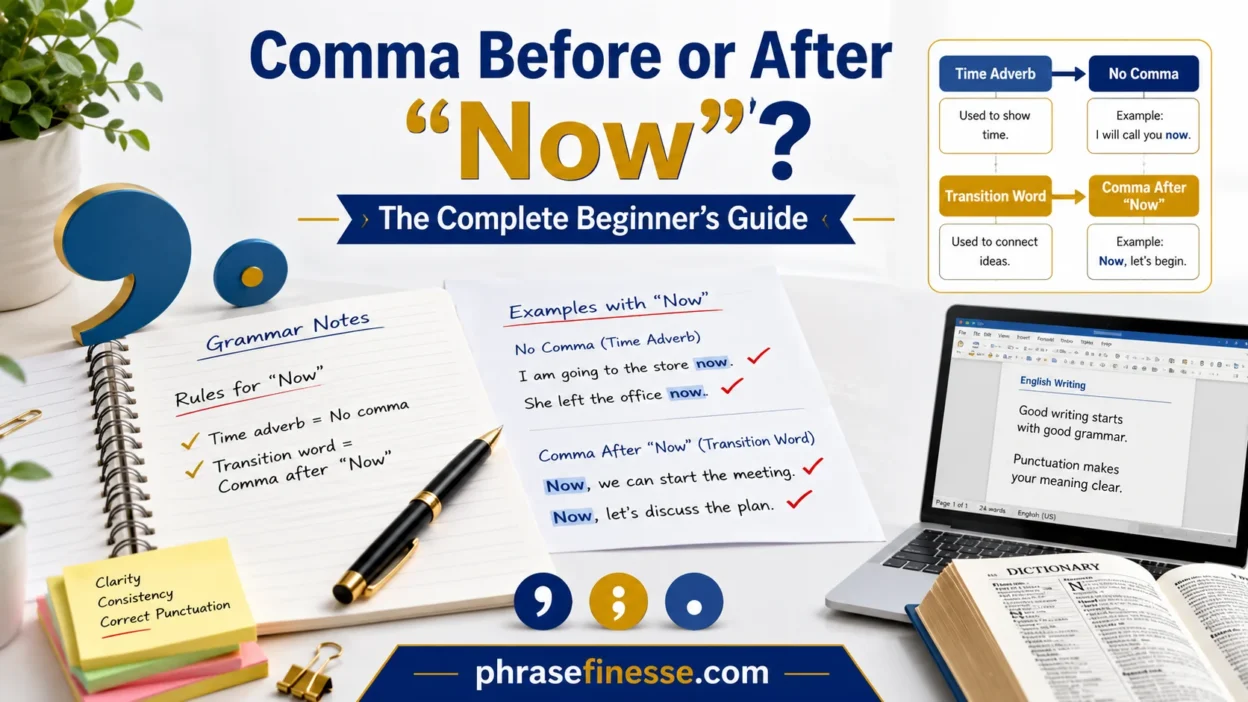
Have you ever paused while writing a sentence and wondered whether you need a comma before or after “now”? Many writers face this common punctuation challenge because “now” can function as an adverb, sentence transition, or conversation marker depending on the context. This guide, “Comma Before Or After “Now” – Explained For Beginners”, will help you understand the correct comma placement, improve your English usage, and make your writing clearer and more professional.
Understanding where to place a comma with “now” is essential for effective grammar, formal writing, and everyday communication. Whether you are preparing emails, managing business communication, writing reports, organizing meetings, or creating content, proper punctuation improves clarity and consistency. This article explains when you should use a comma before “now”, when you need a comma after “now”, and when no comma is required.
From scheduling tasks and improving time management to writing content for online booking, broadcasting, or project management platforms, accurate punctuation helps your message sound polished and trustworthy. By exploring practical examples and simple explanations, this beginner-friendly guide will help you master comma rules, strengthen your writing skills, and apply correct punctuation in English with confidence.
Understanding the Role of “Now” in a Sentence
Before discussing commas, it’s important to understand what “now” actually does.
The word can serve several different functions:
| Function | Meaning | Example |
| Time Adverb | Refers to the present moment | I need the report now. |
| Transition Word | Signals a shift in topic or focus | Now, let’s examine the evidence. |
| Discourse Marker | Guides conversation flow | Now, what do you think? |
| Emphasis Marker | Draws attention to a point | The software, now, works differently. |
Because “now” can perform multiple jobs, punctuation rules change based on context.
Think of it this way:
The function determines the punctuation.
That’s the golden rule that solves most comma-related questions involving “now.”
What Does “Now” Mean?
Most people associate “now” with time.
For example:
- We need to leave now.
- The meeting starts now.
- She understands the concept now.
In these examples, “now” simply means at this moment.
However, writers frequently use “now” to introduce a new idea.
For example:
Now, let’s move to the next chapter.
Here, “now” doesn’t really mean the present moment. Instead, it acts as a bridge between ideas.
This distinction matters because punctuation changes depending on which role the word plays.
Why Comma Rules Depend on Context
English punctuation exists primarily to improve readability.
Commas help readers:
- Recognize pauses
- Separate ideas
- Understand sentence structure
- Avoid confusion
The word “now” sometimes needs separation from the rest of the sentence and sometimes doesn’t.
Consider these examples:
Example A
I need an answer now.
No pause exists.
No comma is necessary.
Example B
Now, let’s discuss the results.
A natural introductory pause exists.
A comma improves readability.
Same word.
Different purpose.
Different punctuation.
Do You Put a Comma Before “Now”?
Many writers struggle with commas before “now.”
The answer depends on how the sentence is constructed.
Use a Comma Before “Now” When It Introduces a New Related Thought
Sometimes “now” links two closely connected ideas.
Example:
The presentation is finished, now we can answer questions.
While many writers use a comma here, grammar experts often consider this a comma splice because two independent clauses are joined incorrectly.
A better version would be:
The presentation is finished. Now we can answer questions.
Or:
The presentation is finished; now we can answer questions.
Or:
The presentation is finished, and now we can answer questions.
These alternatives create stronger grammar and clearer writing.
Better Alternatives Than a Comma
| Original | Better Version |
| The project ended, now we can celebrate. | The project ended. Now we can celebrate. |
| The storm passed, now it’s safe outside. | The storm passed; now it’s safe outside. |
| She graduated, now she’s job hunting. | She graduated, and now she’s job hunting. |
When Another Punctuation Mark Works Better
Many professional editors prefer:
- Periods
- Semicolons
- Coordinating conjunctions
instead of a standalone comma before “now.”
For example:
Weak
The training is complete, now everyone understands the system.
Better
The training is complete. Now everyone understands the system.
The second version reads more naturally and avoids punctuation issues.
Related Topics: Nicholas’ or Nicholas’s? Correct Possessive Form
Do Not Use a Comma Before “Now” as a Regular Time Adverb
When “now” simply indicates time, commas are unnecessary.
Examples:
- I need your decision now.
- We should leave now.
- The store closes now.
- Everything makes sense now.
In each sentence, “now” is essential information.
Removing it changes the meaning.
Therefore, no comma should appear before it.
Incorrect
I need your decision, now.
Correct
I need your decision now.
The comma creates an unnatural pause.
Do You Put a Comma After “Now”?
This question appears more frequently than the previous one.
Fortunately, the rule is often easier.
Use a Comma After “Now” When It Is an Introductory Word
When “now” introduces a statement, explanation, or transition, place a comma after it.
Examples:
- Now, let’s examine the evidence.
- Now, you can see the difference.
- Now, we understand why the problem occurred.
- Now, the results become much clearer.
In these cases, the comma signals a slight pause.
It also improves readability.
Why This Comma Matters
Imagine reading:
Now let’s discuss grammar.
The sentence isn’t wrong.
However, many style guides prefer:
Now, let’s discuss grammar.
The comma makes the transition smoother.
Common Situations Where Introductory “Now” Takes a Comma
Presentations
Now, let’s move to the next slide.
Teaching
Now, consider the following example.
Instructions
Now, click the submit button.
Storytelling
Now, here’s where things become interesting.
These examples show how “now” guides readers through information.
Do Not Use a Comma After “Now” When It Simply Means “At This Moment”
Sometimes “now” appears at the beginning of a sentence without acting as an introductory transition.
Examples:
- Now everything is different.
- Now people work remotely more often.
- Now technology changes rapidly.
- Now life feels easier.
In these cases, “now” functions primarily as a time adverb.
A comma is often unnecessary.
Compare the Difference
Time Meaning
Now everything has changed.
Transition Meaning
Now, let’s examine what changed.
The first sentence focuses on timing.
The second guides the reader into a new idea.
That distinction determines punctuation.
Using Commas Before and After “Now”
Sometimes writers place commas on both sides of “now.”
This approach creates a parenthetical interruption.
When “Now” Functions as an Interrupter
Examples:
The software, now, includes AI-powered tools.
The company, now, serves customers worldwide.
The policy, now, applies to all departments.
These sentences use “now” to emphasize a change.
The commas signal that the word interrupts the normal sentence flow.
Why Writers Use This Style
Writers sometimes want to:
- Create emphasis
- Slow the reading pace
- Mimic speech patterns
- Highlight a recent change
For example:
The restaurant, now, offers online ordering.
The commas draw attention to the update.
When to Avoid This Style
Most modern writing favors simplicity.
Therefore, many editors would revise:
The restaurant, now, offers online ordering.
to:
The restaurant now offers online ordering.
The second version feels cleaner and easier to read.
Comma Before or After “Now” in Different Types of Writing
Different writing styles use punctuation differently.
Business Writing
Business communication values clarity.
Examples:
Preferred
Now, let’s review the quarterly results.
Preferred
We need a decision now.
Preferred
The rollout is complete. Now we can begin training.
Business documents typically avoid unnecessary commas.
Academic Writing
Academic writing tends to be more formal.
Writers usually reserve commas for clear grammatical purposes.
Example:
Now, consider the implications of this theory.
However:
The evidence available now supports the conclusion.
No comma is needed because “now” simply indicates time.
Blog Writing
Blogs often use a conversational tone.
Because of this, introductory commas appear frequently.
Examples:
- Now, here’s the interesting part.
- Now, let’s talk about what this means for you.
- Now, you may be wondering whether the rule always applies.
These commas improve flow and reader engagement.
Everyday Conversation
In casual writing, punctuation becomes more flexible.
Text messages often omit commas entirely.
Example:
Now let’s go.
While technically acceptable in informal contexts, formal writing generally benefits from proper punctuation.
Common Mistakes Writers Make with “Now”
Understanding mistakes helps you avoid them.
Adding a Comma After Every Instance of “Now”
Many beginners assume every sentence beginning with “now” requires a comma.
That’s not true.
Incorrect
Now, everything is different.
Better
Now everything is different.
The sentence refers to time, not a transition.
Creating Comma Splices
This mistake appears frequently.
Incorrect
The meeting ended, now everyone can leave.
Two complete sentences cannot be joined with only a comma.
Better
The meeting ended. Now everyone can leave.
Better
The meeting ended; now everyone can leave.
Better
The meeting ended, and now everyone can leave.
Using Commas Only for Dramatic Effect
Some writers insert commas because they “feel right.”
Example:
We should, now, begin.
This creates unnecessary interruption.
A cleaner version reads:
We should now begin.
Always prioritize clarity over dramatic pauses.
Quick Reference Table: Comma Rules for “Now”
| Situation | Comma Before | Comma After | Example |
| Time adverb at sentence end | No | No | I need it now. |
| Introductory transition | No | Yes | Now, let’s begin. |
| Mid-sentence interrupter | Yes | Yes | The system, now, works faster. |
| Time reference at sentence start | No | Usually No | Now everything is easier. |
| New sentence after independent clause | Period or semicolon preferred | Sometimes | The work is done. Now we can relax. |
Real-World Examples Explained
Let’s analyze common examples.
“Now, Let’s Get Started.”
Correct
Why?
“Now” introduces the next action.
The comma creates a natural transition.
“I Need an Answer Now.”
Correct
Why?
“Now” functions purely as a time adverb.
No comma is needed.
“The Old System, Now Replaced, Was Inefficient.”
Correct
Why?
“Now replaced” provides extra information.
Commas set off the nonessential phrase.
“Now We Understand the Problem.”
Correct
Why?
“Now” refers to timing.
No introductory pause is necessary.
However, some style guides may still allow:
Now, we understand the problem.
Both versions can be acceptable depending on intended emphasis.
A Simple Test: Should You Use a Comma with “Now”?
Whenever you’re unsure, follow this four-step test.
Ask Whether “Now” Means Time
If the answer is yes:
Usually no comma is needed.
Example:
We understand now.
Ask Whether “Now” Introduces a New Idea
If yes:
A comma after “now” is often appropriate.
Example:
Now, let’s move forward.
Remove the Word and Re-Read the Sentence
If the sentence still works smoothly, “now” may be acting as an introductory element.
Example:
Now, let’s begin.
Becomes:
Let’s begin.
The sentence remains complete.
Listen for a Natural Pause
Read the sentence aloud.
If you naturally pause after “now,” a comma may help.
If not, skip it.
Mini Case Study: Why One Comma Changes Readability
Consider these two versions.
Version One
Now let’s discuss the results.
Version Two
Now, let’s discuss the results.
Most readers process the second version more easily because the comma signals a transition.
The difference is subtle.
Yet professional editors routinely make this adjustment because small improvements accumulate throughout an article.
That’s why punctuation matters.
Not because rules exist for their own sake.
Because good punctuation helps readers understand ideas faster.
Expert Writing Tips for Using “Now”
Follow these practical guidelines:
Keep It Simple
Avoid unnecessary punctuation.
Focus on Meaning
Ask what role “now” plays.
Avoid Comma Splices
Use periods, semicolons, or conjunctions.
Read Aloud
Your ears often catch problems your eyes miss.
Prioritize Clarity
Clear writing always beats complicated punctuation.
FAQs
1. Do you need a comma before “now”?
It depends on how “now” is used in a sentence. You usually need a comma before “now” when it introduces a contrast, interruption, or change from a previous situation. For example: “The system was difficult before, now it works smoothly.” However, in many cases, “now” does not require a comma when it functions as a simple adverb of time.
2. When should you use a comma after “now”?
You should use a comma after “now” when “now” appears at the beginning of a sentence or introduces a transition. For example: “Now, we can begin the meeting.” The comma helps separate the introductory word from the main idea and improves clarity in writing.
3. Is “now” always followed by a comma?
No, “now” is not always followed by a comma. When it directly modifies a verb, a comma is usually unnecessary. For example: “I now understand the grammar rule.” In this sentence, “now” works as an adverb and does not need punctuation.
4. Should I use a comma before “now” in formal writing?
In formal writing, you should use a comma before “now” only when grammar rules require it. Adding unnecessary commas can affect consistency, readability, and the professional tone of your content. Always consider the role “now” plays in the sentence before adding punctuation.
5. How does comma placement with “now” affect communication?
Correct comma placement improves the flow and meaning of your sentences. In business communication, emails, reports, and professional documents, proper punctuation helps readers understand your message quickly. Clear writing also supports effective project management, meetings, and workplace communication.
6. What is the easiest way to remember comma rules for “now”?
The easiest method is to identify the function of “now” in the sentence. If it introduces a new thought or acts as an introductory word, use a comma after it. If it simply shows time or modifies a verb, you usually do not need a comma. Practicing examples will help you develop stronger English grammar skills.
Conclusion
Understanding comma before or after “now” becomes much easier when you focus on the word’s purpose in a sentence. “Now” can introduce a transition, show time, or add emphasis, and each use may require different punctuation. By learning these simple rules, you can avoid common grammar mistakes and create smoother, more accurate sentences.
Correct comma usage strengthens your English writing, whether you are creating professional documents, managing business communication, preparing presentations, or writing online content. Good punctuation improves readability, builds credibility, and helps your ideas connect with readers.
With regular practice and attention to sentence structure, you can confidently use “now” with commas in both casual and formal writing. Mastering small grammar details like this will improve your overall writing style and help you communicate with greater clarity and consistency.

Alyan Ashraf is an English language writer and editor at Phrase Finesse, where he specializes in grammar, vocabulary, spelling, word usage, and clear communication. Passionate about the English language, he creates practical, research-backed content that helps readers avoid common mistakes and write with greater accuracy and confidence.
Known for his clear writing style and attention to detail, Alyan simplifies complex language topics into easy-to-understand guides filled with real-world examples and actionable insights. His work covers confusing word pairs, grammar rules, idioms, punctuation, and everyday English usage, making learning both accessible and engaging for students, professionals, writers, and non-native English speakers.
Every article Alyan writes is carefully researched, fact-checked, and designed to meet high editorial standards. His goal is to help readers strengthen their English skills, expand their vocabulary, and communicate more effectively in academic, professional, and everyday settings.
Through Phrase Finesse, Alyan is committed to publishing trusted language resources that make mastering English simpler, clearer, and more enjoyable for learners around the world