Have you ever paused while writing and wondered whether you should use given or gave? This common grammar question can affect clarity in both everyday and professional writing. In Given vs. Gave? Difference Explained, you’ll learn how these two forms of the verb give differ, when each one is correct, and how to avoid mistakes that can weaken your English usage, grammar, and formal writing.
Understanding the difference becomes especially important in workplace and academic settings. Whether you’re drafting emails, handling business communication, organizing meetings, managing a calendar, or working on project management tasks, choosing the correct verb form improves accuracy and consistency. It also helps when writing about activities such as scheduling, time management, online booking, and even broadcasting, where precise language matters.
This guide breaks down the rules in a simple, practical way. You’ll discover how gave functions as the simple past tense, how given works as a past participle, and why confusing them creates grammatical errors. With clear explanations, real-world examples, and easy-to-follow tips, you’ll gain confidence in using these words correctly in both spoken and written English.
The Short Answer: Given vs. Gave
If you’re looking for the fastest explanation possible, here it is:
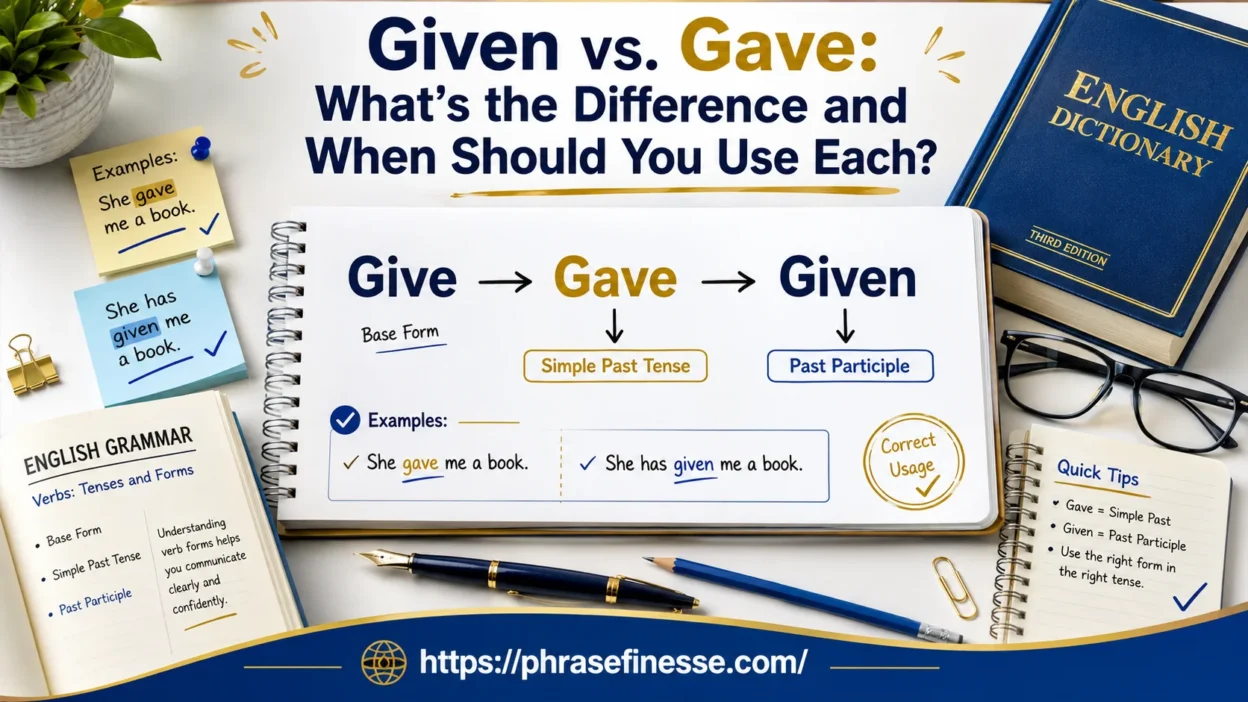
- Gave is the simple past tense of give.
- Given is the past participle form of give.
Quick Comparison Table
| Word | Verb Form | Function | Example |
| Give | Base Form | Present | I give advice. |
| Gave | Simple Past | Past Action | I gave advice. |
| Given | Past Participle | Perfect Tenses & Passive Voice | I have given advice. |
The Key Rule
Gave can stand alone.
Example:
She gave me a notebook.
Given usually needs a helping verb.
Example:
She has given me a notebook.
Think of it this way:
Gave works independently. Given usually needs support.
That single rule solves most grammar mistakes involving these two words.
Understanding the Verb “Give”
Before comparing given and gave, it helps to understand how English verbs change forms.
Many English verbs follow predictable patterns:
| Base Verb | Past Tense | Past Participle |
| Walk | Walked | Walked |
| Jump | Jumped | Jumped |
| Play | Played | Played |
These are called regular verbs.
The verb give is different.
It belongs to a group known as irregular verbs, which do not follow the standard “-ed” pattern.
Principal Parts of Give
| Form | Word |
| Base Form | Give |
| Simple Past | Gave |
| Past Participle | Given |
| Present Participle | Giving |
Because English contains hundreds of irregular verbs, memorizing these forms becomes essential.
Other similar examples include:
| Base Form | Past Tense | Past Participle |
| See | Saw | Seen |
| Write | Wrote | Written |
| Take | Took | Taken |
| Break | Broke | Broken |
| Give | Gave | Given |
Notice the pattern.
Just as:
- Saw → Seen
- Wrote → Written
- Took → Taken
You also get:
- Gave → Given
What Does “Gave” Mean?
Gave is the simple past tense form of the verb give.
It describes an action that happened and finished in the past.
Definition of Gave
Gave means that someone transferred, provided, offered, or handed something to another person at a specific point in the past.
Examples:
- She gave me her phone number.
- They gave us excellent directions.
- The teacher gave extra credit.
Each action happened in the past and is complete.
Read More: Forgot or Forgotten? Difference Explained
How to Use Gave Correctly
Gave in Statements
Most often, you’ll see gave used in simple declarative sentences.
Examples:
- My grandmother gave me valuable advice.
- The company gave employees additional vacation days.
- He gave his friend a ride home.
Formula:
Subject + Gave + Object
Example:
- Sarah gave flowers.
You can also use:
Subject + Gave + Indirect Object + Direct Object
Example:
- Sarah gave her mother flowers.
Gave in Questions
Questions often place the verb after question words.
Examples:
- Who gave you that gift?
- What gave you that idea?
- Which teacher gave the assignment?
When using auxiliary verbs like did, the main verb returns to its base form.
Correct:
- Did she give you permission?
Incorrect:
- Did she gave you permission?
The word did already signals past tense.
Gave in Negative Sentences
Negative forms follow the same principle.
Correct:
- She did not give me the documents.
- They didn’t give us enough time.
Incorrect:
- She didn’t gave me the documents.
Again, did carries the past tense.
What Does “Given” Mean?
Unlike gave, given is a past participle.
Past participles usually cannot function as standalone main verbs.
Instead, they work alongside helping verbs.
Definition of Given
Given represents a completed action but typically appears in:
- Perfect tenses
- Passive voice constructions
- Adjectival expressions
- Certain prepositional phrases
Examples:
- I have given my answer.
- The award was given yesterday.
- Given the circumstances, we left early.
Notice how each sentence uses given differently.
Using Given With Helping Verbs
This is where most learners encounter the word.
Present Perfect
Structure:
Has/Have + Given
Examples:
- I have given my opinion.
- She has given excellent feedback.
- They have given us plenty of notice.
The present perfect connects a past action to the present.
Past Perfect
Structure:
Had + Given
Examples:
- He had given the speech before the meeting started.
- They had given instructions earlier.
The action happened before another past event.
Future Perfect
Structure:
Will Have + Given
Examples:
- She will have given her presentation by noon.
- We will have given everyone access before launch.
This indicates completion before a future point.
Given in Passive Voice
Passive voice shifts focus from the person performing the action to the recipient of the action.
Active Voice:
The principal gave the award.
Passive Voice:
The award was given by the principal.
More examples:
- Permission was given immediately.
- Instructions were given to all employees.
- Scholarships were given to deserving students.
Although active voice often sounds stronger, passive voice remains useful when the recipient matters more than the giver.
Given as an Adjective
Many people don’t realize that given can function as an adjective.
Examples:
- Any given day
- A given situation
- A given amount
- The given information
In these cases, given describes a noun rather than acting as a verb.
Example:
On any given day, the store serves hundreds of customers.
Here, “given” means “particular” or “specific.”
Given as a Preposition
English also uses given as a preposition.
Meaning:
Considering or taking into account.
Examples:
- Given the weather, we postponed the trip.
- Given the evidence, the verdict makes sense.
- Given current market conditions, prices may rise.
This usage is extremely common in formal writing, academic papers, and business communication.
Given vs. Gave: Side-by-Side Comparison
The easiest way to remember the distinction is through direct comparison.
| Feature | Gave | Given |
| Verb Form | Simple Past | Past Participle |
| Can Stand Alone? | Yes | Usually No |
| Needs Helping Verb? | No | Usually Yes |
| Used in Perfect Tenses? | No | Yes |
| Used in Passive Voice? | No | Yes |
| Can Be an Adjective? | No | Yes |
| Can Be a Preposition? | No | Yes |
Quick Reference
Use gave when describing a completed action in the past.
Use given when working with:
- Has
- Have
- Had
- Was
- Were
- Is
- Are
- Been
- Being
This simple distinction eliminates most errors.
Examples of Given and Gave in Everyday English
Context often makes the difference easier to understand.
Everyday Conversation
Gave:
- She gave me her number yesterday.
- He gave me a ride to work.
Given:
- She has given me her number.
- He has given me great advice.
Business Communication
Gave:
- The manager gave clear instructions.
Given:
- The manager has given clear instructions.
- Employees were given updated guidelines.
Academic Writing
Gave:
- Researchers gave participants a questionnaire.
Given:
- Participants were given a questionnaire before testing.
1: What is the difference between gave and given?
Gave is the simple past tense of the verb give. It describes an action completed in the past. Given is the past participle form and is usually used with helping verbs such as has, have, had, was, or were.
Example:
- She gave me a book yesterday.
- She has given me several books this year.
2: Can I use given without a helping verb?
In most cases, given requires a helping verb when it functions as a verb. However, it can also act as an adjective.
Examples:
- Incorrect: He given me a gift.
- Correct: He has given me a gift.
- Adjective: Under the given circumstances, we had no choice.
3: Is gave present tense or past tense?
Gave is the simple past tense of give. It refers to something that already happened.
Example:
- The teacher gave us extra homework last week.
4: When should I use given in a sentence?
Use given when forming perfect tenses, passive voice constructions, or when it functions as an adjective.
Examples:
- I have given my answer.
- The award was given to the winner.
- We worked within the given deadline.
5: Which is correct: “I have gave” or “I have given”?
I have given is correct. After have, has, or had, you must use the past participle form given.
Correct: I have given my presentation.
Incorrect: I have gave my presentation.
6: Why do people confuse gave and given?
Many learners confuse them because both words come from the same verb, give, and both relate to past actions. The key difference is that gave is the simple past form, while given is the past participle used with helping verbs or as an adjective.
Conclusion
The difference between gave and given is straightforward once you understand their grammatical roles. Gave is the simple past tense used for completed actions, while given is the past participle used with helping verbs or as an adjective. Using the correct form improves grammar, strengthens formal writing, and ensures consistency in both professional and everyday communication. By remembering this simple distinction and practicing with real examples, you can confidently choose the right word every time.