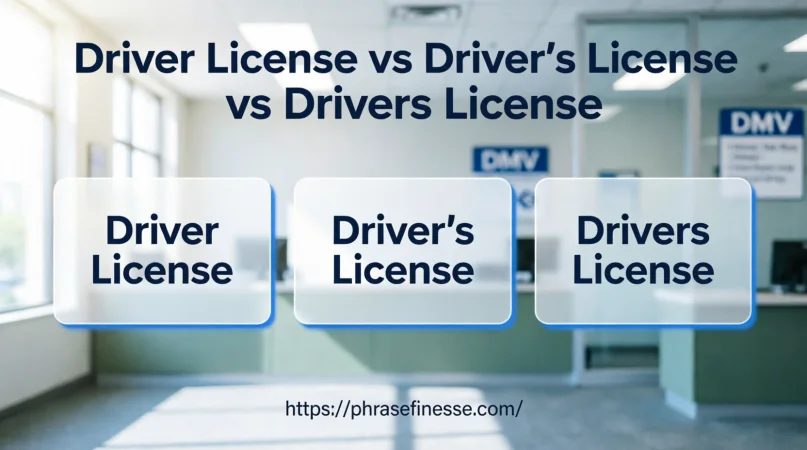
vHave you ever wondered whetherDriver License vs Driver’s License: Grammar & Usage Guide is the correct spelling? This small punctuation difference often creates confusion in English usage, especially when writing official documents, applications, or everyday conversations.
In this guide, you’ll learn the correct form, understand the role of the apostrophe, and discover how each version fits into modern grammar and formal writing.
The terms driver license, driver’s license, and drivers license may look similar, but they don’t always carry the same level of accuracy or acceptance. This article explains the possessive form, standard spelling conventions, and regional differences that influence English consistency.
Whether you’re preparing professional documents, handling business communication, organizing meetings, or improving your writing skills, choosing the right term helps you communicate clearly.
Beyond simple spelling rules, understanding these differences strengthens your overall writing quality and attention to detail. Just like accuracy matters in scheduling, calendar management, online booking, broadcasting, and project management, correct word usage builds credibility.
Keep reading to explore the meaning, examples, and practical rules behind “Driver License vs Driver’s License: Grammar & Usage Guide so you can use the correct expression with confidence.
Quick Answer
Let’s get straight to the point.
- Correct in standard American English: driver’s license
- Common in government systems and forms: driver license
- Incorrect in formal writing: drivers license
If you remember only one thing, remember this:
“Driver’s license” is grammatically correct. “Driver license” is system-driven. “Drivers license” is usually an error.
Now let’s break down why all three exist.
Driver’s License Meaning: What the Word Actually Represents
The term refers to a legal document that allows a person to operate a motor vehicle.
At its core, it combines two ideas:
- A driver (the person)
- A license (the permission document)
So the phrase literally means:
“The license belonging to a driver.”
That ownership idea is where the apostrophe comes from.
Driver’s License Grammar Explained in Simple Terms
Why the apostrophe exists
In English, we use an apostrophe to show possession.
So we write:
- doctor’s appointment (an appointment for a doctor)
- teacher’s guide (a guide for a teacher)
- driver’s license (a license for a driver)
This structure is clean, logical, and widely accepted in grammar rules.
Breaking it down visually
| Phrase | Grammar Structure | Meaning |
| driver’s license | possessive noun + noun | license belonging to a driver |
| driver license | noun + noun (compound) | license related to driving |
| drivers license | plural noun error | unclear, nonstandard form |
The possessive version wins in traditional grammar.
Why “Driver License” Exists in Real Life
Now here’s where things get interesting.
If “driver’s license” is correct, why do governments and systems often use “driver license”?
The answer is not grammar. It’s system design.
Government standardization
Many agencies prefer simplified naming conventions in databases.
They avoid punctuation because:
- Apostrophes can break search systems
- Data fields need consistency
- Software parsing becomes easier
So instead of “driver’s license,” systems often store:
driver license
It is not about correctness. It is about functionality.
Example from real usage
You’ll often see:
- Driver License Number
- Driver License Renewal
- Driver License Status
This is especially common in forms, APIs, and databases.
Why “Drivers License” Is Incorrect in Formal Writing
Let’s be blunt.
“Drivers license” is usually a mistake.
It appears when:
- Someone forgets the apostrophe
- Autocorrect removes punctuation
- Informal typing ignores grammar rules
What changes without the apostrophe?
Without the apostrophe, “drivers” looks like a plural noun.
So instead of showing possession, it becomes unclear.
It almost reads like:
licenses belonging to multiple drivers (but not structured correctly)
That’s why editors avoid it in professional writing.
Driver’s License vs Driver License: Regional and Context Differences
English is not uniform across countries or institutions. That’s where the confusion grows.
United States
- Standard writing: driver’s license
- Government systems: driver license
- Style guides: prefer possessive form
United Kingdom
The UK takes a different route entirely:
- “driving licence”
- Uses British spelling of “licence”
- Avoids the American structure
Canada and Australia
- “driver’s licence” is common
- British influence affects spelling
- Possessive form still widely used
Style Guides and What Experts Actually Say
Professional writing follows established guides.
AP Style (Associated Press)
AP Style recommends:
driver’s license
This is widely used in journalism and media writing.
Chicago Manual of Style
Chicago also supports:
- driver’s license as the standard form
- emphasizes grammatical clarity over system conventions
Government vs editorial difference
Here’s the key divide:
| Context | Preferred Form |
| Newspapers | driver’s license |
| Books | driver’s license |
| DMV systems | driver license |
| Legal documents | depends on jurisdiction |
So the “correctness” depends on where you’re writing.
Why All Three Versions Exist Online
Now let’s step into the digital world.
Search engines don’t care about grammar rules. They care about intent.
People search all variations
Users commonly type:
- driver’s license
- drivers license
- driver license
Google understands all three.
Why content must include variations
If you only target one version, you miss traffic.
- correct form for authority
- variations for search reach
Search engines rank meaning, not punctuation.
See More :As Evidenced By vs. As Evident By: Which Is Correct?
Practical Usage Guide: When to Use Each Version
This is where things become useful in real life.
Clear usage breakdown
| Situation | Correct Choice |
| Academic writing | driver’s license |
| News articles | driver’s license |
| DMV forms | driver license |
| UI labels | driver license |
| all variations | |
| Legal documents | jurisdiction-based |
Simple rule to remember
- Writing for humans → driver’s license
- Writing for systems → driver license
- Avoid altogether → drivers license
Common Mistakes People Make
Even native speakers get this wrong.
Mistake patterns
- Dropping the apostrophe
- Copying government form labels into essays
- Assuming all versions mean the same thing formally
- Relying on autocorrect
Why it keeps happening
Three main reasons:
- Digital systems normalize simplified spelling
- People copy what they see on forms
- Grammar rules feel less important in casual typing
Real-World Case Studies: How the Term Is Used
Let’s look at how different environments handle the phrase.
Case Study: DMV Systems
Most Department of Motor Vehicles systems in the U.S. use:
- Driver License Number
- Driver License Renewal
Why?
Because databases avoid punctuation to prevent errors in:
- search indexing
- data storage
- API calls
Case Study: Newsroom Editing
News organizations follow AP Style rules.
Editors enforce:
- driver’s license in articles
- correction of missing apostrophes
Even if public forms differ, editorial writing stays consistent.
Case Study: UX and App Design
Apps and websites often prefer:
- Driver License (clean labels)
- No apostrophes for UI simplicity
Why?
Because UI design values clarity over grammatical precision.
Why the Apostrophe Still Matters in Writing
Even though systems simplify it, grammar still matters.
The apostrophe does important work
It helps:
- clarify ownership
- maintain readability
- preserve formal correctness
Without it, language becomes less precise.
Think of it like punctuation traffic signals. You can still drive without them, but confusion increases.
Memory Trick to Never Forget the Difference
Here’s a simple way to lock it in.
The quick rule
- Possession = driver’s license
- System label = driver license
- Missing apostrophe = avoid
Easy analogy
Think of it like this:
A driver owns the license. So the license “belongs” to the driver.
That ownership is what the apostrophe shows.
Why This Confusion Matters More Than You Think
You might wonder why this even matters.
It matters in:
- job applications
- academic writing
- legal documents
- professional communication
A small punctuation mark can signal attention to detail.
And in many fields, detail equals credibility.
FAQs
1. Is “Driver License” or “Driver’s License” correct?
“Driver’s License” is the most widely accepted and grammatically correct form in American English. The apostrophe shows possession, meaning the license belongs to or is associated with the driver. However, some official agencies use “driver license” as a standardized term without the apostrophe.
2. Why do some places write “Driver License” without an apostrophe?
Some government organizations and legal documents use “Driver License” as an official title or standardized label. In these cases, the phrase works like a compound noun rather than a traditional possessive phrase. Official terminology may differ from everyday English usage.
3. Is “Drivers License” without an apostrophe grammatically correct?
Generally, “Drivers License” is considered incorrect in standard English when referring to an individual’s license. Without an apostrophe, the word drivers becomes a plural noun, which changes the meaning. The correct possessive form is usually “Driver’s License.”
4. Should I use “Driver’s License” in formal writing?
Yes, “Driver’s License” is a safe choice for most formal writing, professional communication, and general content. It follows common grammar rules and helps maintain consistency in essays, articles, emails, and business documents.
5. Is “driver license” used in official documents?
Yes, some regions and government offices officially use “driver license” without an apostrophe. When completing forms, applications, or legal paperwork, you should follow the exact wording provided by the issuing authority.
6. How can I remember the difference between “Driver License” and “Driver’s License”?
A simple way to remember is to think about ownership. A driver’s license is a license connected to one driver, so the apostrophe shows the relationship. For general writing, this form is usually the clearest and most natural choice.
Conclusion
Understanding the difference between “Driver License,” “Driver’s License,” and “Drivers License” helps you avoid common spelling and grammar mistakes. Although official terminology may vary, “Driver’s License” remains the most familiar and widely accepted form in everyday English usage.
Using the correct expression improves clarity in formal writing, professional communication, and digital content. Whether you are creating documents, managing business communication, organizing project management tasks, or improving your overall writing style, small details like apostrophe placement can make a significant difference.
By learning these simple rules and applying them consistently, you can write with greater confidence and accuracy. The right word choice not only follows grammar standards but also creates clearer communication for every reader.

Mia Rose is an English language specialist and editorial writer at Phrase Finesse, where she helps readers master grammar, vocabulary, spelling, and effective communication. Passionate about making English simple and practical, she creates well-researched, reader-friendly content that explains complex language concepts in a clear and engaging way.
With extensive experience in English language education, content writing, and editorial review, Mia specializes in grammar, punctuation, word choice, idioms, confusing word pairs, and writing style. Her articles are carefully researched, fact-checked, and designed to help students, professionals, writers, and English learners build confidence in both written and spoken English.