Have you ever paused while writing and wondered whether you should use “chose” or “chosen” in a sentence? You’re not alone. Many learners struggle with these two forms because they look similar but serve different purposes in English usage. In this guide, “Chose vs. Chosen: Which Is Correct?” will help you understand the key differences, sentence structures, and practical examples that make choosing the right word easier in everyday and formal writing.
Understanding the difference between chose and chosen improves your overall grammar, communication skills, and writing accuracy. While one is used for a completed action in the past, the other works as a past participle that usually appears with helping verbs. These distinctions matter in professional settings, including business communication, meetings, project management, and even digital tasks involving scheduling, calendar planning, and online booking systems where clear language builds trust and consistency.
This article will explain how chose and chosen function, when to use each form, and how to avoid common mistakes. You’ll explore simple explanations, real-world examples, and helpful tips that strengthen your confidence in written and spoken English. Whether you create content, handle broadcasting, manage workplace conversations, or improve your language skills, mastering these verb forms will support clearer and more effective communication.
Quick Answer
Let’s clear the confusion immediately.
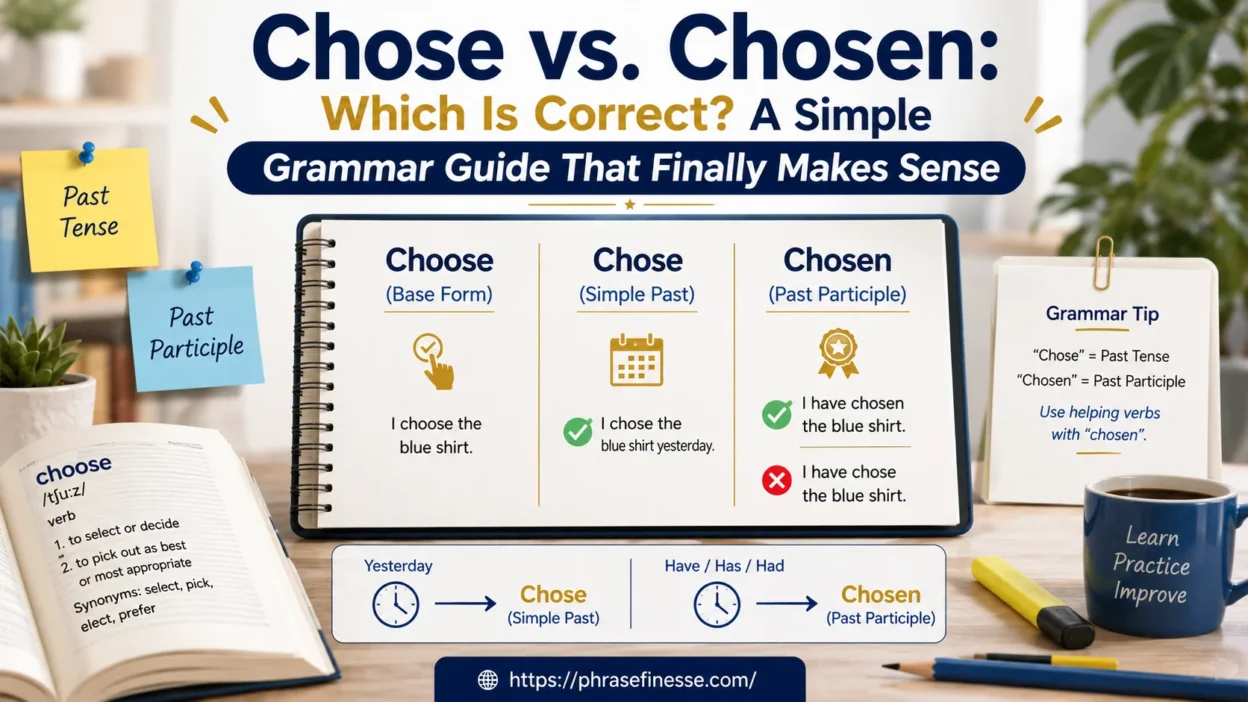
- Chose = simple past tense
- Chosen = past participle used with helper verbs like have, has, had
That’s the entire core rule.
Here’s the easiest memory shortcut:
Chose = finished in the past
Chosen = connected to “have” or “has”
Examples:
- I chose the wrong answer yesterday.
- I have chosen the right path now.
Simple. But the real understanding comes next.
Understanding the Verb “Choose” Before Chose vs Chosen
Everything starts with the base verb: choose.
It means to pick something from options. You use it every day without noticing.
Examples:
- I choose tea over coffee.
- You choose your own path in life.
- We choose what matters most.
Now here’s the tricky part. English doesn’t keep this verb the same in the past. It changes form irregularly:
| Form | Word | Example |
| Base form | choose | I choose my outfit |
| Past tense | chose | I chose my outfit yesterday |
| Past participle | chosen | I have chosen my outfit |
This irregular pattern is why people mix up chose vs chosen so often.
English does not follow a neat “add -ed” rule here. Instead, it shifts the vowel sound and form completely.
Think of it like this:
- choose → present (right now)
- chose → past (done and finished)
- chosen → result (linked to now or another past moment)
Chose Meaning and Usage in Real English
Let’s talk about chose first since it’s simpler.
What “Chose” Means
You use chose when an action happened in the past and finished.
No connection to the present. No helper verbs needed.
Sentence Structure
Subject + chose + object
Real Examples
- I chose the red dress for the party.
- She chose silence over argument.
- They chose the cheapest flight option.
- He chose not to attend the meeting.
Notice something important here. Every action sits in a clear past moment.
Words like these often appear with chose:
- yesterday
- last week
- in 2020
- an hour ago
Common Mistake with Chose
Wrong:
- I have chose the wrong answer.
Correct:
- I have chosen the wrong answer.
Why? Because “have” needs a past participle, not simple past.
Chosen Meaning and Usage in Real English
Now let’s move to the one that confuses people more: chosen.
What “Chosen” Means
You use chosen when the action connects to another verb like have, has, or had.
It often shows a result that still matters now.
Sentence Structure
Subject + have/has/had + chosen + object
Real Examples
- I have chosen my career path.
- She has chosen peace over conflict.
- They had chosen the wrong route before GPS fixed it.
- We have chosen to stay home tonight.
Why “Chosen” Feels Different
“Chosen” doesn’t just show a past action. It shows a completed decision with ongoing relevance.
That’s why English uses it in perfect tenses.
Think of it like a decision that still echoes into the present.
Chose vs Chosen: Key Differences Side by Side
Let’s simplify everything into a clear comparison.
| Feature | Chose | Chosen |
| Verb type | Simple past | Past participle |
| Helper verbs | Not needed | Needed (have/has/had) |
| Time reference | Specific past time | Past + present connection |
| Meaning focus | Action happened | Result or completion |
| Example | I chose coffee yesterday | I have chosen coffee |
This table alone clears up most confusion.
Why Chose vs Chosen Confuses So Many People
This confusion does not come from ignorance. It comes from patterns that look familiar but behave differently.
Here’s why people struggle:
Similar spelling
Both words look almost identical. Only one letter separates them.
False grammar assumption
Many learners think English always uses “-ed” for past tense. So they expect “choosed” or simple patterns.
Helping verb confusion
Words like “have” change the rule completely. That shift feels unnatural at first.
Speech habits
In spoken English, people often contract sentences. That hides grammar structure.
For example:
- I’ve chosen → sounds like one smooth phrase
- I chose → sounds more direct and blunt
Real-Life Examples of Chose vs Chosen
Let’s compare them directly in real situations.
Examples
1. Set One
- I chose the blue shirt yesterday.
- I have chosen the blue shirt for tomorrow’s event.
2. Set Two
- She chose silence during the meeting.
- She has chosen not to speak about it anymore.
3. Set Three
- They chose a small apartment in 2021.
- They have chosen a better home now.
Notice how “chosen” often feels more current or relevant.
Case Study: How Small Grammar Choices Change Meaning
Let’s look at a real communication scenario.
Situation: Job Selection Email
A candidate writes:
“I chose this company for my career.”
This sounds like a past decision with no present focus.
Now compare:
“I have chosen this company for my career.”
This version feels stronger. It signals a final decision that still stands.
What changed?
- “Chose” = completed decision
- “Have chosen” = committed decision with ongoing impact
A recruiter instantly feels more certainty with the second version.
Small grammar shift. Big meaning difference.
Common Mistakes with Chose vs Chosen
Let’s fix the errors people make most often.
Using “chose” with have/has
Wrong:
- I have chose the wrong option.
Correct:
- I have chosen the wrong option.
Using “chosen” without helper verbs
Wrong:
- I chosen the red car.
Correct:
- I have chosen the red car.
Mixing time context
Wrong:
- I chose my job now.
Correct:
- I have chosen my job now.
Overgeneralizing past tense rules
Wrong assumption:
- “Add -ed for everything.”
Reality:
English has irregular verbs like choose → chose → chosen.
Read More: Williams’ or Williams’s? Choose the Correct One!
Memory Tricks That Actually Work
You don’t need heavy grammar study. You just need patterns.
Trick One: Time Clue Rule
- If you see a finished time → use chose
- If you see have/has/had → use chosen
Trick Two: Story Method
Imagine this:
- Yesterday, I chose my outfit.
- Today, I have chosen confidence.
The story locks the difference in your mind.
Trick Three: Sound Shift
Say both out loud:
- chose = sharp, past sound
- chosen = longer, flowing sound with “have/has”
Your brain starts recognizing rhythm patterns.
Practice Section: Test Yourself
Try filling in the blanks:
- I ___ the wrong path yesterday.
- She has ___ a new direction in life.
- They ___ the cheapest hotel last night.
- We have ___ to stay longer.
Answers:
- chose
- chosen
- chose
- chosen
Quick Grammar Summary for Chose vs Chosen
Here’s everything in one snapshot:
- Choose = present
- Chose = simple past action
- Chosen = past participle with have/has/had
If you remember just this, you will rarely make mistakes again.
FQAs
1. What is the difference between chose and chosen?
The main difference between chose and chosen is their grammatical role. Chose is the simple past tense of the verb choose and describes an action that happened in the past. Chosen is the past participle form and usually needs a helping verb such as has, have, had, is, or was.
Examples:
- She chose the blue dress yesterday.
- She has chosen the blue dress for the event.
2. Is chose the past tense of choose?
Yes, chose is the correct past tense of choose. You use it when someone made a decision at a specific time in the past.
Examples:
- I chose a different route last week.
- They chose a new manager after the interview.
3. When should I use chosen in a sentence?
Use chosen when you need the past participle form of choose. It usually appears with auxiliary verbs like has, have, had, or forms of be.
Examples:
- She has chosen her career path.
- The winner was chosen by the judges.
- We had chosen the best option before the deadline.
4. Can I use chosen without a helping verb?
In most cases, chosen needs a helping verb. Using it alone as a past tense verb is incorrect.
Incorrect:
- He chosen the wrong answer.
Correct:
- He chose the wrong answer.
- He has chosen the wrong answer.
5. Why do people confuse chose and chosen?
People often confuse chose and chosen because both come from the irregular verb choose. Unlike regular verbs that simply add -ed, irregular verbs change forms completely.
6. How can I remember the difference between chose and chosen?
A simple way to remember is:
- Chose = past action completed alone
- Chosen = completed action with a helper verb
Think of chose as something that happened, while chosen shows a choice that has been completed or received.
Examples:
- She chose a new laptop yesterday.
- She has chosen a new laptop for her studies.
Conclusion:
Understanding chose vs. chosen becomes much easier when you remember their different roles in English grammar. Chose is the simple past form of choose, while chosen is the past participle that works with helping verbs. Knowing when to use each word helps you create clearer sentences and avoid common grammar mistakes.
Strong English usage requires attention to small details like verb forms, especially in formal writing, professional conversations, and digital communication. Whether you’re preparing reports, managing business communication, organizing meetings, or writing online content, using the correct form of a verb improves clarity and credibility.
By practicing examples and recognizing sentence patterns, you can confidently choose between chose and chosen. Once you understand this simple distinction, your writing becomes more accurate, consistent, and effective across everyday conversations and professional settings.

Mia Rose is an English language specialist and editorial writer at Phrase Finesse, where she helps readers master grammar, vocabulary, spelling, and effective communication. Passionate about making English simple and practical, she creates well-researched, reader-friendly content that explains complex language concepts in a clear and engaging way.
With extensive experience in English language education, content writing, and editorial review, Mia specializes in grammar, punctuation, word choice, idioms, confusing word pairs, and writing style. Her articles are carefully researched, fact-checked, and designed to help students, professionals, writers, and English learners build confidence in both written and spoken English.