Have you ever paused while writing a report or email and wondered whether In the Last Year vs. Last Year vs. Past Year: Difference is the correct choice? Although these expressions seem similar, they convey different time frames and can change the meaning of your message.
Understanding these distinctions is essential for accurate English usage, effective grammar, and clear formal writing, especially when discussing trends, results, or events over time.
In professional settings, choosing the right phrase improves business communication and strengthens consistency across documents. Whether you are managing project management updates, preparing broadcasting content, reviewing a calendar, organizing meetings, or discussing scheduling and time management, the wording you select can affect how readers interpret timelines.
These expressions also appear frequently in reports, data analysis, performance reviews, and online booking records, making their correct usage particularly important.
This guide will explain the meaning, usage, and key differences between “in the last year,” “last year,” and “in the past year.” You will learn when each phrase is appropriate, explore practical examples, discover common mistakes to avoid, and gain confidence in choosing the most accurate expression for any context.
By the end, you’ll have a clearer understanding of timeline-related language and how to communicate dates and durations with precision.
Quick Answer:
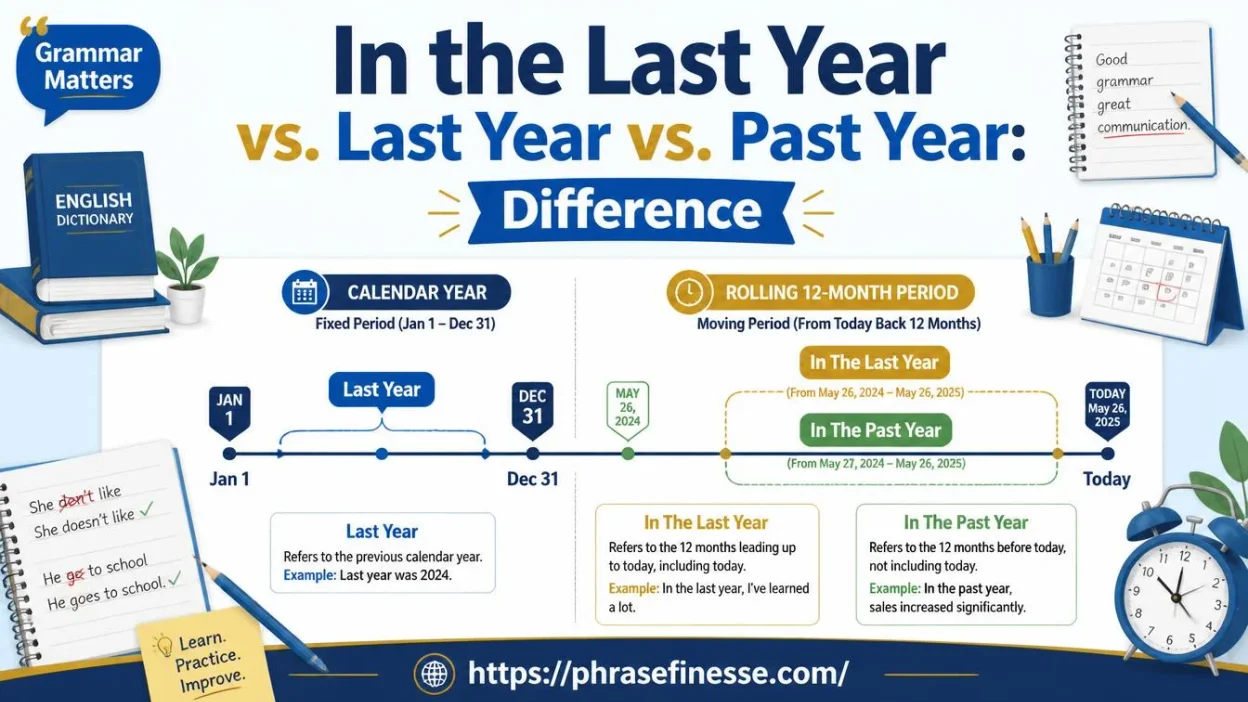
The main difference comes down to whether you’re talking about a fixed calendar year or a rolling twelve-month period.
| Expression | Meaning | Time Period |
| Last year | The year before the current year | Fixed calendar year |
| In the last year | The previous 12 months counting back from now | Rolling period |
| In the past year | The previous 12 months counting back from now | Rolling period |
Simple Example
Assume today’s date is July 2026.
| Phrase | Time Covered |
| Last year | January 2025 – December 2025 |
| In the last year | July 2025 – July 2026 |
| In the past year | July 2025 – July 2026 |
That small difference can completely change the meaning of a statement.
What Does “Last Year” Mean?
The phrase “last year” refers to the calendar year immediately before the current one.
If you’re currently in 2026, then last year means 2025.
This is a fixed period. It doesn’t move depending on the date.
Examples
- I bought a new car last year.
- The company opened three offices last year.
- We traveled to Canada last year.
- She graduated from college last year.
In all of these examples, the speaker refers to events that happened sometime during the previous calendar year.
Timeline
2025 2026
|—————-|
Last Year
Why Native Speakers Use “Last Year”
Native speakers often choose “last year” when discussing:
- Completed events
- Historical facts
- Annual reports
- Past accomplishments
- Personal milestones
Example in Business
Imagine a company reviewing its performance.
✅ Revenue increased by 15% last year.
This means the increase occurred during the previous calendar year.
The phrase sounds natural because annual business reports typically organize data by calendar years.
What Does “In The Last Year” Mean?
The phrase “in the last year” means during the twelve months immediately before now.
Unlike “last year,” this period is not fixed.
It moves forward every day.
If today is July 9, 2026, then “in the last year” refers to the period from approximately July 9, 2025, to July 9, 2026.
Examples
- I’ve learned a lot in the last year.
- Our sales have doubled in the last year.
- Technology has changed rapidly in the last year.
- We’ve hired twenty new employees in the last year.
Why Businesses Prefer This Expression
Companies frequently use rolling twelve-month measurements because they provide a more current picture.
For example:
- Revenue growth
- Customer retention
- Website traffic
- Product adoption
Instead of waiting for the end of a calendar year, businesses analyze the most recent twelve months.
Example
A software company might say:
“Our customer base has grown by 42% in the last year.”
This statement focuses on recent growth rather than a completed calendar year.
What Does “In The Past Year” Mean?
The phrase “in the past year” is extremely similar to “in the last year.”
In most situations, they mean exactly the same thing.
Both refer to the twelve months immediately preceding the present moment.
Examples
- We’ve expanded significantly in the past year.
- Customer satisfaction has improved in the past year.
- The market has changed dramatically in the past year.
- Researchers have made important discoveries in the past year.
Why Writers Use “In The Past Year”
Many writers choose this phrase because it sounds slightly more formal.
You’ll often find it in:
- Academic journals
- Market research reports
- Government publications
- News articles
- Corporate communications
Example
“Consumer spending patterns have shifted considerably in the past year.”
This sentence sounds professional and analytical.
In The Last Year vs. In The Past Year
Many learners ask whether these phrases are interchangeable.
In most cases, the answer is yes.
Comparison
| Phrase | Typical Tone |
| In the last year | Conversational |
| In the past year | Slightly formal |
Example
- We’ve grown significantly in the last year.
- We’ve grown significantly in the past year.
Both sentences communicate essentially the same idea.
Subtle Difference
Some language experts note a slight distinction.
Last often emphasizes recency.
Past often emphasizes the time period itself.
However, native speakers rarely notice this difference in everyday conversation.
Which One Sounds Better?
It depends on context.
| Context | Preferred Expression |
| Casual conversation | In the last year |
| Business reports | In the past year |
| Academic writing | In the past year |
| Personal updates | In the last year |
| News articles | Either works |
Last Year vs. In The Last Year
This is where confusion usually occurs.
These expressions are not identical.
Example Scenario
Imagine today’s date is July 2026.
Last Year
Refers to:
January 2025 through December 2025
In The Last Year
Refers to:
July 2025 through July 2026
Notice how those periods overlap but are not the same.
Comparison Table
| Expression | Timeframe |
| Last year | Previous calendar year |
| In the last year | Most recent 12 months |
| In the past year | Most recent 12 months |
Real-World Example
Suppose a company launched a product in March 2026.
Would this sentence be correct?
❌ The company launched the product last year.
No.
If the current year is 2026, March 2026 occurred this year.
However:
✅ The company launched the product in the last year.
This is accurate because March 2026 falls within the previous twelve months.
Why Time Reference Matters
Many people underestimate how important precise time references are.
A small wording change can affect:
- Financial reporting
- Legal documents
- Academic research
- Job applications
- Performance evaluations
Example
Imagine two statements:
- Revenue increased 20% last year.
- Revenue increased 20% in the last year.
The first refers to a completed calendar year.
The second refers to the most recent twelve months.
Investors, managers, and analysts may interpret these statements differently.
Precision matters.
Which Preposition Is Correct?
The preposition plays a major role in these expressions.
Let’s examine the most common options.
Using “In The Last Year”
The preposition in is the standard choice.
It means something happened during a specific period.
Examples
- I’ve improved my writing skills in the last year.
- Sales have increased in the last year.
- The market has evolved in the last year.
This construction is extremely common in modern English.
Using “In The Past Year“
The same rule applies.
Examples
- We’ve expanded globally in the past year.
- The industry has transformed in the past year.
- Researchers have published groundbreaking findings in the past year.
Again, “in” signals that something occurred during that time period.
Using “Over The Last Year”
The preposition over is also common.
However, it often emphasizes change, growth, movement, or development.
Examples
- Revenue increased over the last year.
- Costs declined over the last year.
- Demand rose steadily over the last year.
Why It Works
Think of “over” as describing movement across time.
The focus is not merely on the period itself.
Instead, the focus is on change during that period.
Using “During The Last Year”
The word during emphasizes events that occurred within a timeframe.
Examples
- During the last year, we launched three new products.
- During the last year, customer demand remained stable.
This phrasing sounds slightly more formal.
Using “For The Last Year”
This construction usually indicates duration.
Examples
- I’ve worked here for the last year.
- She’s been studying French for the last year.
The emphasis is on continuity.
Preposition Comparison Table
| Expression | Meaning |
| In the last year | Something happened within the period |
| Over the last year | Change occurred across the period |
| During the last year | Events occurred within the period |
| For the last year | Continuous duration |
Grammar Patterns Commonly Used With These Expressions
Certain verb tenses naturally pair with these time expressions.
Understanding these patterns makes your English sound more natural.
Read More :7 Words for Doing Something Without Thinking
Present Perfect With “In The Last Year”
The present perfect is often the best choice.
Examples
- I’ve improved significantly in the last year.
- We’ve expanded rapidly in the last year.
- The company has grown substantially in the last year.
Why?
The action connects the past with the present.
The results are still relevant now.
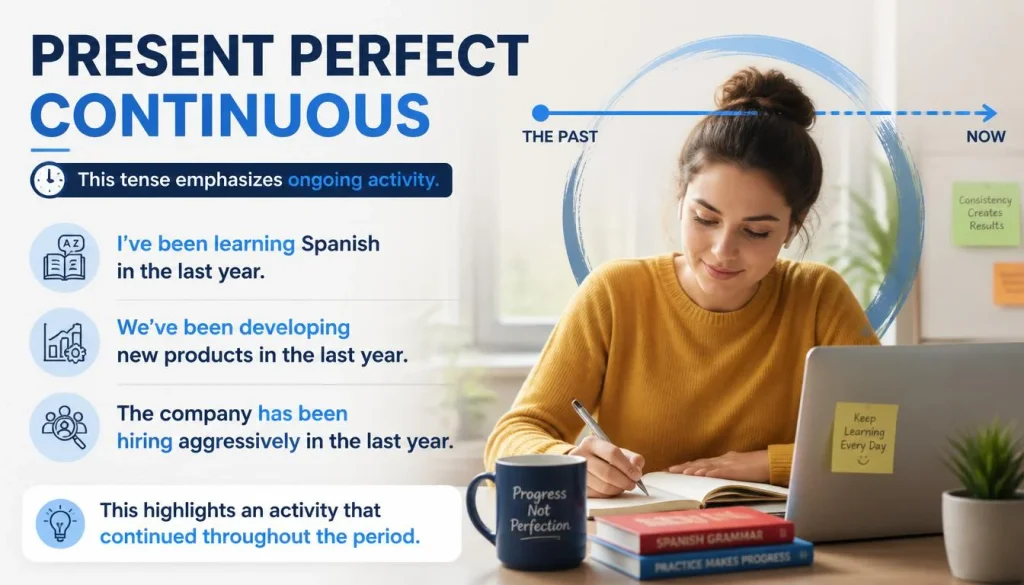
Present Perfect Continuous
This tense emphasizes ongoing activity.
Examples
- I’ve been learning Spanish in the last year.
- We’ve been developing new products in the last year.
- The company has been hiring aggressively in the last year.
This highlights an activity that continued throughout the period.
Simple Past With “Last Year”
When using “last year,” the simple past is usually correct.
Examples
- I moved last year.
- We launched the product last year.
- She graduated last year.
Incorrect Usage
❌ I’ve moved last year.
Because “last year” refers to a finished time period, the simple past is required.
Correct Version
✅ I moved last year.
Common Mistakes and How to Avoid Them
Even advanced English speakers occasionally confuse these expressions.
Here are the most common errors.
Using “Last Year” for a Rolling Period
Incorrect
❌ Sales increased last year.
When discussing data from July 2025 through July 2026.
Correct
✅ Sales have increased in the last year.
Mixing Tenses
Incorrect
❌ I’ve started a new job last year.
Correct
✅ I started a new job last year.
Confusing Calendar Years With Rolling Years
Before choosing a phrase, ask yourself:
Am I talking about the previous calendar year or the previous twelve months?
That question solves most mistakes instantly.
Real-World Examples
Let’s see how these phrases appear in different contexts.
Business English
Examples
- Revenue has increased by 28% in the past year.
- Customer retention improved in the last year.
- The company opened four offices last year.
Notice how each expression serves a different purpose.
Academic Writing
Researchers frequently use rolling periods.
Example
“Researchers observed a substantial increase in online learning participation in the past year.”
This sounds precise and professional.
Job Interviews
Interviewers often ask about recent achievements.
Example
“I’ve developed strong leadership skills in the last year.”
This highlights growth during the most recent twelve months.
Everyday Conversation
Examples
- We bought a house last year.
- A lot has changed in the last year.
- I’ve traveled more in the past year than ever before.
These expressions appear constantly in everyday speech.
Similar Time Expressions You Should Know
English contains many related phrases.
Understanding them improves your fluency.
Common Alternatives
- In the previous year
- Over the past year
- Over the last 12 months
- During the previous year
- Throughout the past year
- Within the last year
Comparison Table
| Expression | Meaning |
| Last year | Previous calendar year |
| Previous year | Usually relative to another year |
| Past year | Previous 12 months |
| Last 12 months | Previous 12 months |
| Previous 12 months | Previous 12 months |
How Native Speakers Actually Use These Expressions
Language textbooks explain rules.
Real life is sometimes messier.
Native speakers often choose phrases based on context, audience, and style.
Casual Speech
Most people naturally say:
- Last year
- In the last year
These expressions sound conversational and familiar.
Business Writing
Business professionals frequently use:
- Over the last year
- In the past year
- Over the past twelve months
These phrases sound analytical and data-driven.
Academic Writing
Researchers often prefer:
- In the past year
- Over the previous twelve months
These constructions feel formal and objective.
Quick Rules to Remember
If you’re ever unsure, remember these simple guidelines:
Use “Last Year” When:
- Referring to the previous calendar year
- Discussing completed events
- Using simple past tense
Use “In The Last Year” When:
- Referring to the previous twelve months
- Discussing recent changes
- Using present perfect tense
Use “In The Past Year” When:
- Referring to the previous twelve months
- Writing formally
- Presenting research or business findings
Use “Over The Last Year” When:
- Highlighting growth
- Describing trends
- Discussing change over time
FAQs
Is “in the last year” the same as “last year”?
No. “In the last year” refers to the previous 12 months counting back from the present moment. “Last year” refers to the previous calendar year. For example, if today is July 2026, “in the last year” covers roughly July 2025–July 2026, while “last year” means January–December 2025.
When should I use “in the past year”?
Use “in the past year” when talking about events, changes, or trends that occurred during the previous 12 months. It is very similar to “in the last year” and is common in reports, research, and professional communication.
Which phrase is more common in formal writing?
All three phrases appear in formal writing, but the best choice depends on the intended meaning. “Last year” is preferred for specific calendar-year references, while “in the last year” and “in the past year” are better when discussing a rolling 12-month period.
Can “in the last year” and “in the past year” be used interchangeably?
In most situations, yes. Both expressions typically refer to the previous 12 months. However, “in the past year” sometimes sounds slightly more reflective or analytical, while “in the last year” often feels more direct and conversational.
Which phrase is better for business reports?
If you are discussing performance over the previous 12 months, use “in the last year” or “in the past year.” If your report focuses on a completed calendar year, “last year” is usually the more accurate choice.
Do these phrases affect clarity in communication?
Yes. Choosing the wrong expression can create confusion about the timeframe being discussed. Using the correct phrase improves clarity, consistency, and accuracy in business communication, formal writing, and everyday conversations.
Conclusion
The difference between “in the last year,” “last year,” and “in the past year” comes down to the timeframe each expression describes. “Last year” refers to the previous calendar year, while “in the last year” and “in the past year” generally refer to the most recent 12-month period.
Although the phrases are closely related, selecting the correct one helps ensure precision and avoids misunderstandings. Whether you are writing a report, sending a professional email, analyzing data, or simply improving your English grammar, understanding these distinctions will help you communicate timelines more accurately and confidently.