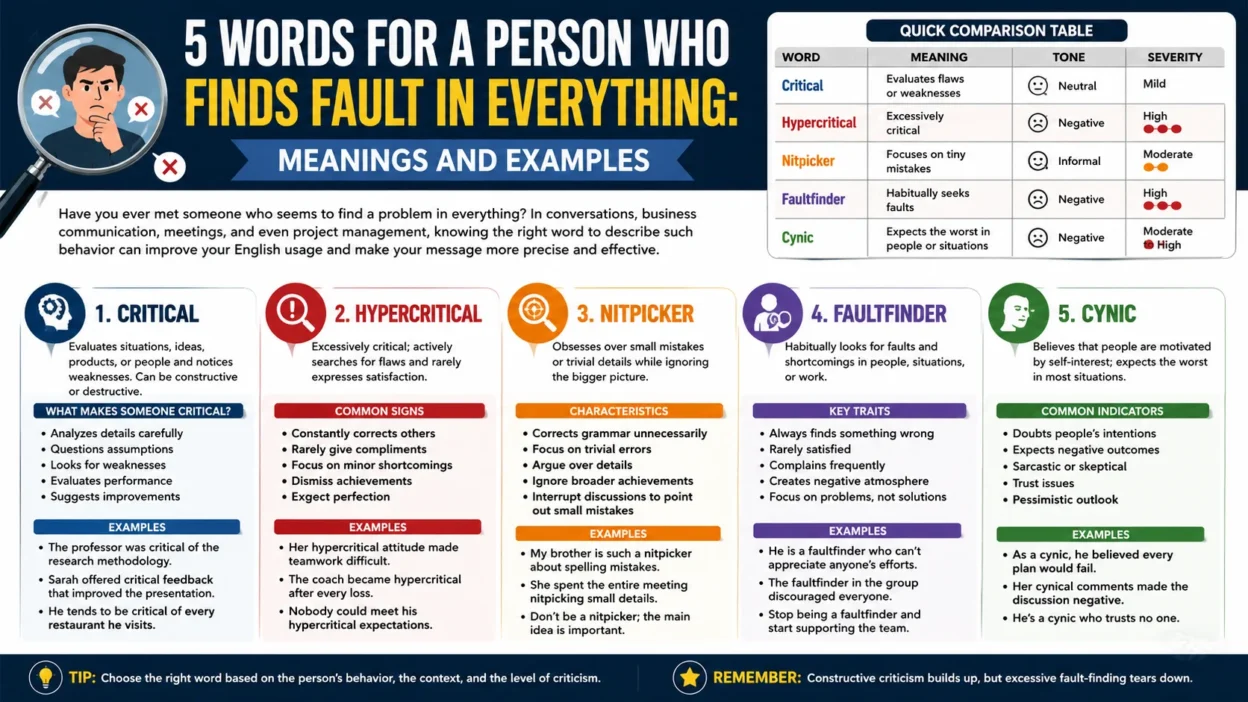
Have you ever met someone who seems to find a problem in everything? In conversations, business communication, meetings, and even project management, knowing the right word to describe such behavior can improve your English usage, grammar, and formal writing. In this guide, “5 Words for a Person Who Finds Fault in Everything: Meanings and Examples”, you’ll discover the most accurate terms used for people who constantly point out flaws and shortcomings.
While words like critical, hypercritical, nitpicker, faultfinder, and cynic may seem similar, they have distinct meanings and uses. Understanding these differences can help you communicate more clearly and maintain consistency in both personal and professional settings. Whether discussing time management, scheduling, calendar planning, online booking, or broadcasting, choosing the right word makes your message more precise and effective
What Do You Call a Person Who Finds Fault in Everything?
The most common words for someone who constantly points out flaws are:
- Critical
- Hypercritical
- Nitpicker
- Faultfinder
- Cynic
Although these words seem similar, they describe different behaviors and attitudes.
Quick Comparison Table
| Word | Meaning | Tone | Severity |
| Critical | Evaluates flaws or weaknesses | Neutral | Mild |
| Hypercritical | Excessively critical | Negative | High |
| Nitpicker | Focuses on tiny mistakes | Informal | Moderate |
| Faultfinder | Habitually seeks faults | Negative | High |
| Cynic | Expects the worst in people or situations | Negative | Moderate to High |
Understanding these differences helps you communicate more accurately and avoid using the wrong term.
Critical
Among all the words for a person who finds fault in everything, critical is probably the most versatile.
A critical person evaluates situations, ideas, products, or people and notices weaknesses. Unlike some of the other words on this list, being critical isn’t automatically negative.
In many professions, critical thinking is highly valued.
Doctors analyze symptoms critically. Engineers critically examine designs. Editors critically review manuscripts before publication.
The issue arises when criticism becomes excessive or unbalanced.
What Makes Someone Critical?
A critical person often:
- Analyzes details carefully
- Questions assumptions
- Looks for weaknesses
- Evaluates performance
- Suggests improvements
These traits can be beneficial when applied constructively.
Examples
- The professor was critical of the research methodology.
- Sarah offered critical feedback that improved the presentation.
- He tends to be critical of every restaurant he visits.
Notice how the meaning changes depending on context.
Constructive vs. Destructive Criticism
| Constructive Criticism | Destructive Criticism |
| Focuses on improvement | Focuses on flaws |
| Provides solutions | Provides complaints |
| Encourages growth | Discourages effort |
| Balanced and fair | One-sided and harsh |
A critical person may fall into either category.
When to Use “Critical”
Use this word when:
- You want a professional tone.
- The criticism isn’t necessarily excessive.
- The person evaluates rather than attacks.
- The context involves analysis or judgment.
Hypercritical
When criticism crosses the line into excess, the word hypercritical becomes much more accurate.
A hypercritical person doesn’t simply notice flaws. They actively search for them.
Even when something is objectively good, they focus on imperfections.
It’s like using a magnifying glass to inspect every tiny crack while ignoring the entire building.
What Does Hypercritical Mean?
Hypercritical describes someone who:
- Judges harshly
- Sets unrealistically high standards
- Rarely expresses satisfaction
- Overemphasizes mistakes
- Finds flaws in nearly everything
Unlike a merely critical person, a hypercritical individual often struggles to recognize positive qualities.
Common Signs of a Hypercritical Person
You may be dealing with a hypercritical individual if they:
- Constantly correct others
- Rarely give compliments
- Focus on minor shortcomings
- Dismiss achievements
- Expect perfection
Real-Life Example
Imagine a manager reviewing an employee’s report.
The report is accurate, well-researched, and professionally written.
Instead of acknowledging the quality of the work, the manager spends twenty minutes discussing a formatting issue on page twelve.
That behavior reflects hypercritical tendencies.
Example Sentences
- Her hypercritical attitude made teamwork difficult.
- The coach became hypercritical after every loss.
- Nobody could meet his hypercritical expectations.
Why Hypercritical People Behave This Way
Researchers and psychologists often associate excessive criticism with:
- Perfectionism
- Anxiety
- Insecurity
- High personal standards
- Learned behavior from childhood
Not every hypercritical person intends harm. Sometimes their behavior reflects their internal struggles rather than genuine hostility.
Nitpicker
If someone constantly focuses on tiny details while ignoring the bigger picture, nitpicker may be the perfect word.
This term is less formal and often appears in everyday conversations.
What Is a Nitpicker?
A nitpicker obsesses over small mistakes, trivial inconsistencies, or insignificant details.
The word comes from the literal act of picking tiny nits, or lice eggs, from hair. Over time, it evolved into a metaphor for excessive attention to minor flaws.
Characteristics of a Nitpicker
Nitpickers often:
- Correct grammar unnecessarily
- Focus on trivial errors
- Argue over details
- Ignore broader achievements
- Interrupt discussions to point out small mistakes
Example Situations
A team launches a successful marketing campaign that generates thousands of new customers.
Instead of discussing the results, a nitpicker might complain about a single typo in one advertisement.
The campaign succeeds.
The typo becomes the only thing they mention.
Examples
- My brother is such a nitpicker about spelling mistakes.
- She spent the entire meeting nitpicking small details.
- Don’t be a nitpicker. Focus on the main issue.
Nitpicker vs. Perfectionist
Many people confuse these terms.
| Nitpicker | Perfectionist |
| Focuses on tiny flaws | Focuses on achieving excellence |
| Often criticizes others | Often criticizes self and others |
| Concerned with details | Concerned with outcomes |
| Can miss the big picture | Usually focused on overall quality |
The distinction matters because not every perfectionist is a nitpicker.
Faultfinder
Few words describe habitual criticism as directly as faultfinder.
Unlike some modern alternatives, faultfinder leaves little room for ambiguity.
A faultfinder is someone who routinely seeks mistakes, defects, weaknesses, or shortcomings in people, ideas, and situations.
Definition of Faultfinder
A faultfinder:
- Looks for problems first
- Focuses on mistakes
- Highlights weaknesses
- Frequently criticizes
- Rarely acknowledges strengths
The word combines two simple concepts:
- Fault
- Finder
Together, they create a powerful description of someone whose attention naturally gravitates toward defects.
Why Faultfinders Create Problems
Faultfinding can damage:
- Workplace morale
- Family relationships
- Friendships
- Team productivity
- Personal confidence
When people expect criticism regardless of their effort, motivation often declines.
Case Study: The Workplace Faultfinder
Consider a team leader who reviews every project.
Employees consistently meet deadlines.
Clients remain satisfied.
Revenue increases.
Yet the leader only discusses mistakes.
Over time:
- Employee engagement falls.
- Creativity decreases.
- Turnover rises.
- Trust disappears.
The faultfinder’s behavior undermines success despite positive results.
Example Sentences
- Nobody enjoyed working with the office faultfinder.
- His reputation as a faultfinder followed him everywhere.
- Constant faultfinding damaged the relationship.
When to Use “Faultfinder”
This word works best when:
- The criticism is habitual.
- The behavior occurs frequently.
- The focus is on flaws rather than solutions.
- You want a strong descriptive term.
Cynic
A cynic differs from the other words on this list because their criticism stems from pessimism rather than simple fault-finding.
Cynics often assume negative motives.
They expect disappointment.
They distrust optimism.
As a result, they frequently find fault in people, organizations, and ideas.
What Is a Cynic?
A cynic typically believes:
- People act out of self-interest.
- Good intentions are rare.
- Success hides ulterior motives.
- Positive outcomes won’t last.
This worldview naturally leads to criticism.
How Cynics Find Fault
Imagine a company donates millions to charity.
A cynic might immediately say:
“They’re only doing it for publicity.”
Whether that’s true or not, the assumption reflects cynical thinking.
Cynic vs. Faultfinder
| Cynic | Faultfinder |
| Distrusts motives | Focuses on mistakes |
| Expects negative outcomes | Searches for flaws |
| Questions intentions | Questions performance |
| Driven by skepticism | Driven by criticism |
Example Sentences
- The cynic doubted every promise.
- She remained cynical despite the positive results.
- His cynical outlook affected team morale.
When to Use “Cynic”
Choose this word when:
- Negative expectations drive the criticism.
- The person questions motives.
- Skepticism plays a central role.
- The behavior extends beyond simple fault-finding.
see more: Universities or University’s or Universities’? Use Correct One!
Other Useful Words for Someone Who Finds Fault in Everything
The English language offers several additional terms worth knowing.
Captious
Captious describes someone who raises unnecessary objections and finds fault over trivial matters.
Example:
- The lawyer’s captious arguments delayed the discussion.
This word appears more often in formal writing than casual conversation.
Carping
Carping refers to persistent complaining or criticism.
Example:
- His constant carping irritated the entire team.
The word carries a distinctly negative tone.
Complainer
A complainer regularly expresses dissatisfaction.
Unlike a faultfinder, a complainer may not actively analyze flaws. They simply voice grievances frequently.
Example:
- Everyone knew him as the office complainer.
Detractor
A detractor criticizes or discredits a person, idea, or achievement.
Example:
- Even successful leaders attract detractors.
Perfectionist
Perfectionists often find faults because they pursue exceptionally high standards.
However, unlike faultfinders, perfectionists usually apply those standards to themselves as well.
Example:
- Her perfectionist tendencies made every project take longer.
Comparison Table
| Word | Main Focus | Tone |
| Captious | Trivial objections | Negative |
| Carping | Constant criticism | Negative |
| Complainer | Dissatisfaction | Negative |
| Detractor | Opposition | Negative |
| Perfectionist | High standards | Neutral |
How to Choose the Right Word
Choosing the correct term depends on the specific behavior you’re describing.
If They Criticize Everything
Best choices:
- Hypercritical
- Faultfinder
These words suggest frequent and excessive criticism.
If They Focus on Tiny Details
Best choice:
- Nitpicker
This emphasizes attention to minor flaws.
If They Expect the Worst
Best choice:
- Cynic
The criticism comes from skepticism and pessimism.
If They Analyze and Evaluate
Best choice:
- Critical
This remains the most balanced and professional option.
If They Demand Extremely High Standards
Best choice:
- Perfectionist
The emphasis shifts from criticism to excellence.
Quick Decision Guide
| Situation | Best Word |
| Constant criticism | Faultfinder |
| Excessive criticism | Hypercritical |
| Tiny details matter most | Nitpicker |
| Negative worldview | Cynic |
| Balanced evaluation | Critical |
| Unrealistically high standards | Perfectionist |
Common Places You’ll Encounter Fault-Finding Behavior
Understanding context can help you choose the most accurate term.
In the Workplace
Fault-finding often appears during:
- Performance reviews
- Team meetings
- Project evaluations
- Quality assurance processes
Constructive criticism helps organizations improve.
Excessive fault-finding creates resentment.
In Relationships
Personal relationships frequently suffer when one person constantly highlights weaknesses.
Examples include:
- Criticizing appearance
- Correcting small mistakes
- Pointing out flaws in decisions
- Focusing on negatives instead of positives
Over time, this behavior can erode trust and intimacy.
In Education
Teachers and professors must balance criticism carefully.
Too little feedback prevents growth.
Too much criticism discourages learning.
The most effective educators combine honest evaluation with encouragement.
In Literature and Media
Writers often use faultfinding personalities to create memorable characters.
Think about:
- The grumpy neighbor
- The skeptical detective
- The demanding boss
- The cynical journalistThese personalities create tension and conflict that drive stories forward
Why Some People Always Find Fault
Fault-finding behavior doesn’t appear randomly.
Several factors often contribute.
Perfectionism
People with perfectionist tendencies struggle to tolerate mistakes.
As a result, flaws attract their attention immediately.
Anxiety
Anxious individuals frequently scan for problems.
Their brains become trained to detect risks and imperfections.
Learned Behavior
Children who grow up around constant criticism sometimes adopt similar habits as adults.
Desire for Control
Pointing out flaws can create a sense of authority or control.
Some individuals unconsciously use criticism to maintain influence.
Fear of Failure
Ironically, people who fear failure often criticize others to avoid confronting their own insecurities.
Understanding these causes doesn’t excuse harmful behavior.
However, it provides useful context.
Read More: Universities or University’s or Universities’? Use Correct One!
Famous Quote About Fault-Finding
One well-known observation states:
“Any fool can criticize, condemn, and complain—and most fools do.”
The quote highlights an important distinction.
Finding faults is easy.
Offering solutions requires greater skill, wisdom, and effort.
The most respected leaders don’t merely identify problems.
They help solve them.
FAQs
1. What do you call a person who finds fault in everything?
A person who constantly notices and points out flaws can be described using words such as critic, faultfinder, cynic, nitpicker, or perfectionist, depending on the context and severity of the behavior.
2. Is being a faultfinder always a negative trait?
Not necessarily. Some people identify problems to improve quality, efficiency, or accuracy. However, when criticism becomes excessive or unconstructive, it can negatively affect relationships, teamwork, and communication.
3. What is the difference between a critic and a faultfinder?
A critic typically evaluates something and may provide balanced feedback, including strengths and weaknesses. A faultfinder, on the other hand, tends to focus primarily on mistakes, flaws, or shortcomings.
4. What word describes someone who is overly critical of small details?
The word nitpicker is commonly used for someone who focuses excessively on minor mistakes or insignificant details that others may overlook.
5. Can a perfectionist be considered someone who finds fault in everything?
Sometimes. A perfectionist often has very high standards and may frequently notice imperfections. However, perfectionism is usually driven by a desire for excellence rather than a desire to criticize others.
6. Why is it important to choose the right word for a fault-finding person?
Different words carry different meanings and tones. Using the correct term improves English usage, strengthens formal writing, enhances business communication, and ensures greater clarity and consistency in both spoken and written language.
Conclusion
Finding the right way to describe a person who constantly points out flaws can make your communication more precise and effective. The 5 Words For A Person Who Finds Fault In Everything discussed in this article each carry unique meanings, connotations, and levels of intensity. While some terms suggest constructive evaluation, others imply persistent negativity or excessive criticism.
Understanding these distinctions helps improve vocabulary, strengthen grammar, and support clearer formal writing. Whether you’re communicating in professional settings, participating in meetings, managing projects, or simply expanding your knowledge of the English language, choosing the most accurate word allows you to express ideas with confidence and clarity. By using the right term in the right context, you can communicate more effectively and avoid misunderstandings.

Alyan Ashraf is an English language writer and editor at Phrase Finesse, where he specializes in grammar, vocabulary, spelling, word usage, and clear communication. Passionate about the English language, he creates practical, research-backed content that helps readers avoid common mistakes and write with greater accuracy and confidence.
Known for his clear writing style and attention to detail, Alyan simplifies complex language topics into easy-to-understand guides filled with real-world examples and actionable insights. His work covers confusing word pairs, grammar rules, idioms, punctuation, and everyday English usage, making learning both accessible and engaging for students, professionals, writers, and non-native English speakers.
Every article Alyan writes is carefully researched, fact-checked, and designed to meet high editorial standards. His goal is to help readers strengthen their English skills, expand their vocabulary, and communicate more effectively in academic, professional, and everyday settings.
Through Phrase Finesse, Alyan is committed to publishing trusted language resources that make mastering English simpler, clearer, and more enjoyable for learners around the world