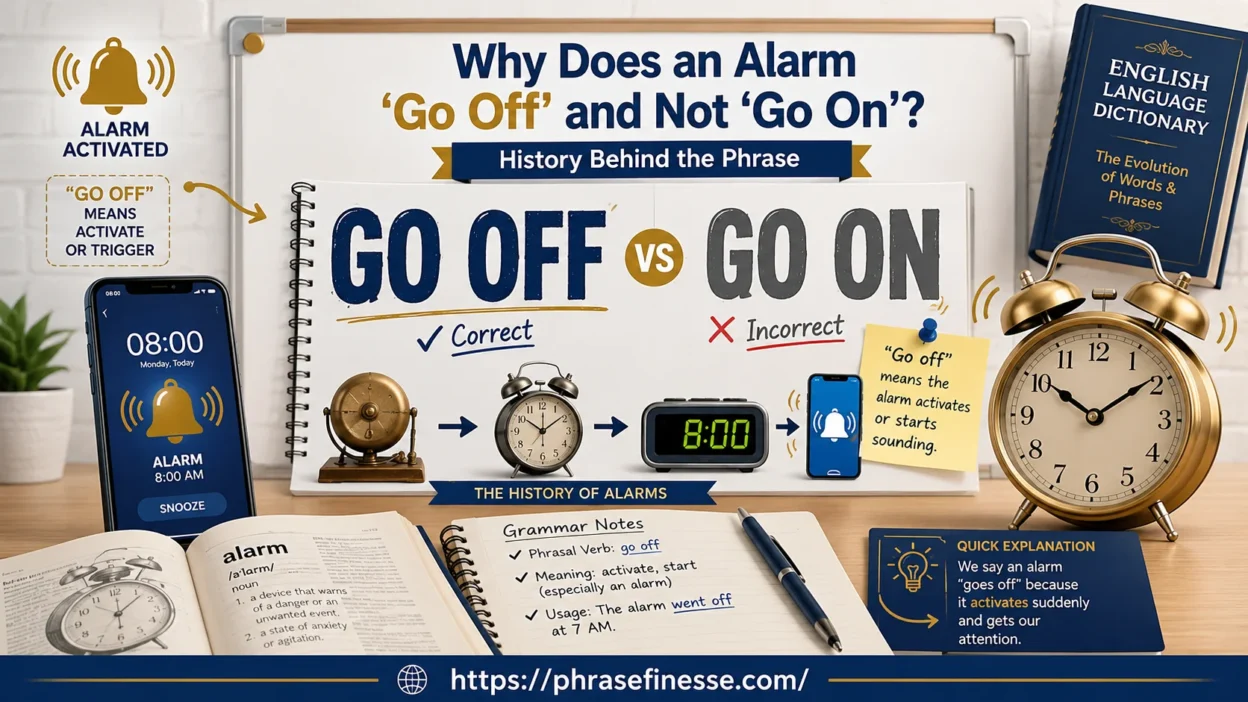
Have you ever silenced your phone and wondered, “Why Does An Alarm ‘Go Off’ And Not ‘Go On’?” At first glance, the phrase seems backward. After all, an alarm becomes active when it starts ringing. Yet native speakers consistently say an alarm “goes off.” This curious expression often sparks questions about English usage, grammar, everyday communication, and the logic behind common idioms.
Understanding this phrase is more than a matter of curiosity. In contexts involving scheduling, time management, calendar reminders, meetings, project management, and even online booking systems, alarms play a vital role in keeping tasks on track.
The language surrounding alarms has evolved over time, creating expressions that may seem confusing but remain widely accepted in both casual and professional settings. Recognizing these patterns can improve business communication, strengthen formal writing, and promote greater consistency in language use.
In this article, you’ll discover the history and meaning behind the phrase “go off,” why it became associated with alarms, and whether “go on” could ever be considered correct in the same context.
We’ll also explore related examples from broadcasting, modern technology, and everyday speech to reveal how language develops through usage rather than strict logic. By the end, you’ll have a clearer understanding of this common expression and the linguistic principles behind it..
Why Does an Alarm Go Off? The Short Answer
The simple answer is this:
An alarm goes off because the phrase “go off” historically meant “to be triggered, activated, discharged, or suddenly begin operating.”
In older English, “off” didn’t always mean the opposite of “on.”
Instead, people commonly used “go off” to describe events that suddenly happened or mechanisms that suddenly activated.
For example:
- A gun went off.
- A cannon went off.
- A firework went off.
- A bomb went off.
When alarm systems became common, English speakers naturally applied the same phrase to alarms because alarms also activate suddenly and produce a noticeable signal.
Over time, the expression became standard English.
Today, even though technology has changed dramatically, the phrase remains exactly the same.
Why the Phrase Sounds Backward Today
Modern technology changed how people think about the words on and off.
Most people now associate:
| Word | Modern Meaning |
| On | Active, running, operating |
| Off | Inactive, stopped, powered down |
Because of this association, hearing that an alarm “goes off” feels contradictory.
After all:
- A light turns on.
- A computer turns on.
- A fan turns on.
- A heater turns on.
So why doesn’t an alarm turn on?
The answer is that language often preserves older meanings long after society changes.
Many common expressions survive for hundreds of years even when their original logic disappears.
An alarm going off is one of those linguistic leftovers.
The Historical Meaning of “Go Off”
To understand the phrase fully, it helps to examine how English speakers used the expression centuries ago.
Historically, go off commonly meant:
- Explode
- Discharge
- Trigger
- Activate
- Begin suddenly
- Occur unexpectedly
Notice that none of those meanings involve turning something off.
Instead, they all involve something starting.
This historical meaning dates back hundreds of years and appeared regularly in English literature, military records, newspapers, and everyday conversation.
Early Examples
Consider these phrases:
- The cannon went off at dawn.
- The musket accidentally went off.
- The fireworks went off after sunset.
- The charge went off unexpectedly.
In every case, go off refers to activation.
The event begins rather than ends.
This older meaning eventually became deeply rooted in English usage.
How Guns, Cannons, and Explosives Influenced Alarm Language
One of the biggest clues comes from military terminology.
Long before electronic alarms existed, people frequently used the phrase go off when discussing weapons and explosives.
When a gun fires:
- A trigger activates.
- Energy releases suddenly.
- A loud sound occurs.
- A noticeable event happens.
Exactly the same pattern occurs when an alarm activates.
When an alarm triggers:
- A mechanism activates.
- A warning signal begins.
- A loud sound occurs.
- A noticeable event happens.
Because the actions were so similar, English speakers naturally adopted the same wording.
Comparison
| Event | What Happens |
| Gun goes off | Trigger activates and sound occurs |
| Firework goes off | Ignition activates and explosion occurs |
| Bomb goes off | Detonation activates |
| Alarm goes off | Warning signal activates |
The linguistic connection becomes much easier to see once these events are compared side by side.
The Evolution of Alarm Systems
The phrase existed before modern alarms, but understanding alarm history helps explain why the expression survived.
Early Warning Systems
Before alarm clocks existed, communities relied on warning systems such as:
- Church bells
- Town bells
- Signal horns
- Watchmen
- Factory whistles
- Air raid sirens
These systems served one purpose:
Get people’s attention immediately.
When activated, they produced sudden noise.
Because the event resembled other sudden triggers like gunfire or explosions, the expression go off fit naturally.
Mechanical Alarm Clocks and the Rise of the Phrase
Mechanical alarm clocks became popular during the nineteenth century.
Unlike modern digital alarms, these devices worked entirely through gears, springs, and mechanical triggers.
When the designated time arrived:
- A mechanism released.
- A hammer struck bells.
- A loud ringing sound began.
The action happened instantly.
The mechanism was literally triggered.
As a result, people commonly said:
“The alarm went off at six o’clock.”
The phrase matched existing English patterns and quickly became standard.
Why Smartphones Didn’t Change the Expression
Technology evolves faster than language.
Even though modern alarms are digital, people still use the same wording.
Examples include:
- Phone alarms
- Smartwatch alarms
- Security alarms
- Fire alarms
- Carbon monoxide alarms
- Vehicle alarms
Nobody says:
- My alarm went on.
- My smoke detector went on.
- My car alarm went on.
Instead, English speakers overwhelmingly prefer:
- My alarm went off.
- The detector went off.
- The security system went off.
Language tends to resist change when an expression already communicates meaning effectively.
Read More: “Answer TO, FOR, Or OF The Question”? Perfect Examples
What Does “Off” Actually Mean Here?
One reason this phrase confuses people is that off has many meanings.
English contains thousands of words with multiple definitions, and “off” is among the most flexible.
Different Meanings of “Off”
| Meaning | Example |
| Away from a position | Take the book off the shelf |
| Disconnected | Turn the television off |
| Triggered suddenly | The alarm went off |
| Exploded | The bomb went off |
| Occurred successfully | The event went off without problems |
| Departed | The train went off toward London |
The alarm usage comes from the triggered suddenly definition.
It does not come from the deactivated definition.
That distinction explains almost all of the confusion.
Why Context Matters in English
English relies heavily on context.
The same word can carry completely different meanings depending on how it’s used.
Consider the word “run.”
You can:
- Run a race
- Run a company
- Run software
- Run water
- Run late
Each use means something different.
The word off works similarly.
When people hear:
“The alarm went off.”
They automatically understand:
“The alarm activated.”
Context removes ambiguity.
Native speakers rarely stop to analyze the phrase because they learned it as a complete expression.
Other Things That “Go Off”
Alarms aren’t the only things that go off.
Many English expressions use the same structure.
Explosions and Discharges
- A bomb goes off.
- A grenade goes off.
- A firework goes off.
- A mine goes off.
Warning Systems
- A siren goes off.
- A smoke detector goes off.
- A security alarm goes off.
- A motion sensor goes off.
Detection Devices
- A metal detector goes off.
- A radiation detector goes off.
- A gas detector goes off.
Mental Reactions
- A light bulb goes off in your head.
- Something goes off in your brain.
- Warning bells go off mentally.
Despite the variety, the underlying concept remains consistent:
Something is triggered and begins producing a reaction.
Why We Don’t Say an Alarm “Goes On”
Many people assume the opposite phrase should be correct.
After all, if a device activates, shouldn’t it go on?
Not necessarily.
The Problem With “Go On”
In English, go on usually means:
- Continue
- Persist
- Proceed
- Carry on
Examples include:
- The show must go on.
- Life goes on.
- The meeting went on for hours.
- The discussion went on all night.
Notice the pattern.
The phrase emphasizes continuation rather than activation.
Because of this established meaning, saying:
“The alarm went on.”
sounds unusual to native speakers.
Most people interpret it as:
“The alarm continued.”
rather than:
“The alarm activated.”
Similar English Phrases That Seem Illogical
English contains many expressions that appear strange when interpreted literally.
Common Examples
| Phrase | Actual Meaning |
| Go off | Activate or trigger |
| Wind up | Finish |
| Break down | Stop functioning |
| Put up with | Tolerate |
| Carry on | Continue |
| Turn in | Submit or sleep |
| Call off | Cancel |
| Bring up | Mention |
These phrases are known as idiomatic expressions.
Their meanings developed through centuries of usage rather than strict logic.
How Other Languages Describe Alarm Activation
Interestingly, not all languages describe alarms the same way.
Some languages focus on the sound.
Others focus on the activation itself.
Common Approaches Worldwide
| Method | Meaning |
| Ring | Alarm rings |
| Sound | Alarm sounds |
| Activate | Alarm activates |
| Trigger | Alarm triggers |
| Start | Alarm starts |
English chose a more historical path.
Instead of adopting a literal phrase, it preserved an older expression that already existed.
This makes English both fascinating and occasionally confusing.
A Mini Case Study: The Smoke Alarm Example
Imagine a smoke detector senses smoke in a kitchen.
What happens?
Step-by-Step Process
- Sensor detects smoke.
- Internal circuitry activates.
- Warning signal begins.
- Sound reaches occupants.
- People react.
In everyday English, we summarize all five steps with one sentence:
“The smoke alarm went off.”
The phrase efficiently captures the entire event.
This efficiency helps explain why the wording has survived for generations.
How Linguists Explain the Phrase
Language experts often classify this phenomenon as semantic shift.
Semantic shift occurs when words gradually change meaning over time.
What Is Semantic Shift?
Semantic shift happens when:
- Society changes
- Technology evolves
- New contexts emerge
- Old meanings remain
Over centuries, words often develop additional meanings rather than replacing older ones entirely.
The phrase go off demonstrates this perfectly.
Originally associated with explosions and triggers, it expanded to include alarms, detectors, and warning systems.
Fossilized Expressions: Language Time Capsules
Linguists sometimes refer to phrases like this as fossilized expressions.
A fossilized expression preserves older language patterns that survive long after everyday speech changes.
Examples include:
- Kith and kin
- To and fro
- By and large
- Go off
These phrases act like linguistic time capsules.
They preserve historical meanings that might otherwise disappear.
The alarm example provides one of the clearest illustrations of this phenomenon.
Why the Phrase Has Survived for So Long
Several factors helped the expression endure.
It Is Widely Understood
Nearly every English speaker recognizes it instantly.
It Is Short
Two simple words communicate a complete event.
It Is Precise
The phrase specifically implies sudden activation.
It Has Historical Momentum
Once millions of people adopt a phrase, changing it becomes extremely difficult.
Language usually favors familiarity over perfect logic.
FAQs
1. Why do we say an alarm “goes off” instead of “goes on”?
We say an alarm “goes off” because the phrase historically meant that a signal, explosion, or warning device was activated. Over time, the expression became the standard way to describe an alarm beginning to ring, even though it may seem counterintuitive today.
2. Is “an alarm goes on” grammatically correct?
Not usually. Native English speakers rarely use “an alarm goes on” to mean that an alarm starts ringing. Instead, they say the alarm “goes off.” However, “goes on” may be used in different contexts, such as describing an event that continues for a period of time.
3. Where did the phrase “go off” originate?
The phrase “go off” originally referred to things being triggered or activated, such as guns, explosives, bells, and warning signals. Since alarms function as warning devices, the expression naturally became associated with them as well.
4. Do all English-speaking countries use “alarm goes off”?
Yes. The phrase “alarm goes off” is widely used in American English, British English, Canadian English, Australian English, and most other English-speaking regions. It is considered the standard expression across major dialects.
5. Can I use “alarm sounds” instead of “alarm goes off”?
Absolutely. “The alarm sounds” is a correct and slightly more formal alternative. It is often used in formal writing, technical documentation, and professional communication where greater precision is preferred.
6. Why does English use phrases that seem illogical?
English contains many idioms and phrasal verbs that developed through historical usage rather than strict logic. Expressions such as “go off,” “break down,” and “carry on” became common because speakers adopted them over time. Consistent usage eventually made them standard parts of the language.
Conclusion
The question “Why Does An Alarm ‘Go Off’ And Not ‘Go On’?” highlights how fascinating and sometimes unpredictable the English language can be. Although “go on” may seem more logical because an alarm becomes active when it starts ringing, historical usage established “go off” as the accepted expression. The phrase evolved from older meanings related to signals, warnings, and devices being triggered.
Understanding these language patterns can improve your English usage, strengthen grammar skills, and help you communicate with greater consistency in both everyday conversations and professional settings. Whether you are managing schedules, organizing meetings, handling project management tasks, or simply setting your morning alarm, knowing why this expression exists provides valuable insight into how English develops. Sometimes, language follows tradition more closely than logic—and “alarm goes off” is a perfect example.

Mia Rose is an English language specialist and editorial writer at Phrase Finesse, where she helps readers master grammar, vocabulary, spelling, and effective communication. Passionate about making English simple and practical, she creates well-researched, reader-friendly content that explains complex language concepts in a clear and engaging way.
With extensive experience in English language education, content writing, and editorial review, Mia specializes in grammar, punctuation, word choice, idioms, confusing word pairs, and writing style. Her articles are carefully researched, fact-checked, and designed to help students, professionals, writers, and English learners build confidence in both written and spoken English.