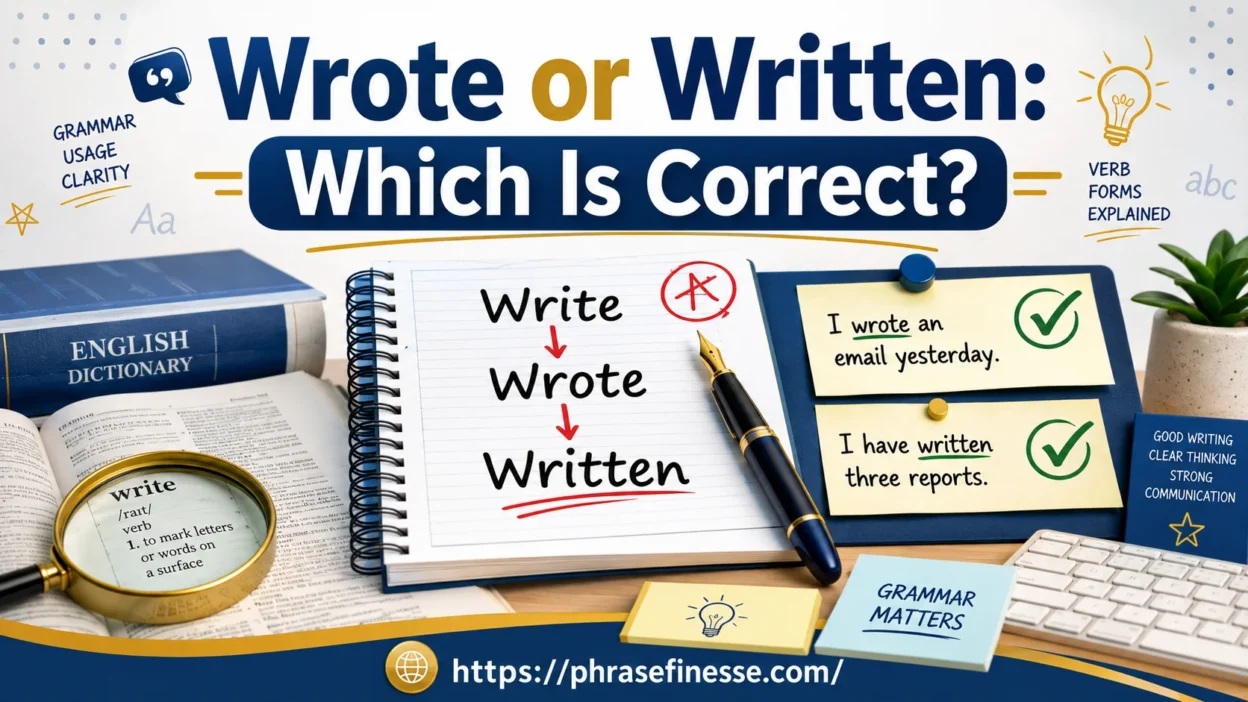
Have you ever paused while writing an email and wondered whether you should use “wrote” or “written”? That small choice can affect clarity, credibility, and professional communication. In this guide, Wrote or Written: Which Is Correct? (Helpful Examples), you’ll learn the key differences between these commonly confused verb forms, when to use each one, and how to avoid mistakes in everyday English usage.
Understanding the distinction matters more than many people realize. Whether you’re handling business communication, preparing formal writing, managing project management updates, or sending notes about meetings, correct grammar helps your message sound polished and professional. It also promotes consistency, which is essential in workplace documents, academic papers, and digital communication.
Throughout this article, you’ll find simple explanations, practical examples, and easy-to-follow rules that make the difference clear. We’ll also explore how accurate language supports tasks such as scheduling, time management, online booking, broadcasting, maintaining a calendar, and other professional activities where precise communication matters. By the end, you’ll know exactly when to use “wrote” and when “written” is the correct choice..
Quick Answer
The simplest way to understand the difference is this:
- Wrote is the simple past tense of write.
- Written is the past participle of write.
Quick Comparison Table
| Word | Verb Form | Can Stand Alone? | Example |
| Wrote | Simple Past Tense | Yes | I wrote a letter yesterday. |
| Written | Past Participle | Usually No | I have written a letter. |
Examples
✅ 1. I wrote an email yesterday.
✅ 2. She wrote a book last year.
✅ 3. I have written three reports this week.
✅ 4. The novel was written in 2019.
❌ 5. I written an email yesterday.
❌ 6. I have wrote three reports.
The difference comes down to verb tense and sentence structure.
What Does “Wrote” Mean?
Wrote is the simple past tense form of the verb write.
You use it when discussing an action that started and finished in the past.
Basic Structure
Subject + Wrote + Object
Examples:
- I wrote a report.
- She wrote an article.
- They wrote a proposal.
- We wrote several emails.
The action is complete.
Nothing else is required.
When to Use Wrote
Use wrote when:
- The action happened in the past.
- The action is finished.
- The sentence does not require a helping verb.
Examples in Everyday English
- I wrote to my friend last night.
- The manager wrote a detailed review.
- She wrote her first novel at age twenty-five.
- We wrote the meeting notes before leaving.
Notice how every action occurred at a specific point in the past.
What Does “Written” Mean?
Written is the past participle form of write.
Unlike wrote, it generally cannot function as the main verb by itself.
Instead, it works with helping verbs such as:
- Have
- Has
- Had
- Was
- Were
- Been
- Being
Basic Structure
Subject + Helping Verb + Written
Examples:
- I have written the report.
- She has written five articles.
- They had written the proposal before the deadline.
- The letter was written yesterday.
Read More: Chose vs Chosen: Guide That Finally Makes Sense
Why Written Needs a Helping Verb
English verbs often have three key forms:
| Verb | Base Form | Past Tense | Past Participle |
| Write | Write | Wrote | Written |
| Speak | Speak | Spoke | Spoken |
| Drive | Drive | Drove | Driven |
| Eat | Eat | Ate | Eaten |
The past participle cannot usually stand alone.
For example:
❌ I eaten lunch.
✅ I have eaten lunch.
Similarly:
❌ I written a report.
✅ I have written a report.
Understanding the Verb Forms of Write
Learning all three forms makes everything easier.
| Verb Form | Word |
| Base Form | Write |
| Present Tense | Write/Writes |
| Past Tense | Wrote |
| Past Participle | Written |
| Present Participle | Writing |
Examples
Present:
- I write articles every week.
Past:
- I wrote an article yesterday.
Present Perfect:
- I have written several articles this month.
Continuous:
- I am writing an article now.
Understanding these forms helps eliminate confusion permanently.
Wrote vs. Written: Side-by-Side Comparison
| Feature | Wrote | Written |
| Verb Type | Simple Past | Past Participle |
| Used Alone | Yes | Usually No |
| Requires Helping Verb | No | Yes |
| Indicates Completed Past Action | Yes | Often |
| Used in Perfect Tenses | No | Yes |
| Used in Passive Voice | No | Yes |
Example Comparison
Wrote
- She wrote a letter.
Written
- She has written a letter.
Although both refer to writing, the grammar structure differs significantly.
When Should You Use “Wrote”?
Use wrote whenever you’re discussing a completed action in the past.
Common Time Expressions With Wrote
You’ll frequently see wrote paired with:
- Yesterday
- Last week
- Last month
- Last year
- Earlier today
- In 2024
- A few days ago
Examples
- I wrote the report yesterday.
- She wrote her thesis last year.
- They wrote a detailed proposal last week.
- We wrote several emails this morning.
Business Writing Examples
- The CEO wrote a company-wide memo.
- The marketing team wrote a campaign brief.
- The consultant wrote a recommendation report.
Academic Examples
- The student wrote a research paper.
- She wrote her dissertation on climate policy.
- He wrote a literature review for his course.
Everyday Conversation Examples
- I wrote a text message.
- She wrote a birthday card.
- They wrote thank-you notes.
When Should You Use “Written”?
Use written when a helping verb appears in the sentence.
Written in Present Perfect Tense
Structure:
Have/Has + Written
Examples:
- I have written three reports.
- She has written a new article.
- They have written several books.
The present perfect connects past actions to the present.
Written in Past Perfect Tense
Structure:
Had + Written
Examples:
- I had written the report before the meeting.
- She had written the article before publication.
- They had written the proposal before the deadline.
The action happened before another past event.
Written in Future Perfect Tense
Structure:
Will Have + Written
Examples:
- I will have written the report by Friday.
- She will have written the book by next year.
- They will have written the proposal before launch.
Written in Passive Voice
Structure:
Was/Were + Written
Examples:
- The novel was written in six months.
- The report was written by the finance department.
- The letter was written yesterday.
Passive voice focuses on the result rather than the person performing the action.
Why “I Written” Is Incorrect
One of the most common English grammar mistakes is saying:
❌ I written a letter.
The sentence lacks a helping verb.
Correct versions include:
✅ 1. I wrote a letter.
✅ 2. I have written a letter.
✅ 3. I had written a letter.
Why This Error Happens
Many English learners memorize verb forms separately without understanding how they function together.
They know:
- Write
- Wrote
- Written
However, they don’t always know when each form belongs in a sentence.
The result is incorrect constructions like:
- I written it.
- She written the report.
- They written a book.
None are grammatically correct.
Is “Have Wrote” Correct?
No.
Have wrote is always incorrect.
Incorrect Examples
Wrong One:
❌ 1. I have wrote the report.
❌ 2. She has wrote a novel.
❌ 3. They had wrote several articles.
Correct Examples
Correct One:
✅ 1. I have written the report.
✅ 2. She has written a novel.
✅ 3. They had written several articles.
The Rule
Whenever you use:
- Have
- Has
- Had
You must use the past participle.
For the verb write, the past participle is written, not wrote.
Common Phrases Using Wrote
Certain expressions frequently use wrote.
Examples
- Wrote a book
- Wrote a letter
- Wrote a report
- Wrote an email
- Wrote a review
- Wrote a speech
- Wrote a note
- Wrote a proposal
Example Sentences
- She wrote a bestselling novel.
- He wrote a heartfelt letter.
- They wrote a detailed review.
- The manager wrote an annual performance report.
Common Phrases Using Written
You’ll often see written paired with helping verbs.
Examples
- Have written
- Has written
- Had written
- Was written
- Been written
- Will have written
Example Sentences
- She has written several books.
- The article was written by an expert.
- The report had written itself into company history through its impact.
- The proposal has been written and submitted.
Wrote vs. Written in Professional Writing
Grammar mistakes can affect credibility.
Consider these examples.
Incorrect Business Email
I have wrote the quarterly report and sent it to management.
Readers immediately notice the mistake.
Correct Version
I have written the quarterly report and sent it to management.
The corrected sentence sounds professional and polished.
Workplace Impact
Accurate grammar can:
- Improve communication
- Build trust
- Enhance professionalism
- Strengthen credibility
- Reduce misunderstandings
Wrote vs. Written in Academic Writing
Academic writing requires precision.
Universities, journals, and researchers expect proper grammar.
Example
Incorrect:
The student has wrote an excellent analysis.
Correct:
The student has written an excellent analysis.
Even a small mistake can distract readers from strong ideas.
Wrote vs. Written in Everyday Conversation
People sometimes overlook grammar during casual conversations.
However, correct usage still matters.
Examples
Incorrect:
- I have wrote him already.
- She written me yesterday.
Correct:
- I have written him already.
- She wrote me yesterday.
Using the correct form helps communication sound natural and fluent.
Common Mistakes People Make
Using Written Without a Helping Verb
Incorrect:
- I written a report.
Correct:
- I wrote a report.
- I have written a report.
Using Wrote After Have, Has, or Had
Incorrect:
- I have wrote a report.
Correct:
- I have written a report.
Mixing Past Tense With Past Participles
Incorrect:
- She had wrote the article.
Correct:
- She had written the article.
Incorrect Passive Voice
Incorrect:
- The report written yesterday.
Correct:
- The report was written yesterday.
Correction Table
| Incorrect | Correct |
| I written a letter. | I wrote a letter. |
| I have wrote a letter. | I have written a letter. |
| She had wrote the article. | She had written the article. |
| The book written in 2024. | The book was written in 2024. |
| We has wrote the report. | We have written the report. |
| They written a proposal. | They wrote a proposal. |
A Simple Memory Trick
Many learners remember the rule with a simple shortcut.
Think of This Formula
Wrote = Yesterday
Written = Have, Has, Had
Quick Reference Table
| Word Nearby | Correct Choice |
| Yesterday | Wrote |
| Last week | Wrote |
| Last year | Wrote |
| Have | Written |
| Has | Written |
| Had | Written |
| Been | Written |
| Was | Written |
Examples
Yesterday:
- I wrote an email.
Have:
- I have written an email.
Had:
- I had written an email.
This trick works surprisingly well.
Practice Exercises
Try these before checking the answers.
Fill in the Blank
- I _____ a report yesterday.
- She has _____ three novels.
- We _____ the proposal last week.
- The article was _____ by an editor.
- They had _____ the document before noon.
Answers
- Wrote
- Written
- Wrote
- Written
- Written
Real-World Case Study: Why This Difference Matters
Imagine two job applicants.
Applicant One
I have wrote several reports for senior management.
Applicant Two
I have written several reports for senior management.
Both applicants possess the same experience.
However, recruiters often notice grammar errors immediately.
A small mistake can influence first impressions, especially in careers involving communication, writing, marketing, law, education, publishing, and management.
The second sentence demonstrates stronger language skills and greater attention to detail.
FAQs
1. Is it correct to say “I have wrote” or “I have written”?
You should say “I have written.” The verb written is the past participle form of write and must be used with helping verbs such as have, has, or had.
Correct: I have written the report.
Incorrect: I have wrote the report.
2. What is the difference between “wrote” and “written”?
Wrote is the simple past tense of write, while written is the past participle. Use wrote when describing a completed action in the past. Use written with auxiliary verbs such as have, has, had, was, or were.
- I wrote a letter yesterday.
- I have written several letters this week.
3. Can “written” be used without a helping verb?
Generally, written needs a helping verb when it functions as part of a verb phrase. However, it can also act as an adjective.
Examples:
- She has written three novels. (verb)
- The written instructions were easy to follow. (adjective)
4. Why do people confuse “wrote” and “written”?
Many learners confuse them because both forms relate to past actions. The difference is grammatical: wrote stands alone as the past tense, while written typically works with an auxiliary verb or as an adjective.
5. Which form is more common in formal writing?
Both forms are common in formal writing, but they serve different purposes. Use wrote for simple past actions and written when the sentence requires a perfect tense or passive construction.
Examples:
- The author wrote the article in 2024.
- The article was written by an experienced editor.
6. How can I remember when to use “written”?
A simple trick is to look for a helping verb. If you see have, has, had, is, was, were, or been, the correct form is usually written.
Examples:
- She has written a book.
- The memo was written yesterday.
If there is no helping verb and you are describing a completed past action, use wrote.
Conclusion
Understanding the difference between wrote and written is essential for accurate English grammar and effective communication. While wrote is the simple past tense used for actions completed in the past, written is the past participle that works with helping verbs or functions as an adjective. Recognizing this distinction improves formal writing, strengthens business communication, and helps you maintain grammatical consistency in everyday conversations and professional documents.
Whenever you are unsure, remember one simple rule: if the sentence includes a helping verb such as have, has, had, or was, use written. Otherwise, use wrote for a completed past action. With regular practice and exposure to real-world examples, choosing the correct form will quickly become second nature.

Alyan Ashraf is an English language writer and editor at Phrase Finesse, where he specializes in grammar, vocabulary, spelling, word usage, and clear communication. Passionate about the English language, he creates practical, research-backed content that helps readers avoid common mistakes and write with greater accuracy and confidence.
Known for his clear writing style and attention to detail, Alyan simplifies complex language topics into easy-to-understand guides filled with real-world examples and actionable insights. His work covers confusing word pairs, grammar rules, idioms, punctuation, and everyday English usage, making learning both accessible and engaging for students, professionals, writers, and non-native English speakers.
Every article Alyan writes is carefully researched, fact-checked, and designed to meet high editorial standards. His goal is to help readers strengthen their English skills, expand their vocabulary, and communicate more effectively in academic, professional, and everyday settings.
Through Phrase Finesse, Alyan is committed to publishing trusted language resources that make mastering English simpler, clearer, and more enjoyable for learners around the world