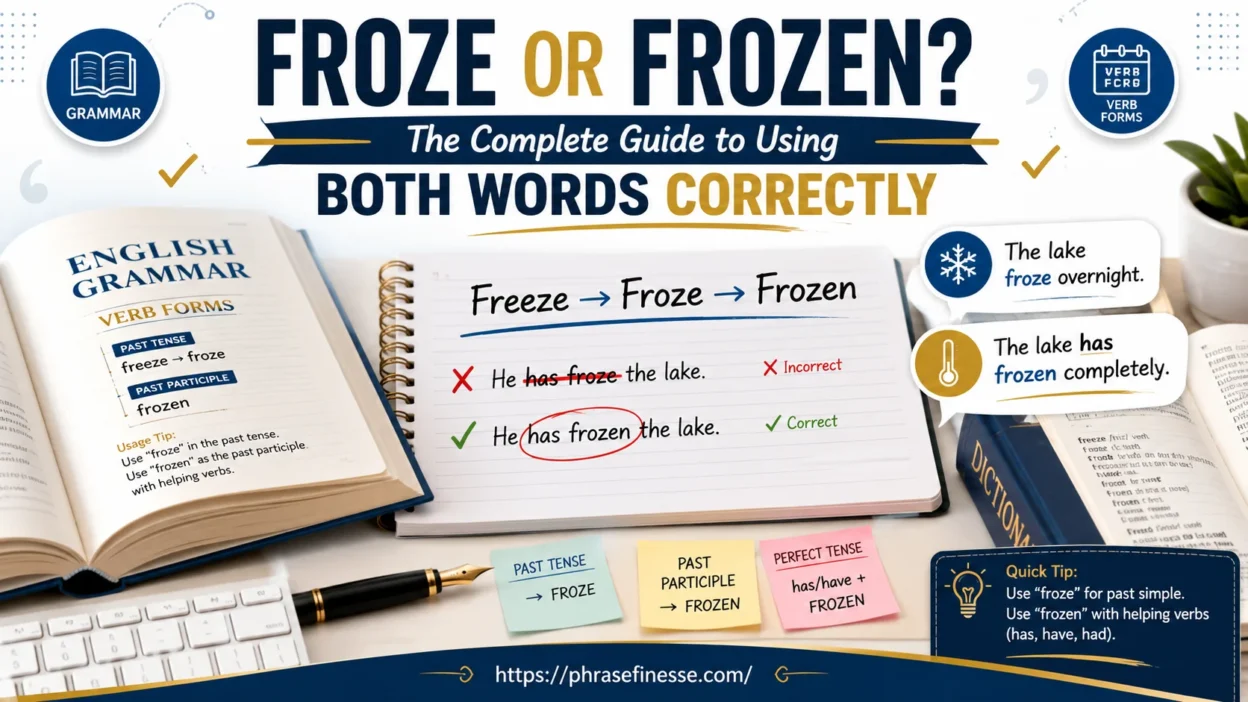
Have you ever paused while writing and wondered whether “froze” or “frozen” is the correct form to use? The distinction between Froze or Frozen? Past Tense Of “Freeze” (Helpful Examples) confuses many English learners and even experienced writers. Because accurate grammar, English usage, and clear communication matter in everyday and professional contexts, understanding when to use each form can help you write with greater confidence and precision.
The verb “freeze” follows an irregular pattern, which makes it different from standard verbs that simply add “-ed.” Knowing the difference between “froze” (simple past tense) and “frozen” (past participle) is essential for formal writing, emails, reports, and business communication.
It also helps maintain consistency when discussing events related to scheduling, meetings, calendar planning, project management, online booking, or even broadcasting updates where accurate language is important.
In this guide, you’ll learn the correct usage of froze and frozen, discover simple grammar rules, and explore practical examples that show each form in real-world sentences. By the end, you’ll understand how these verb forms function in different contexts, avoid common mistakes, and improve your overall command of English grammar with clarity and confidence.
Quick Answer
The simplest way to remember the difference is this:
| Word | Function | Example |
| Froze | Simple past tense | The lake froze overnight. |
| Frozen | Past participle or adjective | The lake has frozen. |
The Golden Rule
- Use froze when describing an action that happened in the past.
- Use frozen after helping verbs such as has, have, had, was, were, is, are, been, or when describing a noun.
For example:
✅ The river froze last night.
✅ The river has frozen completely.
❌ The river has froze completely.
What Does “Froze” Mean?
Froze is the simple past tense form of the verb freeze.
It describes an action that happened and finished in the past.
Basic Structure
Subject + Froze
Examples:
- The pond froze overnight.
- My computer froze during the presentation.
- The roads froze after the snowstorm.
- I froze when I heard a strange noise.
In each sentence, the action occurred in the past and ended.
There is no helping verb.
That is the key.
Real-Life Examples of Froze
Weather
- The lake froze after three days of below-freezing temperatures.
- The waterfall partially froze during the cold snap.
Technology
- My laptop froze while I was saving a file.
- The software froze during the update.
Human Reactions
- She froze when the interviewer asked an unexpected question.
- He froze in fear after hearing the loud crash.
Notice that froze is not limited to cold temperatures.
English speakers often use it figuratively to describe moments when someone suddenly stops moving, thinking, or reacting.
What Does “Frozen” Mean?
Frozen serves two important roles in English grammar:
- Past participle
- Adjective
Understanding both uses eliminates most confusion.
Frozen as a Past Participle
The past participle form works with helping verbs.
Examples:
- The river has frozen.
- The pipes had frozen before sunrise.
- The lake was frozen by morning.
- The food has been frozen for months.
Here, frozen cannot stand alone.
It relies on a helping verb.
Frozen as an Adjective
Frozen can also describe a noun.
Examples:
- Frozen vegetables
- Frozen pizza
- Frozen yogurt
- Frozen ground
- Frozen assets
In these examples, frozen functions exactly like descriptive words such as:
- Red
- Large
- Expensive
- Heavy
Everyday Adjective Examples
- We bought frozen berries.
- The frozen lake attracted hundreds of skaters.
- Farmers struggled with frozen soil.
- The company reported frozen financial assets.
When frozen describes something, it acts as an adjective rather than a verb.
Understanding the Verb Forms of Freeze
Every English learner benefits from memorizing the three forms of irregular verbs.
For freeze, the pattern looks like this:
| Verb Form | Word |
| Base Form | Freeze |
| Past Tense | Froze |
| Past Participle | Frozen |
Examples:
| Tense | Example |
| Present | Water freezes quickly. |
| Past | Water froze overnight. |
| Perfect | Water has frozen overnight. |
Many English mistakes occur because people mix the second and third forms.
Why English Uses Different Forms
English inherited many irregular verbs from older Germanic languages.
These verbs changed vowels instead of adding endings.
The pattern still exists today.
Examples include:
| Base | Past | Past Participle |
| Drive | Drove | Driven |
| Speak | Spoke | Spoken |
| Break | Broke | Broken |
| Choose | Chose | Chosen |
| Freeze | Froze | Frozen |
Notice the similarity.
Nobody says:
❌ I have drove.
Instead they say:
✅ I have driven.
The same rule applies to freeze.
❌ I have froze.
✅ I have frozen.
When to Use Froze
Use froze whenever the action happened at a specific time in the past.
Completed Past Events
Examples:
- The lake froze last night.
- The machine froze yesterday.
- The river froze during January.
These actions happened and ended.
Common Situations Where Froze Appears
Weather Reports
Meteorologists often use froze when discussing past weather events.
Examples:
- Several reservoirs froze during the winter storm.
- The temperature dropped so quickly that crops froze overnight.
Technology Problems
Computer users encounter this word frequently.
Examples:
- My phone froze during a video call.
- The application froze unexpectedly.
Emotional Reactions
Psychologists call this the “freeze response.”
Examples:
- She froze under pressure.
- He froze when everyone looked at him.
Read More: Chose vs Chosen: Guide That Finally Makes Sense
When to Use Frozen
Use frozen whenever a helping verb appears before it or when it describes a noun.
Frozen with Present Perfect Tense
Examples:
- The lake has frozen.
- My account has been frozen.
- The river has frozen solid.
Frozen with Past Perfect Tense
Examples:
- The pipes had frozen before repairs began.
- The roads had frozen before sunrise.
Frozen with Passive Voice
Examples:
- The assets were frozen.
- The food was frozen immediately.
Frozen as an Adjective
Examples:
- Frozen seafood
- Frozen meals
- Frozen fruit
- Frozen desserts
Common Mistakes People Make
Grammar errors involving froze and frozen appear everywhere online.
Let’s examine the most common ones.
Mistake: Using Frozen as a Simple Past Tense
Incorrect:
❌ The river frozen yesterday.
Correct:
✅ The river froze yesterday.
Why?
Because frozen is not the simple past form.
Mistake: Using Froze After Has, Have, or Had
Incorrect:
❌ The lake has froze.
Correct:
✅ The lake has frozen.
The helping verb requires the past participle.
Mistake: Mixing Verb and Adjective Usage
Incorrect:
❌ I frozen the berries yesterday.
Correct:
✅ I froze the berries yesterday.
Mistake: Confusing Spoken English with Correct Grammar
Sometimes people hear incorrect phrases repeatedly.
Examples:
- Has froze
- Have froze
- Had froze
These forms remain grammatically incorrect despite their occasional appearance in casual speech.
Froze vs. Frozen in Everyday Life
Understanding context makes the rule easier to remember.
Weather Examples
Froze
- The pond froze overnight.
- The lake froze after the cold front arrived.
Frozen
- The pond has frozen completely.
- The frozen pond became a skating rink.
Food Industry Examples
Food manufacturers frequently use frozen as an adjective.
Examples:
- Frozen vegetables retain nutrients well.
- Frozen seafood allows year-round availability.
- Frozen fruit works perfectly in smoothies.
Interesting fact:
Many frozen fruits are processed within hours of harvesting, which helps preserve vitamins and minerals.
Technology Examples
Froze
- My computer froze.
- The app froze unexpectedly.
Frozen
- The system has frozen again.
- The frozen screen won’t respond.
Banking and Finance Examples
Financial institutions often freeze accounts or assets.
Froze
- The bank froze the account.
Frozen
- The account has been frozen.
- Frozen assets remain inaccessible until restrictions are removed.
Why “Has Froze” Is Wrong
This deserves special attention because it is one of the most common mistakes online.
Many people assume that because “froze” sounds like a completed action, it should follow “has.”
English grammar disagrees.
Compare These Examples
| Incorrect | Correct |
| Has froze | Has frozen |
| Have froze | Have frozen |
| Had froze | Had frozen |
Think about other irregular verbs:
| Incorrect | Correct |
| Has drove | Has driven |
| Have broke | Have broken |
| Had spoke | Had spoken |
The pattern remains identical.
A Simple Memory Trick That Actually Works
Many grammar tricks are forgettable.
This one is not.
Think of the freeze family:
Freeze → Froze → Frozen
Now compare:
Drive → Drove → Driven
Nobody says:
❌ I have drove.
Everyone says:
✅ I have driven.
Apply the same logic.
❌ I have froze.
✅ I have frozen.
The structure becomes easy to remember.
Real-World Case Study: Why Grammar Matters
Imagine two customer support messages.
Version One
Your account has froze due to suspicious activity.
Version Two
Your account has frozen due to suspicious activity.
Neither sentence is ideal.
However, the first immediately signals poor grammar.
Professional organizations rely on correct language because errors reduce trust and credibility.
Now consider the properly written version:
Your account has been frozen due to suspicious activity.
This version sounds polished and professional.
A single word choice makes a noticeable difference.
Quick Comparison Table
| Situation | Correct Word |
| Action happened yesterday | Froze |
| Action happened last winter | Froze |
| After has | Frozen |
| After have | Frozen |
| After had | Frozen |
| After was | Frozen |
| After were | Frozen |
| Describing food | Frozen |
| Describing a lake | Frozen |
| Describing assets | Frozen |
Froze vs. Frozen in Popular Expressions
English contains several common phrases involving freeze.
Freeze Up
Meaning: become unable to think or act.
Example:
- I froze up during the presentation.
Frozen Solid
Meaning: completely frozen.
Example:
- The lake was frozen solid.
Frozen Out
Meaning: excluded from a group.
Example:
- He felt frozen out of the discussion.
Freeze Frame
Meaning: a paused video image.
Example:
- The movie ended with a freeze frame.
These expressions demonstrate how versatile the verb freeze has become.
Practice Quiz
Choose the correct word.
Questions
- The river ______ overnight.
- The river has ______ completely.
- My computer ______ during the meeting.
- The vegetables were ______ before shipping.
- The bank has ______ the account.
- The pond ______ after several cold nights.
- The screen has ______ again.
- We bought ______ berries.
Answers
- Froze
- Frozen
- Froze
- Frozen
- Frozen
- Froze
- Frozen
- Frozen
FAQs
1. Is it correct to say “I frozen” or “I froze”?
“I froze” is correct when describing an action that happened in the past. “I frozen” is grammatically incorrect unless it follows a helping verb, such as “I have frozen.”
2. What is the past tense of “freeze”?
The simple past tense of freeze is froze. Example: “The lake froze during the winter.”
3. When should I use “frozen”?
Use frozen as the past participle with a helping verb. Example: “The pipes have frozen because of the cold weather.”
4. Is “frozen” a past tense verb?
No. Frozen is not the simple past tense. It is the past participle form of freeze and is commonly used with auxiliary verbs.
5. Can “frozen” be used as an adjective?
Yes. Frozen often functions as an adjective. Examples include frozen food, frozen lake, and frozen ground.
6. Why do people confuse “froze” and “frozen”?
People often confuse them because freeze is an irregular verb. Unlike regular verbs, its past tense and past participle forms are different: freeze → froze → frozen. Learning this pattern helps prevent common grammar mistakes.
Conclusion
Understanding the difference between froze and frozen is essential for accurate English grammar and clear communication. While froze serves as the simple past tense of freeze, frozen functions as the past participle and typically appears with helping verbs such as has, have, had, is, or was. Mixing them up is a common mistake, but the correct choice becomes much easier once you recognize their grammatical roles.
Whether you’re working on formal writing, business communication, academic assignments, or everyday conversations, using the right verb form improves clarity and professionalism. By remembering that “I froze the water yesterday” uses the past tense and “The water has frozen” uses the past participle, you can avoid confusion and write with greater confidence. With regular practice and exposure to real examples, choosing between froze and frozen will soon become second nature.

Emma Brooke is an English language specialist, editor, and content writer at Phrase Finesse, where she helps readers develop stronger writing and communication skills through clear, practical, and engaging content. With a passion for the English language, she specializes in simplifying grammar rules, vocabulary, spelling, punctuation, and word usage for learners at every level.
Emma has extensive experience creating educational content that is accurate, well-researched, and easy to understand. She is particularly skilled at explaining confusing word pairs, grammar concepts, idioms, sentence structure, and effective writing techniques, making complex topics approachable for students, professionals, educators, and English learners worldwide.