Have you ever paused while writing and wondered, Can You Start A Sentence With “While”? Learn It Here! It’s a common question in English usage, especially when aiming for clear grammar, polished formal writing, and strong consistency. Many writers worry that beginning a sentence with “while” might be incorrect, but the answer is more nuanced than a simple yes or no.
Understanding how to use “while” correctly can improve the flow of emails, reports, essays, and everyday messages. Whether you’re working on business communication, managing project management documents, participating in meetings, or creating content for broadcasting, proper sentence structure helps you communicate ideas with confidence. Small grammar choices often make a big difference in readability and professionalism.
In this guide, you’ll learn when it is correct to start a sentence with “while,” when it may cause confusion, and how to use it effectively in different contexts. We’ll explore practical examples, common mistakes, and expert tips that support clear communication across topics such as scheduling, time management, online booking, and calendar planning. By the end, you’ll know exactly how to use “while” naturally and accurately in both casual and professional writing.
Can You Start a Sentence With “While”?
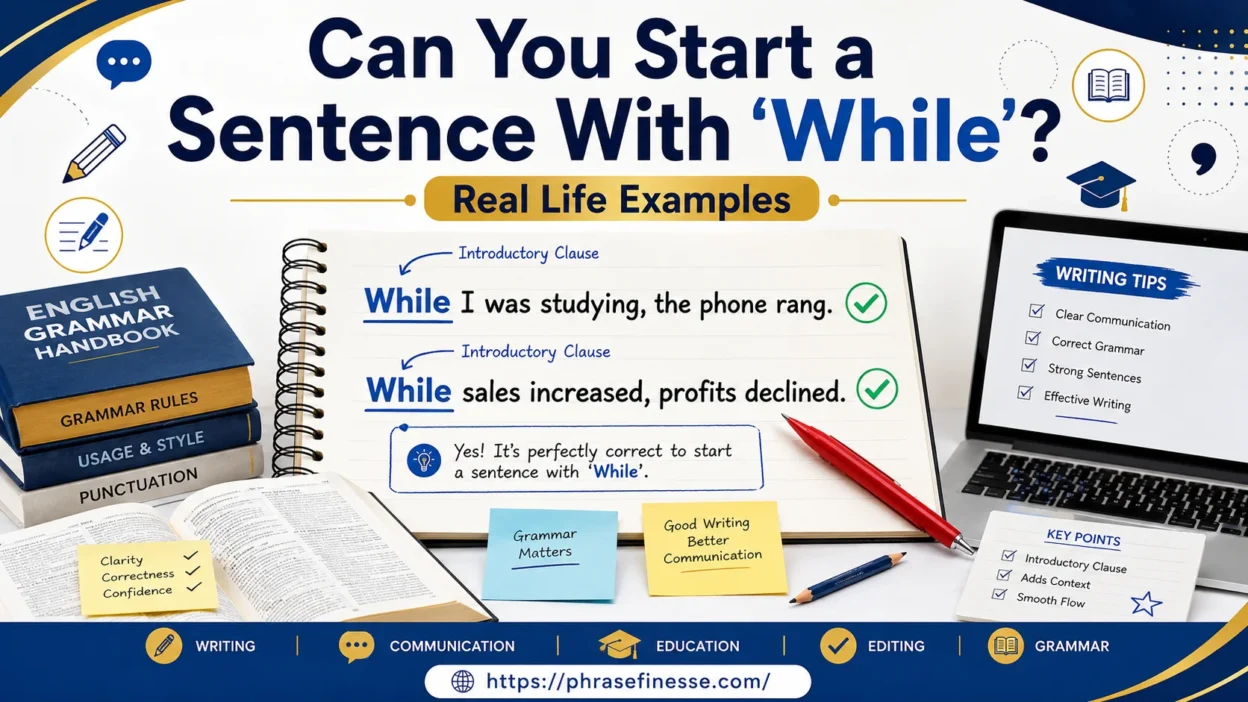
Yes.
Starting a sentence with while is completely acceptable in modern English grammar.
Consider these examples:
- While I was preparing dinner, the phone rang.
- While many businesses struggled, others experienced rapid growth.
- While the proposal seemed promising, several concerns remained.
All three examples are grammatically correct.
In fact, beginning a sentence with a dependent clause often improves readability because it provides context before presenting the main idea.
Professional writers regularly use this structure because it creates smoother transitions and better sentence variety.
What Does “While” Mean in a Sentence?
Understanding the meaning of while is essential because it affects how readers interpret your sentence.
“While” as a Time Connector
Most commonly, while indicates that two actions happen simultaneously.
Examples:
- While I was reading, my dog slept beside me.
- While the meeting continued, employees reviewed the report.
- While the children played outside, their parents prepared lunch.
In these examples, the actions occur at the same time.
Think of while as a bridge connecting simultaneous events.
“While” as a Contrast Connector
Another common use of while introduces contrast.
Examples:
- While coffee is popular worldwide, tea remains the preferred beverage in many countries.
- While the software is powerful, it requires significant training.
- While some investors seek growth, others prioritize stability.
Here, while doesn’t indicate time.
Instead, it highlights differences between ideas.
This contrastive use is especially common in formal writing, journalism, academic papers, and business reports.
Less Common Uses of “While”
Occasionally, while refers to duration or a period of time.
Examples:
- Stay here for a while.
- It took a while to solve the problem.
- The project remained inactive for quite a while.
Although these uses don’t usually appear at the beginning of sentences, they demonstrate the word’s versatility.
Read More: Campuses or Campus’s or Campus’? Choose Correct One!
Is It Grammatically Correct to Start a Sentence With “While”?
Absolutely.
No recognized grammar authority prohibits it.
The idea that you shouldn’t start a sentence with while belongs to the same category as myths about ending sentences with prepositions or beginning sentences with conjunctions.
Modern English usage has moved far beyond those outdated restrictions.
Why the Rule Is a Myth
Many grammar myths originated from attempts to force English into structures borrowed from Latin grammar.
English evolved differently.
As a result, many old “rules” were actually style preferences rather than grammatical requirements.
Starting a sentence with while has appeared in English literature, newspapers, academic journals, and professional writing for centuries.
If it were truly incorrect, countless published works would need revision.
What Modern Grammar Authorities Say
Major style guides accept introductory while clauses.
Professional editors focus on:
- Clarity
- Readability
- Sentence flow
- Audience understanding
They do not ban sentence openings that begin with while.
Good writing depends on effective communication, not arbitrary restrictions.
Examples From Real-World Writing
You’ll frequently encounter sentence-initial while in:
| Writing Type | Example Usage |
| Journalism | While inflation slowed, consumer prices remained elevated. |
| Academic Writing | While previous studies focused on adults, this research examined children. |
| Business Writing | While revenue increased, operating expenses also rose. |
| Fiction | While the storm raged outside, the house remained eerily quiet. |
These examples demonstrate how naturally the structure works.
How to Start a Sentence With “While” Correctly
The key lies in sentence structure.
Use “While” to Introduce a Dependent Clause
A clause beginning with while is usually dependent.
That means it cannot stand alone.
Example:
While I was driving
This isn’t a complete sentence.
Readers expect additional information.
Follow With an Independent Clause
You must complete the thought.
Example:
While I was driving, it started raining heavily.
Now the sentence works because the second clause contains a complete idea.
A useful formula is:
While + dependent clause + comma + independent clause
Examples:
- While the team celebrated, management planned the next project.
- While technology advances rapidly, human behavior changes more slowly.
- While demand increased, supply remained limited.
Correct Punctuation Rules
Most introductory while clauses require a comma.
Correct:
- While I studied, my roommate watched television.
Incorrect:
- While I studied my roommate watched television.
The comma signals the transition between the introductory clause and the main clause.
Quick Structure Guide
| Pattern | Example | Correct? |
| While + dependent clause + comma + independent clause | While she worked, I cleaned the kitchen. | Yes |
| While + dependent clause only | While she worked. | No |
| Independent clause + while + dependent clause | I cleaned the kitchen while she worked. | Yes |
| While + contrast clause + comma + main clause | While sales rose, profits declined. | Yes |
Common Mistakes When Starting a Sentence With “While”
Many writing problems involve structure rather than the word itself.
Creating Sentence Fragments
A fragment occurs when a sentence lacks a complete thought.
Incorrect:
- While preparing for the presentation.
Correct:
- While preparing for the presentation, Sarah discovered several errors.
The second version provides closure and meaning.
Creating Ambiguous Meaning
Because while can indicate both time and contrast, ambiguity sometimes arises.
Consider:
While the company expanded internationally, profits declined.
Does while mean:
- At the same time?
- In contrast?
Readers may wonder.
A clearer alternative might be:
- Although the company expanded internationally, profits declined.
Clarity always wins.
Overusing “While”
Using while repeatedly creates monotony.
For example:
- While sales increased…
- While customer satisfaction improved…
- While production expanded…
Readers quickly notice repetition.
Vary your transitions.
Use alternatives such as:
- Although
- Whereas
- However
- As
- When
- Even though
Misplaced Commas
Comma mistakes frequently appear around introductory clauses.
Correct:
- While the report was thorough, management requested revisions.
Incorrect:
- While the report was thorough management requested revisions.
A missing comma can reduce readability.
While vs. Similar Words
Several words perform functions similar to while.
Understanding the differences improves precision.
While vs. Although
Both can express contrast.
Examples:
- While the design looks attractive, it lacks functionality.
- Although the design looks attractive, it lacks functionality.
Difference:
Although focuses exclusively on contrast.
While can indicate either contrast or simultaneous timing.
When clarity matters, although may be the stronger choice.
While vs. Whereas
Whereas emphasizes direct comparison.
Example:
- Sarah prefers remote work, whereas Michael enjoys office environments.
Compared with:
- While Sarah prefers remote work, Michael enjoys office environments.
Both work.
However, whereas sounds more formal and comparison-focused.
While vs. During
These words belong to different grammatical categories.
| Word | Type | Example |
| While | Conjunction | While I worked, she studied. |
| During | Preposition | During the meeting, phones remained silent. |
Notice that during must be followed by a noun phrase.
While must be followed by a clause.
Examples of Sentences That Start With “While”
Studying examples helps build confidence.
Everyday Conversation Examples
- While you’re here, would you like some coffee?
- While I understand your concern, I think we’re making progress.
- While we’re waiting, let’s review the agenda.
These sound completely natural.
Academic Writing Examples
- While previous research emphasized economic factors, recent studies highlight social influences.
- While the sample size was relatively small, the findings remained statistically significant.
Academic writers frequently begin sentences with while.
Business Writing Examples
- While quarterly revenue increased by 12%, operating costs rose by 8%.
- While customer retention improved, acquisition costs remained challenging.
Business reports often use while to present balanced analysis.
Creative Writing Examples
- While moonlight spilled across the empty street, distant thunder echoed through the valley.
- While everyone slept, a single candle flickered in the attic window.
Writers use introductory clauses to create atmosphere and rhythm.
Case Study: How Professional Writers Use “While”
Consider these two versions.
Version One
The company launched a new product. Customer demand increased rapidly. Competitors struggled to respond.
Version Two
While the company launched a new product, customer demand increased rapidly and competitors struggled to respond.
The second version creates stronger flow and connects related ideas.
Professional writers often use introductory while clauses to establish context before delivering the main point.
This technique improves readability and narrative momentum.
When You Should Avoid Starting a Sentence With “While”
Although the structure is correct, it isn’t always the best choice.
When Readers May Misinterpret Meaning
Avoid while when readers could confuse time and contrast.
Example:
- While the economy improved, unemployment remained high.
Some readers interpret this as simultaneous timing.
Others see contrast.
A clearer revision might use:
- Although the economy improved, unemployment remained high.
When Simpler Alternatives Work Better
Sometimes direct language is stronger.
Instead of:
- While conducting the analysis, the team identified several trends.
You might write:
- During the analysis, the team identified several trends.
The simpler version often reads more smoothly.
When Sentence Variety Is Needed
Repeated sentence openings weaken writing.
Good writers vary their structures.
Mix:
- While…
- Although…
- Because…
- When…
- Since…
- After…
Variety keeps readers engaged.
Strong Alternatives to Starting a Sentence With “While”
Alternatives for Contrast
Consider:
- Although
- Even though
- Whereas
- However
- Yet
- Nevertheless
Examples:
- Although sales increased, profits declined.
- Whereas urban populations grew, rural populations shrank.
Alternatives for Time Relationships
Useful options include:
- When
- As
- During
- At the same time
- Meanwhile
Examples:
- When the meeting ended, employees returned to work.
- As the sun set, temperatures dropped.
Choosing the Right Alternative
Use this quick guide:
| Goal | Best Choice |
| Simultaneous actions | While |
| Direct contrast | Although |
| Formal comparison | Whereas |
| Time period | During |
| Transition between ideas | However |
Selecting the right word improves clarity immediately.
Why Starting a Sentence With “While” Improves Writing
Used correctly, introductory while clauses provide several advantages.
Better Flow
Readers receive context before encountering the main idea.
Example:
- While preparing the annual report, analysts uncovered unexpected market trends.
The context appears first, making the sentence easier to follow.
Greater Sentence Variety
Repeated subject-verb openings become predictable.
Compare:
- The company expanded internationally.
- The company increased production.
- The company hired new staff.
Versus:
- While the company expanded internationally, it also increased production.
- After entering new markets, it hired additional staff.
The second version sounds more dynamic.
Improved Emphasis
The opening clause frames the information that follows.
This technique helps readers focus on what matters most.
FAQs
1. Can you start a sentence with “while”?
Yes, you can start a sentence with “while”. It is a common and grammatically correct way to introduce a dependent clause. For example: “While I understand your concern, I believe there is a better solution.”
2. Is it formal to begin a sentence with “while”?
Yes. Starting a sentence with “while” is acceptable in both casual and formal writing. It is frequently used in academic papers, business documents, and professional communication to show contrast or simultaneous actions.
3. Should I put a comma after a clause that starts with “while”?
In most cases, yes. When a sentence begins with a while-clause, a comma usually follows it. Example: “While the meeting was productive, several issues remained unresolved.”
4. What does “while” mean at the beginning of a sentence?
At the beginning of a sentence, “while” can indicate either:
- Two actions happening at the same time, or
- A contrast between two ideas.
The intended meaning depends on the context of the sentence.
5. Can starting a sentence with “while” cause confusion?
Sometimes. If readers cannot tell whether “while” expresses time or contrast, the sentence may become unclear. In such cases, consider revising the sentence or using alternatives like although, whereas, or during.
6. What are some alternatives to “while” at the start of a sentence?
Depending on the context, you can use:
- Although
- Whereas
- Even though
- Since
- During
- At the same time
These alternatives can help improve clarity and sentence variety.
Conclusion
So, can you start a sentence with “while”? Absolutely. In fact, it is a standard and effective part of English grammar that can add variety, clarity, and sophistication to your writing. Whether you use it to show contrast or describe actions happening simultaneously, “while” can help create smoother transitions between ideas.
The key is to use it thoughtfully and ensure your meaning remains clear. By understanding the different functions of “while,” following proper punctuation rules, and avoiding ambiguous constructions, you can strengthen your English usage, improve formal writing, and maintain greater consistency in both personal and professional communication. With practice, starting a sentence with “while” will feel natural and enhance the overall quality of your writing.

Mia Rose is an English language specialist and editorial writer at Phrase Finesse, where she helps readers master grammar, vocabulary, spelling, and effective communication. Passionate about making English simple and practical, she creates well-researched, reader-friendly content that explains complex language concepts in a clear and engaging way.
With extensive experience in English language education, content writing, and editorial review, Mia specializes in grammar, punctuation, word choice, idioms, confusing word pairs, and writing style. Her articles are carefully researched, fact-checked, and designed to help students, professionals, writers, and English learners build confidence in both written and spoken English.