Have you ever paused while writing and wondered whether you should use stole or stolen? It’s a common question, even for confident English speakers. In this guide, “Stole or Stolen: Which Is Correct? You’ll learn the key differences between these two verb forms, when to use each one, and how to avoid common mistakes in everyday and professional writing.
Understanding the distinction between stole and stolen is essential for accurate grammar, clear English usage, and effective formal writing. Whether you’re drafting emails, preparing reports, participating in business communication, or creating content for broadcasting, using the correct verb form improves clarity and credibility.
Strong language skills also support workplace tasks such as project management, organizing meetings, maintaining a calendar, and ensuring communication consistency across teams.
This article breaks down the rules in a simple, practical way with real-world examples and easy explanations. You’ll discover how these words function in different sentence structures, why one form requires a helping verb while the other does not, and how mastering this distinction can strengthen your writing.
From everyday conversations to topics involving scheduling, time management, and even online booking, knowing the correct usage will help you communicate with greater confidence and precision.
The Short Answer: Stole vs. Stolen
If you only remember one thing from this article, remember this:
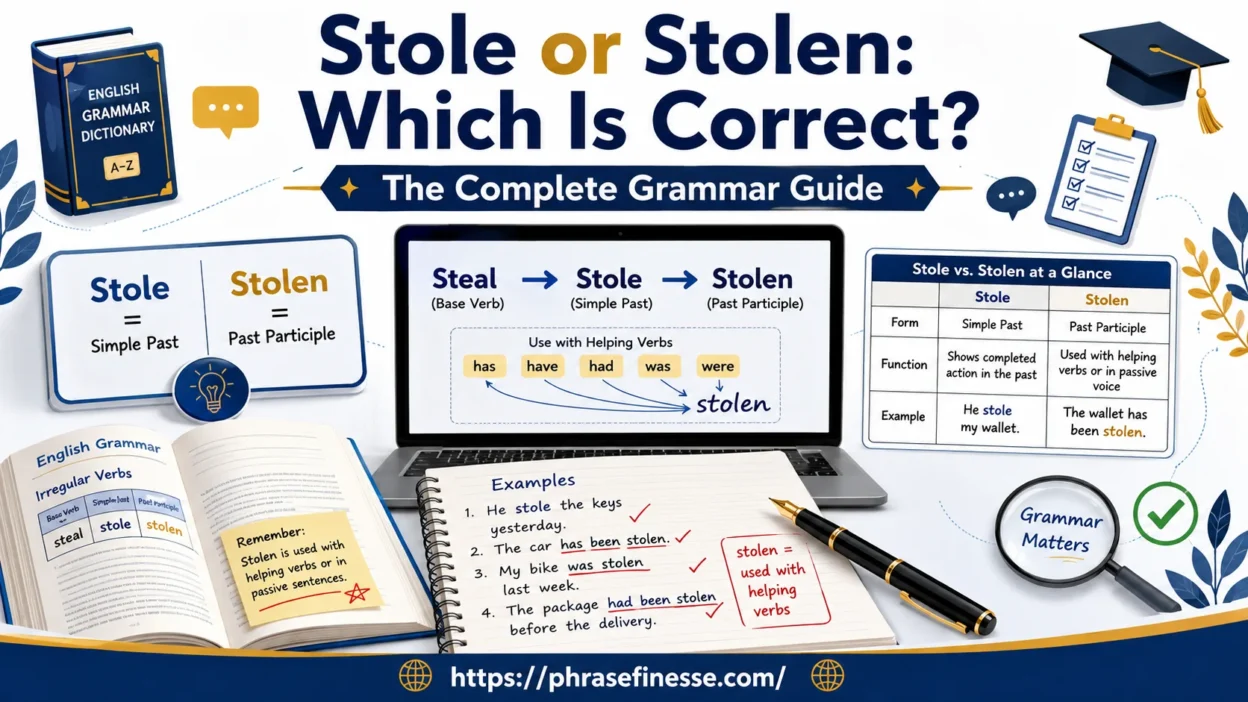
- Stole is the simple past tense of steal.
- Stolen is the past participle of steal.
When to Use “Stole”
Use stole when describing an action that happened in the past and is complete.
Examples:
- She stole my bicycle yesterday.
- Someone stole the package from the porch.
- The thief stole several expensive watches.
When to Use “Stolen”
Use stolen with a helping verb such as:
- has
- have
- had
- was
- were
- is
- are
- been
Examples:
- Someone has stolen my bicycle.
- The package was stolen overnight.
- They had stolen thousands of dollars before getting caught.
Understanding the Verb “Steal”
Before comparing stole and stolen, it helps to understand the complete verb family.
Verb Forms of Steal
| Verb Form | Word |
| Base Form | Steal |
| Present Simple | Steal / Steals |
| Simple Past | Stole |
| Past Participle | Stolen |
| Present Participle | Stealing |
These forms belong to what grammarians call an irregular verb.
Unlike regular verbs that simply add -ed, irregular verbs change form.
Examples:
| Base Verb | Past Tense | Past Participle |
| Write | Wrote | Written |
| Break | Broke | Broken |
| Drive | Drove | Driven |
| Speak | Spoke | Spoken |
| Steal | Stole | Stolen |
Notice a pattern?
Many irregular verbs follow a similar structure:
Base verb → Simple past → Past participle
This explains why stole and stolen both exist.
Why English Uses Different Past Forms
Many learners wonder:
“If stole already means something happened in the past, why does stolen exist?”
The answer lies in English tense construction.
English uses:
- Simple past tense
- Present perfect tense
- Past perfect tense
- Passive voice constructions
Each requires different verb forms.
Consider these examples:
| Sentence | Verb Form |
| He stole the wallet. | Simple Past |
| He has stolen the wallet. | Past Participle |
| He had stolen the wallet. | Past Participle |
| The wallet was stolen. | Past Participle |
The helping verb determines which form you need.
When to Use Stole
Stole in the Simple Past Tense
Use stole when discussing a completed action in the past.
This tense does not require a helping verb.
Formula:
Subject + Stole + Object
Examples:
- The burglar stole a laptop.
- Someone stole my phone.
- They stole confidential documents.
- A pickpocket stole his wallet.
These actions happened at a specific point in the past.
Common Time Expressions with Stole
You will often see stole with words such as:
- Yesterday
- Last week
- Last month
- Last year
- Earlier today
- In 2024
- Two days ago
Examples:
- Someone stole my bike yesterday.
- The criminals stole jewelry last month.
- Hackers stole customer data in 2023.
The time reference clearly places the action in the past.
Read More: Wrote or Written: Which Is Correct?
Examples of Correct Usage of Stole
Everyday Conversation
- Someone stole my parking spot.
- My brother stole my last slice of pizza.
- A stranger stole my backpack at the station.
News Reporting
- The suspects stole luxury vehicles worth $500,000.
- Thieves stole rare artwork from the museum.
- Criminals stole sensitive information from company databases.
Business Writing
- An employee stole confidential company records.
- Fraudsters stole customer account information.
Academic Writing
- Researchers found that hackers stole millions of personal records.
- Historical accounts indicate pirates stole valuable cargo.
When to Use Stolen
Stolen as a Past Participle
The word stolen cannot usually stand alone as the main verb.
Instead, it works with helping verbs.
Formula:
Helping Verb + Stolen
Examples:
- The documents were stolen.
- Someone has stolen my wallet.
- The jewels had been stolen years earlier.
Common Helping Verbs Used with Stolen
Has Stolen
Examples:
- Someone has stolen my bicycle.
- The company has stolen market share from competitors.
Have Stolen
Examples:
- Criminals have stolen thousands of identities.
- Hackers have stolen sensitive information.
Had Stolen
Examples:
- They had stolen the money before police arrived.
- The gang had stolen several vehicles.
Was Stolen
Examples:
- My car was stolen yesterday.
- The painting was stolen during the robbery.
Were Stolen
Examples:
- The files were stolen overnight.
- Several computers were stolen from the office.
Understanding Passive Voice with Stolen
One reason people confuse stole and stolen is passive voice.
Active Voice
The subject performs the action.
Examples:
- The thief stole the necklace.
- The hacker stole customer information.
Passive Voice
The subject receives the action.
Examples:
- The necklace was stolen.
- Customer information was stolen.
Compare them:
| Active Voice | Passive Voice |
| The thief stole the car. | The car was stolen. |
| Someone stole my phone. | My phone was stolen. |
| Criminals stole the artwork. | The artwork was stolen. |
Both are correct. The structure simply changes.
Stole vs. Stolen: Side-by-Side Comparison
| Feature | Stole | Stolen |
| Verb Type | Simple Past | Past Participle |
| Can Stand Alone? | Yes | Usually No |
| Needs Helping Verb? | No | Usually Yes |
| Used in Passive Voice? | No | Yes |
| Example | She stole my watch. | My watch was stolen. |
This table summarizes the entire difference.
Common Mistakes People Make
Understanding mistakes is often the fastest way to learn correct grammar.
Using Stolen Without a Helping Verb
Incorrect:
- She stolen my wallet.
- They stolen the money.
Correct:
- She stole my wallet.
- They stole the money.
Using Stole After Has, Have, or Had
Incorrect:
- He has stole my bike.
- They had stole the documents.
Correct:
- He has stolen my bike.
- They had stolen the documents.
Using Was Stole
Incorrect:
- My phone was stole.
Correct:
- My phone was stolen.
This mistake is surprisingly common among English learners.
Real-World Examples of Stole and Stolen
Seeing grammar in context makes it easier to remember.
Daily Conversation Examples
- Someone stole my umbrella.
- My umbrella was stolen.
- Somebody has stolen my seat.
- A child stole cookies from the jar.
News Headlines
Examples that frequently appear in media:
- Thieves stole luxury watches from a jewelry store.
- Rare artifacts were stolen from a museum.
- Hackers have stolen millions of customer records.
Legal Context
Law enforcement reports often use both forms.
Examples:
- The suspect stole property valued at $10,000.
- The property was stolen during the burglary.
- Prosecutors alleged the defendant had stolen company funds.
Business Context
Examples:
- Cybercriminals stole customer information.
- Sensitive files were stolen from company servers.
- Attackers have stolen thousands of account credentials.
Case Study: Why One Word Changes the Entire Sentence
Consider this sentence:
The thief stole the painting.
Focus: the thief.
Now compare:
The painting was stolen.
Focus: the painting.
The event remains identical.
Note. However, the second sentence emphasizes what happened to the painting rather than who committed the crime.This is why journalists, investigators, and businesses often choose passive voice when the responsible person is unknown.
For example:
- The car was stolen overnight.
- Personal data was stolen during the breach.
In both cases, the offender may not be known yet.
Memory Trick to Never Confuse Stole and Stolen Again
Many grammar guides make the distinction seem complicated.
It isn’t.
The One-Second Rule
Ask yourself:
Is there a helping verb?
- If the answer is yes, use stolen.
2. If the answer is no, use stole.
Examples:
- She stole my wallet.
- She has stolen my wallet.
- The wallet was stolen.
- The thief stole the wallet.
Easy Formula
Steal → Stole → Stolen
Yesterday = Stole
Last Week = Stole
Has = Stolen
Have = Stolen
Had = Stolen
Was = Stolen
Were = Stolen
Been = Stolen
Many students memorize this sequence and never make the mistake again.
Practice Quiz: Test Your Understanding
Only Choose either stole or stolen.
Questions
- Someone has _____ my bicycle.
- The thief _____ my wallet.
- My laptop was _____ yesterday.
- They had _____ thousands of dollars.
- Someone _____ my package.
- The jewelry was _____ overnight.
- Hackers have _____ customer data.
- The criminals _____ several vehicles.
- My phone was _____ last week.
- Somebody _____ my seat.
Answers
| Question | Correct Answer |
| 1 | Stolen |
| 2 | Stole |
| 3 | Stolen |
| 4 | Stolen |
| 5 | Stole |
| 6 | Stolen |
| 7 | Stolen |
| 8 | Stole |
| 9 | Stolen |
| 10 | Stole |
Explanation
Notice the pattern:
Be remember: Whenever a helping verb appears, stolen follows.
Without a helping verb, stole is the correct choice.
FAQs
1. What is the difference between stole and stolen?
Stole is the simple past tense of the verb steal, while stolen is the past participle. You use stole by itself in a sentence, but stolen usually requires a helping verb such as has, have, had, was, or were.
Examples:
- She stole my notebook yesterday.
- Someone has stolen my notebook.
2. Is it correct to say “I have stole”?
No, “I have stole” is incorrect. After have, has, or had, you must use the past participle stolen.
Correct: I have stolen the keys.
Incorrect: I have stole the keys.
3. Can stolen be used without a helping verb?
In most cases, no. Stolen functions as a past participle and typically needs a helping verb.
Correct: The car was stolen last night.
Incorrect: The car stolen last night.
4. Which word is used in the passive voice: stole or stolen?
The passive voice requires the past participle form, so stolen is the correct choice.
Example: The package was stolen before it arrived.
5. Why do people confuse stole and stolen?
Many English learners mix them up because both words refer to actions that happened in the past. However, stole is a standalone past-tense verb, while stolen works with helping verbs and passive constructions.
6. How can I remember when to use stole or stolen?
A simple trick is to look for a helping verb. If you see words like has, have, had, was, or were, use stolen. If there is no helping verb and you’re describing a completed past action, use stole.
Examples:
- He stole the wallet.
- He has stolen the wallet.
Conclusion
Understanding the difference between stole and stolen is an important part of mastering English grammar and improving your overall writing consistency. While stole serves as the simple past tense of steal, stolen functions as the past participle and typically requires a helping verb. Using the correct form helps you communicate more clearly in everyday conversations, formal writing, business communication, and professional settings.
Whenever you’re unsure, remember this simple rule: use stole for a completed past action and stolen when a helping verb is present. By applying this guideline and reviewing the examples in this article, you’ll avoid common mistakes and use both words with confidence.

Mia Rose is an English language specialist and editorial writer at Phrase Finesse, where she helps readers master grammar, vocabulary, spelling, and effective communication. Passionate about making English simple and practical, she creates well-researched, reader-friendly content that explains complex language concepts in a clear and engaging way.
With extensive experience in English language education, content writing, and editorial review, Mia specializes in grammar, punctuation, word choice, idioms, confusing word pairs, and writing style. Her articles are carefully researched, fact-checked, and designed to help students, professionals, writers, and English learners build confidence in both written and spoken English.