Have you ever paused while writing and wondered whether Students or Student’s or Students’? is the correct form to use? This common grammar question can quickly create confusion, especially when you’re working on essays, emails, reports, or other forms of formal writing.
Understanding the difference between these terms is essential for clear English usage, helping you communicate with accuracy and confidence.
The distinction comes down to plural nouns, possessive forms, and proper punctuation. Whether you’re referring to one student’s belongings, multiple students, or something owned by a group of students, choosing the correct form improves readability and maintains consistency in your writing.
This skill is valuable across academic settings, professional documents, business communication, and everyday correspondence.
In this guide, you’ll learn exactly when to use Students, Student’s, and Students’, along with simple explanations and practical examples.
We’ll also explore how correct grammar supports effective time management, project management, calendar planning, meetings, online booking systems, broadcasting content, and other communication tasks where clarity matters. By the end, you’ll be able to apply these rules confidently and avoid one of the most common mistakes in modern English writing..
Students, Student’s, or Students’? Understanding the Core Difference
Before diving into examples, it helps to understand what each form actually means.
| Word | Meaning | Function |
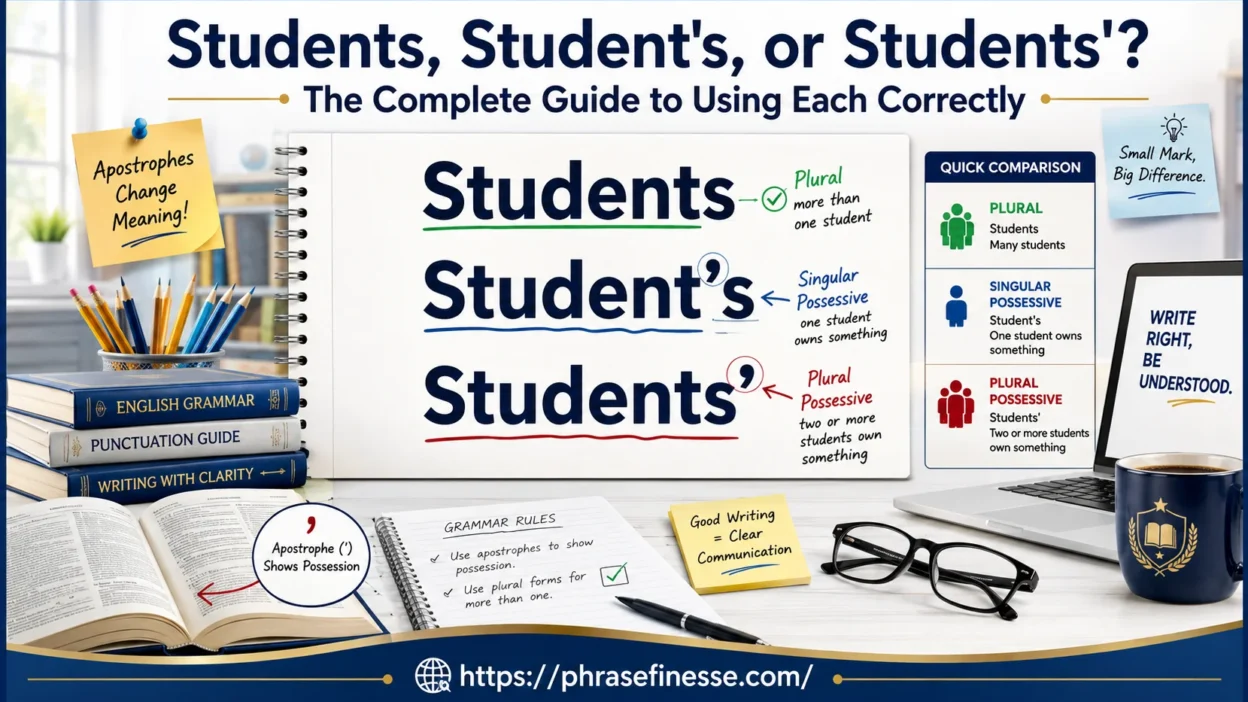
| Students | More than one student | Plural noun |
| Student’s | Something belongs to one student | Singular possessive noun |
| Students’ | Something belongs to multiple students | Plural possessive noun |
A simple way to think about it:
- Students = many students
- Student’s = one student owns something
- Students’ = many students own something
That single apostrophe changes everything.
What Is a Plural Noun?
A plural noun refers to more than one person, place, thing, or idea.
The word students is simply the plural form of student.
Examples of Students
- Students are preparing for final exams.
- Many students attended the workshop.
- The university welcomed new students.
- International students contribute to campus diversity.
Notice something important.
There is no ownership in any of these examples.
The word merely tells us there is more than one student.
Other Similar Plurals
| Singular | Plural |
| Student | Students |
| Teacher | Teachers |
| Child | Children |
| Professor | Professors |
| Employee | Employees |
The absence of an apostrophe means the noun is functioning only as a plural.
What Is a Possessive Noun?
A possessive noun shows ownership, connection, association, or belonging.
Possessive nouns typically use an apostrophe.
For example:
- Sarah’s book
- The company’s policy
- The student’s assignment
In each case, something belongs to someone.
Possession does not always mean physical ownership. It can also indicate relationships, responsibilities, or associations.
For example:
- The student’s opinion
- The student’s future
- The student’s performance
These things aren’t physical objects, yet they are connected to a particular student.
When to Use “Students”
The word students is the easiest of the three forms because it is simply plural.
Definition of Students
Students means more than one student.
No ownership exists.
No apostrophe is required.
Examples of Correct Usage
- Students gathered in the auditorium.
- Students often struggle with time management.
- The school encourages students to participate in sports.
- Students completed the survey before graduation.
- Many students prefer online learning resources.
Common Contexts
You’ll frequently see students used in:
- Educational articles
- University websites
- Research studies
- Government reports
- News publications
Example in Context
Consider this sentence:
Students participated in the science fair.
The sentence merely states that multiple students participated.
Nothing belongs to them.
Therefore, students is correct.
When to Use “Student’s”
Now things get slightly more interesting.
Definition of Student’s
Student’s is the singular possessive form.
It means something belongs to one student.
Rule
Add an apostrophe followed by s when one student owns, controls, creates, or is associated with something.
Student + ‘s = Student’s
Examples
- The student’s notebook was missing.
- The student’s essay received high marks.
- A student’s determination can influence success.
- The student’s scholarship covered tuition expenses.
- The student’s laptop malfunctioned during the exam.
Why the Apostrophe Comes Before the S
The apostrophe appears before the final s because ownership belongs to a single student.
Think of it this way:
One student = student’s
Example Breakdown
Sentence:
The student’s backpack was left in the classroom.
Ask yourself:
Who owns the backpack?
Answer:
One student.
Therefore:
Student’s backpack is correct.
Read More: Campuses or Campus’s or Campus’? Choose Correct One!
When to Use “Students’”
This is where many writers become uncertain.
Definition of Students’
Students’ is the plural possessive form.
It indicates ownership by multiple students.
Rule
First make the noun plural:
Student → Students
Then add an apostrophe after the s:
Students → Students’
Examples
- The students’ projects impressed the judges.
- The students’ classroom was renovated.
- The students’ concerns were addressed.
- The students’ grades improved significantly.
- The students’ participation increased this semester.
Why the Apostrophe Moves
The apostrophe moves after the s because the noun is already plural.
Think of the formula:
Many students + ownership = students’
Example Breakdown
Sentence:
The students’ presentations were excellent.
Question:
Who gave the presentations?
Answer:
Multiple students.
The presentations belong to several students.
Therefore:
Students’ presentations is correct.
Students vs. Student’s vs. Students’: Side-by-Side Comparison
The easiest way to master these forms is to compare them directly.
Comparison Table
| Sentence | Correct Form | Why |
| Students are studying. | Students | Simple plural |
| The student’s book is missing. | Student’s | One student owns the book |
| The students’ books are missing. | Students’ | Multiple students own books |
| Students attended class. | Students | No possession |
| The student’s score improved. | Student’s | One student |
| The students’ scores improved. | Students’ | Multiple students |
A Simple Memory Trick
Many grammar experts teach a quick shortcut.
Remember This Formula
| Meaning | Form |
| One student | Student |
| Many students | Students |
| One student owns something | Student’s |
| Many students own something | Students’ |
Visual Guide
Student = One student
Students = Many students
Student’s = One student owns something
Students’ = Many students own something
This tiny chart can solve most apostrophe questions instantly.
Real-World Examples and Corrections
Learning grammar becomes easier when you see actual mistakes.
Example One
Incorrect:
The students notebook is on the desk.
Correct:
The student’s notebook is on the desk.
Why?
One student owns the notebook.
Example Two
Incorrect:
The student’s projects were displayed.
Correct:
The students’ projects were displayed.
Why?
Several students created projects.
Example Three
Incorrect:
Student’s are waiting outside.
Correct:
Students are waiting outside.
Why?
No ownership exists.
The sentence only refers to multiple students.
Example Four
Incorrect:
The students classroom was renovated.
Correct:
The students’ classroom was renovated.
Why?
The classroom belongs to multiple student
Example Five
Incorrect:
The student performance improved.
Correct:
The student’s performance improved.
Why?
The performance belongs to one student.
Common Mistakes People Make
Even experienced writers occasionally misuse apostrophes.
Let’s look at the most frequent errors.
Using Apostrophes for Simple Plurals
Many people incorrectly believe plurals require apostrophes.
Examples:
❌ Student’s attending orientation
✅ Students attending orientation
❌ Teacher’s meeting tomorrow
✅ Teachers meeting tomorrow
Apostrophes never create ordinary plural nouns.
Confusing Singular and Plural Ownership
Writers often forget to identify the owner.
Consider:
The students’ teacher
This means one teacher belongs to multiple students.
Compare that with:
The student’s teacher
This means one teacher belongs to one student.
A tiny apostrophe changes the meaning dramatically.
Writing Too Quickly
Apostrophe mistakes frequently occur because writers focus on ideas rather than grammar.
Professional editors often recommend asking one question:
Who owns this thing?
The answer usually reveals the correct form immediately.
Depending Entirely on Spell Check
Many grammar programs identify spelling errors but miss apostrophe mistakes.
For example:
- Students
- Student’s
- Students’
All three are valid words.
Software may not recognize which one fits your sentence.
Human judgment still matters.
Special Cases and Exceptions
English grammar occasionally introduces situations that aren’t quite as straightforward.
Singular Nouns Ending in S
Consider names like:
- James
- Charles
- Chris
Most modern style guides prefer:
- James’s laptop
- Charles’s presentation
- Chris’s report
However, some publishers use:
- James’ laptop
Both may appear depending on the style guide.
Collective Ownership
Sometimes multiple students share ownership.
Example:
The students’ lounge was renovated.
The lounge belongs collectively to all students.
Plural possessive works perfectly here.
Joint Possession vs. Separate Possession
This distinction appears frequently in advanced writing.
Joint Ownership
Jack and Emma’s project won first place.
They share one project.
Separate Ownership
Jack’s and Emma’s projects won awards.
Each student has a different project.
Understanding this concept improves writing precision.
How Educational Institutions Commonly Use These Forms
Schools and universities frequently use possessive constructions.
Examples
| Phrase | Meaning |
| Student’s handbook | One student’s handbook |
| Students’ union | Union representing students collectively |
| Students’ rights | Rights belonging to all students |
| Student’s record | Record belonging to one student |
| Students’ council | Council representing multiple students |
Why “Students’ Union” Is Correct
Many people wonder about this phrase.
A students’ union represents all students.
Ownership or association belongs collectively to students.
Therefore, students’ union is grammatically correct.
Case Study: A University Newsletter Error
A university newsletter once published the headline:
Student’s Achieve Record Graduation Rates
The headline contained a grammatical error.
The correct version should have been:
Students Achieve Record Graduation Rates
Why?
The headline referred to multiple students.
No ownership existed.
This small mistake generated criticism because readers immediately noticed the misplaced apostrophe.
The lesson is simple:
Apostrophe errors can damage credibility.
How Professional Editors Check Possessives
Professional editors often follow a three-step process.
Step One: Identify the Noun
Ask:
Who or what is involved?
Example:
Student
Step Two: Determine Quantity
Ask:
One student or multiple students?
Step Three: Determine Possession
Ask:
Does something belong to the student or students?
If no:
- Student
- Students
If yes:
- Student’s
- Students’
This method works nearly every time.
Practice Exercises
Choose the correct form.
Exercise Set
- The _____ assignments were submitted yesterday.
- _____ gathered outside the auditorium.
- The _____ laptop stopped working.
- The _____ opinions influenced the discussion.
- Several _____ volunteered for the event.
- The _____ research paper won an award.
- The _____ classroom was redesigned.
- Many _____ attended orientation.
- The _____ grades improved after tutoring.
- The _____ schedule changed unexpectedly.
Answers and Explanations
Answer Key
| Question | Answer | Reason |
| 1 | Students’ | Multiple students own assignments |
| 2 | Students | Simple plural |
| 3 | Student’s | One student owns laptop |
| 4 | Students’ | Multiple students own opinions |
| 5 | Students | No ownership |
| 6 | Student’s | One student owns paper |
| 7 | Students’ | Shared classroom |
| 8 | Students | Simple plural |
| 9 | Students’ | Multiple students own grades |
| 10 | Student’s | One student’s schedule |
Quick Cheat Sheet
Save this section for future reference.
| If You Mean | Use |
| One student | Student |
| More than one student | Students |
| Something belongs to one student | Student’s |
| Something belongs to many students | Students’ |
The Fastest Rule
Ask:
Is there ownership?
If no:
- Student
- Students
If yes:
Ask:
One owner or many owners?
One owner:
- Student’s
Many owners:
- Students’
FAQs
1. What is the difference between Students, Student’s, and Students’?
Students is the plural form of student and refers to more than one student. Student’s is the singular possessive form, showing that something belongs to one student. Students’ is the plural possessive form, showing that something belongs to multiple students.
Examples:
- The students attended the lecture.
- The student’s notebook is on the desk.
- The students’ projects were displayed in the hall.
2. When should I use Student’s?
Use Student’s when one student owns or is associated with something.
Examples:
- The student’s assignment was submitted early.
- I reviewed the student’s presentation yesterday.
3. When should I use Students’?
Use Students’ when something belongs to or relates to multiple students.
Examples:
- The students’ classroom was recently renovated.
- We discussed the students’ concerns during the meeting.
4. Is Students ever possessive?
No. Students without an apostrophe is only a plural noun. To show possession, you must add an apostrophe in the correct position.
Correct:
- The students’ achievements were celebrated.
Incorrect:
- The students achievements were celebrated.
5. How can I quickly identify the correct form?
Ask yourself two questions:
- Is it singular or plural?
- Does it show ownership?
- More than one student, no ownership → Students
- One student owns something → Student’s
- Multiple students own something → Students’
6. Why is using the correct possessive form important?
Correct grammar, English usage, and formal writing improve clarity and professionalism. Whether you’re writing academic papers, business communication, reports, emails, or project management documents, proper apostrophe use ensures your message remains clear and consistent.
Conclusion
Understanding the difference between Students, Student’s, and Students’ is a simple but important part of mastering English grammar. Students refers to more than one student, Student’s shows possession by one student, and Students’ indicates possession by multiple students. Using the correct form strengthens formal writing, improves consistency, and helps you communicate more effectively in academic, professional, and everyday situations.
By remembering the basic rule of singular versus plural ownership, you can avoid common apostrophe mistakes and write with greater accuracy and confidence.

Alyan Ashraf is an English language writer and editor at Phrase Finesse, where he specializes in grammar, vocabulary, spelling, word usage, and clear communication. Passionate about the English language, he creates practical, research-backed content that helps readers avoid common mistakes and write with greater accuracy and confidence.
Known for his clear writing style and attention to detail, Alyan simplifies complex language topics into easy-to-understand guides filled with real-world examples and actionable insights. His work covers confusing word pairs, grammar rules, idioms, punctuation, and everyday English usage, making learning both accessible and engaging for students, professionals, writers, and non-native English speakers.
Every article Alyan writes is carefully researched, fact-checked, and designed to meet high editorial standards. His goal is to help readers strengthen their English skills, expand their vocabulary, and communicate more effectively in academic, professional, and everyday settings.
Through Phrase Finesse, Alyan is committed to publishing trusted language resources that make mastering English simpler, clearer, and more enjoyable for learners around the world