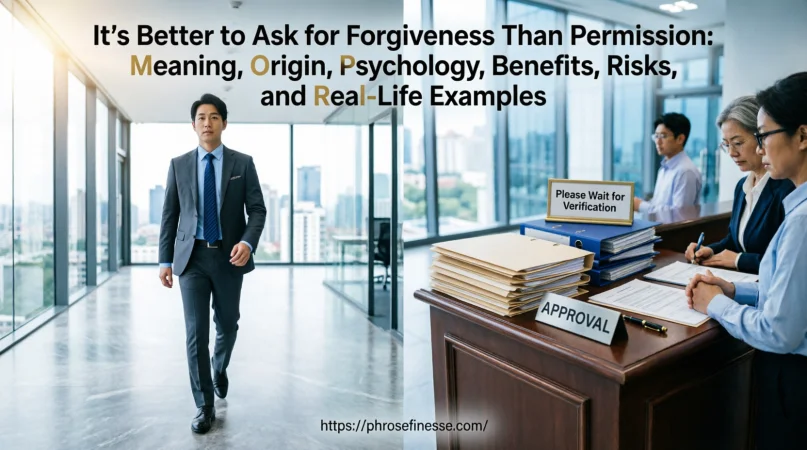
Have you ever acted first and explained yourself later? The phrase “It’s Better To Ask For Forgiveness Than Permission” Meaning & Origin is a well-known expression that encourages taking action without waiting for approval, then dealing with the consequences afterward if necessary.
It frequently appears in discussions about decision-making, leadership, business communication, project management, and personal initiative, making it a fascinating phrase to explore from both a linguistic and practical perspective.
Although the saying is often associated with bold action and innovation, its meaning can vary depending on the situation.
In professional environments involving meetings, calendar planning, scheduling, time management, online booking, and broadcasting, following this approach may sometimes speed up progress, while in other cases it can create unnecessary risks.
Understanding when and why people use this expression helps you interpret it correctly and apply it more effectively in everyday conversations and workplace settings.
In this guide, you’ll discover the complete meaning, origin, and modern usage of “It’s Better To Ask For Forgiveness Than Permission.”
We’ll examine its historical background, common examples, cultural significance, and how it appears in English usage, grammar, formal writing, and professional communication.
By the end, you’ll have a clear understanding of what this popular saying means, where it came from, and why it continues to influence discussions about action, responsibility, and consistency in decision-making.
What Does “It’s Better to Ask for Forgiveness Than Permission” Mean?
The phrase “it’s better to ask for forgiveness than permission” means that it can sometimes be more effective to take action first and apologize later rather than seeking approval beforehand.
The underlying assumption is simple:
- People often reject ideas before seeing results.
- Approval processes can slow progress.
- Taking initiative may create better outcomes.
- Forgiveness is sometimes easier to obtain than permission.
In practical terms, someone following this philosophy believes that acting quickly creates opportunities that might vanish if they wait for authorization.
Simple Example
Imagine an employee who notices a small issue affecting customer satisfaction.
Instead of spending weeks seeking approval from multiple managers, the employee fixes the problem immediately. If management later questions the decision, the employee explains the reasoning and accepts responsibility.
The employee chose action over bureaucracy.
That’s the essence of the saying.
The True Meaning Behind the Phrase
Many people misunderstand the expression.
The phrase does not mean:
- Ignore laws
- Break ethical standards
- Disrespect authority
- Violate contracts
- Act recklessly
Instead, the phrase generally encourages:
- Initiative
- Resourcefulness
- Independent thinking
- Responsible risk-taking
- Problem-solving
The focus is on removing unnecessary delays while maintaining accountability.
A useful way to think about it is this:
“Move forward when the risks are manageable and the benefits outweigh the potential consequences.”
The Origin of “It’s Better to Ask for Forgiveness Than Permission”
The quote is most commonly associated with Grace Hopper, one of the most influential figures in computer science.
Who Was Grace Hopper?
Grace Hopper was:
- A pioneering computer scientist
- A U.S. Navy Rear Admiral
- A key contributor to early programming languages
- One of the developers who influenced COBOL
She became famous not only for her technical achievements but also for encouraging innovation and practical problem-solving.
How Grace Hopper Popularized the Saying
Hopper reportedly said:
“It’s easier to ask forgiveness than it is to get permission.”
She used the phrase when encouraging people to innovate rather than become trapped by excessive bureaucracy.
Her philosophy reflected a practical reality often found in large organizations. Endless approval chains can delay progress for months, while action can produce immediate results.
Did Grace Hopper Invent the Quote?
Probably not.
Historians have found similar ideas expressed long before Hopper popularized the phrase.
Throughout history, military leaders, explorers, entrepreneurs, and inventors have embraced comparable principles. While Hopper may not have originated the exact wording, she played a major role in making it famous.
Today, her version remains the most widely cited.
Why the Phrase Became So Popular
The popularity of this expression didn’t happen by accident.
Modern organizations often struggle with slow decision-making.
Many companies require:
- Multiple approvals
- Lengthy reviews
- Committee discussions
- Formal sign-offs
While these processes can reduce risk, they can also create delays.
The Problem of Bureaucracy
Bureaucracy exists for a reason. It creates structure and accountability.
However, excessive bureaucracy can become a roadblock.
Imagine needing six approvals to solve a problem that takes five minutes to fix.
The delay may cost more than the mistake itself.
This is why many successful organizations encourage employees to take ownership of low-risk decisions.
Speed Creates Opportunities
Opportunities often have expiration dates.
Consider:
- Market trends
- Customer requests
- Product launches
- Business partnerships
A company that moves quickly can gain an advantage over slower competitors.
Sometimes the difference between success and failure is timing.
The Psychology Behind Asking Forgiveness Instead of Permission
The saying isn’t only about business.
It’s deeply connected to human psychology.
Action Bias
Researchers use the term action bias to describe people’s tendency to prefer doing something over doing nothing.
When faced with uncertainty, many individuals feel more comfortable taking action.
Action creates momentum.
Inaction often creates frustration.
Fear of Rejection
Many people seek permission because they fear rejection.
Seeking approval feels safer.
If the answer is no, responsibility shifts to someone else.
However, this mindset can also prevent innovation and growth.
Ownership and Accountability
The forgiveness approach works only when responsibility follows action.
People who successfully use this principle don’t avoid consequences.
Instead, they accept them.
That distinction matters.
A responsible decision-maker says:
“I made this choice because I believed it would help. Here’s why.”
That attitude builds credibility.
Confidence Versus Recklessness
Confidence involves informed decision-making.
Recklessness ignores consequences.
The difference is enormous.
| Confidence | Recklessness |
| Evaluates risks | Ignores risks |
| Accepts responsibility | Avoids responsibility |
| Considers outcomes | Acts impulsively |
| Protects stakeholders | Disregards stakeholders |
| Learns from mistakes | Repeats mistakes |
The phrase works best when confidence—not recklessness—guides decisions.
Real-Life Examples of “It’s Better to Ask for Forgiveness Than Permission”
Understanding the theory is useful.
Seeing it in action makes the concept clearer.
Workplace Example: Solving a Customer Problem
A customer receives incorrect information and becomes frustrated.
Instead of waiting for managerial approval, a customer service representative offers a reasonable solution immediately.
The customer leaves satisfied.
Management later reviews the situation and supports the decision.
In this case, quick action protected the customer relationship.
Startup Example: Launching an MVP
Many successful startups release a Minimum Viable Product (MVP) before perfecting every feature.
Founders know that waiting for perfection often delays learning.
By launching early, they collect real-world feedback.
The decision may involve risk, but it accelerates progress.
Personal Example: Learning a New Skill
Imagine someone who wants to learn public speaking.
Instead of waiting until they feel completely prepared, they volunteer to give a presentation.
The experience teaches more than months of preparation.
Sometimes action itself becomes the best teacher.
Case Study: Innovation Inside Large Organizations
Large companies often struggle with innovation because of complex approval systems.
Consider an employee who identifies a process wasting ten hours every week.
The employee creates a small automation tool during personal time and tests it within a limited environment.
The tool reduces workload dramatically.
Had the employee waited months for approvals, the opportunity might have disappeared.
The employee didn’t act recklessly. Instead, they took a calculated risk.
The result benefited everyone.
This illustrates why many leaders value initiative.
See More :Drove or Driven: Which Is Correct?
Advantages of Asking for Forgiveness Instead of Permission
The philosophy has survived for decades because it offers genuine benefits.
Faster Decision-Making
Speed is often the most obvious advantage.
Instead of waiting for approval:
- Problems get solved sooner.
- Opportunities are captured faster.
- Customers receive quicker support.
Time is often the most valuable resource.
Increased Innovation
Innovation rarely emerges from endless meetings.
Experimentation drives breakthroughs.
People who take initiative often discover solutions that formal processes overlook.
Stronger Leadership Skills
Leadership involves decision-making.
When individuals take ownership, they develop:
- Confidence
- Judgment
- Accountability
- Resourcefulness
These qualities often lead to professional growth.
Reduced Bottlenecks
Organizations frequently suffer from approval bottlenecks.
Empowering people to act within reasonable limits removes unnecessary friction.
Greater Learning Opportunities
Action creates feedback.
Feedback creates learning.
Learning creates improvement.
This cycle often develops faster when people stop waiting for perfect conditions.
Key Benefits at a Glance
| Benefit | Impact |
| Speed | Faster execution |
| Innovation | More experimentation |
| Initiative | Stronger leadership |
| Learning | Real-world feedback |
| Efficiency | Fewer delays |
| Adaptability | Faster response to change |
Risks and Criticisms of the Philosophy
The saying sounds attractive, but it has limitations.
Ignoring those limitations can create serious problems.
Damaged Trust
Trust takes years to build and seconds to damage.
If people repeatedly make decisions without consulting stakeholders, relationships may suffer.
Others may feel excluded or ignored.
Legal Consequences
Some actions require approval by law.
Examples include:
- Regulatory compliance
- Contract modifications
- Financial reporting
- Employee matters
Forgiveness may not protect someone from legal penalties.
Financial Losses
Unauthorized spending can create significant problems.
A well-intentioned decision can still become an expensive mistake.
Ethical Issues
Not every decision belongs to one person.
When actions affect others, ethical considerations become important.
Respecting boundaries remains essential.
Team Conflict
Teams function best when communication is strong.
Repeatedly bypassing colleagues can create tension and resentment.
Major Risks Overview
| Risk | Potential Outcome |
| Trust Issues | Relationship damage |
| Compliance Violations | Legal exposure |
| Financial Mistakes | Monetary losses |
| Ethical Concerns | Reputation harm |
| Team Friction | Reduced collaboration |
When the Forgiveness Approach Works Best
The principle works best under specific conditions.
Low-Risk Situations
If the potential downside is minimal, taking action may be reasonable.
Examples include:
- Minor workflow improvements
- Small customer service decisions
- Routine operational adjustments
Reversible Decisions
Reversible decisions are ideal candidates.
If something can be undone easily, experimentation becomes safer.
Time-Sensitive Opportunities
Sometimes delays destroy opportunities.
Examples include:
- Market trends
- Promotional campaigns
- Customer retention efforts
- Competitive responses
Quick action can provide a significant advantage.
Innovation Projects
Innovation often requires experimentation.
Not every idea will succeed.
However, organizations that never experiment rarely lead their industries.
Emergencies
During emergencies, waiting for approval may be impractical.
Immediate action can prevent larger problems.
A Simple Decision Framework
Before acting without permission, ask yourself these questions:
Is the Decision Reversible?
If the answer is yes, risk decreases significantly.
What Is the Worst Possible Outcome?
Think realistically.
Could the consequences be severe?
Who Might Be Affected?
Consider:
- Customers
- Employees
- Partners
- Stakeholders
Is There a Legal Concern?
Legal issues should almost always trigger a permission-first approach.
Does the Action Align With Organizational Goals?
If the action supports established objectives, the decision becomes easier to justify.
When You Should Always Ask Permission First
Some situations demand approval.
No exceptions.
Legal Matters
Never assume forgiveness will replace legal compliance.
Financial Commitments
Large purchases, contracts, and investments require authorization.
Safety-Related Decisions
Human safety should never depend on unauthorized experimentation.
Human Resources Issues
Personnel decisions affect careers and livelihoods.
Appropriate approvals are essential.
Contractual Obligations
Agreements exist for a reason.
Violating them can create costly consequences.
Regulatory Compliance
Industries such as healthcare, banking, aviation, and pharmaceuticals operate under strict regulations.
Permission isn’t optional.
Common Misunderstandings About the Phrase
Myth: It Encourages Rule-Breaking
Reality: The phrase encourages initiative, not lawlessness.
Myth: Successful People Never Ask Permission
Reality: Successful leaders know when to ask and when to act.
Myth: Speed Is Always Better
Reality: Fast decisions can still be poor decisions.
Myth: Forgiveness Is Guaranteed
Reality: Sometimes forgiveness never comes.
Consequences still exist.
Myth: The Phrase Applies Everywhere
Reality: Context determines whether the approach makes sense.
Similar Sayings and Their Meanings
Several popular expressions share related themes.
| Saying | Core Idea |
| Fortune Favors the Bold | Courage creates opportunity |
| Done Is Better Than Perfect | Execution matters |
| Move Fast and Learn Fast | Experimentation accelerates learning |
| Take Initiative | Ownership drives results |
| Act Decisively | Avoid unnecessary hesitation |
Although similar, each phrase emphasizes a different aspect of action and decision-making.
How Effective Leaders Use This Philosophy Responsibly
The best leaders don’t blindly follow the phrase.
Instead, they apply it strategically.
They Understand Risk
Experienced leaders assess consequences before acting.
They Protect Trust
Trust remains a top priority.
Even when acting independently, they communicate clearly afterward.
They Accept Accountability
Ownership separates leaders from spectators.
When outcomes are positive, they share credit.
When mistakes occur, they accept responsibility.
They Learn Continuously
Every decision provides feedback.
Strong leaders analyze both successes and failures.
They Know Their Boundaries
The smartest decision-makers understand which decisions belong to them and which require approval.
That judgment often determines long-term success.
FAQs
1. What does “It’s Better To Ask For Forgiveness Than Permission” mean?
The phrase means that it can sometimes be more effective to take action first rather than wait for approval. If the action causes problems, you can apologize afterward and seek forgiveness instead of asking for permission in advance.
2. Who originally said “It’s Better To Ask For Forgiveness Than Permission”?
The exact origin is debated, but the saying is commonly attributed to Grace Hopper, a pioneering computer scientist and U.S. Navy rear admiral. She frequently promoted innovation and decisive action.
3. Is “It’s Better To Ask For Forgiveness Than Permission” always good advice?
No. While it can encourage initiative and quick decision-making, it is not appropriate in every situation. Legal, financial, safety-related, and workplace matters often require proper approval before action is taken.
4. Why is this phrase popular in business and leadership?
Many leaders value the phrase because it encourages creativity, problem-solving, and innovation. In fast-moving industries, waiting for approval can sometimes slow progress, making proactive action more attractive.
5. Can this phrase be used in formal writing?
Yes, but it is generally best suited for discussions about leadership, management, workplace culture, or decision-making. In highly formal or academic writing, it may be helpful to explain the phrase rather than rely on it alone.
6. What is the opposite of “It’s Better To Ask For Forgiveness Than Permission”?
The opposite idea is that people should obtain approval before taking action. This approach prioritizes caution, compliance, accountability, and risk management over speed and independence.
Conclusion
“It’s Better To Ask For Forgiveness Than Permission” is a powerful expression that reflects a proactive approach to decision-making. Often associated with innovation, leadership, and personal initiative, the phrase encourages people to act first and address objections later. While this mindset can help overcome delays and bureaucracy, it also carries risks when approval, compliance, or safety are important considerations.
Understanding the meaning and origin of this popular saying provides valuable insight into how it is used in modern communication.
Whether you encounter it in business discussions, workplace conversations, or everyday English, recognizing its context will help you determine when it represents smart initiative and when asking permission first may be the wiser choice.

Emma Brooke is an English language specialist, editor, and content writer at Phrase Finesse, where she helps readers develop stronger writing and communication skills through clear, practical, and engaging content. With a passion for the English language, she specializes in simplifying grammar rules, vocabulary, spelling, punctuation, and word usage for learners at every level.
Emma has extensive experience creating educational content that is accurate, well-researched, and easy to understand. She is particularly skilled at explaining confusing word pairs, grammar concepts, idioms, sentence structure, and effective writing techniques, making complex topics approachable for students, professionals, educators, and English learners worldwide.


[…] See More :It’s Better to Ask for Forgiveness Than Permission […]
[…] See More :It’s Better to Ask for Forgiveness Than Permission […]