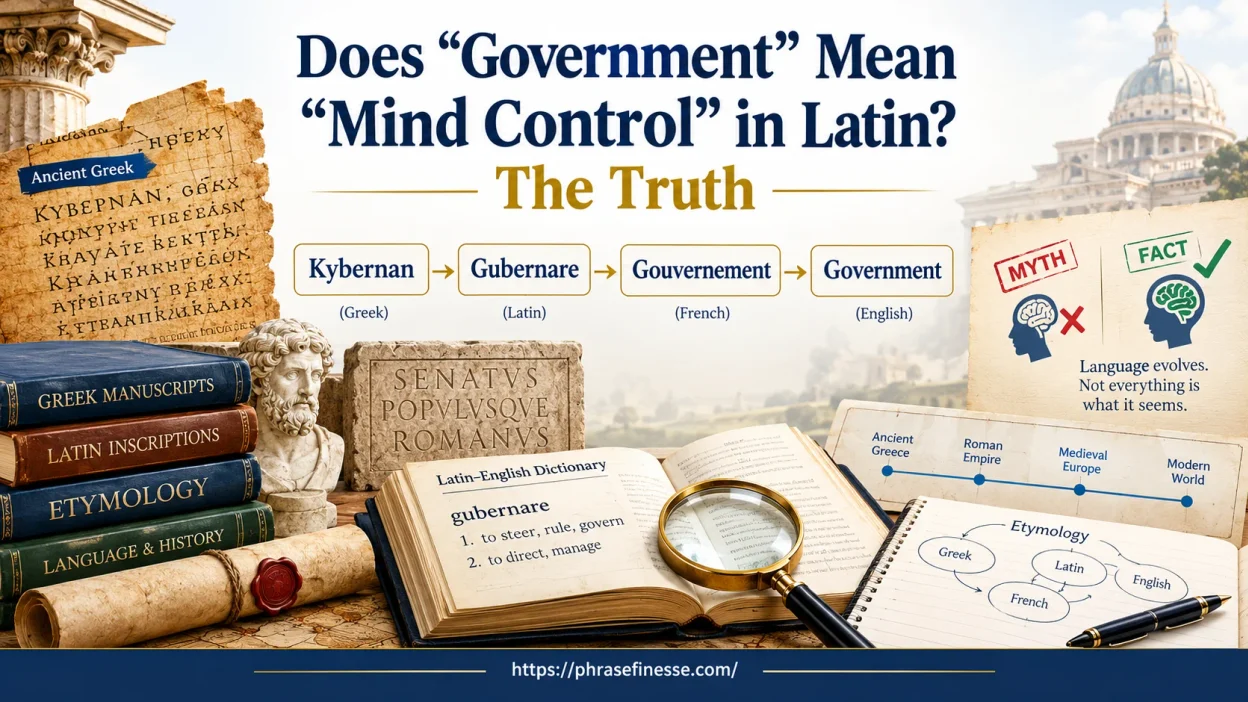
Have you ever wondered,Does “Government” Mean “Mind Control” in Latin? The TruthThis question often appears in discussions about Latin word origins, government terminology, and the hidden meanings people associate with political language. The claim may sound convincing at first, especially when online explanations connect government with ideas like control, authority, or the human mind.
However, word origins require more than a clever breakdown of modern English words. Understanding the Latin roots, historical usage, and evolution of government can reveal whether this popular interpretation has any linguistic basis.
In this article, you’ll discover where the word government actually comes from and what its Latin roots mean. We’ll examine its etymology, historical development, and connection to concepts such as rule, guidance, authority, and administration. You’ll also see why separating genuine English usage and grammar from internet myths matters when evaluating word meanings.
Although terms like scheduling, time management, business communication, online booking, broadcasting, meetings, calendar, and project management may seem unrelated, they demonstrate how language carries specialized meanings across different contexts. The same principle applies to formal writing: context, historical usage, and consistency matter.
Most importantly, this guide will separate linguistic fact from popular interpretation. You’ll learn what the Latin roots behind government actually signify, whether “mind control” has any legitimate connection to them, and how the misconception developed.
By the end, you’ll have a clearer understanding of government meaning, Latin etymology, and the difference between an intriguing wordplay claim and a historically supported explanation.
Quick Answer
No. “Government” does not mean “mind control” in Latin. The English word government ultimately comes through Old French from Latin gubernare, meaning “to steer,” “to govern,” or “to direct.” Latin gubernare relates to the idea of steering or guiding, especially a ship. It does not literally mean “mind control.” The modern phrase “mind control” describes a very different concept and shouldn’t be presented as the original Latin meaning of government.
Does “Government” Mean “Mind Control” In Latin?
The short answer is no.
There is no credible linguistic evidence showing that the word government means mind control in Latin. No major etymological dictionary, Latin scholar, university language department, or historical linguistic source supports this interpretation.
The claim usually relies on breaking the word into:
- Govern = control
- Ment = mind
At first glance, that might seem logical. However, language evolution doesn’t work that way.
Words are not always understood by splitting them into modern-looking pieces and assigning meanings to each part. Linguists trace words through historical records, documented usage, and known language changes. When they do this with government, they find a completely different story.
The Actual Origin of the Word Government
The real history of the word is surprisingly interesting.
Rather than involving mind control, the word evolved through several languages over thousands of years.
The Journey of the Word Through History
| Period | Word | Meaning |
| Ancient Greek | kybernan | To steer or guide |
| Classical Latin | gubernare | To steer, direct, govern |
| Old French | gouvernement | Administration or governance |
| Middle English | government | System of ruling or administration |
This documented progression appears in numerous etymological references and historical dictionaries.
The key idea throughout every stage is not mental manipulation.
It’s guidance.
The Greek Root: Kybernan
The oldest ancestor of government comes from the Greek verb kybernan.
This word meant:
- To steer a ship
- To pilot a vessel
- To guide a course
- To direct movement
Ancient Greeks often used nautical metaphors when discussing leadership. A skilled captain guided a ship safely through storms and rough seas.
Similarly, a ruler guided a city or state.
This comparison became deeply embedded in political language.
Imagine It This Way
Think of a ship crossing the Mediterranean Sea.
Without someone steering, the vessel drifts aimlessly.
The captain doesn’t control the minds of the sailors.
Instead, the captain guides the direction of the journey.
That’s the original concept behind the earliest ancestor of the word government.
The Latin Root: Gubernare
The Greek word eventually became the Latin verb gubernare.
This word meant:
- To steer
- To direct
- To govern
- To guide
Roman writers used gubernare in both literal and metaphorical ways.
A captain could gubernare a ship.
A leader could gubernare a province.
A statesman could gubernare public affairs.
In every context, the central idea remained the same:
Direction and guidance.
Not mind control.
The French Influence: Gouvernement
After the fall of the Roman Empire, Latin evolved into several Romance languages.
One of those languages was French.
The Latin gubernare eventually developed into gouvernement in Old French.
This word referred to:
- Administration
- Rule
- Governance
- Public authority
When Norman French influenced English after 1066, many French words entered the English language.
Government was one of them.
How the “Government Means Mind Control” Theory Started
The theory likely emerged through a misunderstanding of word formation.
Many versions of the claim argue:
Govern = control
Ment = mind
Therefore government = mind control
The argument sounds clever.
Unfortunately, it ignores how etymology actually works.
Why the Theory Seems Convincing
Several factors make the theory attractive.
It Sounds Secretive
People enjoy discovering hidden meanings.
A claim that reveals a supposedly concealed truth naturally attracts attention.
It Fits Existing Beliefs
If someone already distrusts governments, the theory appears to validate their worldview.
It’s Easy to Remember
Complex linguistic history requires explanation.
“Government means mind control” takes only a few seconds to understand.
Simple stories often spread faster than accurate ones.
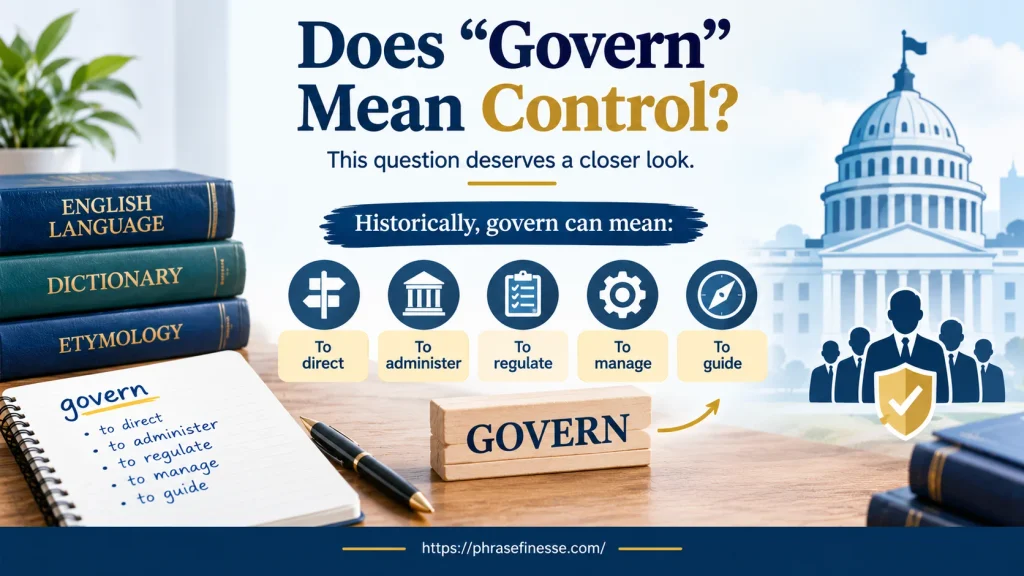
Does “Govern” Mean Control?
This question deserves a closer look.
Historically, govern can mean:
- To direct
- To administer
- To regulate
- To manage
- To guide
In some contexts, governing involves exercising authority.
However, authority is not the same thing as mind control.
Consider these examples:
| Example | Meaning |
| Govern a country | Administer public affairs |
| Govern a company | Manage operations |
| Govern a classroom | Maintain order |
| Govern a ship | Steer direction |
Notice something important.
None of these definitions involve controlling thoughts.
Instead, they involve directing actions, systems, or processes.
What Does the Suffix “-ment” Actually Mean?
This is where much of the confusion begins.
Many viral posts claim:
“Ment means mind in Latin.”
This statement is incorrect.
The English suffix -ment comes primarily through French and Latin grammatical development.
Its purpose is to create nouns.
Common Examples
| Word | Meaning |
| Movement | Act of moving |
| Development | Process of developing |
| Achievement | Something achieved |
| Improvement | Result of improving |
| Government | System or act of governing |
Notice the pattern.
The suffix transforms verbs into nouns.
It does not mean “mind.”
What Linguists Say About -ment
The suffix generally indicates:
- Action
- Process
- Result
- State
- Means of performing an action
Examples include:
- Enjoy → enjoyment
- Improve → improvement
- Govern → government
There is no hidden reference to mental control.
The Latin Word for Mind: Mens
Here’s where the misunderstanding likely originated.
Latin does have a word for mind.
That word is:
Mens
Plural:
Mentes
From this Latin root, English gained words such as:
- Mental
- Mentality
- Dementia
- Mention (through a more complex linguistic pathway)
Because mens looks somewhat similar to ment, some people incorrectly assume they are connected.
Similarity in spelling does not prove a shared origin.
Language is full of coincidences.
Words That Actually Come From Mens
Let’s compare.
| Word | Related to Latin Mens? |
| Mental | Yes |
| Mentality | Yes |
| Dementia | Yes |
| Government | No |
| Development | No |
| Achievement | No |
The suffix -ment is not derived from the Latin noun mens.
They are separate linguistic elements with different histories.
Why Professional Linguists Reject the Claim
Professional etymologists rely on evidence.
They do not create definitions by breaking modern words into convenient pieces.
Instead, they examine:
- Historical documents
- Ancient texts
- Recorded spellings
- Language evolution patterns
- Documented pronunciation shifts
This evidence-based process leaves little room for speculation.
How Etymology Actually Works
Imagine someone claims:
Butterfly means butter that flies.
The word contains both “butter” and “fly.”
Yet that doesn’t prove the meaning.
Historical evidence matters more than surface appearances.
The same principle applies to government.
Words evolve through centuries of documented usage.
Their meanings come from that history.
Not from modern reinterpretations.
A Linguistic Case Study
Incorrect Method
- Break word apart.
- Assign meanings to pieces.
- Combine meanings.
- Claim hidden definition.
Correct Method
- Find earliest recorded form.
- Trace language development.
- Examine historical usage.
- Follow documented changes.
Only the second approach is accepted in linguistics.
The Difference Between Governance and Mind Control
The viral claim often blurs two separate concepts.
Governance
Governance refers to:
- Administration
- Rule-making
- Organization
- Leadership
- Public management
See More : Joiners vs. Joiners: Which Is Correct?
Mind Control
Mind control refers to:
- Psychological manipulation
- Coercive influence
- Brainwashing
- Cognitive domination
These concepts are fundamentally different.
Even if someone criticizes a government for manipulation, that criticism does not change the etymology of the word itself.
Word origins and political opinions are separate subjects.
Similar Etymology Myths That Spread Online
The government myth isn’t unique.
Many false etymologies circulate online.
“News” Means North East West South
This popular claim says NEWS is an acronym.
Historical evidence shows otherwise.
The word existed long before such acronyms were common.
“Golf” Means Gentlemen Only, Ladies Forbidden
Another widespread myth.
The sport’s name has entirely different linguistic origins.
“Posh” Means Port Out, Starboard Home
This explanation sounds neat.
However, historians have found no evidence supporting it.
Common Traits of False Etymologies
Most share similar characteristics:
- Easy to remember
- Emotionally appealing
- Difficult to verify quickly
- Repeated frequently
- Lacking historical evidence
The government mind-control theory fits this pattern perfectly.
Why the Myth Continues to Spread
Even after repeated debunking, the claim remains popular.
Why?
People Prefer Simple Stories
A dramatic explanation often beats a complicated one.
Ancient Greek roots and language evolution require effort to understand.
“Government means mind control” requires only one sentence.
Social Media Rewards Virality
Posts that trigger strong reactions receive more engagement.
The claim encourages:
- Shares
- Comments
- Arguments
- Emotional responses
As a result, algorithms may amplify it.
Confirmation Bias
People naturally favor information supporting existing beliefs.
Someone skeptical of authority may find the theory persuasive because it reinforces their assumptions.
That doesn’t make it true.
How to Verify Etymology Claims Yourself
Whenever you encounter a surprising word-origin claim, use a simple checklist.
Ask These Questions
- Is there documented historical evidence?
- Do major dictionaries support the claim?
- Can the word be traced through older languages?
- Do professional linguists agree?
If the answer is no, skepticism is warranted.

Reliable Sources for Etymology Research
Useful references include:
- Oxford English Dictionary
- Merriam-Webster Etymology
- Online Etymology Dictionary
- University linguistics departments
- Historical language databases
These sources rely on documented evidence rather than speculation.
Quick Fact Check: Does Government Mean Mind Control?
Fact Check Table
| Claim | True or False? | Explanation |
| Government means mind control in Latin | False | No historical evidence supports this |
| Government comes from Latin gubernare | True | Means to steer or direct |
| The word has Greek roots | True | Derived from kybernan |
| -ment means mind | False | It is a noun-forming suffix |
| Linguists accept the theory | False | It is considered a folk etymology |
| Government originally referred to guidance | True | Steering and directing are the original concepts |
Key Takeaways About the Government Mind Control Claim
Before reaching a final conclusion, it’s worth summarizing the evidence.
What We Know
✅ Government comes from Greek and Latin roots related to steering and guidance.
✅ The Latin word involved is gubernare, meaning to steer or govern.
✅ The suffix -ment functions as a noun-forming ending.
✅ The Latin word for mind is mens, not -ment.
✅ No credible linguistic authority supports the mind-control interpretation.
What We Don’t Find
❌ Historical texts defining government as mind control.
❌ Latin dictionaries supporting the claim.
❌ Linguistic evidence connecting government to mental domination.
❌ Academic support for the theory.
FAQs
1. Does “government” mean “mind control” in Latin?
No. “Government” does not mean “mind control” in Latin. The English word comes through Old French from Latin gubernare, meaning to steer, guide, govern, or direct. The phrase “mind control” represents a modern interpretation rather than the historical meaning of the Latin root.
2. What is the Latin root of the word “government”?
The word government ultimately traces back to the Latin verb gubernare. It referred to steering, guiding, or directing, especially in the metaphorical sense of guiding a state or group. The root is also associated with the idea of a steersman or helmsman guiding a ship.
3. Where does the idea that government means “mind control” come from?
The idea largely comes from wordplay and alternative interpretations of etymology. Some explanations attempt to divide or reinterpret the word to suggest control over the mind. However, historical linguistics doesn’t support that interpretation as the actual origin of government.
4. Does the Latin word for “government” relate to control?
There is a connection to direction, guidance, and authority, but that doesn’t mean “mind control.” Latin gubernare conveys the idea of steering or governing. Over time, related words developed broader meanings involving leadership, administration, and political authority.
5. Is “government” a Latin word?
Government is not directly a Latin word in its modern English form. English borrowed it through Old French governement, which ultimately traces back to Latin gubernare. This linguistic history shows how words can change in spelling, pronunciation, and meaning as they move between languages.
6. What does “government” actually mean?
In modern English, government generally refers to the system or organization that exercises authority over a country, state, or community. Depending on context, it can also mean the act of governing or the people responsible for administering public affairs. Its historical roots center on guiding, directing, and governing, rather than controlling someone’s mind.
Conclusion
So, does “government” mean “mind control” in Latin? No. The historical evidence points to a very different origin. The English word government ultimately comes from the Latin gubernare, associated with steering, guiding, and governing.
The “mind control” explanation may sound intriguing, but it relies on modern wordplay rather than established etymology. When you examine English usage, historical linguistics, grammar, and formal writing, context becomes essential. A word’s meaning comes from its documented linguistic history, not simply from how its letters can be interpreted today.
Understanding that distinction helps you evaluate similar claims more accurately. Whether you’re researching Latin roots, studying English vocabulary, or improving your writing, reliable etymology provides a stronger foundation than appealing but unsupported interpretations.




[…] See More : Does “Government” Mean “Mind Control” in Latin? The Truth […]
[…] See More : Does “Government” Mean “Mind Control” in Latin? The Truth […]