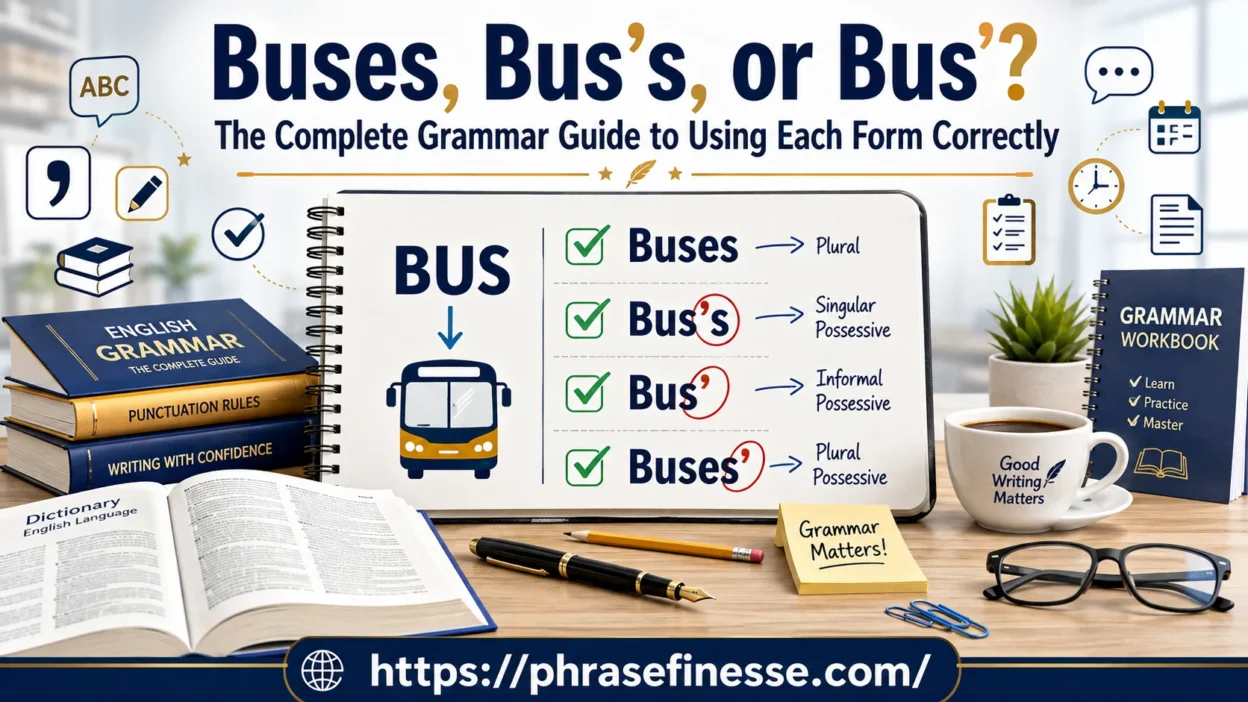
Have you ever paused while writing and wondered whether “Buses or Bus’s or Bus’? Is the right form to use? This common grammar question often creates confusion, especially when you’re aiming for accuracy in formal writing, professional emails, or academic work.
Understanding the correct possessive form helps you write with greater consistency and confidence.
The distinction between plural and possessive nouns may seem small, but it plays a major role in clear English usage. Whether you’re discussing a bus company’s scheduling system, updating a calendar, managing online booking details, handling business communication, or preparing reports for project management, proper punctuation ensures your message remains precise and professional.
Correct possessive forms also improve readability in documents, presentations, and everyday correspondence.
In this guide, you’ll learn when to use buses, bus’s, and bus’, along with practical examples that remove uncertainty.
We’ll break down the relevant grammar rules, explain modern style preferences, and show how these forms appear in real-world contexts such as meetings, broadcasting, time management, and workplace communication. By the end, you’ll know exactly which form to choose and why it matters.
The Short Answer: Which Form Is Correct?
Before diving into the details, here’s the quick answer.
| Form | Meaning | Correct? |
| Buses | More than one bus | ✅ Yes |
| Bus’s | Something belonging to one bus | ✅ Yes |
| Bus’ | Alternative singular possessive | ✅ Sometimes |
| Buses’ | Something belonging to multiple buses | ✅ Yes |
| Busses | Alternate spelling in some contexts | ⚠ Rare |
| Buss’s | Related to the verb “buss” (kiss) | ❌ Not related to buses |
Quick Examples
| Form | Example |
| Bus | The bus arrived. |
| Buses | The buses arrived. |
| Bus’s | The bus’s driver was late. |
| Bus’ | The bus’ driver was late. |
| Buses’ | The buses’ schedules changed. |
If you’re writing for a general audience, buses, bus’s, and buses’ will be the forms you use most often.
Understanding the Difference Between Plural and Possessive Nouns
Most confusion begins here.
A plural noun and a possessive noun are not the same thing.
What Is a Plural Noun?
A plural noun refers to more than one person, place, thing, or idea.
Examples:
- Bus → Buses
- Car → Cars
- Train → Trains
- Class → Classes
The word buses simply means multiple buses.
Example:
The buses were parked behind the station.
Nothing belongs to anyone in this sentence. The word is merely plural.
What Is a Possessive Noun?
A possessive noun shows ownership, association, or connection.
Examples:
- The bus’s windshield
- The driver’s schedule
- The company’s policy
In these examples, something belongs to or is associated with something else.
The Simple Rule
| Form | Meaning |
| Plural | More than one |
| Possessive | Ownership or relationship |
A useful way to remember this:
Plural means quantity. Possessive means ownership.
That distinction solves most apostrophe mistakes instantly.
When to Use “Buses” (Plural Form)
The word buses is the standard plural form of bus.
English grammar follows a common rule for nouns ending in s.
Instead of simply adding another s, we add es.
Examples
| Singular | Plural |
| Bus | Buses |
| Class | Classes |
| Kiss | Kisses |
| Glass | Glasses |
Because “bus” already ends in s, adding es makes pronunciation easier.
Correct Examples of Buses
- The buses arrived on time.
- Several buses were delayed by traffic.
- School buses lined the parking lot.
- New buses entered service this year.
- The city purchased electric buses.
Each sentence refers to multiple buses.
No ownership exists.
No apostrophe is needed.
Why Writers Make Mistakes
Many people assume every word ending in s requires an apostrophe.
That assumption leads to incorrect sentences such as:
❌ The bus’s are arriving now.
The correct version:
✅ The buses are arriving now.
Apostrophes do not create plurals.
This is one of the most common grammar mistakes in English.
When to Use “Bus’s”
The form bus’s shows that something belongs to one bus.
This is called the singular possessive.
How Singular Possession Works
The standard rule is simple:
Singular noun + apostrophe + s
Examples:
| Singular Noun | Possessive Form |
| Bus | Bus’s |
| Class | Class’s |
| Boss | Boss’s |
| Witness | Witness’s |
Following this rule, the possessive form of bus becomes:
Bus’s
Correct Examples of Bus’s
- The bus’s engine overheated.
- The bus’s route changed unexpectedly.
- The bus’s driver reported an issue.
- The bus’s doors remained closed.
- The bus’s tires needed replacement.
In each example, something is associated with one specific bus.
Why Modern Grammar Favors Bus’s
Most major style guides now support adding ‘s to singular nouns ending in s.
Reasons include:
- Greater clarity
- Easier pronunciation
- Consistency across grammar rules
- Better readability
For example, most people naturally pronounce:
bus-iz
rather than abruptly stopping at:
bus
Adding ‘s reflects normal speech patterns.
When to Use “Bus’”
This is where things become interesting.
The form bus’ is sometimes accepted.
However, usage depends on the style guide being followed.
Is Bus’ Correct?
Yes.
But not universally.
Some editors and organizations prefer an apostrophe alone after singular nouns ending in s.
Example:
- The bus’ engine failed.
- The bus’ route was updated.
These sentences are not necessarily wrong.
They simply follow a different editorial style.
Why Style Guides Disagree
English has evolved over centuries.
Different publishers developed different standards.
As a result, two accepted approaches exist:
Method One
Add apostrophe + s.
Example:
Bus’s
Method Two
Add apostrophe only.
Example:
Bus’
Both can appear in professional writing.
Which Form Is More Common Today?
Most modern publications favor:
Bus’s
It provides clearer pronunciation and stronger consistency.
Therefore, unless your organization specifically requires otherwise, bus’s is generally the safer choice.
Read More: Campuses or Campus’s or Campus’? Choose Correct One!
What About Multiple Buses Showing Possession?
Now let’s combine plural and possessive forms.
Suppose several buses own or share something.
In that situation, use the plural possessive form.
Correct Form: Buses’
The process is simple:
- Make the noun plural.
- Add an apostrophe.
Example:
Bus → Buses → Buses’
Examples
- The buses’ schedules were revised.
- The buses’ engines underwent inspection.
- The buses’ maintenance records were updated.
- The buses’ routes changed after construction.
In each case, multiple buses possess or share something.
Quick Comparison
| Meaning | Correct Form |
| One bus | Bus |
| Multiple buses | Buses |
| Belonging to one bus | Bus’s |
| Belonging to several buses | Buses’ |
This table alone solves many grammar questions.
Bus’s vs Bus’ vs Buses’: Side-by-Side Comparison
Here’s the easiest way to visualize the differences.
| Form | Function | Example |
| Bus | Singular noun | The bus arrived. |
| Buses | Plural noun | The buses arrived. |
| Bus’s | Singular possessive | The bus’s door opened. |
| Bus’ | Alternative singular possessive | The bus’ door opened. |
| Buses’ | Plural possessive | The buses’ doors opened. |
Notice how a single apostrophe completely changes meaning.
Grammar often works this way.
Tiny marks create major distinctions.
Grammar Rules Behind Apostrophes and Nouns Ending in “S”
Many grammar debates involve words ending in s.
Bus is only one example.
The Traditional Rule
Historically, some style guides removed the extra s after nouns already ending in s.
Examples:
- Charles’
- Jesus’
- Bus’
The reasoning was simplicity.
The Modern Rule
Most contemporary grammar authorities recommend adding:
‘s
Examples:
- Charles’s
- James’s
- Bus’s
- Witness’s
This approach reflects actual pronunciation.
Why Pronunciation Matters
Language exists primarily for communication.
When grammar mirrors speech, readers process information more quickly.
For example:
- James’s car
- Bus’s engine
- Class’s schedule
Most speakers naturally pronounce the extra syllable.
Modern style rules often reflect that reality.
Style Guide Differences: AP Style vs Chicago Style
Professional writers frequently ask:
Which style guide should I follow?
The answer depends on where your content appears.
AP Style
The Associated Press Stylebook is common in journalism.
Historically, AP often favored apostrophe-only possessives in certain situations.
News organizations value brevity.
Chicago Manual of Style
The Chicago Manual of Style is widely used in publishing, academia, and book production.
Chicago generally recommends:
Singular noun + ‘s
Examples:
- Bus’s
- Class’s
- Witness’s
Which Is Best?
For most blogs, websites, businesses, and academic writing:
Bus’s is the preferred option.
It aligns with current usage and causes less confusion.
Common Mistakes Writers Make
Grammar errors involving buses and apostrophes appear everywhere.
Let’s fix the most common ones.
Mistake: Using Apostrophes for Plurals
Incorrect:
❌ The bus’s are arriving.
Correct:
✅ The buses are arriving.
Remember:
Apostrophes do not create plural nouns.
Mistake: Forgetting Possession
Incorrect:
❌ The buses engine failed.
Correct:
✅ The bus’s engine failed.
Ownership requires a possessive form.
Mistake: Mixing Singular and Plural Possession
Incorrect:
❌ The buses schedules changed.
Correct:
✅ The buses’ schedules changed.
The apostrophe belongs after the plural noun.
Mistake: Inconsistent Style
Incorrect:
- The bus’s route changed.
- The bus’ engine failed.
Choose one style and stay consistent throughout the document.
Consistency improves professionalism.
Real-World Examples from Everyday Writing
Understanding grammar rules is easier when you see them in action.
Transportation Industry
Correct:
- The bus’s maintenance report was submitted.
- The buses’ inspection records were archived.
School Communications
Correct:
- The bus’s departure time changed.
- The buses’ pickup locations were updated.
Business Reports
Correct:
- The bus’s operating cost increased.
- The buses’ fuel efficiency improved.
News Writing
Correct:
- The bus’s brakes malfunctioned.
- The buses’ schedules were disrupted by weather.
Technical Documentation
Correct:
- The bus’s transmission requires replacement.
- The buses’ diagnostic systems were upgraded.
These examples reflect how professionals use grammar in practical settings.
Case Study: How One Apostrophe Changes Meaning
Consider these two sentences:
Example One
The buses were inspected.
Meaning:
Multiple buses received inspections.
Example Two
The buses’ inspections were completed.
Meaning:
The inspections belonging to multiple buses were completed.
The difference is subtle.
The meaning changes dramatically.
That tiny apostrophe acts like a road sign directing readers toward the correct interpretation.
Quick Memory Tricks for Buses, Bus’s, and Bus’
Grammar becomes easier when you use memorable shortcuts.
Memory Trick One
Ask yourself:
Is there more than one bus?
If yes:
Buses
Example:
The buses arrived.
Memory Trick Two
Ask yourself:
Does one bus own or have something?
If yes:
Bus’s
Example:
The bus’s windshield cracked.
Memory Trick Three
Ask yourself:
Do multiple buses own or share something?
If yes:
Buses’
Example:
The buses’ routes changed.
Visual Cheat Sheet
| Question | Correct Form |
| More than one bus? | Buses |
| One bus owns it? | Bus’s |
| Multiple buses own it? | Buses’ |
Many editors keep a similar chart near their desk.
FAQs
1. Is bus’s grammatically correct?
Yes. Bus’s is the standard singular possessive form in most modern style guides. For example: The bus’s engine needs maintenance.
2. When should I use bus’ instead of bus’s?
Some style guides allow bus’ as a singular possessive, especially for nouns ending in s. However, bus’s is generally preferred because it reflects natural pronunciation and improves clarity.
3. What is the difference between buses and bus’s?
Buses is simply the plural form of bus, meaning more than one bus. Bus’s is the singular possessive form, showing ownership or association.
- Buses are waiting outside.
- The bus’s door is open.
4. How do I make buses possessive?
To show possession for multiple buses, add an apostrophe after the s:
- The buses’ schedules were updated.
Here, buses’ means the schedules belong to multiple buses.
5. Is buses’s ever correct?
No. Buses’s is not a standard English form. The correct plural possessive is buses’, not buses’s.
6. Which form should I use in formal writing?
For most professional, academic, and business contexts, use bus’s for the singular possessive and buses’ for the plural possessive. These forms align with modern grammar conventions and promote consistency in formal writing.
Conclusion
Understanding the difference between buses, bus’s, and bus’ is essential for accurate English usage. While buses refers to more than one bus, bus’s is the preferred singular possessive form in most modern style guides. Although bus’ may appear in some publications, it is less common and can sometimes create uncertainty for readers.
Using the correct possessive form improves clarity in formal writing, business communication, project management documents, scheduling updates, online booking systems, and everyday correspondence. By applying these simple grammar rules consistently, you can write with greater precision, professionalism, and confidence. When in doubt, remember: use bus’s for one bus that owns something and buses’ for multiple buses that share ownership.

Alyan Ashraf is an English language writer and editor at Phrase Finesse, where he specializes in grammar, vocabulary, spelling, word usage, and clear communication. Passionate about the English language, he creates practical, research-backed content that helps readers avoid common mistakes and write with greater accuracy and confidence.
Known for his clear writing style and attention to detail, Alyan simplifies complex language topics into easy-to-understand guides filled with real-world examples and actionable insights. His work covers confusing word pairs, grammar rules, idioms, punctuation, and everyday English usage, making learning both accessible and engaging for students, professionals, writers, and non-native English speakers.
Every article Alyan writes is carefully researched, fact-checked, and designed to meet high editorial standards. His goal is to help readers strengthen their English skills, expand their vocabulary, and communicate more effectively in academic, professional, and everyday settings.
Through Phrase Finesse, Alyan is committed to publishing trusted language resources that make mastering English simpler, clearer, and more enjoyable for learners around the world