Have you ever paused while writing an email or report and wondered whether “At That Time” or “At The Time” is the correct phrase to use? Understanding the distinction between “At That Time” vs. “At The Time” – Difference & Preposition Guide can make your writing more precise and professional.
These seemingly similar expressions often appear in everyday conversations, business communication, and formal writing, yet they serve different grammatical purposes and contexts.
Choosing the right phrase is important for clear English usage and maintaining consistency in your message. Whether you are discussing past events, describing a specific moment in a meeting, referring to a date on a calendar, or documenting progress in project management, the correct expression helps readers understand your intended meaning without confusion.
Small grammar choices often have a significant impact on clarity and credibility.
In this guide, you’ll learn the exact difference between “At That Time” and “At The Time,” when to use each one, and the grammar rules behind them.
We’ll also explore practical examples from scheduling, time management, online booking, broadcasting, workplace communication, and everyday situations. By the end, you’ll know how to use both phrases confidently in spoken and written English.
At That Time vs. At the Time: The Short Answer
The main difference is simple:
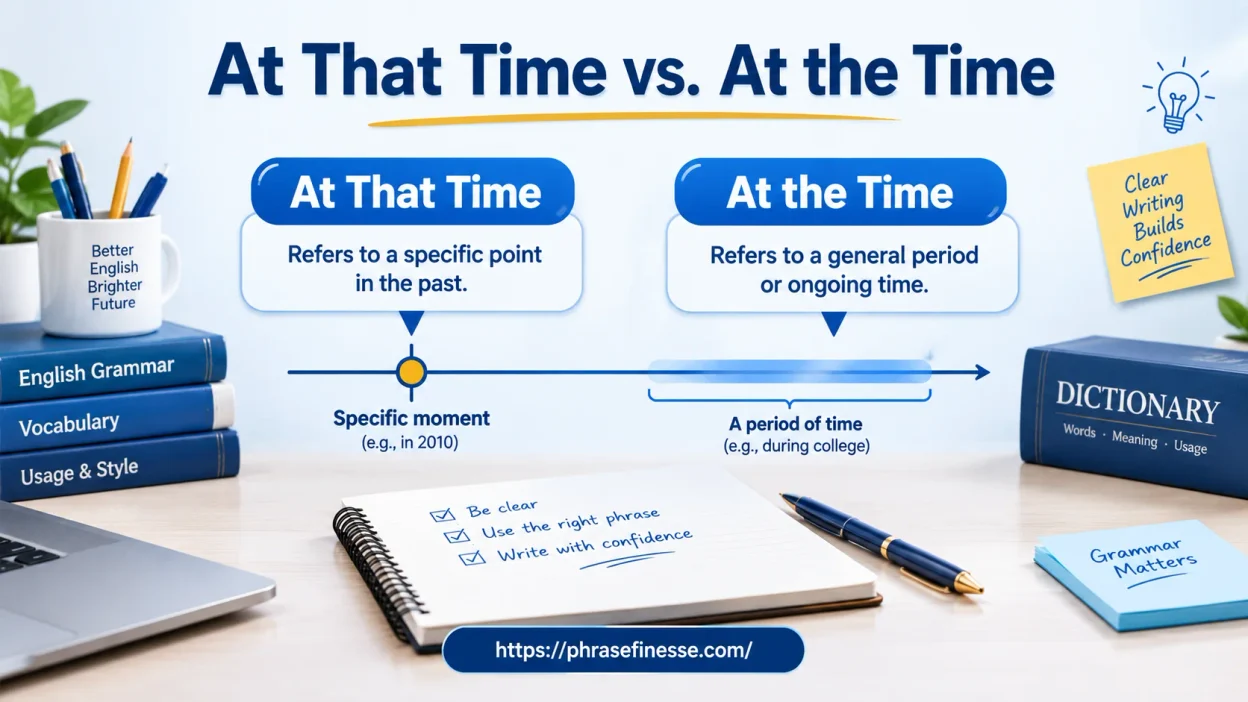
- At the time refers to a period that is already understood from context.
- At that time points to a specific moment or period that has been identified or mentioned.
Quick Comparison Table
| Phrase | Meaning | Specificity |
| At the time | During a previously understood period | More general |
| At that time | During a specifically identified moment or period | More specific |
Examples
- Example 1 At the time
another example At the time, nobody realized how important the discovery was.
At that time
The meeting began at 3:00 PM. At that time, all participants were present.
A useful memory trick is this:
“The” assumes the reader already knows the time period. “That” points directly to a specific time.
Understanding the Meaning of “At the Time”
The phrase at the time is extremely common in English.
Native speakers often use it when discussing past situations, decisions, opinions, beliefs, or circumstances.
The listener already understands which period is being discussed, so the speaker doesn’t need to identify the exact moment again.
Examples
- At the time, we believed the information was accurate.
- She was working in California at the time.
- Nobody questioned the decision at the time.
- At the time, technology wasn’t advanced enough to solve the problem.
Notice something interesting.
The phrase doesn’t identify a precise date, hour, or event. Instead, it refers to a period that exists naturally within the conversation.
Why Native Speakers Prefer “At the Time”
In everyday conversation, people often choose the simplest expression possible.
Because context usually provides enough information, at the time sounds more natural.
Consider these examples:
Natural
At the time, I thought moving abroad was a great idea.
Less Natural
At that time, I thought moving abroad was a great idea.
The second sentence isn’t wrong. It simply sounds more formal and slightly more specific.
Common Situations Where “At the Time” Appears
You’ll frequently hear this phrase when discussing:
- Past beliefs
- Previous decisions
- Historical events
- Old relationships
- Career changes
- Business strategies
- Scientific understanding
Examples
Past Beliefs
At the time, doctors believed the treatment was effective.
Business
At the time, the company had only ten employees.
History
At the time, international travel was expensive and difficult.
Understanding the Meaning of “At That Time”
The phrase at that time functions differently.
Instead of relying on context alone, it directs attention toward a specific moment or period.
The word that acts as a demonstrative determiner. It points directly to something.
Think of it as a verbal finger pointing at a particular moment in time.
Examples of “At That Time”
Specific Event Reference
The power outage began at 8 PM. At that time, hundreds of homes lost electricity.
Historical Reference
At that time in history, transportation relied heavily on horses.
Personal Story
I lived in New York during college. At that time, I worked part-time as a waiter.
In each example, the phrase identifies a clearly defined period.
How “The” and “That” Change the Meaning
The difference comes from the words the and that.
Although these are small words, they carry important grammatical functions.
What “The” Does
“The” is a definite article.
It refers to something known or understood by both the speaker and listener.
Example
At the time, nobody knew the truth.
The listener doesn’t need additional information because the surrounding context provides it.
What “That” Does
“That” is a demonstrative determiner.
It identifies a specific thing.
Example
The merger happened in 2015. At that time, the company expanded internationally.
The phrase points directly to the year 2015.
Side-by-Side Comparison
| Sentence | Meaning |
| At the time, I agreed with the decision. | General reference to that period. |
| At that time, I agreed with the decision. | Specific reference to a particular identified moment. |
The difference is subtle but real.
At That Time vs. At the Time: Usage Comparison
Let’s examine several common situations.
| Situation | Better Choice |
| Discussing past beliefs | At the time |
| Explaining decisions | At the time |
| Referring to a specific date | At that time |
| Referring to a previously mentioned event | At that time |
| General storytelling | At the time |
| Historical analysis | Either, depending on context |
Example: Past Decision
At the time, buying the property seemed like a smart investment.
The timeframe is already understood.
Example: Specific Historical Event
The treaty was signed in 1783. At that time, political tensions remained high.
The phrase points directly to a specific year.
See More :“Special Thanks Go To” or “Special Thanks Goes To”?
Can At That Time and At the Time Be Interchangeable?
Sometimes yes.
Many sentences remain grammatically correct regardless of which phrase you choose.
Example
At the time, I was studying abroad.
At that time, I was studying abroad.
Both work.
However, native speakers often hear a slight difference in emphasis.
The Difference in Emphasis
At the Time
- More conversational
- More common
- Less formal
- Sounds natural in everyday speech
At That Time
- More precise
- More deliberate
- More formal
- Often used in writing and historical discussion
Native Speaker Preference
If no special emphasis is needed, native speakers generally choose:
At the time
This version appears more frequently in modern English conversation.
Common Grammar Structures With “At the Time”
Understanding patterns helps you use the phrase naturally.
At the Time + Clause
Examples
- At the time, we believed the project would succeed.
- At the time, nobody questioned the evidence.
- At the time, she was living overseas.
Subject + Verb + At the Time
Examples
- He worked in finance at the time.
- They owned several businesses at the time.
- We lived near the coast at the time.
At the Time + Statement of Circumstances
Examples
- At the time, inflation was rising rapidly.
- At the time, internet access was limited.
Common Grammar Structures With “At That Time”
This phrase often follows a specific time reference.
Time Reference + At That Time
Examples
- The accident happened in 2012. At that time, safety regulations were weaker.
- She graduated in 2018. At that time, the job market was strong.
Event + At That Time
Examples
- The company launched its first product. At that time, competition was limited.
- The war began unexpectedly. At that time, few people anticipated a prolonged conflict.
Narrative Storytelling
Authors frequently use this phrase to anchor readers to a particular moment.
Example
The clock struck midnight. At that time, nobody realized what would happen next.
Common Mistakes English Learners Make
Even advanced learners sometimes misuse these expressions.
Using “At That Time” Without a Reference
Incorrect
At that time, life was difficult.
The reader may wonder:
Which time?
Better
During the recession, life was difficult. At that time, unemployment was high.
Now the reference is clear.
Overusing “At That Time”
Many learners use at that time in every situation because it sounds formal.
However, native speakers often prefer at the time.
Less Natural
At that time, I liked soccer.
More Natural
At the time, I liked soccer.
Confusing Similar Time Expressions
Several related phrases create confusion.
At That Time vs. Other Time Expressions
Understanding similar expressions prevents mistakes.
At That Moment
Refers to a very precise instant.
Example
At that moment, the lights went out.
At the Moment
Refers to the present.
Example
I’m busy at the moment.
During That Time
Refers to an entire period.
Example
During that time, we traveled extensively.
Back Then
Informal reference to the past.
Example
Back then, smartphones didn’t exist.
In Those Days
Refers nostalgically to a past era.
Example
In those days, children spent more time outdoors.
Comparison Table
| Expression | Meaning | Time Focus |
| At the time | Known past period | General |
| At that time | Specific identified period | Specific |
| At that moment | Exact instant | Very specific |
| During that time | Entire period | Broad |
| Back then | Informal past reference | General |
| In those days | Past era | Broad |
Using At the Time and At That Time in Academic Writing
Academic writing values precision.
Because of that, both expressions appear frequently.
Historical Research
Example
At the time, many scholars accepted the prevailing theory.
Example
At that time, trade routes connected several major civilizations.
Analytical Writing
Researchers often use these expressions to establish context.
Example
At the time, economic conditions favored industrial expansion.
Using At the Time and At That Time in Business Writing
Business communication often relies on timelines.
These phrases help explain decisions and circumstances.
Examples
Business Report
At the time, management believed demand would continue growing.
Corporate Memo
At that time, the organization operated in three countries.
Project Review
At the time, available data supported the recommendation.
How Native Speakers Use These Expressions in Conversation
Everyday speech reveals an important pattern.
People overwhelmingly favor at the time.
Casual Conversation
Example
At the time, I didn’t know what was happening.
Example
We were just kids at the time.
Example
At the time, the idea sounded crazy.
Storytelling
When speakers introduce a specific point in a story, they often switch to at that time.
Example
The train arrived at exactly 6:15. At that time, the station was completely empty.
Historical and Literary Usage
Historians and authors use both phrases strategically.
Historical Writing
Example
At that time, the empire controlled vast territories.
Example
At the time, few citizens understood the long-term consequences.
Literary Writing
Writers often use these expressions to establish perspective.
Example
At the time, she considered the letter insignificant.
Example
At that time, destiny seemed to be moving in an entirely different direction.
Quick Decision Guide
When you’re unsure, ask yourself one question.
Am I referring to a specific identified moment?
If yes:
✅ Use at that time
If no:
✅ Use at the time
Cheat Sheet
| If You Mean… | Use… |
| A generally understood past period | At the time |
| A specific identified moment | At that time |
| Natural everyday English | At the time |
| Formal precision | At that time |
| Past beliefs or opinions | At the time |
| Reference to a named year or event | At that time |
Practice Quiz
Choose the correct phrase.
Question 1
The company had only five employees _______.
Answer: At the time
Question 2
The merger occurred in 2018. _______ the company faced strong competition.
Answer: At that time
Question 3
_______, we believed the market would recover quickly.
Answer: At the time
Question 4
The treaty was signed in 1648. _______ Europe was undergoing major political changes.
Answer: At that time
FAQs
1. What is the difference between “At That Time” and “At The Time”?
“At That Time” refers to a specific point in time that has already been mentioned or clearly identified. “At The Time” generally refers to a period or situation that existed during a particular event in the past. While both relate to past time references, their usage depends on context and specificity.
2. Is “At That Time” more specific than “At The Time”?
Yes. “At That Time” usually points to a precise moment or previously mentioned time. In contrast, “At The Time” often describes circumstances or conditions that existed during a broader period.
Example:
- At that time, the meeting had already ended.
- At the time, I was working in another city.
3. Can “At That Time” and “At The Time” be used interchangeably?
Not always. Although they may seem similar, replacing one with the other can change the meaning of a sentence. “At That Time” emphasizes a specific moment, while “At The Time” focuses on the circumstances surrounding a period.
4. Which phrase is more common in formal writing?
Both phrases are acceptable in formal writing, but “At The Time” appears more frequently in reports, academic papers, and historical descriptions because it often provides context about a past situation. “At That Time” is commonly used when referring to a clearly identified moment.
5. How are these phrases used in business communication?
In business communication, “At That Time” is useful when discussing a specific deadline, appointment, or event. “At The Time” is better when describing conditions or decisions that existed during a particular period.
Examples:
- At that time, the project deadline was extended.
- At the time, the company was expanding rapidly.
6. Are “At That Time” and “At The Time” considered prepositional phrases?
Yes. Both expressions are prepositional phrases beginning with the preposition “at.” They function as adverbial phrases, providing information about when an action or event occurred.
Conclusion
Understanding the difference between “At That Time” and “At The Time” can significantly improve your grammar, English usage, and overall writing clarity. While “At That Time” points to a specific moment that has been identified or mentioned, “At The Time” describes the circumstances or situation that existed during a particular period. Recognizing this distinction helps you communicate more accurately in everyday conversations, business communication, formal writing, and professional settings.
When in doubt, ask yourself whether you are referring to a precise moment or the conditions surrounding a period. If it is a specific point in time, choose “At That Time.” If you are describing what was true during a certain period, “At The Time” is usually the better option. Mastering this small but important grammar difference will make your writing more natural, professional, and consistent.

Emma Brooke is an English language specialist, editor, and content writer at Phrase Finesse, where she helps readers develop stronger writing and communication skills through clear, practical, and engaging content. With a passion for the English language, she specializes in simplifying grammar rules, vocabulary, spelling, punctuation, and word usage for learners at every level.
Emma has extensive experience creating educational content that is accurate, well-researched, and easy to understand. She is particularly skilled at explaining confusing word pairs, grammar concepts, idioms, sentence structure, and effective writing techniques, making complex topics approachable for students, professionals, educators, and English learners worldwide.