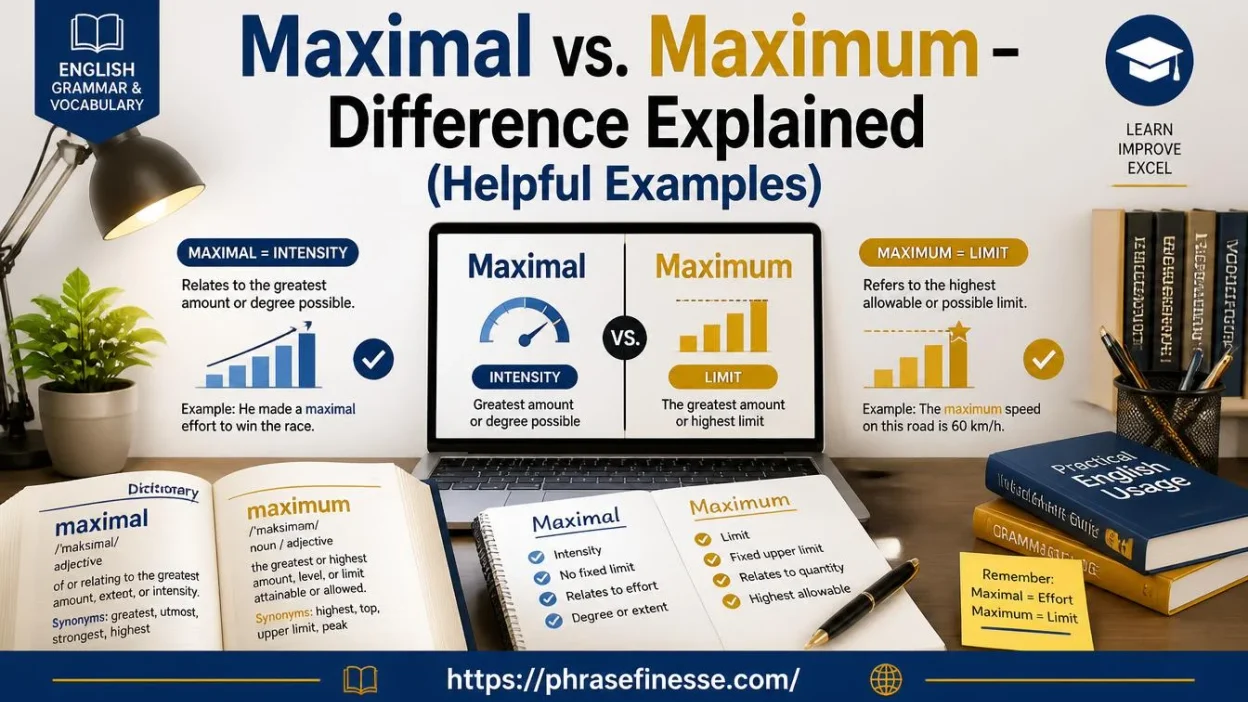
Have you ever paused while writing and wondered whether “maximal” and “maximum” mean the same thing? Many English learners and professionals use them interchangeably, yet subtle differences can affect clarity and precision. In this guide, “Maximal vs. Maximum – Difference Explained (Helpful Examples)”, you’ll learn when each term is appropriate, how they function in different contexts, and why choosing the right word matters in English usage, grammar, formal writing, and professional communication.
Although both words relate to the idea of the greatest possible amount, they are not always interchangeable. The distinction often appears in fields such as project management, time management, scheduling, and business communication, where accuracy is essential.
You may also encounter these terms in online booking systems, calendar planning, meetings, and broadcasting, where word choice influences understanding, efficiency, and consistency.
This article breaks down the meaning, usage, and grammatical roles of both terms with clear explanations and practical examples.
You’ll discover common mistakes, learn how native speakers use these words in real situations, and gain confidence in selecting the correct option. By the end, you’ll have a stronger grasp of vocabulary precision, formal communication, and the subtle differences that make your writing more accurate and professional.
Maximal vs. Maximum – Quick Difference
Before diving into the details, here’s the simplest way to understand the difference.
| Word | Part of Speech | Meaning | Example |
| Maximal | Adjective | As great, intense, or complete as possible | She gave maximal effort during training. |
| Maximum | Noun and Adjective | The greatest amount, number, or limit possible | The maximum speed is 65 mph. |
Quick Rule
- Use maximal when talking about effort, intensity, performance, or degree.
- Use maximum when talking about limits, quantities, capacities, or measurable amounts.
Think of it this way:
Maximal describes how intensely something is done.
Maximum describes the highest amount something can reach.
What Does “Maximal” Mean?
The word maximal means the greatest possible degree, intensity, or extent of something.
Unlike maximum, maximal almost always functions as an adjective. It describes a condition that has reached its highest achievable level.
Simple Definition
Maximal = as intense, complete, or extensive as possible.
Because of this meaning, maximal often appears in:
- Sports science
- Fitness training
- Medicine
- Psychology
- Research papers
- Academic writing
Examples of Maximal in Sentences
- The athlete performed at maximal intensity.
- Researchers measured the patient’s maximal oxygen uptake.
- The team exerted maximal effort during the project.
- Scientists observed maximal stimulation of the nerve cells.
- The runners completed a maximal endurance test.
Notice that maximal describes the degree or intensity of an action rather than a measurable limit.
Common Collocations with Maximal
Certain word combinations frequently appear with maximal.
| Common Phrase | Meaning |
| Maximal effort | Greatest possible effort |
| Maximal strength | Highest achievable strength |
| Maximal performance | Best possible performance |
| Maximal stimulation | Greatest degree of stimulation |
| Maximal exercise | Exercise performed at highest intensity |
| Maximal response | Strongest possible reaction |
These phrases are particularly common in research literature and fitness discussions.
Why Is Maximal Less Common?
Although grammatically correct, maximal isn’t used as frequently in everyday conversation.
Most people naturally say:
- Maximum effort
- Maximum output
- Maximum performance
Instead of:
- Maximal effort
- Maximal output
- Maximal performance
However, in scientific and technical contexts, maximal often sounds more precise.
For example:
The researchers measured the participants’ maximal aerobic capacity.
This sentence sounds natural in an academic paper.
What Does “Maximum” Mean?
The word maximum refers to the highest amount, number, quantity, level, or limit that something can reach.
Unlike maximal, maximum functions as both:
- A noun
- An adjective
This flexibility makes it far more common in everyday English.
Maximum as a Noun
When used as a noun, maximum refers to the highest possible value.
Examples
- The speed limit has a maximum of 70 mph.
- There is a maximum of three attempts.
- The maximum score is 100 points.
- The company reached its maximum production level.
In these examples, maximum acts as the thing being discussed.
Maximum as an Adjective
When used as an adjective, maximum describes a limit or upper boundary.
Examples
- Maximum capacity: 200 people.
- Maximum speed: 80 mph.
- Maximum temperature: 95°F.
- Maximum weight allowance: 50 pounds.
This usage appears constantly in daily life.
You see it on:
- Road signs
- Product labels
- Safety instructions
- Airline baggage rules
- Building occupancy notices
Common Collocations with Maximum
| Common Phrase | Meaning |
| Maximum capacity | Largest number something can hold |
| Maximum speed | Highest speed allowed or achievable |
| Maximum limit | Highest permitted amount |
| Maximum benefit | Greatest possible advantage |
| Maximum security | Highest level of security |
| Maximum score | Highest attainable score |
| Maximum output | Greatest amount produced |
| Maximum efficiency | Highest achievable efficiency |
These combinations dominate everyday English usage.
Maximal vs. Maximum: Side-by-Side Comparison
The easiest way to understand the distinction is to compare them directly.
| Feature | Maximal | Maximum |
| Primary Role | Adjective | Noun and adjective |
| Focus | Intensity and extent | Quantity and limit |
| Common Usage | Technical and scientific | Everyday English |
| Frequency | Less common | Extremely common |
| Sounds Natural in Daily Speech | Sometimes | Almost always |
| Example | Maximal effort | Maximum capacity |
The Core Difference
Imagine two runners.
Runner A pushes herself as hard as physically possible.
This is maximal effort.
Runner B is told the race allows only 100 participants.
That number represents the maximum capacity.
One focuses on intensity.
The other focuses on limits.
Can Maximal and Maximum Be Used Interchangeably?
Sometimes.
But not always.
That’s where confusion often begins.
Situations Where Both Work
Consider these examples:
- Maximum effort
- Maximal effort
Both are grammatically correct.
Most native speakers would probably choose maximum effort in casual conversation.
However, sports scientists often prefer maximal effort because it emphasizes intensity.
Situations Where Only Maximum Sounds Natural
Example 1
✅ Maximum capacity
❌ Maximal capacity
While maximal capacity exists in technical writing, maximum capacity sounds more natural to most readers.
Example 2
✅ Maximum speed
❌ Maximal speed
Maximum speed is the standard expression.
Example 3
✅ Maximum occupancy
❌ Maximal occupancy
Maximum occupancy appears on building regulations and safety notices.
Comparison Table
| Sentence | Correct? | Natural? |
| She gave maximal effort. | Yes | Yes |
| She gave maximum effort. | Yes | Yes |
| The room has maximum capacity of 150. | Yes | Yes |
| The room has maximal capacity of 150. | Technically | Less natural |
| Maximum speed is 70 mph. | Yes | Yes |
| Maximal speed is 70 mph. | Rare | Unusual |
Maximal vs. Maximum in Academic and Scientific Writing
This is where the distinction becomes especially important.
Researchers often choose words very carefully because slight differences can affect meaning.
Why Scientists Prefer Maximal
In scientific fields, maximal often refers to the greatest degree of performance or biological function.
Examples include:
Maximal Oxygen Uptake (VO₂ Max)
VO₂ max measures the maximum amount of oxygen the body can use during intense exercise.
Researchers frequently discuss:
- Maximal aerobic capacity
- Maximal oxygen consumption
- Maximal exercise testing
These phrases emphasize physical performance rather than numerical limits.
Maximal Heart Rate
Fitness professionals often calculate:
220 − Age = Estimated Maximal Heart Rate
For example:
| Age | Estimated Maximal Heart Rate |
| 20 | 200 bpm |
| 30 | 190 bpm |
| 40 | 180 bpm |
| 50 | 170 bpm |
The term maximal describes the highest sustainable physiological effort.
Maximum in Scientific Writing
Maximum still appears frequently in technical documents.
Examples:
- Maximum dosage
- Maximum temperature
- Maximum pressure
- Maximum load
- Maximum concentration
These refer to measurable upper boundaries.
Maximal vs. Maximum in Sports and Fitness
Sports science offers some of the clearest examples.
Understanding Maximal Effort
Imagine a weightlifter attempting a personal record.
They’re not concerned with limits imposed by rules.
Instead, they’re exerting every ounce of energy.
That’s maximal effort.
Examples
- Maximal sprint
- Maximal jump
- Maximal strength test
- Maximal power output
The emphasis remains on intensity.
Understanding Maximum Results
Now imagine the same athlete recording data.
The coach notes:
- Maximum squat: 400 pounds
- Maximum bench press: 275 pounds
- Maximum vertical jump: 35 inches
These represent measurable results.
The emphasis shifts from effort to outcome.
Case Study: Marathon Training
A sports scientist monitors two runners.
Runner A
Completes intervals at maximal effort.
Focus:
- Intensity
- Physical exertion
- Performance capacity
Runner B
Tracks maximum weekly mileage.
Focus:
- Quantifiable distance
- Training volume
- Numerical limits
Both concepts matter, but they measure different things.
See More :7 Words To Describe Someone Who Is Able To See The Big Picture
Common Mistakes People Make
Even experienced writers occasionally confuse these words.
Using Maximal for Numerical Limits
Incorrect:
The theater has a maximal capacity of 500 people.
Better:
The theater has a maximum capacity of 500 people.
Capacity refers to a measurable limit.
Assuming the Words Mean Exactly the Same Thing
While they overlap, they aren’t perfect substitutes.
One emphasizes degree.
The other emphasizes quantity.
Overusing Maximal in Everyday Writing
Many writers choose maximal because it sounds sophisticated.
However, maximum often sounds more natural.
For example:
Instead of:
The maximum attendance allowed is 100.
Don’t write:
The maximal attendance allowed is 100.
The second version feels awkward.
Ignoring Context
Context determines the best choice.
Ask yourself:
Am I describing intensity or a limit?
That question usually reveals the correct answer.
Synonyms of Maximal
Depending on context, these alternatives may work.
| Synonym | Best Used For |
| Ultimate | Final or highest level |
| Peak | Highest point |
| Full-scale | Complete intensity |
| Extreme | Very high intensity |
| Complete | Total extent |
| Full-strength | Maximum force |
Examples
- Ultimate effort
- Peak performance
- Extreme concentration
- Full-scale operation
Synonyms of Maximum
Several alternatives can replace maximum.
| Synonym | Meaning |
| Limit | Upper boundary |
| Ceiling | Highest allowed level |
| Peak | Highest point |
| Top | Uppermost position |
| Highest | Greatest level |
| Greatest | Largest amount |
Examples
- Spending limit
- Earnings ceiling
- Peak production
- Highest score
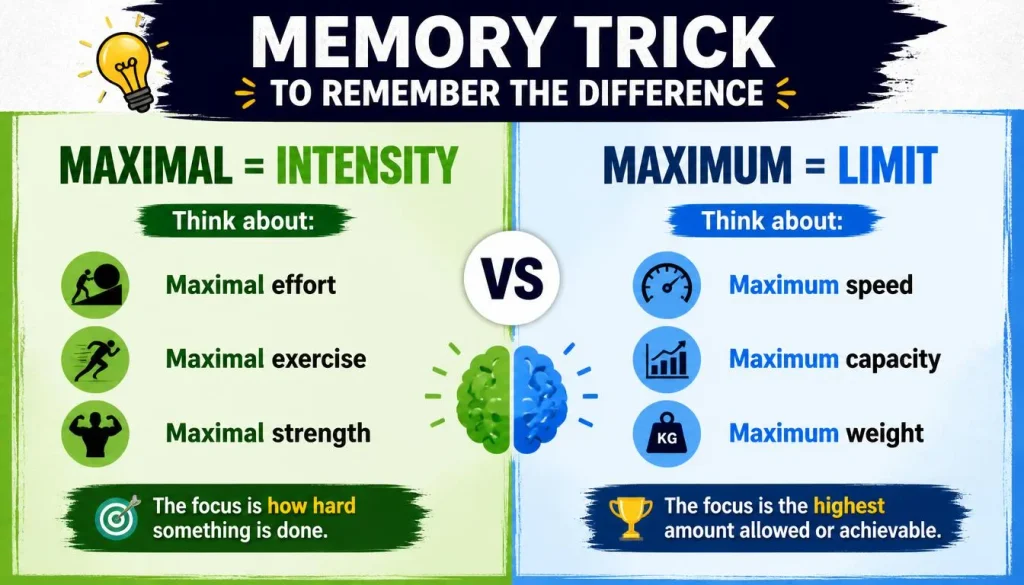
Memory Trick to Remember the Difference
Here’s an easy trick.
Maximal = Intensity
Think about:
- Maximal effort
- Maximal exercise
- Maximal strength
The focus is how hard something is done.
Maximum = Limit
Think about:
- Maximum speed
- Maximum capacity
- Maximum weight
The focus is the highest amount allowed or achievable.
Quick Visual Guide
MAXIMAL
↓
Intensity
Effort
Performance
Exertion
MAXIMUM
↓
Limit
Quantity
Amount
Capacity
If you remember this chart, you’ll rarely choose the wrong word.
Practice Quiz: Maximal or Maximum?
Choose the correct word.
Question 1
The elevator has a ______ capacity of 12 people.
Answer: Maximum
Question 2
The cyclist completed a ______ effort sprint.
Answer: Maximal
Question 3
The ______ speed allowed is 55 mph.
Answer: Maximum
Question 4
Researchers measured the athlete’s ______ oxygen uptake.
Answer: Maximal
Question 5
The airline enforces a ______ baggage weight of 50 pounds.
Answer: Maximum
Question 6
The participants performed a ______ exercise test.
Answer: Maximal
FAQs
1. What is the main difference between maximal and maximum?
Maximal usually describes something that reaches the greatest possible degree or intensity under certain conditions, while maximum refers to the highest limit, amount, or value that can be achieved. In many cases, maximum is more common in everyday English.
2. Can maximal and maximum be used interchangeably?
Sometimes, but not always. While both words relate to the idea of the greatest extent, maximum is generally used for limits and quantities, whereas maximal is often used in technical, scientific, medical, or mathematical contexts.
3. Which word is more common in everyday English?
Maximum is far more common in daily conversation, business documents, instructions, and professional writing. For example, people usually say “the maximum capacity” rather than “the maximal capacity.”
4. Is maximal a correct English word?
Yes, maximal is a fully correct English adjective. It is frequently used in academic, scientific, and specialized fields to describe the highest achievable level of something within a specific framework or condition.
5. How are these words used in business communication?
In business communication, maximum often refers to limits or allowances, such as a maximum budget, maximum attendance, or maximum storage capacity. Maximal may appear in technical reports or research-based discussions where precision is required.
6. How can I remember when to use maximal or maximum?
A simple rule is to think of maximum as a limit or highest number and maximal as the greatest achievable degree under certain circumstances. If you are discussing capacity, quantity, or restrictions, maximum is usually the safer choice.
Conclusion
Understanding the difference between maximal and maximum can improve the clarity and accuracy of your writing. Although both words express the idea of reaching the highest possible level, maximum typically refers to a fixed upper limit, while maximal describes the greatest attainable degree within a given context.
This distinction is especially important in formal writing, business communication, project management, and technical fields where precision matters.
By learning how these terms function and reviewing real-world examples, you can avoid common mistakes and choose the word that best matches your intended meaning. When in doubt, remember that maximum is the more widely used and familiar option, while maximal often appears in specialized or academic contexts.
Mastering this difference will help you communicate with greater consistency, confidence, and professionalism.

Mia Rose is an English language specialist and editorial writer at Phrase Finesse, where she helps readers master grammar, vocabulary, spelling, and effective communication. Passionate about making English simple and practical, she creates well-researched, reader-friendly content that explains complex language concepts in a clear and engaging way.
With extensive experience in English language education, content writing, and editorial review, Mia specializes in grammar, punctuation, word choice, idioms, confusing word pairs, and writing style. Her articles are carefully researched, fact-checked, and designed to help students, professionals, writers, and English learners build confidence in both written and spoken English.