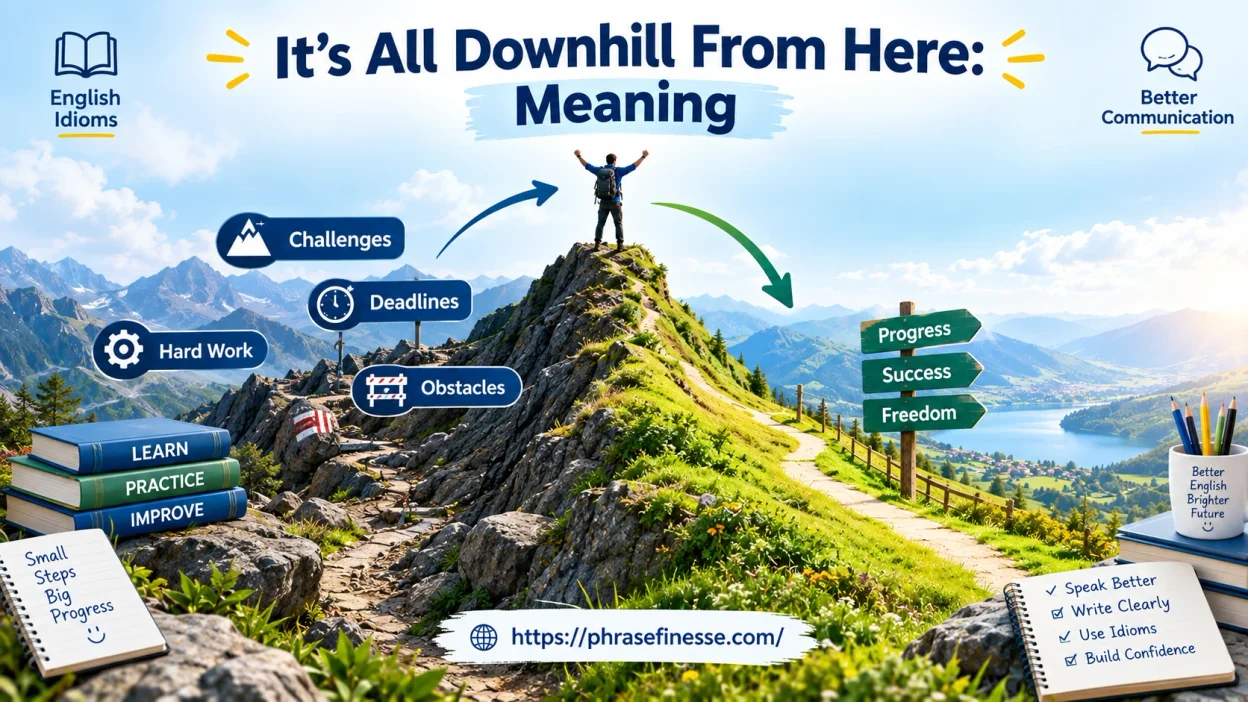
Have you ever heard someone say “It’s All Downhill From Here”: Meaning & Origin (Helpful Examples) and wondered whether it signals success or trouble ahead? This widely used idiom can carry different meanings depending on the context, which often leads to confusion.
Understanding its meaning, origin, and real-life usage can improve your English usage, strengthen your grammar skills, and help you interpret conversations more accurately.
In everyday communication, this expression appears in personal discussions, professional settings, and even business communication. You may encounter it during meetings, project management discussions, broadcasting, or while talking about scheduling, time management, and long-term goals.
Because idioms often rely on context, knowing when the phrase conveys ease and progress versus decline and difficulty is essential for maintaining clarity and consistency in both spoken and written communication.
This guide explores the complete background of the phrase, including its historical origin, modern interpretations, and practical examples.
You’ll also learn how it fits into formal writing, everyday conversation, and workplace communication involving calendar planning, online booking, and organizational workflows. By the end, you’ll have a clear understanding of how to use this expression naturally, confidently, and correctly in a variety of situations.
What Does “It’s All Downhill From Here” Mean?
The phrase “it’s all downhill from here” generally means that the most difficult part has already been completed and the remaining journey will be easier.
Imagine climbing a steep mountain.
The climb requires effort, determination, and endurance. Once you reach the top, the hardest work is behind you. The path downward requires far less physical exertion.
That simple image forms the foundation of the expression.
Simple Definition
It’s all downhill from here means that future progress will require less effort because the hardest challenge has already been overcome.
Today, this positive interpretation is the most common meaning in everyday conversation.
Quick Meaning Table
| Expression | Meaning |
| It’s all downhill from here | The hardest part is over and things should become easier |
| Downhill journey | Less effort required moving forward |
| Figurative meaning | Future challenges are expected to be easier |
Example Sentences
- We finished the most complicated phase of the project. It’s all downhill from here.
- After passing the final exam, it’s all downhill from here.
- The steepest section of the hike is behind us. It’s all downhill from here.
- Once the company secured funding, it was all downhill from there.
Notice how each example involves overcoming a major obstacle before using the expression.
Why Does “It’s All Downhill From Here” Have Two Meanings?
Here’s where things get interesting.
Although many speakers use the phrase positively, others use it in exactly the opposite way.
That’s because the concept of moving downhill can be interpreted differently.
The Positive Meaning
The traditional positive interpretation focuses on effort.
Climbing uphill is hard.
Going downhill is easier.
Under this interpretation, the phrase means:
- The worst part is over.
- Progress will become easier.
- Success is within reach.
- Future obstacles should be smaller.
Positive Examples
Workplace
“We’ve completed the software migration. It’s all downhill from here.”
Education
“The final research paper was the hardest assignment. It’s all downhill from here.”
Sports
“After finishing the toughest stage of training, it’s all downhill from here.”
The Negative Meaning
The negative interpretation focuses on decline.
When something goes downhill, it often deteriorates.
For example:
- A business can go downhill.
- Health can go downhill.
- Product quality can go downhill.
In this context, the phrase suggests that things will continue getting worse.
Negative Examples
Career
“After losing several key clients, it was all downhill from there.”
Sports Team
“The season started strong, but it was all downhill from there.”
Personal Performance
“Once injuries began piling up, it was all downhill from there.”
Meaning Comparison
| Interpretation | Meaning | Tone |
| Positive | Future progress becomes easier | Optimistic |
| Negative | Situation continues to decline | Pessimistic |
| Modern Everyday Usage | Hardest part is over | Usually positive |
| Retrospective Usage | Things worsened after a point | Usually negative |
The surrounding context almost always reveals which meaning is intended.
The Origin of “It’s All Downhill From Here”
Understanding the phrase’s origin makes its meaning much easier to remember.
Literal Origins
Long before becoming an idiom, the phrase described actual travel.
For centuries, people traveled on foot, horseback, wagons, and carts.
When travelers reached the highest point of a route, the remainder of the journey often involved descending.
Descending generally required less physical effort than climbing.
As a result, travelers would naturally describe the easier portion of the trip as being “all downhill.”
From Physical Travel to Figurative Language
Over time, English speakers began applying the concept to life situations.
Instead of describing roads and mountains, people used the phrase to describe:
- Work projects
- Educational goals
- Financial challenges
- Business ventures
- Athletic achievements
The metaphor worked perfectly because nearly everyone understands how difficult climbing can be.
Why the Expression Survived
Many idioms disappear over time.
This one endured because it relies on a universal experience.
Whether you’re climbing a mountain, riding a bicycle, or walking a steep hill, the contrast between uphill and downhill is easy to understand.
That visual clarity helped the phrase remain popular for generations.
Is “It’s All Downhill From Here” Positive or Negative?
The short answer is:
It can be either.
The longer answer depends entirely on context.
When the Phrase Is Positive
Most modern speakers use it positively when:
- A major challenge has been completed
- Success appears likely
- Future tasks seem easier
- Encouragement is needed
Positive Situations
- Completing a difficult degree
- Finishing a demanding project
- Paying off most of a large debt
- Recovering from a major setback
- Reaching an important milestone
When the Phrase Is Negative
The negative meaning usually appears when discussing events after they have already happened.
People often use it while looking backward.
Negative Situations
- Business decline
- Aging jokes
- Relationship breakdowns
- Team performance drops
- Financial losses
Native Speaker Interpretation Today
In contemporary American English, the positive meaning is generally more common when someone says:
“It’s all downhill from here.”
However, when someone says:
“It was all downhill from there.”
The negative interpretation becomes much more likely.
The tense often provides a valuable clue.
See More :What Does It Mean When Someone Calls You Sunshine?
How to Use “It’s All Downhill From Here” Correctly
Using the phrase naturally requires understanding timing and context.
Basic Structure
A common pattern looks like this:
Major challenge completed + phrase
Examples:
- We’ve finished the hardest part. It’s all downhill from here.
- The mountain peak is behind us. It’s all downhill from here.
- We secured the contract. It’s all downhill from here.
Workplace Examples
Professionals often use the phrase after major milestones.
Examples:
- The budget was approved. It’s all downhill from here.
- We completed system testing. It’s all downhill from here.
- The client signed the agreement. It’s all downhill from here.
School Examples
Students frequently use the expression.
Examples:
- The final exam is over. It’s all downhill from here.
- The dissertation defense is complete. It’s all downhill from here.
- Midterms are behind us. It’s all downhill from here.
Sports Examples
Athletes often use the phrase literally and figuratively.
Examples:
- We survived the toughest stretch of the season. It’s all downhill from here.
- The hardest training block is complete. It’s all downhill from here.
Personal Life Examples
Everyday conversations include countless opportunities.
Examples:
- The house move is finished. It’s all downhill from here.
- Most of the debt is paid off. It’s all downhill from here.
- We made it through the first year. It’s all downhill from here.
Common Situations Where People Say “It’s All Downhill From Here”
Certain situations naturally invite this expression.
After Completing the Hardest Task
People often use it when the biggest obstacle has been removed.
Examples include:
- Finishing construction
- Completing exams
- Recovering from surgery
- Launching a business
After Reaching a Major Milestone
Milestones provide visible proof of progress.
Examples:
- 50% of a project completed
- First profitable quarter
- Graduation
- Mortgage payoff progress
During Long Journeys
The phrase frequently appears in travel and hiking contexts.
For example:
“We’ve reached the summit. It’s all downhill from here.”
This may be both literal and figurative at the same time.
As Motivation
Leaders, coaches, teachers, and managers often use the expression to boost morale.
It reassures people that their effort is paying off.
During Celebrations
The phrase works well when acknowledging achievement.
Examples include:
- Promotions
- Awards
- Successful launches
- Major accomplishments
Similar Expressions and Alternatives
English offers several alternatives depending on the tone you want.
Positive Alternatives
| Expression | Meaning |
| The hard part is over | Major difficulty is finished |
| Smooth sailing from here | Easier progress ahead |
| We’re over the hump | Difficult stage completed |
| The worst is behind us | Problems are mostly over |
| It gets easier from here | Future effort decreases |
Negative Alternatives
| Expression | Meaning |
| Going downhill | Declining |
| On the decline | Gradually worsening |
| Past its prime | Beyond peak condition |
| Falling apart | Losing effectiveness |
| Not what it used to be | Deteriorating |
Which Alternative Should You Choose?
If clarity matters, alternatives can prevent confusion.
For example:
Instead of:
“It’s all downhill from here.”
You might say:
“The hardest part is over.”
The message becomes impossible to misinterpret.
Common Mistakes and Misunderstandings
Many learners misuse this idiom because they focus on only one meaning.
Assuming It Always Means Something Negative
This is perhaps the most common mistake.
Many people associate “downhill” with decline.
However, the expression often carries a positive meaning.
Ignoring Context
Context determines interpretation.
The exact same phrase can mean opposite things depending on the conversation.
Using It Before the Hard Part Is Over
The phrase implies meaningful progress.
Using it too early may sound unrealistic.
For example:
❌ “We just started the project. It’s all downhill from here.”
✔ “We’ve completed the toughest phase. It’s all downhill from here.”
Confusing “From Here” and “From There”
Subtle differences matter.
| Phrase | Common Interpretation |
| It’s all downhill from here | Positive |
| It was all downhill from there | Often negative |
While not an absolute rule, this pattern appears frequently.
Missing Tone Clues
Voice, facial expression, and surrounding details often reveal the intended meaning.
Written text relies entirely on context.
“It’s All Downhill From Here” vs. “Going Downhill”
These phrases sound similar but usually mean different things.
Key Differences
| Expression | Meaning | Tone |
| It’s all downhill from here | Easier progress ahead | Usually positive |
| Going downhill | Declining in quality or condition | Negative |
Example Comparison
Positive:
“We completed the hardest phase. It’s all downhill from here.”
Negative:
“Customer satisfaction is going downhill.”
The difference is significant.
One describes reduced effort.
The other describes deterioration.
Real-Life Examples From Everyday English
Let’s see how the phrase appears in realistic situations.
Business Example
A startup spends two years developing a product.
After securing investment and launching successfully, the founder says:
“Getting the first customers was the hardest challenge. It’s all downhill from here.”
The statement expresses confidence about future growth.
Education Example
A doctoral student completes a dissertation defense.
The advisor says:
“Congratulations. It’s all downhill from here.”
The major academic hurdle has passed.
Fitness Example
A marathon runner reaches mile twenty.
The coach encourages:
“You’ve survived the toughest section. It’s all downhill from here.”
The phrase boosts morale and focus.
Family Example
Parents finish moving into a new house.
After unpacking the largest furniture, one says:
“The difficult part is done. It’s all downhill from here.”
Again, the phrase signals easier progress ahead.
Case Study: Why Context Matters
Consider these two conversations.
Scenario One
Manager: “We’ve completed security testing.”
Developer: “Great. It’s all downhill from here.”
Meaning:
✅ Remaining tasks should be easier.
Scenario Two
Analyst: “The company lost half its revenue.”
Investor: “Unfortunately, it was all downhill from there.”
Meaning:
✅ Things continued getting worse.
Same expression.
Completely different interpretation.
Context changes everything.
FAQs
1. What does “It’s All Downhill From Here” mean?
The phrase “It’s all downhill from here” is an idiom that can have either a positive or negative meaning depending on the context. In a positive sense, it suggests that a difficult part has been completed and things will become easier. In a negative sense, it can imply that a situation is likely to worsen over time.
2. Where did the phrase “It’s All Downhill From Here” originate?
The expression comes from the literal experience of traveling downhill. Moving downhill generally requires less effort than climbing uphill, which led to its positive figurative meaning. Over time, some speakers also began using it ironically or negatively to describe decline or deterioration.
3. Is “It’s All Downhill From Here” positive or negative?
The phrase can be both positive and negative. When referring to completing a challenging task, it usually means future progress will be easier. However, when discussing a person’s situation, performance, or quality of life, it may suggest that things are getting worse.
4. Can I use “It’s All Downhill From Here” in formal writing?
Yes, but it depends on the audience and purpose. Since it is an idiomatic expression, it is more common in conversational and semi-formal contexts. In highly formal documents, you may prefer more direct alternatives to ensure clarity and professionalism.
5. What are some alternatives to “It’s All Downhill From Here”?
Common alternatives include “the hard part is over,” “it gets easier from here,” “the worst is behind us,” and “things are looking up.” The best alternative depends on whether you want to emphasize improvement, relief, or future progress.
6. How can I tell which meaning is intended?
Context is the key. Pay attention to the topic being discussed and the speaker’s tone. If someone has just overcome a challenge, the phrase is usually positive. If they are talking about decline, failure, or worsening circumstances, it is likely being used negatively.
Conclusion
The idiom “It’s all downhill from here” is a fascinating expression because its meaning can shift based on context. While it traditionally suggests that a difficult journey has become easier, modern usage sometimes gives it a negative sense, implying decline or worsening conditions.
Understanding both interpretations helps you avoid confusion and communicate more effectively.
Whether you encounter the phrase in everyday conversation, business communication, formal writing, meetings, or project management discussions, recognizing the intended meaning will improve your English usage and overall language confidence.
By learning its origin, understanding its nuances, and reviewing practical examples, you can use this common idiom accurately and naturally in a wide range of situations.

Mia Rose is an English language specialist and editorial writer at Phrase Finesse, where she helps readers master grammar, vocabulary, spelling, and effective communication. Passionate about making English simple and practical, she creates well-researched, reader-friendly content that explains complex language concepts in a clear and engaging way.
With extensive experience in English language education, content writing, and editorial review, Mia specializes in grammar, punctuation, word choice, idioms, confusing word pairs, and writing style. Her articles are carefully researched, fact-checked, and designed to help students, professionals, writers, and English learners build confidence in both written and spoken English.

[…] See More :It’s All Downhill From Here: Meaning […]