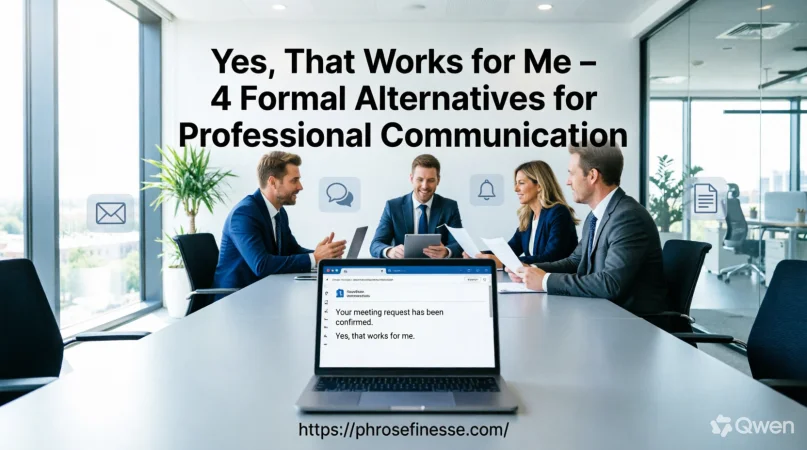
Have you ever needed to confirm a plan professionally but felt that “yes, that works for me” sounded too casual? In modern business communication, the right wording can make your message clearer, more polished, and more effective.
This guide to “Yes, That Works For Me” 4 Formal Alternatives explores professional expressions you can use when responding to meetings, deadlines, appointments, or collaborative requests.
Whether you’re coordinating a calendar, managing scheduling details, handling project management tasks, or confirming arrangements through online booking systems, choosing the appropriate phrase helps maintain professionalism.
Strong communication supports better time management, improves workplace interactions, and creates greater consistency across emails, messages, and formal discussions.
In the sections ahead, you’ll learn when each alternative works best, how it differs in tone and context, and how to use it correctly in formal writing.
We’ll also examine practical examples, English usage tips, and common workplace scenarios involving broadcasting updates, scheduling events, and confirming meetings, helping you communicate with confidence and precision.
When Should You Replace “Yes, That Works for Me”?
The phrase “Yes, that works for me” isn’t unprofessional. In fact, it appears frequently in workplace emails and business conversations.
However, communication isn’t only about agreement. It’s also about tone.
A manager responding to a board member often requires a different tone than a coworker responding to a teammate.
Professional Situations Where Formal Alternatives Work Better
You may want to use a more formal response when:
- Communicating with clients
- Scheduling interviews
- Corresponding with executives
- Confirming project deliverables
- Approving proposals
- Discussing contracts
- Responding to business partners
- Participating in formal negotiations
For example:
Less Formal:
Yes, that works for me.
More Professional:
I am happy to proceed with that.
The meaning remains similar, yet the second response sounds more deliberate and polished.
Situations Where “Yes, That Works for Me” Is Still Fine
Not every interaction requires elevated language.
You can safely use the original phrase in:
- Internal team chats
- Slack conversations
- Casual workplace discussions
- Routine scheduling emails
- Friendly professional relationships
The key is understanding your audience.
“That Arrangement Works Well for Me” – A Professional Alternative to “Yes, That Works for Me”
Among the most effective alternatives, “That arrangement works well for me” strikes an excellent balance between professionalism and friendliness.
It communicates agreement without sounding robotic.
Why This Phrase Works
The word “arrangement” signals that you’ve reviewed the proposed plan, schedule, or agreement.
Instead of merely saying yes, you’re acknowledging the structure that has been proposed.
Best Situations for Using This Alternative
This phrase works especially well when discussing:
- Meetings
- Project timelines
- Team coordination
- Event planning
- Client consultations
- Service agreements
Professional Examples
Meeting Confirmation
Thank you for suggesting Tuesday at 10:00 a.m. That arrangement works well for me.
Client Communication
I have reviewed the proposed schedule. That arrangement works well for me, and I look forward to moving ahead.
Project Planning
The revised timeline aligns with our objectives. That arrangement works well for me.
Benefits
| Benefit | Explanation |
| Professional | Sounds polished without sounding stiff |
| Collaborative | Shows willingness to cooperate |
| Flexible | Indicates accommodation and agreement |
| Versatile | Works across many business contexts |
Example Scenario
Imagine a client proposes a new project timeline.
Instead of replying:
Yes, that works for me.
You could write:
Thank you for sharing the updated schedule. That arrangement works well for me and aligns with our project goals.
The second version sounds more thoughtful and professional.
“I Am Happy to Proceed With That” – A Strong Alternative to “Yes, That Works for Me”
If you want to communicate approval and readiness to move forward, few phrases work better than:
I am happy to proceed with that.
This expression does more than confirm agreement.
It demonstrates confidence.
Why Professionals Use This Phrase
Decision-makers often need to communicate not only acceptance but also commitment.
This phrase achieves both objectives.
Ideal Situations
Use this alternative when:
- Approving proposals
- Authorizing projects
- Accepting recommendations
- Confirming strategic decisions
- Responding to vendors
- Finalizing agreements
Examples
Project Approval
I have reviewed the proposal and am happy to proceed with that approach.
Vendor Communication
The revised pricing structure meets our requirements. I am happy to proceed with that.
Business Partnership
Thank you for the updated terms. I am happy to proceed with that arrangement.
Why It Sounds More Professional
Compare the following:
| Response | Professional Impact |
| Yes, that works for me | Neutral |
| Sounds good | Casual |
| I am happy to proceed with that | Professional and decisive |
The difference lies in the action-oriented language.
Instead of merely agreeing, you’re signaling forward movement.
Common Mistake to Avoid
Don’t use this phrase before reviewing important details.
For example:
❌ I am happy to proceed with that.
(Without reviewing the proposal.)
Always ensure you’ve evaluated the information first.
Professional communication should reflect informed decision-making.
“I Can Accommodate That Schedule” – The Best Scheduling Alternative
Scheduling conversations occur daily in business environments.
When someone proposes a time, date, or appointment, “I can accommodate that schedule” provides a polished response.
Why This Phrase Is Effective
This wording emphasizes flexibility.
It shows you’re making room in your schedule while maintaining professionalism.
Ideal Uses
This phrase works particularly well for:
- Interview scheduling
- Client meetings
- Medical consultations
- Business appointments
- Executive calendars
- Conference calls
Examples
Interview Scheduling
Thank you for the invitation. I can accommodate that schedule and look forward to speaking with the team.
Client Meeting
Thursday at 2:00 p.m. works well. I can accommodate that schedule.
Internal Coordination
I reviewed the proposed timeline and can accommodate that schedule.
Advantages Over “Yes, That Works for Me”
| Factor | Yes, That Works for Me | I Can Accommodate That Schedule |
| Formality | Moderate | High |
| Specificity | General | Scheduling-focused |
| Professional Tone | Good | Excellent |
| Executive Communication | Acceptable | Preferred |
Real-World Example
Suppose a recruiter sends:
Would you be available Wednesday at 9:00 a.m.?
Instead of responding:
Yes, that works for me.
You could write:
Thank you for the opportunity. I can accommodate that schedule and look forward to our conversation.
The response instantly feels more professional.
“That Is Acceptable to Me” – A Formal Alternative for Reviews and Negotiations
Some business situations require neutrality rather than enthusiasm.
That’s where “That is acceptable to me” becomes useful.
Understanding the Tone
This phrase communicates approval while maintaining objectivity.
It’s particularly valuable during negotiations or policy discussions.
Best Uses
Consider using it when discussing:
- Contracts
- Legal agreements
- Procurement processes
- Compliance matters
- Corporate policies
- Service-level agreements
Examples
Contract Revision
I have reviewed the updated clause. That is acceptable to me.
Policy Review
The revised procedure is acceptable to me.
Vendor Negotiation
The proposed adjustment is acceptable to me and addresses our concerns.
Benefits
- Professional
- Neutral
- Precise
- Appropriate for formal documentation
Potential Drawbacks
While professional, this phrase can sound distant in casual communication.
For example:
❌ Team Lunch Discussion
That is acceptable to me.
This sounds overly formal.
A simpler response would be more natural.
See More :Don’t Call Me Late for Dinner Meaning and Origin
Comparison of the Best Formal Alternatives to “Yes, That Works for Me”
The following table provides a quick overview.
| Phrase | Formality Level | Best Use Case | Tone |
| Yes, That Works for Me | Medium | General workplace communication | Friendly |
| That Arrangement Works Well for Me | High | Planning and coordination | Professional |
| I Am Happy to Proceed With That | High | Approvals and decisions | Positive |
| I Can Accommodate That Schedule | High | Scheduling | Flexible |
| That Is Acceptable to Me | Very High | Contracts and negotiations | Neutral |
How to Choose the Right Alternative
Selecting the right phrase depends on context.
When Confirming a Meeting
Best choice:
That arrangement works well for me.
Example:
Tuesday at 11:00 a.m. works perfectly. That arrangement works well for me.
When Approving a Proposal
Best choice:
I am happy to proceed with that.
Example:
After reviewing the proposal, I am happy to proceed with that strategy.
When Scheduling an Interview
Best choice:
I can accommodate that schedule.
Example:
Thank you for reaching out. I can accommodate that schedule and look forward to speaking with you.
When Reviewing Contract Terms
Best choice:
That is acceptable to me.
Example:
The revised payment terms are acceptable to me.
Professional Email Examples Using Alternatives to “Yes, That Works for Me”
Meeting Confirmation Email
Subject: Meeting Confirmation
Hello Sarah,
Thank you for proposing Tuesday at 10:00 a.m.
That arrangement works well for me. I look forward to discussing the project and reviewing next steps.
Best regards,
Michael
Interview Scheduling Email
Subject: Interview Availability
Hello Emily,
Thank you for inviting me to interview for the position.
I can accommodate that schedule and look forward to our conversation on Thursday.
Kind regards,
James
Client Approval Email
Subject: Project Approval
Hello David,
Thank you for sharing the updated proposal.
After reviewing the document, I am happy to proceed with that approach. The revised timeline aligns with our objectives.
Best regards,
Rachel
Contract Review Email
Subject: Contract Revisions
Hello Mark,
I have reviewed the revised agreement.
The updated provisions are acceptable to me. Please proceed with the final version.
Thank you,
Jennifer
Common Responses That Sound Less Professional
Certain responses are common but may not create the best impression in formal business communication.
“Sure”
While friendly, it may sound casual.
Better Alternative
That arrangement works well for me.
“Sounds Good”
Appropriate among colleagues.
Less effective when communicating with clients or executives.
Better Alternative
I am happy to proceed with that.
“Okay”
This response can appear indifferent.
Professional communication benefits from greater clarity.
Better Alternative
I can accommodate that schedule.
“Yep”
This response should generally remain outside professional correspondence.
It may appear careless or overly informal.
Quick Reference Cheat Sheet
| Situation | Recommended Alternative |
| Client Meeting | That Arrangement Works Well for Me |
| Interview Scheduling | I Can Accommodate That Schedule |
| Proposal Approval | I Am Happy to Proceed With That |
| Contract Negotiation | That Is Acceptable to Me |
| Internal Team Planning | That Arrangement Works Well for Me |
| Vendor Discussions | I Am Happy to Proceed With That |
| Policy Review | That Is Acceptable to Me |
Case Study: How Better Responses Improve Professional Communication
A consulting firm reviewed thousands of client emails and discovered a consistent pattern.
Messages that demonstrated clarity, professionalism, and confidence received faster responses and fewer follow-up questions.
Consider these two replies:
Version A
Yes, that works for me.
Version B
Thank you for sharing the revised timeline. That arrangement works well for me and aligns with our project objectives.
Version B accomplishes several goals:
- Confirms agreement
- Demonstrates engagement
- Reinforces alignment
- Maintains professionalism
Small wording changes often create stronger business relationships.
Twenty Ready-to-Use Professional Responses
Meeting Responses
- That arrangement works well for me.
- I can accommodate that schedule.
- The proposed time works well.
- I am available at that time.
- The suggested schedule aligns with my availability.
Client Responses
- I am happy to proceed with that.
- The proposed plan meets our requirements.
- That arrangement works well for me.
- I appreciate the update and can move forward accordingly.
- The revised approach aligns with our objectives.
Executive Communication
- That is acceptable to me.
- I support the proposed course of action.
- I am comfortable proceeding under those terms.
- The recommendation aligns with our goals.
- I approve the proposed direction.
Interview Responses
- I can accommodate that schedule.
- Thank you for the opportunity. The proposed time works well.
- I look forward to speaking with the team.
- The suggested interview time is suitable.
- I confirm my availability for that time.
FAQs
1. What can I say instead of “Yes, that works for me” in a professional email?
You can use formal alternatives such as “That arrangement is acceptable to me,” “I’m available at that time,” “That schedule works well for me,” or “I can accommodate that request.” These phrases sound more polished in professional communication.
2. Is “Yes, that works for me” considered formal?
“Yes, that works for me” is generally polite and acceptable, but it falls into the semi-formal category. In highly professional settings, using more specific and refined alternatives can improve clarity and professionalism.
3. When should I use formal alternatives to “Yes, that works for me”?
Formal alternatives are useful in business communication, client interactions, job-related correspondence, official meetings, and situations where maintaining a professional tone is important.
4. Which alternative is best for scheduling meetings?
For scheduling and calendar coordination, phrases like “I’m available at that time” or “That schedule works well for me” are often the clearest and most professional choices.
5. Can formal alternatives improve workplace communication?
Yes. Using precise language promotes better consistency, reduces misunderstandings, and strengthens professional relationships. It also supports effective time management and collaboration.
6. Are these alternatives suitable for remote work and online communication?
Absolutely. These phrases work well in emails, chat platforms, virtual meetings, online booking confirmations, and other forms of digital business communication where professionalism matters.
Conclusion
Choosing the right response can make a significant difference in professional interactions. While “yes, that works for me” is perfectly acceptable in many situations, using one of these formal alternatives can elevate your business communication and create a more polished impression. Whether you’re confirming meetings, managing scheduling, coordinating a calendar, or handling project management tasks, the appropriate wording helps maintain clarity and professionalism.
By understanding the subtle differences between these expressions, you can select the option that best fits the situation, audience, and level of formality required. Strong English usage, thoughtful formal writing, and consistent communication practices will help you build credibility and communicate more effectively in any professional environment.

Alyan Ashraf is an English language writer and editor at Phrase Finesse, where he specializes in grammar, vocabulary, spelling, word usage, and clear communication. Passionate about the English language, he creates practical, research-backed content that helps readers avoid common mistakes and write with greater accuracy and confidence.
Known for his clear writing style and attention to detail, Alyan simplifies complex language topics into easy-to-understand guides filled with real-world examples and actionable insights. His work covers confusing word pairs, grammar rules, idioms, punctuation, and everyday English usage, making learning both accessible and engaging for students, professionals, writers, and non-native English speakers.
Every article Alyan writes is carefully researched, fact-checked, and designed to meet high editorial standards. His goal is to help readers strengthen their English skills, expand their vocabulary, and communicate more effectively in academic, professional, and everyday settings.
Through Phrase Finesse, Alyan is committed to publishing trusted language resources that make mastering English simpler, clearer, and more enjoyable for learners around the world

[…] See More :“Yes, That Works for Me” 4 Formal Alternatives […]
[…] See More :“Yes, That Works for Me” 4 Formal Alternatives […]
[…] Read More :“Yes, That Works for Me” 4 Formal Alternatives […]