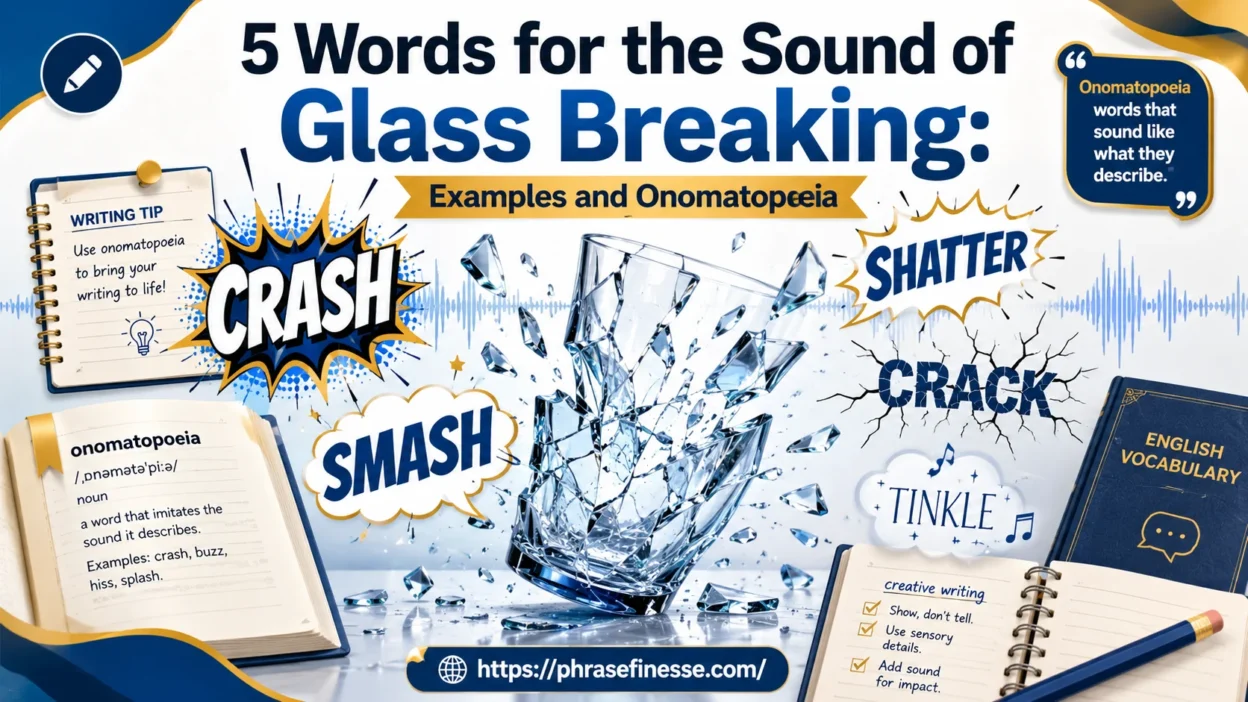
Have you ever heard a window shatter or a glass fall to the floor and wondered how to describe that sound accurately? Understanding 5 Words For The Sound Of Glass Breaking can make your writing more vivid, precise, and engaging. Whether you’re working on creative writing, improving English usage, or refining grammar, choosing the right word helps readers hear the scene in their minds.
The English language offers several ways to describe the sharp, sudden noise of breaking glass, but each term carries its own nuance. Some words emphasize a loud crash, while others focus on a light crack or splintering effect. Knowing these distinctions can improve formal writing, storytelling, business communication, and even content used in broadcasting where clear and accurate descriptions matter.
In this guide, you’ll discover five effective words for describing the sound of shattered glass, along with their meanings, examples, and best-use situations. We’ll also explore how word choice supports clarity and consistency across different contexts, from meetings, project management, and calendar updates to scheduling, time management, and online booking content. By the end, you’ll know exactly which term fits your message and why it works.
Onomatopoeia for Glass Breaking Sounds and Why It Matters in Writing
Before jumping into the words, it helps to understand what you’re really working with.
Onomatopoeia means a word that imitates a sound. Instead of describing noise, it recreates it through language.
For example:
- buzz imitates a bee
- bang imitates an explosion
- pop imitates something bursting
Now glass breaking sits in a more complex category. It isn’t one sound. It’s a sequence of micro-events:
- initial impact
- internal stress fracture
- spreading cracks
- final collapse into fragments
That’s why writers don’t rely on just one word. They choose based on intensity, tone, and emotional impact.
Why Glass Breaking Sounds Feel So Intense
There’s a psychological reason glass breaking stands out.
Research in psychoacoustics shows that humans are highly sensitive to:
- sudden high-frequency sounds
- sharp transients (fast spikes in sound energy)
- unpredictable audio patterns
Glass breaking ticks all three boxes.
Even in real life, a thin glass hitting tile can produce frequencies above 4,000 Hz, which our brains interpret as urgent or alarming. That’s why even a small glass accident can feel dramatic.
Think of it like this:
Glass breaking is sound’s version of a jump scare.
5 Words for the Sound of Glass Breaking (Onomatopoeia List)
Below are five of the most accurate and widely used onomatopoeic words for glass breaking. Each one reflects a different type of break, not just random noise.
Crash – The Heavy Glass Breaking Sound
The word crash represents the loudest and most chaotic type of glass break.
It usually happens when:
- a glass object falls from height
- a bottle hits concrete
- multiple shards scatter violently
The sound is deep, loud, and echoing. It feels like the room itself reacts.
Example usage:
The vase slipped from the shelf and hit the floor with a CRASH that echoed through the hallway.
Why “crash” works so well
- It signals impact first, destruction second
- It feels physically heavy
- It works in action scenes and accidents
Real-world analogy
Imagine dropping a ceramic plate on a stone floor. The sound isn’t just glass breaking—it’s an event. That’s what “crash” captures.
Smash – The Forceful and Intentional Glass Breaking Sound
The word smash carries intention. It feels aggressive, controlled, or even angry.
Unlike “crash,” which can be accidental, smash implies force applied with purpose.
Common scenarios:
- someone throws a glass object
- a character breaks a window
- destruction in heated moments
Example usage:
He raised the bottle and brought it down hard. It went SMASH against the table.
Emotional tone of “smash”
- anger
- frustration
- urgency
- violence
Writing insight
Writers often use “smash” in dialogue-heavy scenes because it mirrors emotional intensity, not just physical impact.
Shatter: The Clean Fragmentation Glass Breaking Sound
Shatter is the most visually descriptive word for glass breaking.
Instead of focusing on sound volume, it focuses on the result of the break.
It describes glass splitting into multiple pieces in a rapid chain reaction.
Example usage:
The bullet hit the window and the glass shattered into a thousand glittering pieces.
Why “shatter” is powerful in storytelling
- It feels cinematic
- It emphasizes transformation
- It works well in slow-motion descriptions
Science connection
Glass shatters because internal stress spreads faster than the material can absorb energy. Cracks propagate at speeds up to 3,000 meters per second, which is why it feels instant.
Writing tip
Use “shatter” when you want readers to see the break, not just hear it.
Read More: 7 Other Ways to Say “Sorry to Bother You” in an Email
Crack: The Warning Glass Breaking Sound
The word crack is all about tension.
It is not full destruction. It is the moment before everything breaks.
This makes it one of the most emotionally powerful onomatopoeic words.
Example usage:
The mirror leaned against the wall, then slowly began to crack from the corner.
Why “crack” stands out
- It creates suspense
- It signals instability
- It slows down the scene emotionally
Real-life example
Think of ice forming on a frozen lake. You hear a faint crack, and suddenly you hesitate before stepping forward. That hesitation is exactly what this word captures.
Tinkle: The Soft and Delicate Glass Breaking Sound
At the opposite end of the spectrum sits tinkle.
This word describes light, gentle glass sounds. It usually applies to:
- small ornaments
- thin glasses
- decorative glass pieces
Example usage:
The wind caught the hanging glass beads, and they made a soft tinkle as they brushed against each other.
Emotional tone of “tinkle”
- delicate
- calm
- fragile
- almost peaceful
Why it matters in writing
Not all glass breaking is dramatic. Sometimes it is subtle. “Tinkle” helps you show fragility instead of destruction.
Comparison of Glass Breaking Onomatopoeia
Here’s a clear breakdown so you can choose the right word quickly.
| Word | Intensity | Emotional Tone | Type of Break | Best Use Case |
| Crash | Very High | Chaotic, loud | Heavy impact break | Accidents, falls |
| Smash | High | Aggressive | Forced break | Violence, action scenes |
| Shatter | Medium | Visual destruction | Fragment explosion | Cinematic writing |
| Crack | Low–Med | Suspenseful | Partial break | Tension buildup |
| Tinkle | Low | Gentle, soft | Light glass contact | Calm or fragile scenes |
How Writers Use Glass Breaking Sounds in Real Media
Glass breaking isn’t just a writing tool. It’s a storytelling device used across media.
Comics and Graphic Novels
Comics exaggerate sound visually:
- CRASH!!
- SMASH!
- jagged lettering
- bold uppercase fonts
This visual styling makes readers “hear” the sound through design alone.
Novels and Short Stories
Writers use more subtle language:
- “The window shattered silently into fragments.”
- “A crack spread across the mirror like lightning.”
They rely on imagination rather than visual emphasis.
Screenwriting
Screenplays often separate action and sound:
A glass drops to the floor.
CRASH.
This keeps clarity for directors and sound designers.
Video Games
Games assign audio tags like:
- glass_break_medium
- glass_shatter_large
- glass_tinkle_light
These categories help developers match sound effects precisely.
Case Study: Glass Breaking in Film Scenes
Case Study: Action Movie Window Break
In action films, a character often jumps through a window.
Typical sequence:
- Impact sound (SMASH)
- Secondary collapse (CRASH)
- Fragment scattering (SHATTER)
This layered sound design increases realism.
Case Study: Horror Film Silence Break
Horror films often use silence before glass breaks.
Then:
- a faint crack appears
- tension builds
- sudden CRASH follows
The contrast amplifies fear.
Common Mistakes When Using Glass Breaking Onomatopoeia
Many writers misuse these words in predictable ways.
Here are the most common issues:
Overusing “shatter”
If everything “shatters,” nothing feels special anymore.
Mixing emotional tone
Using “tinkle” in violent scenes kills tension instantly.
Ignoring context
A glass dropped from a table should not always be “smash.”
Forgetting sound layering
Real breaks often involve more than one sound.
How to Choose the Right Glass Breaking Word
A simple method helps you decide quickly:
Ask yourself:
- Was it loud or soft?
- Was it intentional or accidental?
- Did it break fully or partially?
Then match the word:
- Loud + accidental → crash
- Loud + intentional → smash
- Visual + full break → shatter
- Partial break + tension → crack
- Soft + delicate → tinkle
This keeps your writing precise and natural.
Why Glass Breaking Words Work So Well in Storytelling
These words do more than describe sound. They shape emotion.
- “Crack” builds suspense
- “Shatter” shows transformation
- “Crash” signals chaos
- “Smash” shows intent
- “Tinkle” softens the mood
Together, they give writers control over how readers feel a moment.
Final Thoughts: Turning Glass Breaking Sounds into Narrative Power
Glass breaking is never just noise. It marks change.
Sometimes it signals conflict, Sometimes loss and Sometimes sudden clarity after chaos.
When you choose the right onomatopoeic word, you don’t just describe an event—you shape how it lands in the reader’s mind.
One moment everything holds together. The next, it doesn’t.
And in that split second, the right word makes all the difference.
FAQs
1. What is the most common word for the sound of glass breaking?
The most common word is crash, especially when a large piece of glass breaks with a loud noise. However, words like shatter, smash, crack, and clink may be more accurate depending on the situation.
2. Is “shatter” a sound word or an action word?
Shatter is primarily an action word that describes glass breaking into many pieces. However, it is often used to convey both the action and the sharp sound associated with the break.
3. Which word best describes a small piece of glass breaking?
For smaller or lighter impacts, words such as crack or clink are often more suitable. They suggest a less dramatic sound than a full crash or smash.
4. Why is choosing the right word for glass-breaking sounds important?
The right word creates a clearer mental image and improves communication. It helps readers understand the intensity, size, and nature of the event, making your writing more vivid and precise.
5. Can these words be used in formal writing?
Yes. While some words are more common in creative writing, many can also appear in formal writing, reports, journalism, and business communication when accurately describing an event.
6. How can I improve my vocabulary for describing sounds?
Reading widely, studying sound-related vocabulary, and paying attention to context can help. Learning synonyms and understanding their subtle differences will make your writing more expressive and engaging.
Conclusion
Choosing the right word to describe the sound of breaking glass can significantly improve the clarity and impact of your writing. While terms such as crash, shatter, smash, crack, and clink all relate to broken glass, each conveys a different level of intensity and meaning. Understanding these distinctions allows you to communicate more accurately and create stronger imagery for your readers.
Whether you’re working on creative writing, improving English usage, or enhancing formal writing, selecting the most appropriate word helps your message sound natural and precise. By mastering these 5 Words For The Sound Of Glass Breaking, you can add depth, detail, and authenticity to any piece of writing.

Emma Brooke is an English language specialist, editor, and content writer at Phrase Finesse, where she helps readers develop stronger writing and communication skills through clear, practical, and engaging content. With a passion for the English language, she specializes in simplifying grammar rules, vocabulary, spelling, punctuation, and word usage for learners at every level.
Emma has extensive experience creating educational content that is accurate, well-researched, and easy to understand. She is particularly skilled at explaining confusing word pairs, grammar concepts, idioms, sentence structure, and effective writing techniques, making complex topics approachable for students, professionals, educators, and English learners worldwide.