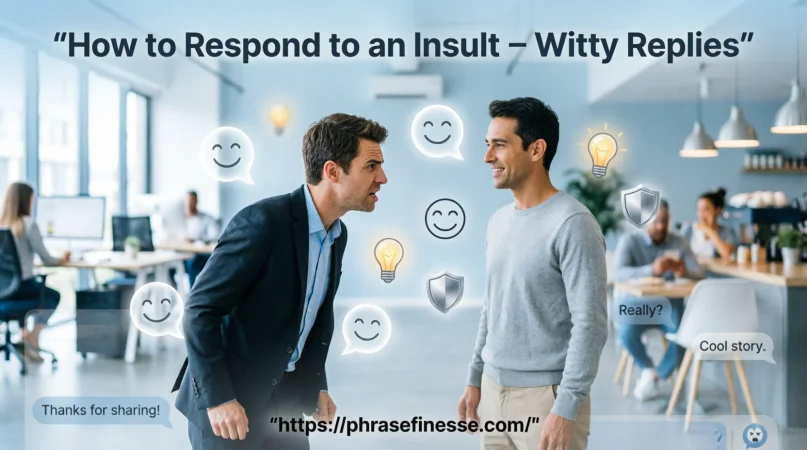
Have you ever been caught off guard by a rude comment and wished you had the perfect comeback ready? Knowing How to Respond to an Insult Witty Replies an help you stay calm, confident, and in control when faced with criticism, sarcasm, or disrespect.
The right response is not about starting an argument. It is about using wit, emotional intelligence, and clever communication skills to handle difficult situations with confidence and grace.
Whether you are dealing with insults in personal conversations, social settings, or professional environments, choosing your words carefully matters. Strong communication, business communication, English usage, grammar, formal writing, and consistency can all influence how effectively your message is received. A smart response can defuse tension, protect your reputation, and demonstrate confidence without escalating the situation.
In this guide, you will discover practical and memorable ways to answer insults with humor, confidence, and composure.
We will explore examples, explain when each response works best, and show how verbal skills connect to broader communication habits such as time management, project management, meetings, calendar organization, scheduling, online booking, and broadcasting, where professionalism and quick thinking are often essential. By the end, you will have a collection of witty and clever responses that help you navigate challenging interactions with confidence and ease.
Understanding the Type of Insult Before You Respond
Not all insults are created equal.
Before choosing a response, identify what you’re dealing with.
Playful Teasing vs. Genuine Insults
Friends often tease each other.
Playful teasing usually contains humor and mutual respect. Genuine insults are designed to embarrass, hurt, or undermine someone.
For example:
Playful Teasing:
“You’re late again. Some things never change.”
Genuine Insult:
“You’re always late because you’re irresponsible.”
One invites laughter. The other attacks character.
Knowing the difference helps you avoid overreacting.
Personal Attacks vs. Criticism
Sometimes people confuse criticism with insults.
Constructive criticism focuses on behavior.
Insults focus on the person.
| Constructive Criticism | Insult |
| “This report needs revisions.” | “You clearly don’t know what you’re doing.” |
| “You missed a few details.” | “You’re careless.” |
| “Let’s improve this section.” | “This is terrible.” |
Responding appropriately starts with understanding intent.
Public Insults vs. Private Insults
Public insults often aim to gain social advantage.
Private insults may stem from frustration, resentment, or personal conflict.
A response that works in private may not work in front of an audience.
Context matters.
Why Most People Lose When Responding to Insults
Many people unintentionally hand power to the person insulting them.
Here’s how.
The Emotional Reaction Trap
Anger narrows judgment.
When emotions take over, people say things they later regret.
The insulter often expects an emotional reaction because it confirms they hit a nerve.
Remaining calm changes the dynamic immediately.
Overexplaining Yourself
Defensiveness rarely looks confident.
Imagine someone says:
“You’re terrible at your job.”
A lengthy explanation often sounds like you’re seeking approval.
A calm, concise response communicates confidence.
Trying to Win Every Exchange
Not every battle deserves your energy.
Sometimes the strongest move is refusing to participate.
As the saying goes:
“Never wrestle with a pig. You both get dirty, and the pig likes it.”
Respond to an Insult With Calm Indifference
One of the most powerful responses is also one of the simplest.
Example Responses
- “Okay.”
- “Interesting.”
- “If you say so.”
- “That’s your opinion.”
Why It Works
Insults thrive on emotional reactions.
Indifference removes the reward.
When someone expects anger and receives calm acceptance instead, their strategy often collapses.
Best Situations
- Online arguments
- Workplace disagreements
- Encounters with strangers
- Attention-seeking individuals
Think of indifference as removing oxygen from a fire.
Without fuel, the fire dies.
Use Humor to Defuse the Situation
Humor is one of the oldest social tools for handling conflict.
Example Responses
- “You spent all day preparing that one?”
- “I’ve heard stronger insults from fortune cookies.”
- “That was surprisingly creative.”
Why Humor Works
Humor changes the emotional atmosphere.
Instead of becoming defensive, you show confidence and emotional control.
People who can laugh under pressure often appear stronger than those who become angry.
Case Study
Imagine a coworker says:
“You move as fast as a snail.”
Instead of getting upset, you reply:
“At least I leave a memorable trail.”
The room laughs.
The insult loses power instantly.
Agree and Amplify
This technique surprises people because it embraces the insult rather than resisting it.
Example Responses
- “Absolutely. I’m a professional disaster.”
- “You’re right. Excellence clearly isn’t my hobby.”
- “I’ve worked hard to achieve this level of chaos.”
Why It Works
The insult depends on resistance.
When you agree in an exaggerated way, the insult loses its sting.
Psychologists often refer to this as a form of emotional disarmament.
When to Avoid It
Don’t use this approach for:
- Serious workplace accusations
- Harmful personal attacks
- Professional reputation concerns
Ask Them to Explain the Insult
Simple questions can expose weak insults.
Example Responses
- “What do you mean by that?”
- “Can you explain?”
- “Why do you think that?”
Why This Works
Many insults rely on assumptions.
When someone must explain their comment, they often realize how unreasonable it sounds.
Example
Person:
“You’re clueless.”
Response:
“What specifically makes you think that?”
Now the burden shifts to them.
Instead of defending yourself, you’re asking for evidence.
Use a Short Witty Comeback
A clever comeback can be effective when delivered calmly.
Example Responses
- “You’ll have to do better than that.”
- “Was that your best material?”
- “I’ve seen sharper spoons.”
- “Keep practicing.”
Why Witty Responses Work
They signal confidence.
They also demonstrate that the insult didn’t affect you emotionally.
Rules for Great Comebacks
- Keep them short.
- Avoid cruelty.
- Don’t escalate unnecessarily.
- Deliver them calmly.
The shorter the comeback, the stronger it usually sounds.
See More :Thomas’s or Thomas’? Which Is Correct?
Respond With Unexpected Kindness
Kindness can be surprisingly effective.
Example Responses
- “Hope your day improves.”
- “You seem frustrated.”
- “I hope things get better for you.”
Why It Works
Aggressive people often expect aggression.
Kindness disrupts that expectation.
It can create a moment of self-awareness.
Real-Life Example
Customer:
“You’re completely useless.”
Employee:
“I’m sorry you’re having a difficult experience. Let me help.”
The conflict often de-escalates immediately.
Use Silence Strategically
Silence is underrated.
Why Silence Works
Silence creates uncertainty.
Most people expect a response.
When none comes, the attention shifts back to the speaker.
How to Use It
- Maintain composure.
- Make eye contact.
- Pause briefly.
- Continue with what you were doing.
The Psychological Effect
Silence communicates:
- Confidence
- Emotional control
- Lack of interest in conflict
Sometimes saying nothing says everything.
Set a Clear Boundary
Not every insult deserves humor.
Sometimes direct communication is necessary.
Example Responses
- “I’m not okay with that.”
- “Let’s keep this respectful.”
- “Please don’t speak to me that way.”
Why Boundaries Matter
Boundaries protect self-respect.
They also establish expectations for future interactions.
Workplace Example
A colleague makes a rude comment during a meeting.
Instead of arguing, you calmly say:
“I’d appreciate keeping feedback professional.”
Simple. Effective.
Professional.
Turn the Focus Back on Them
Questions can reveal motives.
Example Responses
- “Why does that concern you?”
- “What makes you say that?”
- “Why is that important to you?”
Why It Works
Many insults reveal more about the speaker than the target.
These questions encourage reflection.
Common Outcomes
| Possible Outcome | Result |
| They backtrack | Conflict decreases |
| They clarify | Better understanding |
| They become uncomfortable | Insult loses momentum |
| They reveal frustration | Root issue becomes clear |
Respond With Genuine Confidence
Confidence is difficult to attack.
Example Responses
- “I’m comfortable with who I am.”
- “That doesn’t change my opinion of myself.”
- “I like where I’m headed.”
Why Confidence Wins
People who know their value don’t need external validation.
When insults fail to create doubt, they lose power.
Building Confidence
Focus on:
- Competence
- Self-awareness
- Personal growth
- Healthy relationships
- Achievements
Confidence is built, not borrowed.
Use the “Maybe You’re Right” Technique
This approach often surprises aggressive people.
Example Responses
- “Maybe.”
- “You could be right.”
- “That’s possible.”
Why It Works
Arguments require opposition.
Agreement removes tension.
Psychological Advantage
When you stop defending every aspect of yourself, you become harder to provoke.
This response communicates emotional maturity.
Calmly Call Out the Behavior
Sometimes the best response is direct observation.
Example Responses
- “That seemed unnecessary.”
- “That wasn’t very constructive.”
- “That came across as rude.”
Why It Works
You address the behavior without attacking the person.
This often sounds more mature and professional.
Effective Formula
Behavior + Impact
Example:
“That comment felt disrespectful.”
Simple.
Clear.
Difficult to argue with.
Walk Away When Necessary
Walking away is not weakness.
It’s wisdom.
Why Walking Away Works
Not every conversation deserves continuation.
Some people aren’t interested in discussion.
They want conflict.
Signs It’s Time to Leave
- Repeated insults
- Personal attacks
- Bullying behavior
- Escalating hostility
- Toxic interactions
What Walking Away Communicates
- Self-respect
- Emotional intelligence
- Confidence
- Healthy boundaries
Sometimes distance is the smartest comeback.
The Psychology Behind Effective Responses to Insults
Understanding why insults happen helps you respond more effectively.
Why People Insult Others
Research in social psychology suggests insults commonly stem from:
- Insecurity
- Jealousy
- Frustration
- Desire for dominance
- Attention-seeking
- Social competition
Often, the insult isn’t really about you.
It’s about them.
Why Certain Responses Work Better
The best responses share common characteristics:
| Trait | Benefit |
| Calmness | Prevents escalation |
| Confidence | Reduces vulnerability |
| Humor | Defuses tension |
| Brevity | Signals control |
| Boundaries | Protect self-respect |
The Role of Emotional Regulation
Emotionally intelligent individuals pause before reacting.
That brief pause creates choice.
Instead of responding automatically, they respond intentionally.
Best Responses to Insults by Situation
Different environments require different approaches.
| Situation | Best Strategy |
| Workplace | Boundaries and professionalism |
| Family conflict | Calm discussion |
| Online trolling | Indifference or silence |
| School or college | Humor and confidence |
| Social gathering | Witty comeback |
| Stranger confrontation | Walk away |
| Passive-aggressive remarks | Ask for clarification |
| Repeated bullying | Boundary setting and disengagement |
Matching the response to the situation increases effectiveness dramatically.
Responses That Usually Make Things Worse
Some reactions almost always backfire.
Insulting Them Back
Trading insults rarely solves anything.
Instead, it escalates conflict.
Losing Your Temper
Anger clouds judgment.
It also gives the other person evidence that their insult worked.
Overexplaining Yourself
Long explanations often appear defensive.
Confident people don’t feel compelled to justify every criticism.
Seeking Revenge
Revenge may feel satisfying temporarily.
Long-term, it usually creates additional problems.
How Emotionally Intelligent People Respond to Insults
People with strong emotional intelligence tend to follow several principles.
They Pause Before Responding
A few seconds can prevent major mistakes.
1. They Separate Facts From Emotion
They ask:
- Is this true?
- Is this useful?
- Does this deserve a response?
2. They Choose Outcomes Over Ego
Their goal isn’t winning.
Their goal is maintaining control.
They Protect Their Energy
Not every insult deserves attention.
Energy is a limited resource.
Spend it wisely.
3. They Know When Silence Is Powerful
Sometimes the strongest statement is no statement at all.
FAQs
1. What is the best way to respond to an insult?
The best response depends on the situation. In many cases, a calm and witty comeback works better than an angry reaction. Staying composed shows confidence and prevents the insult from affecting you emotionally.
2. Is it better to ignore an insult or respond to it?
Ignoring an insult can be effective when the comment is meant only to provoke you. However, a clever response may be appropriate if you want to set boundaries, defend yourself respectfully, or diffuse tension with humor.
3. How can I respond to an insult without sounding rude?
Focus on using humor, confidence, and politeness. Avoid personal attacks and choose responses that highlight your self-control rather than escalating the conflict.
4. Why do witty responses work so well?
Witty responses often catch people off guard and shift the focus away from negativity. They demonstrate quick thinking, confidence, and strong communication skills, making it harder for the insult to achieve its intended effect.
5. Can witty comebacks be used in professional settings?
Yes, but they should be used carefully. In business communication, meetings, and workplace discussions, a light and professional response is usually more effective than a sarcastic or aggressive comeback.
6. How can I get better at responding to insults?
Practice common scenarios, improve your communication skills, and learn a variety of clever responses. Over time, you will become more comfortable thinking on your feet and handling difficult conversations confidently.
Conclusion
Knowing the 13 Best Ways To Respond To An Insult (Witty & Clever) can help you handle uncomfortable situations with confidence, humor, and self-respect. Rather than reacting emotionally, a thoughtful response allows you to maintain control of the conversation and protect your dignity.
Whether you choose a witty comeback, a calm observation, or simply decide not to engage, the key is to remain composed and confident.
The most effective responses are not always the sharpest. They are the ones that reflect emotional intelligence, strong communication, and good judgment. By mastering these techniques, you can turn awkward or hostile moments into opportunities to demonstrate confidence, maturity, and quick thinking. Ultimately, the best comeback is one that leaves you feeling empowered while keeping the situation firmly under your control.

Mia Rose is an English language specialist and editorial writer at Phrase Finesse, where she helps readers master grammar, vocabulary, spelling, and effective communication. Passionate about making English simple and practical, she creates well-researched, reader-friendly content that explains complex language concepts in a clear and engaging way.
With extensive experience in English language education, content writing, and editorial review, Mia specializes in grammar, punctuation, word choice, idioms, confusing word pairs, and writing style. Her articles are carefully researched, fact-checked, and designed to help students, professionals, writers, and English learners build confidence in both written and spoken English.