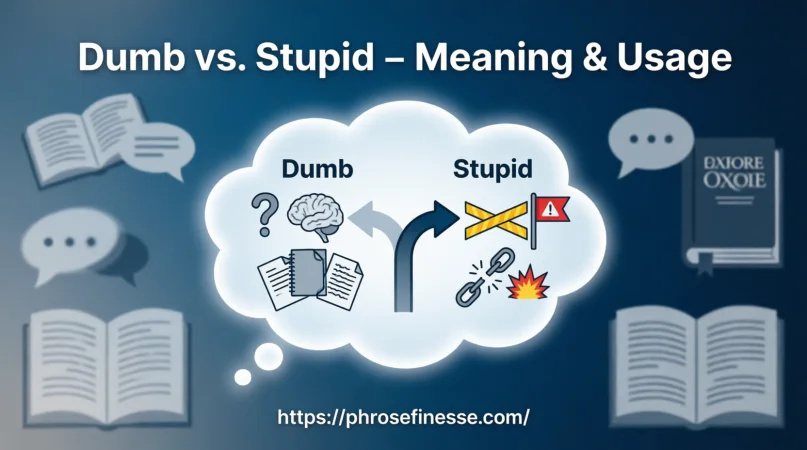
Have you ever wondered whether calling someone “dumb” means the same thing as calling them “stupid”? Many English learners and native speakers use these words interchangeably, yet there are important differences in meaning, tone, and context.
In this guide, Difference Between “Dumb” And “Stupid” (11 Helpful Examples), you’ll discover how each term is used, when one is more appropriate than the other, and why understanding the distinction improves your English usage, grammar, and everyday communication.
Language choices matter, especially in business communication, formal writing, broadcasting, and professional conversations. A word that seems harmless in casual speech can create a different impression during meetings, project management discussions, or workplace interactions.
Understanding the subtle meanings behind “dumb” and “stupid” helps you communicate with greater consistency, accuracy, and confidence while avoiding misunderstandings.
This article breaks down the definitions, connotations, and real-world applications of both terms through clear explanations and practical examples. You’ll also see how word choice influences communication in contexts such as time management, scheduling, calendar planning, online booking systems, and other professional environments where precise language matters.
By the end, you’ll know exactly when to use each word and how to choose the most effective expression for your message.
Difference Between “Dumb” And “Stupid”: The Short Answer
The simplest way to understand the difference is this:
- Dumb often refers to a lack of knowledge, awareness, information, or a simple mistake.
- Stupid usually refers to poor judgment, bad decision-making, or actions that ignore obvious consequences.
While there is overlap, the words frequently carry different shades of meaning.
| Word | Primary Meaning | Typical Use | Severity |
| Dumb | Uninformed, unaware, or making a foolish mistake | Casual situations | Usually milder |
| Stupid | Showing poor judgment or reasoning | Criticism of decisions | Usually stronger |
For example:
- Forgetting where you parked your car might be a dumb mistake.
- Driving through a flooded road despite warning signs could be a stupid decision.
One involves a simple error. The other involves ignoring risks.
What Does “Dumb” Mean?
The word dumb has changed significantly throughout history.
Today, many people use it informally to mean:
- Foolish
- Uninformed
- Silly
- Lacking awareness
Examples:
- “I made a dumb mistake.”
- “That was a dumb thing to say.”
- “I forgot my keys again. Dumb move.”
In these examples, the speaker is not necessarily criticizing intelligence. Instead, they are describing a momentary lapse, oversight, or mistake.
Common Modern Meanings of Dumb
| Meaning | Example |
| Uninformed | “I was dumb about the rules.” |
| Careless mistake | “That was a dumb error.” |
| Silly behavior | “He made a dumb joke.” |
| Lack of awareness | “It was a dumb assumption.” |
Most modern uses focus on actions rather than permanent characteristics.
What Does “Stupid” Mean?
The word stupid generally points toward poor judgment or flawed reasoning.
When people call something stupid, they often mean:
- The decision was obviously unwise.
- Better judgment should have been used.
- The consequences should have been predictable.
Examples:
- “That was a stupid investment.”
- “It was stupid to ignore the warnings.”
- “Making that choice was stupid.”
Notice the focus.
The criticism is directed toward the decision-making process rather than simply lacking information.
The Historical Evolution of “Dumb”
Understanding the history of the word helps explain why confusion exists today.
The Original Meaning of Dumb
Historically, dumb did not mean unintelligent.
For centuries, the primary meaning was:
Unable to speak.
Older books, legal documents, and historical records frequently used the term this way.
Examples include:
- “Deaf and dumb”
- “Born dumb”
- “Rendered dumb with shock”
In these contexts, intelligence had nothing to do with the meaning.
The word referred strictly to speech.
How the Meaning Changed
Language constantly evolves.
Over time, English speakers began using dumb to describe someone who seemed unaware, uninformed, or foolish.
This shift became increasingly common during the twentieth century.
Popular culture, movies, television, and informal speech accelerated the change.
Today, many younger speakers rarely encounter the original definition outside historical discussions.
Why Some People Avoid the Word
Because of its historical association with speech disabilities, some people prefer not to use dumb as an insult.
Instead, they may choose alternatives such as:
- Uninformed
- Mistaken
- Confused
- Inexperienced
- Unaware
Context matters greatly here.
Many speakers use dumb casually without intending offense, while others prefer more precise language.
What Makes Something “Stupid”?
The defining feature of stupidity is often poor judgment.
Someone may possess knowledge, education, and intelligence yet still make a stupid decision.
That’s because intelligence and judgment are not identical.
Intelligence and Judgment Are Different Skills
A person can:
- Score highly on tests
- Hold advanced degrees
- Solve complex problems
Yet still:
- Ignore obvious warnings
- Make reckless choices
- Act impulsively
This distinction explains why highly successful people sometimes make surprisingly bad decisions.
Knowledge does not guarantee wisdom.
Smart People Can Make Stupid Decisions
Consider the following situations:
| Situation | Smart? | Stupid Decision? |
| Doctor texting while driving | Yes | Yes |
| Engineer gambling away rent money | Yes | Yes |
| Executive ignoring legal advice | Yes | Yes |
| Student cheating despite obvious risks | Yes | Yes |
In each example, intelligence exists.
The problem lies in judgment.
That’s why people often describe these actions as stupid rather than dumb.
Dumb vs. Stupid: Side-by-Side Comparison
The differences become clearer when viewed together.
| Feature | Dumb | Stupid |
| Historical meaning | Unable to speak | Lacking judgment |
| Modern meaning | Foolish, uninformed, careless | Poor reasoning |
| Focus | Mistakes or lack of knowledge | Bad decisions |
| Severity | Usually milder | Usually stronger |
| Common usage | Casual speech | Criticism of choices |
| Temporary? | Often | Often |
| Judgment involved? | Not always | Usually |
A useful memory trick:
Dumb often relates to what someone knows. Stupid often relates to what someone chooses.
Real-world examples make the distinction easier to understand.
Forgetting a Password
Imagine you’ve used dozens of passwords over the years.
One day, you forget which one belongs to a particular account.
You might say:
“That was a dumb mistake.”
You probably would not call it stupid because forgetting information happens to everyone.
Ignoring Clear Instructions
A worker receives detailed safety instructions.
Instead of following them, they intentionally ignore every warning.
Result:
“That was a stupid decision.”
The issue isn’t lack of information.
The issue is rejecting information that was already available.
Sending an Email to the Wrong Person
You accidentally hit “Reply All.”
Many office workers have experienced this nightmare.
This is usually:
“A dumb mistake.”
It happened because of oversight rather than poor judgment.
Spending Rent Money on Luxury Purchases
Someone spends money reserved for rent on expensive gadgets.
They know rent is due.
They understand the consequences.
Yet they proceed anyway.
Most people would call this:
“A stupid choice.”
Asking a Question You Don’t Know the Answer To
A student asks a basic question during class.
This isn’t dumb or stupid.
In fact, asking questions often demonstrates curiosity and willingness to learn.
Many people incorrectly label genuine questions as dumb.
Learning begins with uncertainty.
Driving Through a Closed Road Barrier
Authorities close a road due to flooding.
Signs clearly warn drivers.
Someone ignores the warnings.
The vehicle becomes stranded.
This situation is commonly described as:
“A stupid decision.”
The risk was obvious.
Making a Typo in an Important Document
Even experienced writers occasionally make errors.
Typos happen.
Most people would call this:
“A dumb mistake.”
It reflects human error rather than poor reasoning.
Falling for an Obvious Scam
Suppose someone receives an email promising millions of dollars in exchange for personal banking information.
Multiple warning signs appear.
Yet the person proceeds.
Many would describe this as:
“A stupid mistake.”
The available evidence pointed toward danger.
See More :Never Put A Hat On The Bed: Meaning and Origin
Forgetting an Appointment
Life gets busy.
Calendars fill up.
Forgetting a dentist appointment might be:
“A dumb oversight.”
The mistake often results from distraction rather than poor judgment.
Repeating a Known Mistake
Imagine touching a hot stove.
You learn it’s hot.
Then you immediately touch it again.
This begins to move from dumb toward stupid because experience already provided the lesson.
Refusing to Learn From Experience
This example captures the essence of stupidity.
Mistakes happen.
Everyone makes them.
However, repeatedly ignoring lessons and producing identical negative outcomes often leads people to label behavior as stupid.
Can a Smart Person Be Dumb?
Yes.
Even highly intelligent individuals experience moments of absent-mindedness.
Examples include:
- Forgetting names
- Losing keys
- Missing appointments
- Misplacing phones
- Entering the wrong password repeatedly
These moments usually reflect distraction rather than intelligence.
Think of the human brain as a computer running too many programs simultaneously.
Sometimes a small task slips through the cracks.
Can a Smart Person Be Stupid?
Absolutely.
History provides countless examples.
Brilliant scientists, politicians, athletes, and business leaders have all made catastrophic decisions.
The reason is simple.
Intelligence solves problems.
Judgment guides choices.
The two skills often overlap, but they are not identical.
A person may excel in one area while struggling in the other.
Is “Dumb” More Offensive Than “Stupid”?
The answer depends on context.
Some people consider dumb less harsh.
Others view it as more problematic because of its historical connection to speech disabilities.
In Casual Conversations
Friends often use both terms informally.
Examples:
- “That was dumb.”
- “That was stupid.”
Tone frequently matters more than the specific word.
In Professional Settings
Neither term is usually appropriate.
Professional communication benefits from precision.
Instead of saying:
- “That was dumb.”
Try:
- “There was an oversight.”
Instead of saying:
- “That was stupid.”
Try:
- “The decision introduced unnecessary risk.”
These alternatives communicate the same idea without sounding insulting.
Better Alternatives to Dumb and Stupid
Many situations benefit from more accurate language.
Professional Alternatives
| Instead of Dumb | Instead of Stupid |
| Uninformed | Ill-advised |
| Mistaken | Poorly considered |
| Inexperienced | Reckless |
| Unaware | Risky |
| Confused | Unwise |
| Misinformed | Careless |
Friendly Alternatives
- Slip-up
- Oversight
- Error
- Misunderstanding
- Misjudgment
- Miscalculation
- Poor choice
These words describe behavior without attacking the person.
Common Phrases That Use “Dumb”
Several expressions have become part of everyday English.
Dumb Luck
Success achieved by chance rather than skill.
Example:
“He won through dumb luck.”
Dumb Mistake
A simple error that should have been avoided.
Example:
“It was a dumb mistake.”
Dumb Move
A careless action.
Example:
“Selling too early was a dumb move.”
Dumb Question
Often used humorously.
Ironically, many educators believe there are few truly dumb questions.
Questions help people learn.
Common Phrases That Use “Stupid”
Stupid Decision
A choice with predictable negative consequences.
Stupid Risk
An unnecessary gamble.
Stupid Idea
A poorly thought-out suggestion.
Stupid Mistake
An error involving poor judgment.
These phrases often carry stronger criticism than their dumb counterparts.
Dumb vs. Stupid in American English
In modern American English, both words appear frequently.
However, usage patterns differ slightly.
| Situation | More Common Choice |
| Minor mistake | Dumb |
| Lack of information | Dumb |
| Silly oversight | Dumb |
| Poor judgment | Stupid |
| Reckless behavior | Stupid |
| Predictable failure | Stupid |
American speakers often use dumb for everyday mistakes and stupid for more serious lapses in judgment.
Common Mistakes English Learners Make
Learning the distinction helps improve fluency.
Treating Them as Exact Synonyms
The meanings overlap, but the emphasis differs.
Using Them in Formal Writing
Academic and professional writing usually requires more precise language.
Confusing Intelligence With Behavior
A single mistake does not determine intelligence.
Ignoring Context
Context often decides which word sounds natural.
The same action may appear dumb in one context and stupid in another.
Quick Reference Guide
Use dumb when discussing:
- Oversights
- Lack of knowledge
- Careless errors
- Silly mistakes
- Temporary lapses
Use stupid when discussing:
- Poor judgment
- Reckless decisions
- Ignored warnings
- Predictable consequences
- Repeated bad choices
Easy Memory Trick
Remember this phrase:
Dumb is often about information. Stupid is often about judgment.
It’s not perfect in every situation, but it works surprisingly well.
FAQs
1. Is there a difference between “dumb” and “stupid”?
Yes. “Dumb” often refers to a lack of knowledge, understanding, or good judgment in a particular situation. “Stupid” is usually stronger and suggests poor reasoning or an unwise action. However, in everyday conversation, people sometimes use the two words interchangeably.
2. Is “dumb” less offensive than “stupid”?
In many situations, yes. “Dumb” is often considered slightly less harsh than “stupid.” However, both words can sound insulting depending on the context, tone, and audience.
3. Can “dumb” mean something other than unintelligent?
Yes. Historically, “dumb” was used to describe someone who could not speak. Today, that usage is considered outdated in most contexts, and the word more commonly refers to a lack of understanding or poor judgment.
4. Which word is more appropriate in formal writing?
Neither word is usually ideal in formal writing or business communication. More professional alternatives include uninformed, mistaken, illogical, incorrect, or unwise, depending on the situation.
5. Can a smart person do something stupid?
Absolutely. Intelligence and actions are not always the same thing. A highly intelligent person can still make a stupid mistake or a poor decision, especially under pressure or with limited information.
6. Are “dumb” and “stupid” always negative?
Generally, yes. Both words carry negative meanings. However, people sometimes use “dumb” informally to describe a minor mistake, such as saying, “That was a dumb error,” without intending a serious insult.
Conclusion
Understanding the difference between “dumb” and “stupid” can help you communicate more accurately and effectively. While both words relate to poor judgment or a lack of understanding, “dumb” is often viewed as less severe and may refer to a temporary mistake or lack of knowledge.
“Stupid,” on the other hand, usually carries a stronger criticism and implies significantly poor reasoning or decision-making.
Choosing the right word is important for clear English usage, professional business communication, and respectful conversation.
By recognizing the nuances between these terms and reviewing the examples in this guide, you can improve your vocabulary, avoid misunderstandings, and express your thoughts with greater precision and confidence.



[…] Read More :Dumb vs. Stupid Meaning and Usage […]