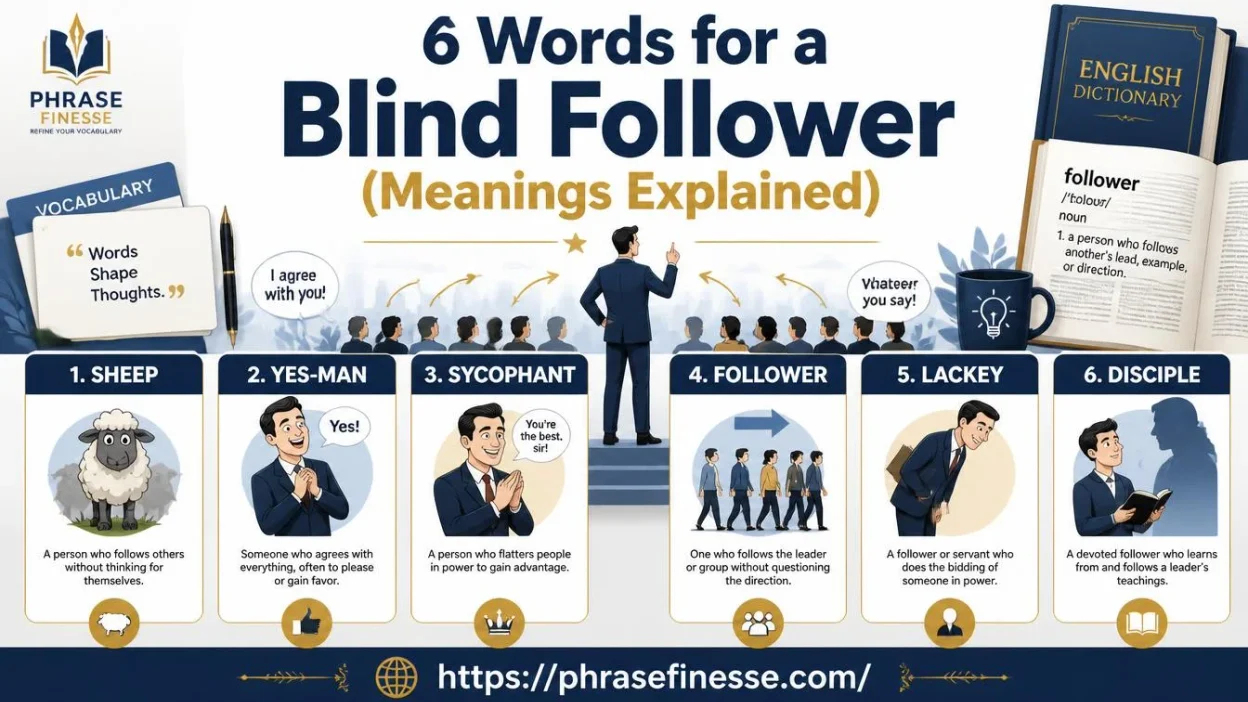
Have you ever met someone who follows ideas, trends, or instructions without questioning them? Understanding the right vocabulary can make your message clearer and more precise. In this guide, we’ll explore 6 Words for a Blind Follower (Meanings Explained) and examine how each term is used in everyday conversations, business communication, formal writing, and professional discussions.
Choosing the correct word helps improve English usage, strengthens grammar, and adds greater accuracy to your writing.
Language becomes more effective when it captures subtle differences in meaning. Some words describe people who follow authority without question, while others refer to individuals who imitate opinions, behaviors, or decisions. These distinctions matter in areas such as project management, meetings, broadcasting, and workplace collaboration, where independent thinking often influences outcomes.
Understanding these terms can also improve clarity and consistency in both personal and professional communication.
This article breaks down six commonly used words, explains their meanings, and provides practical examples to show when each one fits best. Along the way, you’ll discover how these expressions appear across different contexts, from scheduling, time management, calendar planning, and online booking systems to broader discussions about leadership and decision-making.
By the end, you’ll know exactly which word to choose and how to use it confidently in the right situation.
What Is a Blind Follower?
A blind follower is someone who follows a person, group, ideology, or authority figure without critical thinking or independent judgment.
Rather than evaluating information objectively, a blind follower tends to accept claims, instructions, or beliefs at face value. They rarely challenge authority and often adopt opinions simply because someone influential holds them.
Common characteristics include:
- Following without questioning
- Accepting information without verification
- Conforming to group beliefs
- Avoiding disagreement
- Trusting authority excessively
- Prioritizing acceptance over truth
A blind follower isn’t necessarily unintelligent. In many cases, psychological factors such as peer pressure, fear of exclusion, loyalty, or admiration play a significant role.
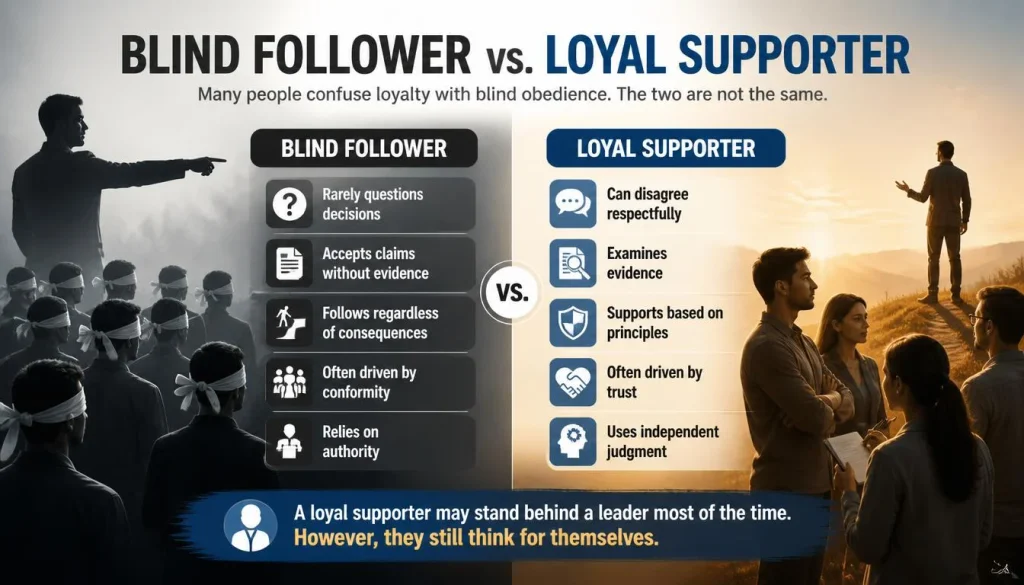
Blind Follower vs. Loyal Supporter
Many people confuse loyalty with blind obedience. The two are not the same.
| Blind Follower | Loyal Supporter |
| Rarely questions decisions | Can disagree respectfully |
| Accepts claims without evidence | Examines evidence |
| Follows regardless of consequences | Supports based on principles |
| Often driven by conformity | Often driven by trust |
| Relies on authority | Uses independent judgment |
A loyal supporter may stand behind a leader most of the time. However, they still think for themselves.
Words That Describe a Blind Follower
Sheep
Meaning
Sheep is perhaps the most common term used to describe a blind follower.
The word comes from the stereotype that sheep move together as a flock and follow one another without questioning direction.
When someone calls another person a sheep, they’re suggesting that the person lacks independent thought and simply follows the crowd.
Why It Fits a Blind Follower
The term highlights:
- Conformity
- Groupthink
- Lack of critical thinking
- Social pressure
It is especially common in discussions involving politics, social media trends, consumer behavior, and public opinion.
Example Sentences
- Many investors acted like sheep and bought the stock simply because everyone else did.
- He never researches issues himself and just repeats what others say like a sheep.
- Social media can sometimes encourage sheep behavior.
Connotation
Negative
Calling someone a sheep is usually an insult. It suggests passivity and an unwillingness to think independently.
Real-World Example
During major online trends, millions of people sometimes participate without understanding the original purpose. Critics often describe this behavior as “acting like sheep” because individuals follow the crowd rather than making independent decisions.
Quote
“Whenever you find yourself on the side of the majority, it is time to pause and reflect.”
— Mark Twain
While not specifically about sheep, the quote captures the idea of avoiding mindless conformity.
Yes-Man
Meaning
A yes-man is a person who constantly agrees with a leader, boss, or authority figure regardless of whether that person is right.
Unlike sheep, who follow the crowd, a yes-man follows a specific individual.
Why It Fits a Blind Follower
A yes-man often:
- Avoids disagreement
- Seeks approval
- Supports every decision
- Suppresses honest opinions
Organizations filled with yes-men frequently struggle because leaders receive little constructive criticism.
Example Sentences
- The CEO surrounded himself with yes-men.
- Every proposal was approved because nobody wanted to challenge the manager.
- A good leader values honest feedback rather than yes-men.
Connotation
Strongly negative
The term suggests weakness, dishonesty, or fear.
Workplace Case Study
Imagine a company facing declining sales.
The CEO proposes an expensive marketing strategy. Several executives privately believe the plan is flawed. However, nobody speaks up because they fear losing influence.
The project fails.
Later analysis reveals that multiple executives saw the problem from the beginning.
This is a classic example of yes-man culture.
Warning Signs of a Yes-Man Environment
- No one challenges decisions
- Meetings lack debate
- Leaders rarely receive criticism
- Mistakes repeat frequently
- Innovation declines
Sycophant
Meaning
A sycophant is a person who flatters powerful individuals to gain personal benefits.
Unlike a simple follower, a sycophant often has strategic motives.
Why It Fits a Blind Follower
A sycophant may:
- Praise excessively
- Agree automatically
- Seek promotions
- Gain favors
- Build influence through flattery
While a sheep follows from conformity, a sycophant follows for personal advantage.
Example Sentences
- The politician surrounded himself with sycophants.
- Her constant praise made her appear sycophantic.
- Sycophants often tell leaders what they want to hear.
Connotation
Highly negative
Few people want to be labeled a sycophant because it implies manipulation and insincerity.
Historical Background
The word originates from Ancient Greece. Over time, it evolved into a term describing someone who gains favor through excessive flattery.
Sycophant vs. Yes-Man
| Sycophant | Yes-Man |
| Uses flattery | Uses agreement |
| Often manipulative | Often submissive |
| Wants rewards | Wants approval |
| Strategic behavior | Fear-driven behavior |
Famous Leadership Lesson
History repeatedly shows that leaders who surround themselves with sycophants often make poor decisions because honest feedback disappears.
When everyone says “yes,” problems remain hidden until it’s too late.
Follower
Meaning
The word follower is much broader than the others on this list.
A follower is simply someone who supports, admires, or follows another person, group, belief system, or movement.
Why It Fits a Blind Follower
In certain contexts, follower can imply blind obedience. However, the word itself is neutral.
Not every follower is a blind follower.
Example Sentences
- She became a follower of the movement.
- The author gained thousands of followers online.
- He follows the philosophy closely.
Connotation
Generally neutral
The surrounding context determines whether the term sounds positive, negative, or neutral.
Types of Followers
| Type | Description |
| Active Follower | Thinks critically while supporting |
| Passive Follower | Rarely participates |
| Blind Follower | Accepts everything without question |
| Devoted Follower | Deeply committed to a cause |
Important Distinction
A follower may carefully evaluate ideas before supporting them.
A blind follower skips that evaluation process.
Lackey
Meaning
A lackey is someone who unquestioningly serves another person, often someone powerful.
The term emphasizes obedience and servitude.
Why It Fits a Blind Follower
A lackey typically:
- Obeys without resistance
- Carries out orders unquestioningly
- Defends authority figures
- Acts on behalf of powerful individuals
Example Sentences
- Critics accused him of being the politician’s lackey.
- The organization relied on loyal lackeys to enforce its policies.
- He acted more like a lackey than an independent adviser.
Connotation
Very negative
The term implies low status and unquestioning loyalty.
Historical Origin
Originally, a lackey referred to a servant who attended wealthy individuals.
Over time, the word expanded to describe anyone who behaves like an obedient subordinate.
Case Study: Political Organizations
In many authoritarian systems throughout history, leaders relied heavily on loyal lackeys.
Rather than providing honest advice, these individuals focused on pleasing superiors and maintaining their positions.
The result often included poor decision-making and widespread corruption.
Disciple
Meaning
A disciple is a devoted follower of a teacher, philosophy, religion, or ideology.
Unlike the other terms, disciple often carries positive associations.
Why It Sometimes Fits a Blind Follower
A disciple becomes a blind follower only when devotion replaces critical thinking.
Otherwise, the word simply describes commitment to learning or belief.
Example Sentences
- He was a disciple of the philosopher.
- The teacher inspired many disciples.
- She became a disciple of the movement’s principles.
Connotation
Neutral to positive
The word often appears in religious, philosophical, and educational contexts.
Disciple vs. Blind Follower
| Disciple | Blind Follower |
| Learns actively | Accepts passively |
| Can ask questions | Rarely questions |
| Pursues understanding | Pursues obedience |
| Often encouraged to think | Often discouraged from thinking |
Historical Perspective
Many influential teachers throughout history encouraged disciples to question ideas rather than accept them blindly.
True discipleship often involves learning, reflection, and growth.
Read More :How to Respond to an Insult – Witty Replies
Comparison Table of All Words for a Blind Follower
| Word | Blind Following Level | Formality | Typical Context | Tone |
| Sheep | High | Informal | Social commentary | Negative |
| Yes-Man | High | Neutral | Workplace | Negative |
| Sycophant | High | Formal | Politics, business | Very Negative |
| Follower | Variable | Neutral | General use | Neutral |
| Lackey | Very High | Formal | Power structures | Very Negative |
| Disciple | Low to Variable | Neutral | Religion, philosophy | Neutral to Positive |
Which Word Should You Use?
Choosing the right word depends on context.
1. Use “Sheep” When
- Describing crowd behavior
- Discussing conformity
- Talking about groupthink
2.Use “Yes-Man” When
- Referring to workplace dynamics
- Discussing unquestioning agreement
- Talking about leadership problems
3. Use “Sycophant” When
- Flattery is involved
- Personal gain is the motivation
- Someone seeks favor from powerful people
4. Use “Lackey” When
- Obedience is the main focus
- Someone acts like a servant of power
- Independence is completely absent
5. Use “Follower” When
- You need a neutral term
- Blind obedience isn’t certain
- General support is being described
6. Use “Disciple” When
- Discussing religion
- Referring to philosophy
- Talking about dedicated students or believers
Why People Become Blind Followers
Blind following isn’t a new phenomenon.
Psychologists have studied it for decades.
Several powerful factors influence human behavior.
Social Proof
People often assume that if many others believe something, it must be correct.
This mental shortcut saves time but can lead to poor decisions.
Example
If hundreds of people rush toward one restaurant, many assume it must be good without checking reviews.
Authority Bias
Humans naturally trust authority figures.
Scientists, executives, politicians, celebrities, and experts can strongly influence opinions.
Sometimes that trust becomes excessive.
Example
A famous influencer recommends a product.
Thousands buy it without researching alternatives.
Fear of Exclusion
Humans are social creatures.
Many people avoid questioning group beliefs because they fear rejection.
Belonging often feels safer than standing alone.
Example
An employee remains silent during a meeting despite recognizing a problem because everyone else agrees.
Cognitive Ease
Independent thinking requires effort.
Following others can feel easier.
When life becomes complex, people often seek simple answers.
Blind following provides certainty even when certainty isn’t justified.
Emotional Attachment
Strong emotions can override logic.
People sometimes become deeply attached to leaders, celebrities, ideologies, or organizations.
Once emotional investment occurs, objective evaluation becomes more difficult.
The Dangers of Blind Following
While following trusted leaders isn’t inherently wrong, blind following can create serious problems.
Poor Decision-Making
Without criticism, mistakes go uncorrected.
Bad ideas gain momentum.
Organizations become less effective.
Groupthink
Groupthink occurs when people prioritize harmony over accuracy.
Members suppress concerns to avoid conflict.
The result is often flawed decisions.
Manipulation
Blind followers are easier to manipulate.
Unscrupulous leaders can exploit trust for personal gain.
Loss of Individual Identity
Over time, excessive dependence on others can weaken independent judgment.
People begin adopting beliefs simply because authority figures endorse them.
Related Words and Synonyms for a Blind Follower
Several other words can describe similar behavior.
| Word | Meaning |
| Conformist | Someone who follows social norms |
| Stooge | A submissive helper |
| Puppet | Controlled by another person |
| Flunky | An obedient subordinate |
| Minion | A loyal servant or follower |
| Devotee | A dedicated supporter |
| Admirer | Someone who respects another person |
| Supporter | Someone who backs a cause or leader |
Each carries its own nuance.
Choosing the correct word improves clarity and precision.
Common Mistakes When Using These Words
Assuming Every Follower Is Blind
Many followers think independently.
Support does not automatically equal blind obedience.
Using “Disciple” as an Insult
Disciple often has positive meanings.
It does not automatically imply unquestioning loyalty.
Confusing “Sycophant” and “Yes-Man”
A sycophant uses flattery strategically.
A yes-man simply agrees constantly.
Overusing “Sheep”
While common, sheep can sound overly dismissive and emotional.
Professional writing often benefits from more precise alternatives.
FAQs
1. What is a blind follower?
A blind follower is someone who accepts ideas, opinions, instructions, or beliefs without questioning them. They tend to follow authority figures, groups, or trends without applying critical thinking or independent judgment.
2. What are some common words used to describe a blind follower?
Several words can describe a blind follower, including sheep, yes-man, disciple, follower, imitator, and sycophant. The best choice depends on the context and the person’s behavior.
3. Is calling someone a blind follower always negative?
Not always. Some terms are neutral, while others carry a negative tone. For example, sycophant and yes-man are usually critical, whereas follower or disciple can be neutral or even positive depending on the situation.
4. Why is it important to know these words?
Understanding these terms improves English vocabulary, communication skills, and writing precision. It allows you to describe behaviors more accurately in conversations, academic writing, and business communication.
5. What is the difference between a follower and a blind follower?
A follower may support or respect a person, idea, or movement while still thinking independently. A blind follower, however, follows without questioning, evaluating, or considering alternative viewpoints.
6. Can a blind follower become an independent thinker?
Yes. Developing critical thinking, asking questions, researching information, and considering multiple perspectives can help someone move from passive acceptance to informed decision-making.
Conclusion
Finding the right word to describe a blind follower can make your writing and communication far more precise. While terms such as sheep, yes-man, sycophant, disciple, imitator, and follower may seem similar, each carries its own meaning and level of intensity. Understanding these distinctions helps you choose language that accurately reflects a person’s behavior and attitude.
Whether you’re improving your English usage, enhancing formal writing, or communicating more effectively in professional settings, selecting the correct term adds clarity and impact. By learning these six words and their nuances, you can express your ideas with greater confidence and communicate more accurately in any context.

Alyan Ashraf is an English language writer and editor at Phrase Finesse, where he specializes in grammar, vocabulary, spelling, word usage, and clear communication. Passionate about the English language, he creates practical, research-backed content that helps readers avoid common mistakes and write with greater accuracy and confidence.
Known for his clear writing style and attention to detail, Alyan simplifies complex language topics into easy-to-understand guides filled with real-world examples and actionable insights. His work covers confusing word pairs, grammar rules, idioms, punctuation, and everyday English usage, making learning both accessible and engaging for students, professionals, writers, and non-native English speakers.
Every article Alyan writes is carefully researched, fact-checked, and designed to meet high editorial standards. His goal is to help readers strengthen their English skills, expand their vocabulary, and communicate more effectively in academic, professional, and everyday settings.
Through Phrase Finesse, Alyan is committed to publishing trusted language resources that make mastering English simpler, clearer, and more enjoyable for learners around the world