Have you ever noticed that the people who help everyone else often neglect their own needs? That timeless idea is perfectly captured inThe Cobbler’s Children Have No Shoes: Meaning, Origin a well-known proverb that has remained relevant across generations.
Whether in business, education, or daily life, the saying highlights a common irony: experts frequently fail to apply their own skills or advice to themselves.
Understanding “The Cobbler’s Children Have No Shoes” goes beyond learning a simple expression. Its history reveals valuable insights into human behavior, priorities, and productivity. In today’s fast-paced world of time management, project management, business communication, meetings, and calendar planning, the proverb still resonates.
Professionals involved in scheduling, online booking, and even broadcasting often dedicate so much attention to serving others that their own tasks remain unfinished. This enduring lesson explains why the phrase continues to appear in conversations, literature, and workplace discussions.
In this guide, you’ll discover the complete meaning, fascinating origin, and modern-day relevance of “The Cobbler’s Children Have No Shoes.” We’ll explore how the expression is used in contemporary contexts, examine practical examples, and clarify its role in English usage, grammar, and formal writing.
By the end, you’ll understand why this centuries-old proverb remains a powerful reminder of the importance of consistency, balance, and self-application in both personal and professional life.
What Does “The Cobbler’s Children Have No Shoes” Mean?
The proverb “The Cobbler’s Children Have No Shoes” means that people who possess a particular skill, expertise, or profession often fail to apply that same expertise to themselves or those closest to them.
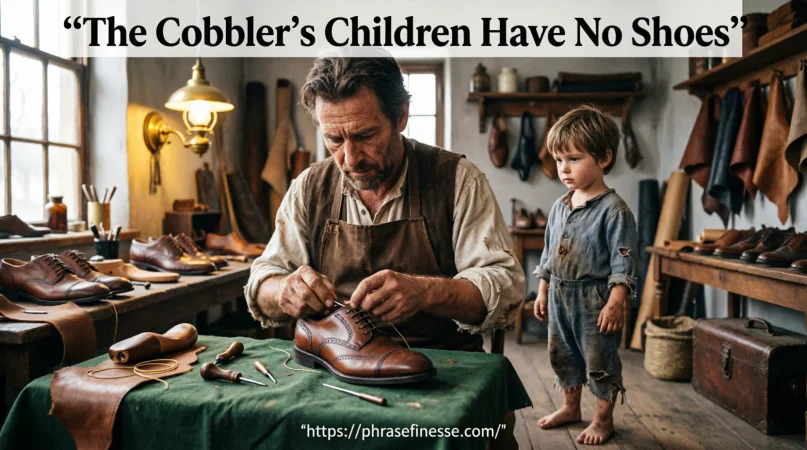
A cobbler makes shoes for a living. Logically, his own children should have the best shoes in town. Yet the proverb suggests the opposite.
The irony is the point.
The cobbler becomes so busy serving customers that his own family’s needs remain unmet.
Literal Meaning
A shoe repairer or shoemaker spends all day making footwear for paying customers while his children walk barefoot.
Figurative Meaning
Professionals frequently prioritize other people’s needs over their own.
The Core Lesson
Being skilled at something doesn’t guarantee you’ll use that skill for yourself.
The Origin of “The Cobbler’s Children Have No Shoes”
The proverb dates back several centuries and appears in multiple European languages.
Historians trace versions of the saying to the Middle Ages and Renaissance Europe. Over time, different cultures adapted the phrase while preserving its essential meaning.
The shoemaker was chosen because shoes were essential items in everyday life. If anyone should have had excellent footwear available, it would have been the person who made shoes professionally.
Yet reality often looked different.
Craftsmen frequently focused on customer work because it generated income. Personal projects came second.
Historical Variations
| Version | Region |
| The Cobbler’s Children Have No Shoes | English |
| The Shoemaker’s Children Go Barefoot | English Variation |
| Les cordonniers sont toujours les plus mal chaussés | French |
| Des Schuhmachers Kinder gehen barfuß | German |
| En casa del herrero, cuchillo de palo | Spanish Equivalent |
The proverb has survived because the underlying problem remains remarkably common.
Why Do Experts Often Neglect Their Own Needs?
At first glance, the situation seems irrational.
If someone has expertise, why wouldn’t they use it?
The answer involves psychology, economics, and human behavior.
Familiarity Creates Blind Spots
People often pay less attention to things they see every day.
A designer may instantly spot flaws in a client’s branding but overlook issues in their own work because they’ve become accustomed to seeing it.
Familiarity can dull awareness.
Client Work Comes First
For professionals and business owners, client projects generate revenue.
Personal projects do not always provide immediate financial rewards.
As a result, personal priorities move further down the list.
Limited Time and Energy
Every day contains only so many productive hours.
After serving clients, attending meetings, handling emails, and solving problems, little energy remains for personal improvement.
Perfectionism Delays Progress
Experts often hold themselves to higher standards.
Ironically, that can create delays.
Instead of launching a good website, the web designer waits for a perfect one.
Months become years.
Burnout Reduces Motivation
Helping others constantly can become exhausting.
Many professionals experience emotional fatigue that makes self-care feel like another task on an already crowded list.
Emotional Distance Matters
When helping others, professionals make objective decisions.
When helping themselves, emotions enter the equation.
That emotional involvement often complicates action.
Real-Life Examples of The Cobbler’s Children Have No Shoes
The proverb appears in almost every profession.
| Profession | Common Irony |
| Doctor | Skips annual health checkups |
| Dentist | Delays dental appointments |
| Financial Advisor | Poor personal budgeting |
| Software Developer | Outdated personal website |
| Social Media Manager | Inactive social profiles |
| Mechanic | Drives an unreliable vehicle |
| Chef | Eats fast food after work |
| Fitness Coach | Inconsistent workout routine |
| Accountant | Files own taxes last minute |
| Teacher | Struggles teaching own children |
These examples illustrate how expertise and personal practice don’t always align.
Modern Business Examples of The Cobbler’s Children Have No Shoes
Today’s business landscape offers countless examples.
Marketing Agencies
Many agencies create exceptional campaigns for clients while neglecting their own lead generation efforts.
Their clients dominate search results.
The agency barely updates its website.
Web Design Companies
Some web design firms build modern websites daily.
Yet their own site may contain outdated information, broken links, and old portfolios.
Law Firms
Attorneys often advise clients about risk management while postponing internal process improvements.
IT Consultants
Technology consultants frequently solve cybersecurity problems for customers while overlooking vulnerabilities within their own systems.
Freelancers
Freelancers commonly spend so much time serving clients that they neglect marketing themselves.
This creates a feast-or-famine cycle.
Startups
Young companies often focus intensely on product development while postponing internal documentation, training, and operational improvements.
Examples in Everyday Life
The proverb extends beyond professional work.
Parents
Parents often provide wise advice that they struggle to follow themselves.
Students
Students sometimes spend hours helping classmates understand assignments while neglecting their own study schedule.
Writers
Many talented writers begin multiple books but never finish their own manuscripts.
Photographers
Professional photographers may have thousands of client images but surprisingly few photographs of their own families.
Home Repair Professionals
Electricians, plumbers, and contractors frequently postpone repairs at home because they’re busy working elsewhere.
The pattern remains consistent.
People often serve others before serving themselves.
Is the Proverb Actually True?
While not universally true, research suggests the proverb reflects a common human tendency.
Several psychological principles help explain why.
Decision Fatigue
Every decision consumes mental energy.
Professionals who make hundreds of work-related decisions daily may struggle to make equally thoughtful personal decisions later.
Prioritization Pressure
Urgent responsibilities usually receive attention before important personal projects.
This creates long-term neglect.
Opportunity Cost
Time spent improving your own situation is time not spent earning income or helping clients.
Many professionals choose immediate demands over future benefits.
Work-Life Imbalance
Modern work environments encourage productivity, responsiveness, and constant availability.
Personal needs often become secondary.
Expertise Doesn’t Guarantee Action
Knowledge alone rarely creates behavior change.
People know they should exercise, save money, and sleep more.
Many still don’t.
That gap between knowledge and action sits at the heart of the proverb.
Similar Proverbs Around the World
One reason this saying has endured is that nearly every culture recognizes the same phenomenon.
| Country or Language | Equivalent Proverb | Meaning |
| English | The Shoemaker’s Children Go Barefoot | Same concept |
| Spanish | En casa del herrero, cuchillo de palo | Wooden knife in blacksmith’s house |
| French | Les cordonniers sont toujours les plus mal chaussés | Shoemakers wear the worst shoes |
| German | Des Schuhmachers Kinder gehen barfuß | Shoemaker’s children go barefoot |
| Italian | Il calzolaio va con le scarpe rotte | Shoemaker wears broken shoes |
Why So Many Cultures Share This Idea
The reason is simple.
Human nature doesn’t change much across borders.
People everywhere struggle with competing priorities.
Different languages merely describe the same reality.
Common Misinterpretations of The Cobbler’s Children Have No Shoes
Many people misunderstand the proverb.
It Doesn’t Mean the Cobbler Is Bad at His Job
The saying actually assumes the cobbler is highly skilled.
His problem isn’t incompetence.
It’s neglect.
It Isn’t Primarily About Poverty
The proverb doesn’t focus on a lack of resources.
Instead, it highlights misplaced priorities.
It Doesn’t Automatically Suggest Hypocrisy
A person may sincerely believe in something while still struggling to apply it consistently.
Knowledge and execution aren’t identical.
It’s Usually About Time and Attention
Most examples stem from limited time, energy, or focus rather than dishonesty.
See More :Comma Before “Like”: Explained for Beginners
The Psychology Behind The Cobbler’s Children Have No Shoes
The proverb aligns surprisingly well with modern psychology.
Decision Fatigue
Mental resources are finite.
The more decisions people make during the day, the harder future decisions become.
The Planning Fallacy
People consistently underestimate how long projects take.
Personal projects often suffer most from this bias.
Opportunity Cost
Every choice excludes alternatives.
Client work usually wins because it produces immediate rewards.
Professional Identity
Many individuals derive satisfaction from helping others.
Ironically, that focus can lead them to neglect themselves.
Delayed Gratification Problems
Personal improvements often provide long-term rewards.
Humans naturally prioritize immediate outcomes.
Cognitive Dissonance
People sometimes experience discomfort when their actions don’t match their beliefs.
Instead of changing behavior immediately, they justify postponement.
This can reinforce the cycle.
Lessons You Can Learn from The Cobbler’s Children Have No Shoes
The proverb contains practical wisdom for modern life.
Prioritize Your Own Needs
You cannot consistently help others if your own foundation is weak.
Schedule Personal Projects
Treat personal commitments with the same seriousness as professional obligations.
Put them on the calendar.
Practice What You Teach
Applying your advice personally strengthens credibility and effectiveness.
Avoid Burnout
Self-care isn’t selfish.
It’s maintenance.
A machine cannot operate efficiently without regular servicing.
Humans aren’t different.
Build Better Boundaries
Not every request deserves immediate attention.
Protecting time for personal priorities improves long-term performance.
Become Your Own Best Client
Many professionals provide exceptional service to customers.
Imagine extending that same care to yourself.
The results could be transformative.
Famous Situations That Reflect the Proverb
Several high-profile examples illustrate the principle.
Companies With Outdated Websites
Many organizations sell digital transformation services while operating outdated websites.
Cybersecurity Firms With Internal Security Issues
Even security experts occasionally become victims of vulnerabilities they help others avoid.
Health Professionals Neglecting Preventive Care
Medical professionals often understand health risks better than anyone.
Yet many postpone preventive appointments.
Productivity Experts Facing Overload
Time management specialists can become overwhelmed by the same challenges they teach others to overcome.
Designers With Incomplete Portfolios
Creative professionals frequently spend years refining client projects while neglecting their own showcase materials.
When The Saying Doesn’t Apply
The proverb describes a tendency, not a law.
Many professionals successfully avoid this trap.
Strong Systems Help
People who create structured routines often maintain their own priorities more effectively.
Delegation Makes a Difference
Successful leaders understand they don’t need to do everything themselves.
Delegating routine tasks frees time for personal development.
Intentional Self-Investment Works
Professionals who schedule time for themselves often experience better long-term outcomes.
Company Culture Matters
Organizations that encourage balance tend to avoid many of the problems described by the proverb.
Case Study: The Freelance Web Designer
Consider a freelance web designer.
They spend six months building websites for clients.
Revenue grows steadily.
Projects arrive consistently.
However, their own website remains unfinished.
Potential clients visit the site and see outdated information, missing portfolio pieces, and old contact details.
Ironically, the designer possesses all the skills necessary to fix the problem.
The challenge isn’t knowledge.
The challenge is prioritization.
Eventually, the designer dedicates one weekend per month to internal improvements.
Within six months:
- Website traffic increases
- Lead quality improves
- Conversion rates rise
- Revenue grows
This case perfectly demonstrates the proverb’s lesson.
Small investments in yourself can generate substantial returns.
A Powerful Quote That Captures the Meaning
“You can’t pour from an empty cup.”
Although not directly connected to the proverb, this quote expresses a similar truth.
People often focus so heavily on serving others that they neglect their own needs.
Eventually, that imbalance becomes unsustainable.
FAQs
1. What does “The Cobbler’s Children Have No Shoes” mean?
“The Cobbler’s Children Have No Shoes” means that people who provide a service, skill, or expertise to others often neglect their own needs. It highlights the irony of professionals helping everyone else while failing to apply the same attention to themselves.
2. Where did the saying “The Cobbler’s Children Have No Shoes” originate?
The proverb is believed to have originated in Europe and has appeared in various forms across several languages. Its central idea has been passed down for centuries, emphasizing a universal human tendency rather than a specific historical event.
3. Is “The Cobbler’s Children Have No Shoes” still relevant today?
Yes. The saying remains highly relevant in modern life. Business owners, consultants, teachers, healthcare professionals, and even experts in time management and project management often prioritize clients or customers over their own needs, making the proverb timeless.
4. How is the phrase used in everyday conversation?
People use the expression when someone neglects their own responsibilities despite being skilled in that area. For example, a professional organizer with a cluttered home or a web designer with an outdated website may be described using this proverb.
5. Are there similar expressions to “The Cobbler’s Children Have No Shoes”?
Yes. Similar sayings include “The shoemaker’s son always goes barefoot” and “Physician, heal thyself.” All of these expressions convey the idea that experts sometimes fail to benefit from their own knowledge or services.
6. Can the proverb be used in professional and formal writing?
Absolutely. The phrase is widely recognized and can be used in business communication, presentations, articles, and formal writing when discussing priorities, resource allocation, or the gap between expertise and personal practice.
Conclusion
“The Cobbler’s Children Have No Shoes” is more than just an old proverb—it is a timeless observation about human nature. The saying reminds us that expertise alone does not guarantee personal application.
From ancient workshops to modern workplaces driven by scheduling, meetings, calendar management, and business communication, the message remains remarkably relevant.
Understanding the meaning and origin of this expression helps you appreciate its enduring value and recognize similar situations in everyday life.
Whether discussing personal habits, professional responsibilities, or organizational challenges, the proverb serves as a powerful reminder that true consistency comes from applying our knowledge not only for others but also for ourselves.




[…] Read More :Cobbler’s Children Have No Shoes: Meaning and Origin […]
[…] Read More :Cobbler’s Children Have No Shoes: Meaning and Origin […]