Have you ever wondered whether “Sure” and “Yes” mean exactly the same thing, or if one sounds more appropriate in certain situations? The difference may seem small, but choosing the right response can change the tone of your conversation.
In this guide,“Sure” vs “Yes” — Difference With Real Examples, you’ll discover how these two common words differ in meaning, tone, politeness, and English usage through clear examples and practical explanations.
Although both “Sure” and “Yes” can express agreement, they often create different impressions in formal writing, business communication, and everyday conversations. Understanding when to use each word helps you communicate with more clarity, confidence, and consistency.
Whether you’re replying to a colleague, confirming a meeting, managing a calendar, or discussing scheduling and time management, the right choice can make your message sound more natural and professional.
This article will explore the grammar rules, contextual differences, and real-world examples of “Sure” and “Yes” to help you master their usage. You’ll learn how these words work in situations like online booking, broadcasting, project management, and professional conversations where precise communication matters.
By the end, you’ll have a better understanding of these expressions and how to use them effectively in both casual and professional settings.
Sure vs Yes Difference Explained — Quick Core Idea
At the simplest level:
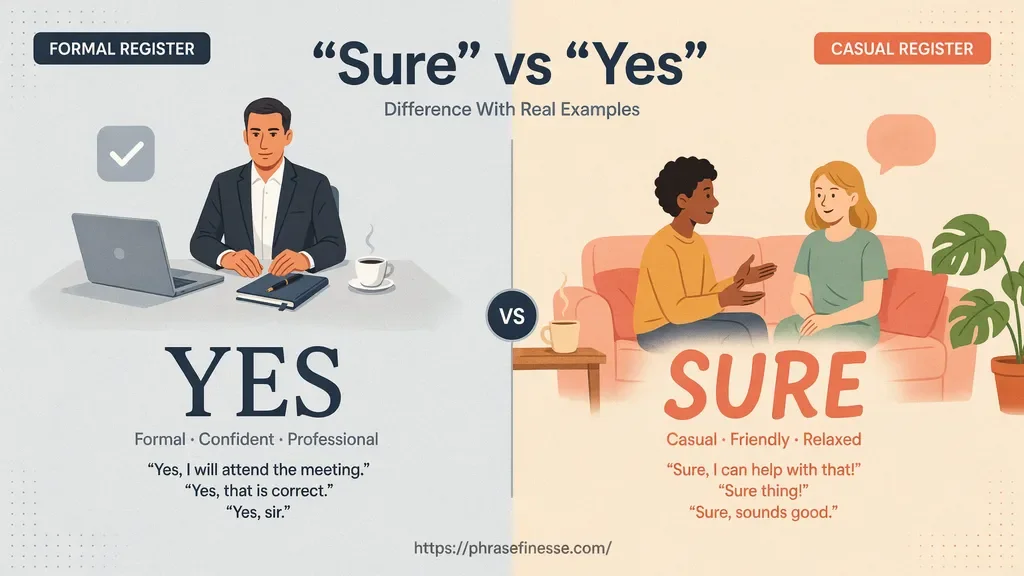
- Yes = clear agreement or confirmation
- Sure = casual, flexible, or slightly informal agreement
But that’s just the surface.
The real difference shows up in tone, confidence, context, and intent.
Think of it like this:
“Yes” is a firm handshake.
“Sure” is a relaxed nod with hands in your pockets.
Both mean agreement. But they feel different.
What “Yes” Really Means in English Communication
When someone uses “yes”, they usually signal:
- Strong agreement
- Clear acceptance
- Formal or neutral tone
- No ambiguity
It works best when clarity matters.
Everyday examples of “yes”
- “Can you attend the meeting at 10?” → “Yes.”
- “Do you understand the instructions?” → “Yes.”
- “Will you submit the report today?” → “Yes.”
Notice something?
There’s no emotional layering. Just direct confirmation.
Where “yes” fits best
You’ll see “yes” used in:
- Work emails
- Formal conversations
- Academic settings
- Customer service responses
- Instructions or authority-based communication
Why “yes” feels stronger
“Yes” removes uncertainty. It signals:
- Commitment
- Responsibility
- Precision
That’s why managers, teachers, and professionals often prefer it.
What “Sure” Really Means in English Communication
Now let’s talk about “sure.”
This word carries a softer tone. It doesn’t just mean agreement. It also hints at attitude.
Core meanings of “sure”
Depending on context, “sure” can mean:
- Agreement
- Willingness
- Casual acceptance
- Mild enthusiasm or neutrality
Everyday examples of “sure”
- “Can you help me with this?” → “Sure.”
- “Do you want to grab coffee?” → “Sure.”
- “Can I call you later?” → “Sure.”
The hidden tone behind “sure”
Unlike “yes,” this word often implies:
- Relaxed agreement
- Friendly attitude
- Informal setting
- Low resistance
But here’s the twist.
Sometimes “sure” sounds less enthusiastic depending on tone.
Compare:
- “Sure.” (flat tone → might feel reluctant)
- “Sure!” (positive tone → friendly agreement)
Same word. Different energy.
Sure vs Yes Difference — Side-by-Side Comparison Table
Let’s make it crystal clear.
| Feature | Yes | Sure |
| Tone | Formal, direct | Casual, relaxed |
| Emotion | Neutral | Flexible |
| Strength of agreement | Strong | Medium |
| Use in workplace | Common | Less formal contexts |
| Social settings | Neutral | Very common |
| Risk of misunderstanding | Low | Medium |
| Example vibe | “I agree fully.” | “I’m okay with it.” |
This table shows something important.
👉 “Yes” reduces ambiguity. “Sure” increases tone interpretation.
The Psychology Behind “Sure” vs “Yes”
Language isn’t just grammar. It’s psychology.
When people hear words, they don’t just process meaning. They also interpret intent.
Why “yes” feels more committed
The brain associates “yes” with:
- Certainty
- Decision-making
- Finality
So when someone says “yes,” the listener assumes:
“This person is fully on board.”
Why “sure” feels more flexible
“Sure” triggers a different mental signal:
- Openness
- Informality
- Low pressure
So the listener thinks:
“They agree, but they’re not strongly invested.”
That’s why tone matters so much.
Real-Life Case Studies (How Misunderstanding Happens)
Let’s look at real situations where this difference actually matters.
Case Study 1: Workplace email confusion
Manager:
“Can you handle the client presentation?”
Employee A: “Yes.”
Employee B: “Sure.”
Outcome
- Employee A sounds confident and accountable
- Employee B sounds slightly unsure or casual
Even if both intend the same thing, perception changes everything.
Read More :Comma Before “Even”: When to Use It and When to Skip It
Case Study 2: Friend planning a meetup
Friend: “Want to go out tonight?”
- “Yes” → sounds enthusiastic or definite
- “Sure” → sounds relaxed or slightly passive
Neither is wrong. But energy shifts.
Case Study 3: Customer support tone
Customer: “Can you check my order?”
- “Yes, I’ll check it now.” → professional and reassuring
- “Sure, I’ll check it now.” → friendly but less formal
Companies often train support teams to prefer “yes” or full confirmations for clarity.
When You Should Use “Yes”
Use yes when clarity and certainty matter.
Best situations for “yes”
- Job interviews
- Business emails
- Academic responses
- Formal requests
- Legal or procedural communication
Example scenarios
- “Yes, I confirm the appointment.”
- “Yes, I agree with the terms.”
- “Yes, I will complete the task by Friday.”
👉 Think of “yes” as your default professional setting.
When You Should Use “Sure”
Use sure when the tone is casual and relaxed.
Best situations for “sure”
- Text messaging
- Friendly conversations
- Informal work chats
- Quick agreements
- Social invitations
Example scenarios
- “Sure, I’ll join you.”
- “Sure, no problem.”
- “Sure thing.”
👉 Think of “sure” as your social tone booster.
Subtle Meaning Shifts You Should Know
Here’s where it gets interesting.
“Sure” isn’t always positive.
Depending on tone and punctuation, it can shift meaning.
1. Neutral agreement
- “Sure.” → I agree, no issue.
2. Friendly enthusiasm
- “Sure!” → I’m happy to do it.
3. Reluctant agreement
- “Sure…” → I agree, but not excited.
👉 Context decides everything.
Common Mistakes People Make
People often misuse these words without realizing the tone impact.
Mistake 1: Using “sure” in formal emails
❌ “Sure, I will send the report.”
✔ “Yes, I will send the report.”
Mistake 2: Overusing “yes” in casual chat
❌ “Yes, I can go. Yes, that works. Yes, I’m free.”
✔ “Sure, I can go. That works for me.”
Mistake 3: Ignoring tone
Same word, different meaning depending on delivery.
“Sure” vs “Yes” in Different English Variants
Language usage shifts slightly across regions.
American English
- “Sure” is very common in casual speech
- “Yes” dominates formal settings
British English
- “Yeah” often replaces both in casual talk
- “Yes” remains formal standard
Workplace English globally
- “Yes” = safe professional choice
- “Sure” = acceptable but informal tone
Practical Decision Guide (Quick Rule)
Use this simple logic:
- Need clarity? → Say yes
- Need friendliness? → Say sure
- Writing formal email? → Always yes
- Texting a friend? → Mostly sure
Think of it like a switch:
Yes = structured communication
Sure = relaxed communication
Mini Dialogue Examples (Real Usage)
Professional setting
Manager: Can you finish this today?
You: Yes, I’ll complete it by 5 PM.
Friendly setting
Friend: Want to watch a movie?
You: Sure, sounds good.
Mixed tone
Colleague: Can you review this?
You: Sure, I’ll take a look.
FAQs
1. What is the main difference between “Sure” and “Yes”?
The main difference between “Sure” and “Yes” is their tone and level of agreement. “Yes” is a direct confirmation or acceptance, while “Sure” often sounds more casual, friendly, or willing. For example, saying “Yes, I can help” sounds straightforward, while “Sure, I can help” sounds more relaxed and approachable.
2. Is “Sure” more polite than “Yes”?
Not always. “Sure” can sound polite in casual conversations because it shows willingness and friendliness. However, “Yes” is often better for formal writing, business communication, and professional situations because it provides a clear and direct response. The best choice depends on the context and relationship between the speakers.
3. Can I use “Sure” in formal emails or workplace communication?
You can use “Sure” in some workplace conversations, especially informal chats with coworkers. However, in official emails, reports, or professional documents, “Yes” or a more specific response may sound more appropriate. Formal communication often requires accuracy, clarity, and consistency.
4. Does “Sure” mean the same as “Definitely”?
Not exactly. While “Sure” can show agreement, “Definitely” expresses stronger confidence or enthusiasm. For example, “Sure, I’ll attend the meeting” shows willingness, while “Definitely, I’ll attend the meeting” shows strong commitment.
5. When should I use “Yes” instead of “Sure”?
Use “Yes” when you want to give a clear confirmation, answer a question directly, or maintain a professional tone. It works well in situations involving scheduling, calendar updates, project management, and formal discussions where a precise response matters.
6. Can “Sure” and “Yes” be used interchangeably?
Sometimes, but not always. Both words can express agreement, yet they carry different emotional tones. “Yes” focuses on confirmation, while “Sure” often adds a sense of willingness or friendliness. Understanding the difference improves your overall English usage and helps you choose the right expression for each situation.
Conclusion
Understanding the difference between “Sure” and “Yes” helps you communicate more effectively in both casual and professional settings. Although these words often express agreement, they create different impressions depending on the situation, tone, and level of formality.
Use “Yes” when you need a clear, direct, and professional response. Choose “Sure” when you want to sound more friendly, flexible, or conversational. Both words have their place in everyday English grammar and communication.
By learning how these expressions work, you can improve your formal writing, workplace conversations, and daily interactions. Paying attention to small language choices creates better communication consistency and helps you express your ideas with greater confidence.

Alyan Ashraf is an English language writer and editor at Phrase Finesse, where he specializes in grammar, vocabulary, spelling, word usage, and clear communication. Passionate about the English language, he creates practical, research-backed content that helps readers avoid common mistakes and write with greater accuracy and confidence.
Known for his clear writing style and attention to detail, Alyan simplifies complex language topics into easy-to-understand guides filled with real-world examples and actionable insights. His work covers confusing word pairs, grammar rules, idioms, punctuation, and everyday English usage, making learning both accessible and engaging for students, professionals, writers, and non-native English speakers.
Every article Alyan writes is carefully researched, fact-checked, and designed to meet high editorial standards. His goal is to help readers strengthen their English skills, expand their vocabulary, and communicate more effectively in academic, professional, and everyday settings.
Through Phrase Finesse, Alyan is committed to publishing trusted language resources that make mastering English simpler, clearer, and more enjoyable for learners around the world