Have you ever paused while writing an email and wondered whether you should sayAt the Weekend vs. On the Weekend vs. In the Weekend? It’s a common question for English learners, professionals, and native speakers alike.
These phrases may seem interchangeable, but their usage depends on regional preferences, English usage, and correct grammar, making them important for clear and effective communication.
Understanding the difference matters more than many people realize. Whether you are planning events on a calendar, discussing meetings, managing scheduling tasks, handling project management responsibilities, or writing professional messages for business communication, choosing the correct preposition helps maintain clarity and consistency.
It can also improve the accuracy of formal writing, workplace conversations, and customer interactions related to online booking and time management.
In this guide, you’ll learn when to use each expression, why some forms are more common than others, and how regional English influences their meaning. We’ll explore practical examples, common mistakes, and real-world contexts, including broadcasting, workplace communication, and everyday conversations.
By the end, you’ll know exactly which phrase fits your sentence and how to use it confidently in both spoken and written English.
Quick Answer:
Here’s the simplest answer.
| Phrase | Correct? | Common Location |
| At the weekend | Yes | British English |
| On the weekend | Yes | American English |
| In the weekend | Usually No | Rare in standard English |
Examples
British English
I’ll visit my parents at the weekend.
American English
I’ll visit my parents on the weekend.
Incorrect Standard Usage
I’ll visit my parents in the weekend.
The first two sentences sound natural to native speakers. The third generally does not.
What Does “Weekend” Mean?
Before examining the prepositions, it helps to understand the word itself.
A weekend refers to the period that typically includes Saturday and Sunday. In most countries, these are the primary days of rest, recreation, family activities, shopping, and social events.
The term emerged during the nineteenth century as working hours became more structured. Over time, the weekend evolved into a recognized period separate from the traditional workweek.
Today, the word appears in countless contexts:
- Weekend trips
- Weekend jobs
- Weekend plans
- Weekend classes
- Weekend sports
- Weekend markets
- Weekend schedules
Because a weekend represents a period of time, English speakers use prepositions to describe activities occurring during that period. That’s where confusion begins.
Is “At the Weekend” Correct?
Yes. At the weekend is completely correct.
In fact, it is the preferred expression throughout much of the United Kingdom and several other countries influenced by British English.
When British speakers discuss plans, activities, or events occurring during the weekend, they commonly use at the weekend.
Examples of At the Weekend
- We usually go hiking at the weekend.
- She’s visiting her grandparents at the weekend.
- What are you doing at the weekend?
- They played football at the weekend.
For British speakers, these sentences sound perfectly natural.
Why British English Uses “At”
Many English learners find this strange because “at” often refers to specific points in time.
For example:
- At noon
- At midnight
- At 3 PM
However, language doesn’t always follow strict logic.
Over centuries, British English developed the convention of using at with weekend references. Native speakers simply learn the pattern through exposure.
The same phenomenon appears throughout English.
Consider:
- At night
- In the morning
- On Monday
Each uses a different preposition despite referring to time.
That’s one reason English prepositions can be challenging.
Is “On the Weekend” Correct?
Absolutely.
On the weekend is standard American English.
If you’re writing for an audience in the United States, this is often the most natural choice.
Examples of On the Weekend
- We usually travel on the weekend.
- I’ll finish the project on the weekend.
- They’re hosting a barbecue on the weekend.
- What are your plans on the weekend?
American readers generally expect this wording.
Why Americans Prefer “On”
American English tends to associate weekends more closely with days.
Because speakers already say:
- On Monday
- On Tuesday
- On Friday
It feels natural to extend that pattern to:
- On the weekend
This creates consistency within American English usage.
Although Americans understand at the weekend, it may sound distinctly British.
Is “In the Weekend” Correct?
In most situations, no.
Native speakers rarely use in the weekend.
As a result, it often sounds awkward or unnatural.
Incorrect Examples
- ❌ We’ll travel in the weekend.
2. ❌ I work in the weekend.
3. ❌ She studies in the weekend.
These expressions don’t follow standard English patterns.
Correct Alternatives
| Incorrect | British English | American English |
| In the weekend | At the weekend | On the weekend |
| In weekends | At weekends | On weekends |
If you’re unsure, choose either at the weekend or on the weekend depending on your audience.
Why Do Learners Use “In the Weekend”?
Many learners arrive at in the weekend through direct translation.
In numerous languages, the equivalent preposition translates more closely to “in.”
As a result, learners naturally assume the same structure works in English.
Unfortunately, English prepositions rarely translate directly between languages.
Consider these examples:
| Expression | Correct Preposition |
| Morning | In |
| Afternoon | In |
| Evening | In |
| Night | At |
| Monday | On |
| Weekend (UK) | At |
| Weekend (US) | On |
There isn’t always a logical rule. Native usage often determines what sounds correct.
British English vs. American English Usage
The primary distinction between at the weekend and on the weekend comes down to regional preference.
British English
Preferred form:
At the weekend
Common in:
- United Kingdom
- Ireland
- Australia
- New Zealand
Examples:
- We went shopping at the weekend.
- They visited relatives at the weekend.
American English
Preferred form:
On the weekend
Common in:
- United States
- Much of Canada
Examples:
- We went shopping on the weekend.
- They visited relatives on the weekend.
Which Is More Common Globally?
This depends on your audience.
American media has enormous global influence through:
- Hollywood films
- Television
- Social media
- Streaming platforms
- News outlets
As a result, many international learners encounter on the weekend more frequently.
However, at the weekend remains firmly established in British English and is equally correct.
At the Weekend vs. On the Weekend: Is There a Difference in Meaning?
No.
This is one of the most important points to understand.
The phrases communicate essentially the same idea.
Compare These Sentences
British English
I saw my friends at the weekend.
American English
I saw my friends on the weekend.
The meaning is identical.
The only real difference is regional preference.
This situation resembles other British-American variations:
| British English | American English |
| Flat | Apartment |
| Holiday | Vacation |
| Lift | Elevator |
| Biscuit | Cookie |
| At the weekend | On the weekend |
The message remains the same.
At Weekends vs. On Weekends
Things become slightly different when discussing repeated actions.
British English
People often say:
- I work at weekends.
- We visit family at weekends.
- They play rugby at weekends.
American English
Americans usually prefer:
- I work on weekends.
- We visit family on weekends.
- They play soccer on weekends.
Notice that “the” often disappears when discussing habits.
Talking About Routine Activities
These phrases describe things that happen regularly.
Examples:
British Style
- We travel at weekends.
- She studies at weekends.
- They volunteer at weekends.
American Style
- We travel on weekends.
- She studies on weekends.
- They volunteer on weekends.
Both patterns are correct.
Why Prepositions Cause So Much Confusion
Prepositions are among the most difficult parts of English grammar.
Unlike verbs and nouns, they rarely follow predictable rules.
Many learners try to memorize logical formulas.
Unfortunately, English developed over centuries through multiple linguistic influences, including:
- Germanic languages
- French
- Latin
- Norse languages
The result is a system filled with exceptions.
Consider These Examples
- In January
- On Monday
- At noon
Each refers to time.
Yet each uses a different preposition.
The weekend expressions follow the same pattern.
Common Mistakes Writers Make
Understanding common errors helps you avoid them.
Using “In the Weekend”
This is by far the most frequent mistake.
Incorrect
We’ll meet in the weekend.
Correct
We’ll meet at the weekend.
or
We’ll meet on the weekend.
Mixing British and American Styles
Consistency matters.
Example
❌ We’ll meet at the weekend. We usually relax on weekends.
The sentence mixes British and American conventions.
Better
British:
✔ We’ll meet at the weekend. We usually relax at weekends.
American:
✔ We’ll meet on the weekend. We usually relax on weekends.
Assuming One Version Is Wrong
Many people mistakenly believe only one expression is correct.
That’s not true.
Both are accepted by native speakers.
Audience determines the better choice.
Real-World Usage Examples
Let’s look at how these expressions appear in everyday life.
Business Communication
British:
I’ll review the proposal at the weekend.
American:
I’ll review the proposal on the weekend.
Education
British:
Students often revise at the weekend.
American:
Students often study on the weekend.
Family Life
British:
We visit relatives at the weekend.
American:
We visit relatives on the weekend.
Travel
British:
We’re going to London at the weekend.
American:
We’re going to Chicago on the weekend.
Case Study: An International Team Meeting
Imagine a marketing team with employees in London, New York, and Sydney.
The London manager writes:
Let’s discuss this at the weekend.
The New York manager writes:
Let’s discuss this on the weekend.
Neither person is wrong.
Each is following the conventions of their local English variety.
Problems only arise when someone assumes one version is incorrect.
In global communication, awareness of regional differences improves clarity and reduces unnecessary corrections.
Similar Time Expressions That Cause Confusion
The weekend debate isn’t unique.
English contains many similar challenges.
See More :“Sure” vs “Yes” Difference With Real Examples
At Christmas vs. On Christmas
General Period
We visit family at Christmas.
Specific Day
We exchanged gifts on Christmas Day.
At Night vs. In the Night
General Time
I usually read at night.
Specific Event During Nighttime
I heard a noise in the night.
In the Morning vs. On Monday
Both refer to time.
Yet each uses a different preposition.
Examples:
- In the morning
- On Monday
These must simply be learned through usage.
What Dictionaries and Style Guides Say
Major dictionaries generally recognize both at the weekend and on the weekend.
The distinction typically appears as a regional usage note rather than a grammar rule.
General Consensus
- British English prefers at the weekend.
- American English prefers on the weekend.
- Both are grammatically correct.
- In the weekend is generally nonstandard.
Professional editors usually recommend matching the style to the audience.
Which Phrase Should You Use?
The answer depends entirely on who will read your writing.
Use “At the Weekend” If:
- Your audience is British.
- You’re following UK English standards.
- You’re writing for British publications.
- You’re using British spelling conventions.
Example
We completed the project at the weekend.
Use “On the Weekend” If:
- Your audience is American.
- You’re following US English standards.
- You’re writing for American publications.
- You’re using American spelling conventions.
Example
We completed the project on the weekend.
Avoid “In the Weekend”
Because it sounds unnatural to most native speakers, avoiding it is usually the safest choice.
A Simple Memory Trick
Many learners appreciate shortcuts.
Remember this:
British English
At the weekend
Think:
At the weekend = UK
American English
On the weekend
Think:
On the weekend = USA
Never Choose
In the weekend
Think:
In the weekend = Usually incorrect
This simple rule solves the problem almost every time.
Quick Comparison Table
| Situation | British English | American English |
| Single weekend | At the weekend | On the weekend |
| Regular weekends | At weekends | On weekends |
| Business communication | At the weekend | On the weekend |
| Casual conversation | At the weekend | On the weekend |
| Academic writing | At the weekend | On the weekend |
| Standard usage | Correct | Correct |
| In the weekend | Rarely accepted | Rarely accepted |
Editorial Recommendation
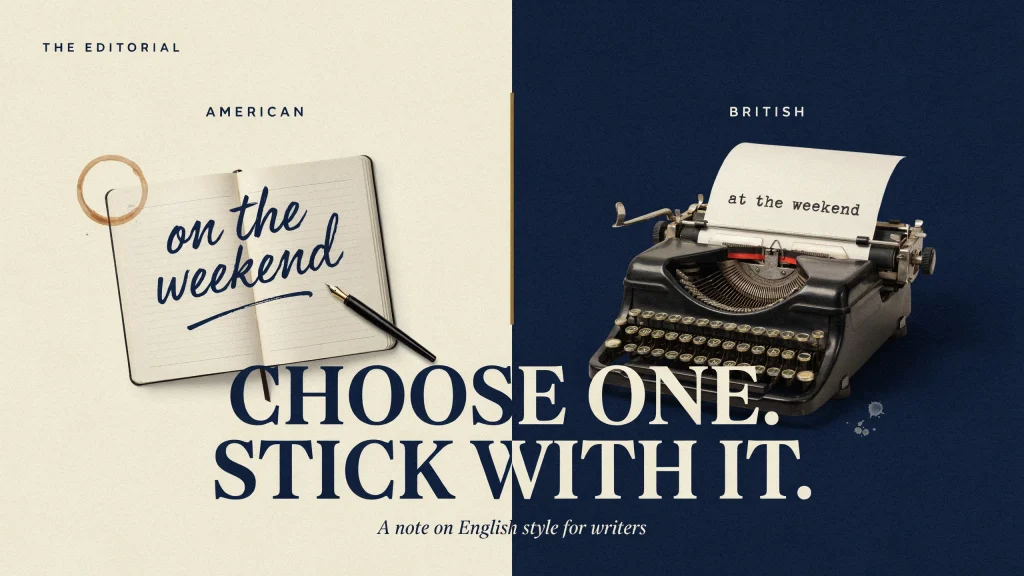
For most writers, the best approach is simple:
- Choose one variety of English.
- Follow it consistently.
- Match your audience’s expectations.
If your readers are primarily American, use on the weekend.
If your readers are primarily British, use at the weekend.
Consistency matters more than personal preference.
As the famous style principle suggests:
Good writing isn’t about following every rule. It’s about choosing the right form for your audience and using it consistently.
FAQs
Which is correct: “at the weekend” or “on the weekend”?
Both are correct, but they are used in different varieties of English. “At the weekend” is more common in British English, while “on the weekend” is preferred in American English. The choice depends on your audience and the style of English you use.
Is “in the weekend” grammatically correct?
Generally, “in the weekend” is not considered standard English. Native speakers rarely use it. In most situations, you should use “at the weekend” or “on the weekend” instead.
Why do British and American English use different prepositions with “weekend”?
Language evolves differently across regions. Over time, British English adopted “at the weekend,” while American English favored “on the weekend.” Both forms are widely accepted within their respective language varieties.
Can I use “during the weekend” instead?
Yes. “During the weekend” is a neutral and widely understood alternative. It emphasizes that something happens at some point within the weekend period rather than on a specific day.
Which phrase should I use in formal writing?
Use the phrase that matches your target audience. For British audiences, choose “at the weekend.” For American audiences, use “on the weekend.” Maintaining consistency throughout your document is more important than the specific choice.
Are these phrases important in professional communication?
Yes. Correct grammar and English usage help create clear and professional messages. Whether you’re discussing meetings, scheduling, project management, or business communication, using the appropriate expression can improve clarity and credibility.
Conclusion
The difference between “at the weekend,” “on the weekend,” and “in the weekend” mainly comes down to regional usage and grammatical convention. “At the weekend” is the standard choice in British English, while “on the weekend” is preferred in American English. In contrast, “in the weekend” is generally considered non-standard and should usually be avoided.
By understanding these distinctions, you can communicate more naturally and confidently in both spoken and written English. Whether you’re managing a calendar, coordinating meetings, improving formal writing, or simply having everyday conversations, choosing the correct phrase helps ensure clarity, professionalism, and consistency. When in doubt, consider your audience and stick to the version that aligns with their variety of English.

Mia Rose is an English language specialist and editorial writer at Phrase Finesse, where she helps readers master grammar, vocabulary, spelling, and effective communication. Passionate about making English simple and practical, she creates well-researched, reader-friendly content that explains complex language concepts in a clear and engaging way.
With extensive experience in English language education, content writing, and editorial review, Mia specializes in grammar, punctuation, word choice, idioms, confusing word pairs, and writing style. Her articles are carefully researched, fact-checked, and designed to help students, professionals, writers, and English learners build confidence in both written and spoken English.