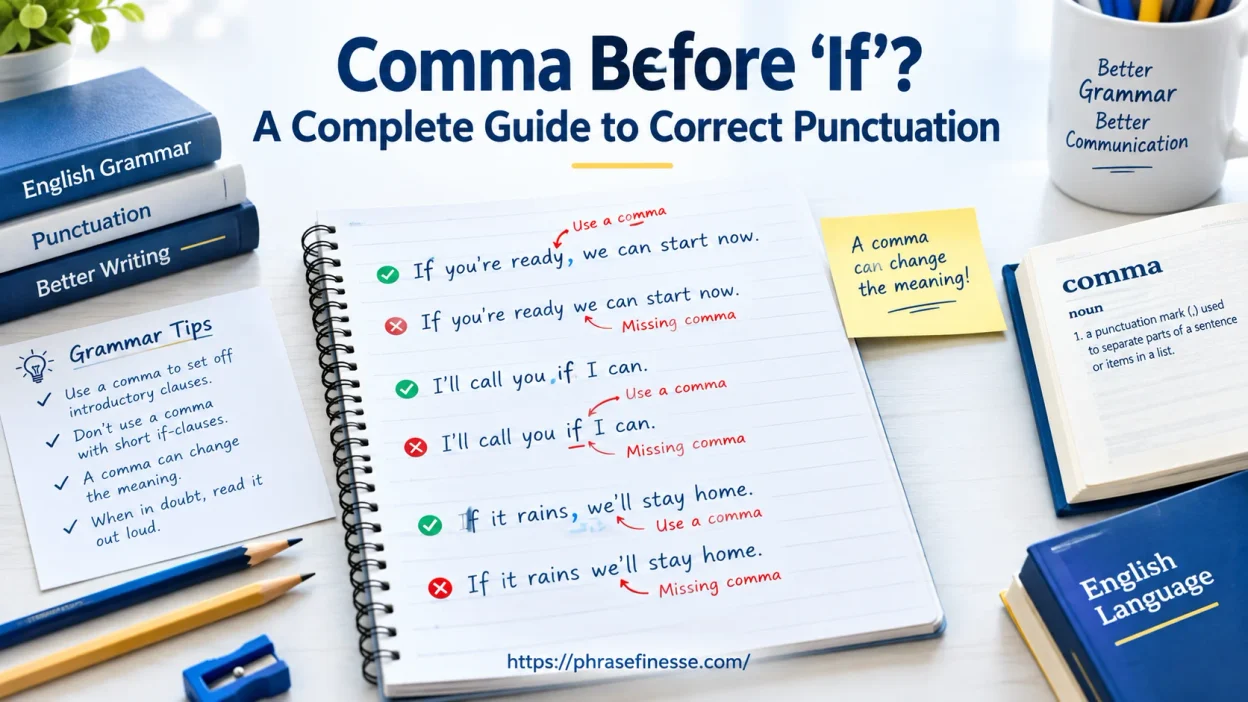
Have you ever paused while writing and wondered whether you need a comma before “if”? It’s one of the most common punctuation questions in English usage, yet many writers still get it wrong. In this guide, “Comma Before ‘If’? Explained For Beginners”, you’ll learn when a comma belongs before if, when it doesn’t, and how correct grammar choices can instantly improve clarity and readability.
Understanding comma placement is important in both casual and professional writing. Whether you’re drafting emails, handling business communication, organizing meetings, managing a calendar, or working on project management tasks, punctuation affects how your message is interpreted.
A misplaced comma can change meaning, reduce consistency, or make even strong formal writing appear less polished.
This article breaks down the rules in a simple, beginner-friendly way. You’ll discover practical examples, common mistakes, and easy-to-follow explanations that apply to real-world contexts such as scheduling, time management, online booking, and broadcasting communications.
By the end, you’ll know exactly how to use commas with if clauses confidently and accurately in everyday and professional writing.
Do You Put a Comma Before “If”?
The answer is: it depends.
Most of the time, you do not use a comma before “if” when the “if” clause appears at the end of a sentence and provides essential information.
Examples:
- I’ll call you if I arrive early.
- We can leave if you’re ready.
- She’ll buy the house if the price drops.
However, commas become necessary in certain situations:
- When an if clause begins a sentence
- When an if clause interrupts the main sentence
- When punctuation improves clarity or meaning
Because “if” can perform different grammatical functions, there isn’t a single rule that applies to every sentence.
Quick Reference Table
| Situation | Comma Before “If”? | Example |
| If clause follows main clause | No | I’ll help if you ask. |
| If clause begins sentence | Comma after clause | If you ask, I’ll help. |
| Parenthetical if clause | Yes | The project, if approved, will begin. |
| Indirect question | Usually No | I wonder if she’s coming. |
| Interrupting phrase | Yes | You can, if necessary, leave early. |
Understanding How “If” Functions in a Sentence
Before deciding whether a comma belongs near “if,” it helps to understand what the word actually does.
In English grammar, “if” is primarily a subordinating conjunction. It introduces a dependent clause that cannot stand alone as a complete sentence.
Example
- If it rains
This phrase leaves the reader hanging. It creates a condition but doesn’t complete the thought.
Now look at this:
- If it rains, we’ll stay home.
The second clause completes the meaning.
Why This Matters
Comma placement often depends on whether the clause is:
- Independent
- Dependent
- Essential
- Nonessential
Writers who understand these distinctions make fewer punctuation mistakes.
Clause Structure Diagram
Independent Clause + if + Dependent Clause
(No Comma)
I will stay home if it rains.
If + Dependent Clause, Independent Clause
(Comma Required)
If it rains, I will stay home.
Think of the “if” clause as a condition attached to the main idea. Its location determines how punctuation works.
When You Should NOT Use a Comma Before “If”
This is the situation you’ll encounter most often.
When an if clause follows the main clause and supplies essential information, no comma is needed.
Examples
- I’ll call you if I arrive early.
- We’ll cancel the picnic if the weather worsens.
- She can join us if she finishes work.
- You’ll pass the test if you study consistently.
- The company will expand if profits increase.
Notice something important.
The “if” clause isn’t extra information. It’s necessary information.
Without it, the sentence changes meaning.
Example
- I’ll call you.
This sounds definite.
- I’ll call you if I arrive early.
Now the action depends on a condition.
Because the condition is essential, English grammar typically omits the comma.
Why Many Writers Make This Mistake
People often assume a pause equals a comma.
In speech, you may naturally pause before saying the condition.
However, punctuation follows grammar more than breathing patterns.
Incorrect Examples
❌ I’ll call you, if I arrive early.
❌ We’ll leave, if you’re ready.
❌ She’ll apply, if the position opens.
Correct Examples
✅ I’ll call you if I arrive early.
✅ We’ll leave if you’re ready.
✅ She’ll apply if the position opens.
Editor’s Tip
If removing the “if” clause significantly changes the sentence’s meaning, you usually should not place a comma before it.
When a Comma Is Needed with “If”
Now let’s examine the opposite situation.
When the if clause comes first, a comma typically follows the clause.
Examples
- If you need help, call me.
- If the weather improves, we’ll go hiking.
- If she agrees, we’ll proceed.
- If the package arrives today, I’ll let you know.
- If traffic is light, we should arrive early.
This rule exists because introductory clauses create a natural transition into the main statement.
The comma signals that the introductory portion has ended.
Why the Comma Helps
Consider this sentence:
- If you need help call me.
Although understandable, it feels crowded.
Now look at the corrected version:
- If you need help, call me.
The comma improves readability instantly.
Pattern to Remember
If + Condition, Result
If it rains, we’ll stay inside.
If prices fall, investors may buy more shares.
If you practice regularly, your skills will improve.
This pattern appears constantly in business writing, academic papers, journalism, and everyday communication.
Commas Around Parenthetical “If” Clauses
One of the most overlooked comma rules involves parenthetical if clauses.
A parenthetical clause adds extra information that isn’t essential to the sentence’s core meaning.
Examples
- The proposal, if approved, could save millions.
- The event, if successful, may become annual.
- The software, if updated regularly, remains secure.
- The policy, if implemented correctly, should improve efficiency.
Notice what happens when the clause disappears.
Example
Original:
- The proposal, if approved, could save millions.
Without the clause:
- The proposal could save millions.
The sentence still works perfectly.
Because the information is nonessential, commas set it apart.
The Removal Test
Ask yourself:
Can I remove the “if” phrase without destroying the sentence?
If yes, commas are often appropriate.
More Examples
- Our team, if properly trained, can handle the workload.
- The building, if renovated, may attract more tenants.
- The system, if maintained, should last for years.
This punctuation style appears frequently in formal and professional writing.
When a Comma Before “If” Changes the Meaning
This is where punctuation becomes fascinating.
A comma can sometimes alter meaning or emphasis.
Example Without Comma
- I’ll forgive you if you apologize.
Meaning:
Forgiveness depends on the apology.
Example With Comma
- I’ll forgive you, if you apologize.
This version sounds different.
The comma introduces hesitation, emphasis, or a conversational tone. In some contexts, it can even sound skeptical.
Another Example
Without comma:
- We’ll invest if the market improves.
Meaning:
Investment depends on improvement.
With comma:
- We’ll invest, if the market improves.
The sentence now feels less direct and slightly more dramatic.
Why Editors Prefer Caution
Unless you intentionally want emphasis or a stylistic effect, avoid inserting unnecessary commas before “if.”
Clarity should always come first.
“Punctuation exists to clarify meaning, not decorate sentences.”
Professional editors follow this principle constantly.
Comma Before “If” in Questions
Questions introduce another layer of complexity.
Fortunately, the rule remains fairly simple.
Indirect Questions
No comma is typically needed.
Examples
- Can you tell me if she’s available?
- Do you know if the store is open?
- I wonder if he received the message.
- She asked if the meeting had been postponed.
- We need to determine if the strategy is working.
In each example, “if” introduces part of the question.
Why No Comma Appears
The information remains essential to the sentence.
Removing it leaves an incomplete thought.
Interrupted Questions
Commas become necessary when a phrase interrupts the sentence.
Examples
- Can you, if possible, finish this today?
- Would you, if you have time, review the report?
- Could we, if circumstances permit, postpone the launch?
The interrupting phrase adds supplementary information.
As a result, commas surround it.
Comma Before “If” in Compound and Complex Sentences
Understanding sentence types helps eliminate punctuation confusion.
Complex Sentences
A complex sentence contains:
- One independent clause
- One dependent clause
Examples
- We’ll leave if the storm passes.
- If the storm passes, we’ll leave.
- She’ll attend if her schedule allows.
- If her schedule allows, she’ll attend.
Notice how clause position changes punctuation.
The meaning stays largely the same.
Compound Sentences Containing “If”
Compound sentences contain multiple independent clauses.
Examples
- I’ll attend the conference, and I’ll speak if time permits.
- She’ll present the report, and she’ll answer questions afterward.
- If funding arrives, we’ll expand operations, and we’ll hire additional staff.
In these examples, commas follow compound sentence rules rather than “if” rules.
That’s an important distinction.
Common Errors
| Incorrect | Correct |
| We’ll leave, if you’re ready. | We’ll leave if you’re ready. |
| If you’re ready we’ll leave. | If you’re ready, we’ll leave. |
| The project if approved will begin. | The project, if approved, will begin. |
| Can you tell me, if she’s coming? | Can you tell me if she’s coming? |
Special Cases Writers Frequently Misunderstand
Certain phrases containing “if” deserve special attention.
Comma Before “Only If”
Examples
- You may enter only if you have a ticket.
- We’ll proceed only if everyone agrees.
- The contract becomes valid only if both parties sign.
No comma typically appears before “if.”
The condition remains essential.
Comma Before “Even If”
Examples
- I’ll help even if I’m busy.
- Even if it rains, we’ll continue.
- She’ll support the project even if challenges arise.
When “even if” starts the sentence, use a comma after the introductory clause.
Comma Before “As If”
Examples
- He acts as if he owns the company.
- She looked as if she’d seen a ghost.
- They behave as if rules don’t apply to them.
No comma is usually required.
The phrase functions as part of the sentence’s meaning.
Comma Before “What If”
Examples
- What if nobody comes?
- What if the plan fails?
- What if we’re overlooking something important?
Because these are direct questions, commas generally aren’t needed.
Comma Before “If” in Formal vs. Informal Writing
Different writing styles influence punctuation choices.
Academic Writing
Academic writing prioritizes precision.
Characteristics include:
- Strict grammar adherence
- Minimal stylistic punctuation
- Clear sentence structure
Example
- Researchers will continue testing if additional funding becomes available.
No unnecessary comma appears.
Business Writing
Business communication values clarity and efficiency.
Example
- If the client approves the proposal, we’ll begin implementation Monday.
The punctuation helps readers understand information quickly.
Creative Writing
Creative writers sometimes bend punctuation rules for rhythm.
Example
- I’ll help you, if that’s really what you want.
Here the comma creates a subtle pause.
While stylistically acceptable, it wouldn’t typically appear in formal writing.
Comma Before “If” vs. Other Common Conjunctions
Many writers struggle with words similar to “if.”
Understanding their similarities can strengthen your punctuation skills.
| Conjunction | Typical Rule |
| If | Depends on clause placement |
| Because | Usually no comma before it |
| Unless | Similar to if |
| When | Introductory clause takes comma |
| Although | Introductory clause usually takes comma |
| Since | Depends on meaning |
| While | Often follows introductory-clause rules |
Examples
Because
- I stayed home because it was raining.
Unless
- We’ll leave unless traffic worsens.
When
- When the show begins, silence your phone.
Although
- Although she was tired, she finished the project.
Recognizing these patterns makes punctuation decisions much easier.
Read More :Any Information vs Some Information: Key Differences
Easy Trick to Know Whether You Need a Comma Before “If”
When in doubt, follow this four-step process.
Step One: Find the “If” Clause
Locate the condition.
Example:
- We’ll leave if the weather improves.
Condition:
- if the weather improves
Step Two: Check Its Position
Does it come before or after the main clause?
After Main Clause
- We’ll leave if the weather improves.
Usually no comma.
Before Main Clause
- If the weather improves, we’ll leave.
Comma required.
Step Three: Test for Essential Meaning
Ask:
Is this information necessary?
If yes, commas usually stay out.
Step Four: Check for Interruption
Ask:
Does the clause interrupt the sentence?
Example:
- The proposal, if approved, could reduce costs.
Because it interrupts the sentence, commas belong around it.
Most Common Comma-Before-“If” Mistakes
Even experienced writers make these errors.
Adding a Comma Before Every “If”
Incorrect:
- I’ll help you, if you ask.
Correct:
- I’ll help you if you ask.
Forgetting the Introductory Comma
Incorrect:
- If you need assistance please contact support.
Correct:
- If you need assistance, please contact support.
Misidentifying Parenthetical Clauses
Incorrect:
- The project if approved will begin immediately.
Correct:
- The project, if approved, will begin immediately.
Changing Meaning Unintentionally
Incorrect punctuation can subtly alter tone and emphasis.
Always evaluate whether the comma improves clarity.
Following Speech Instead of Grammar
Many writers punctuate according to pauses.
Grammar should guide most punctuation decisions.
Not every spoken pause deserves a comma.
Real-World Case Studies
Business Email Example
Incorrect
- We’ll approve the budget, if revenue targets are met.
Correct
- We’ll approve the budget if revenue targets are met.
Reason:
The condition is essential.
Legal Document Example
Correct
- If either party breaches the agreement, written notice must be provided.
Reason:
The introductory clause requires a comma.
Marketing Copy Example
Correct
- The software, if used consistently, can significantly improve productivity.
Reason:
The phrase provides additional information.
Key Takeaways About Comma Before “If”
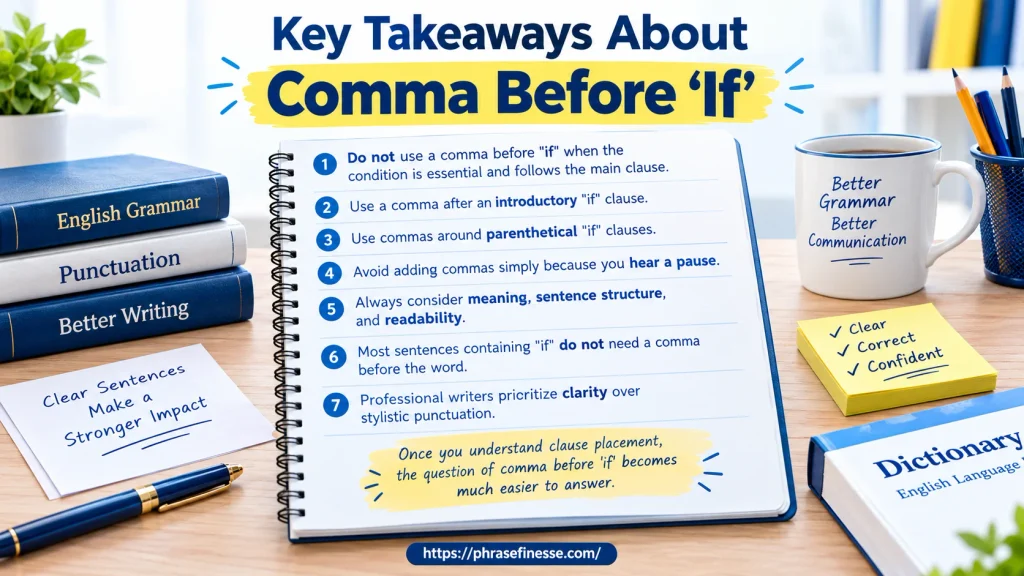
Here’s the rule in its simplest form:
- Do not use a comma before “if” when the condition is essential and follows the main clause.
- Use a comma after an introductory “if” clause.
- Use commas around parenthetical “if” clauses.
- Avoid adding commas simply because you hear a pause.
- Always consider meaning, sentence structure, and readability.
- Most sentences containing “if” do not need a comma before the word.
- Professional writers prioritize clarity over stylistic punctuation.
Once you understand clause placement, the question of comma before “if” becomes much easier to answer.
FAQs
Do you always need a comma before “if”?
No. In most cases, you do not need a comma before if when it introduces an essential condition.
Example:
✅ I’ll attend the meeting if I finish work early.
❌ I’ll attend the meeting, if I finish work early.
When should you use a comma before “if”?
Use a comma before if when it introduces a nonessential comment, interruption, or parenthetical phrase.
Example:
✅ The project will succeed, if my calculations are correct.
Should there be a comma after an “if” clause at the beginning of a sentence?
Yes. When an if clause comes first, place a comma after the clause.
Example:
✅ If the calendar is updated, everyone will receive the new schedule.
Can a comma before “if” change the meaning of a sentence?
Yes. In some situations, adding or removing a comma can subtly change emphasis or meaning.
Example:
- I’ll call you if I arrive early.
- I’ll call you, if I arrive early.
Is a comma before “if” common in formal writing?
Generally, no. Most formal writing, business communication, and academic writing avoid a comma before if unless grammar rules specifically require one.
Example:
✅ Please notify the team if the meeting time changes.
How can I tell whether a comma before “if” is necessary?
Ask yourself whether the if clause is essential to the sentence’s meaning. If removing it changes the core meaning, do not use a comma. If it adds extra information, a comma may be appropriate.
Example:
✅ We will proceed if the client approves the proposal.
Conclusion
Knowing when to use a comma before “if” can make your writing clearer, more professional, and easier to understand. The general rule is simple: do not use a comma before “if” when it introduces an essential condition. However, a comma may be appropriate when the if clause adds nonessential or parenthetical information.
When an if clause starts a sentence, place a comma after the clause before the main statement.
Mastering this punctuation rule improves grammar, English usage, formal writing, and business communication. Whether you’re handling scheduling, coordinating meetings, managing a calendar, or writing professional emails, correct comma placement helps maintain consistency and ensures your message is communicated effectively.
By applying the examples and guidelines in this article, you can use if clauses with confidence in any writing situation.

Alyan Ashraf is an English language writer and editor at Phrase Finesse, where he specializes in grammar, vocabulary, spelling, word usage, and clear communication. Passionate about the English language, he creates practical, research-backed content that helps readers avoid common mistakes and write with greater accuracy and confidence.
Known for his clear writing style and attention to detail, Alyan simplifies complex language topics into easy-to-understand guides filled with real-world examples and actionable insights. His work covers confusing word pairs, grammar rules, idioms, punctuation, and everyday English usage, making learning both accessible and engaging for students, professionals, writers, and non-native English speakers.
Every article Alyan writes is carefully researched, fact-checked, and designed to meet high editorial standards. His goal is to help readers strengthen their English skills, expand their vocabulary, and communicate more effectively in academic, professional, and everyday settings.
Through Phrase Finesse, Alyan is committed to publishing trusted language resources that make mastering English simpler, clearer, and more enjoyable for learners around the world
[…] See More :Comma Before “If”? A Complete Guide to Correct Punctuation […]