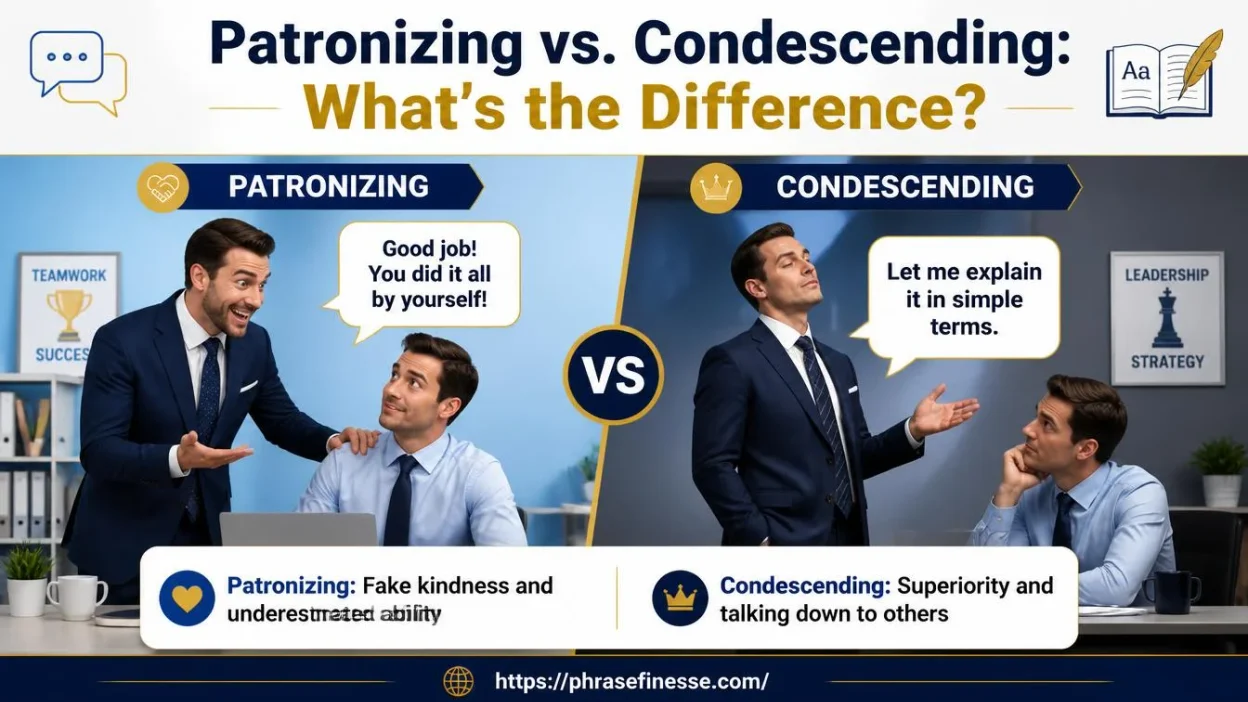
Patronizing vs. Condescending – Difference Revealed explains how fake kindness and a superior attitude can make communication feel disrespectful. Although condescending and patronizing have similar meanings, they often show different attitudes, intentions, and behavioral patterns.
A condescending person acts as if they are better than others, smarter, or more important. Their arrogant behavior, dismissive attitude, and tone of voice may reveal a sense of intellectual superiority and self-importance. They might talk down to someone, belittle others, or treat others as inferior, either overtly or subtly.
In everyday English communication, the context, word choice, and underlying tone help you recognize this condescending attitude. Patronizing behavior, however, often hides behind fake kindness, feigned concern, or false friendliness. A patronizing person may seem kind and seem helpful, but their apparent helpfulness can hide insincere concern or hidden disrespect.
For example, someone might explain an easy task as if you lack intelligence or lack capability, making you feel inferior while pretending to offer helpful advice. Both terms describe forms of disrespectful communication, but their subtle distinctions matter in professional situations, personal situations, and workplace interactions.
Understanding these differences improves your language understanding, vocabulary development, and communication effectiveness. It also helps you avoid misunderstandings, recognize power dynamics, and choose appropriate responses in interpersonal relationships.
By considering someone’s motivation, attitude, and communication style, you can better understand whether their words express genuine helpfulness or a hidden sense of superiority.
Quick Answer:
Patronizing means treating someone as though they are less intelligent, capable, or experienced than they really are, sometimes while pretending to be helpful or encouraging.
Condescending means behaving as though you are better, smarter, or more important than another person. It often involves talking down to someone or dismissing their knowledge and opinions.
For example:
- Patronizing: “Wow, you managed to finish that report all by yourself? Good for you!”
- Condescending: “Let me explain this in simple terms because you clearly don’t understand it.”
The first comment suggests that the speaker underestimated the other person’s abilities. The second directly communicates a sense of superiority.
The key difference: Patronizing behavior often makes someone feel underestimated, while condescending behavior makes someone feel inferior. Both can overlap, and context determines how a particular comment comes across.
What Does Patronizing Mean?
The word patronizing describes behavior that treats someone as though they have less intelligence, ability, experience, or independence than they actually possess.
A patronizing person may speak slowly, offer unnecessary explanations, or give exaggerated praise for an ordinary accomplishment. Their behavior can make the other person feel childish, incompetent, or dependent.
What makes patronizing behavior particularly frustrating is that it may appear friendly on the surface. Someone might smile, offer assistance, or use encouraging words while communicating that they don’t consider you capable.
For example, imagine an experienced employee explaining a familiar computer task to a colleague who has performed it successfully for years. The explanation isn’t necessary, but the employee continues speaking as though the colleague has never used a computer.
Even without an obvious insult, the interaction can feel patronizing.
Why Patronizing Behavior Can Seem Helpful
Patronizing behavior doesn’t always involve open hostility. Sometimes, it hides behind excessive kindness, unwanted advice, or unnecessary protection.
Consider these examples:
- Excessive assistance: Someone insists on helping you with a task you’ve already said you can handle.
- Unnecessary praise: A person congratulates you enthusiastically for completing an ordinary responsibility.
- Childish explanations: Someone explains a basic concept as though you cannot understand it.
- Unwanted protection: A person makes decisions for you because they assume you cannot make good choices.
- Oversimplified instructions: Someone ignores your experience and explains everything at a level far below your knowledge.
The problem isn’t kindness itself. Genuine kindness respects another person’s independence. Patronizing behavior undermines that independence by making assumptions about what someone can do.
For instance, asking a coworker, “Would you like help with that spreadsheet?” shows consideration. Saying, “Here, let me do it for you. This stuff can be difficult for people like you,” makes an unfair assumption about their ability.
Examples of Patronizing Sentences
The following examples show how the word patronizing works in everyday English.
| Example sentence | Why it sounds patronizing |
| “Aren’t you clever for figuring that out!” | It treats an ordinary achievement as unusually impressive. |
| “Don’t worry your little head about it.” | It suggests the other person cannot handle the issue. |
| “Let me show you how to do this properly.” | Depending on the context, it assumes the other person lacks competence. |
| “You did surprisingly well for a beginner.” | It focuses on low expectations rather than the person’s achievement. |
| “That’s a good try, even if you didn’t get it right.” | It can sound childish when directed at a capable adult in an ordinary situation. |
Remember that context matters. “Let me show you how to do this properly” isn’t automatically patronizing when a trainer is correcting a genuine mistake. It becomes patronizing when the speaker unnecessarily assumes incompetence or uses the explanation to belittle someone.
Common Expressions With Patronizing
You’ll often encounter patronizing alongside nouns describing speech, behavior, or attitude.
- Patronizing tone: A way of speaking that makes another person feel inferior.
- Patronizing attitude: A mindset that treats others as less capable or important.
- Patronizing behavior: Actions that suggest someone needs unnecessary guidance or supervision.
- Patronizing remark: A comment that appears helpful or complimentary but feels belittling.
- Patronizing smile: An expression that suggests amusement, pity, or superiority toward another person.
For example: “His patronizing tone made the new employee feel as though her experience didn’t matter.”
Here, patronizing describes how he communicated rather than simply what he said.
What Does Condescending Mean?
Definition of Condescending
The word condescending describes behavior that communicates a sense of superiority over another person.
A condescending person acts as though they are smarter, more experienced, more important, or more sophisticated than the people around them. They may dismiss another person’s ideas, make sarcastic remarks, or explain familiar concepts with an air of superiority.
Unlike patronizing behavior, which often involves treating someone as incapable, condescending behavior places greater emphasis on the speaker’s attitude of being above others.
For example, imagine sharing an idea during a team meeting. Instead of considering it, a colleague responds, “That’s a very basic way to look at the problem. You’ll understand the bigger picture eventually.”
The colleague isn’t simply disagreeing. The response suggests that the speaker occupies a higher intellectual position and that your opinion deserves less consideration.
That’s condescending behavior.
How Condescending Behavior Shows Up
Condescension can be obvious or subtle. Sometimes, it appears in direct insults. Other times, a person’s word choice, facial expressions, or dismissive reactions reveal the attitude.
Common examples include:
- Dismissing opinions: “That’s not worth discussing.”
- Questioning intelligence: “Did you even think that through?”
- Using sarcasm: “Brilliant idea. What could possibly go wrong?”
- Making unnecessary corrections: Interrupting someone to correct a minor detail that doesn’t affect the conversation.
- Showing impatience: Sighing, rolling one’s eyes, or acting annoyed when someone asks a reasonable question.
- Claiming superior knowledge: “People at my level understand things differently.”
Not every disagreement or correction is condescending. People can challenge ideas, correct errors, and express frustration without treating others as inferior.
The difference lies in how they communicate. Respectful criticism addresses the issue. Condescension often attacks the person’s competence, intelligence, or standing.
Examples of Condescending Sentences
| Example sentence | Why it sounds condescending |
| “You’ll understand when you’re more experienced.” | It dismisses the person’s current understanding. |
| “That’s an interesting opinion, coming from you.” | It implies that the speaker considers the opinion unworthy. |
| “Let me explain this because it’s obviously beyond your understanding.” | It directly claims intellectual superiority. |
| “I wouldn’t expect you to know that.” | It assumes the other person lacks knowledge. |
| “Perhaps you should leave the difficult decisions to the experts.” | It undermines the other person’s ability to contribute. |
These sentences communicate more than disagreement. They suggest that the speaker believes the other person deserves less respect or consideration.
Common Expressions With Condescending
The word condescending commonly modifies nouns associated with communication and behavior.
- Condescending tone: A superior or dismissive manner of speaking.
- Condescending remark: A comment that puts another person down.
- Condescending attitude: A belief or manner that places the speaker above others.
- Condescending behavior: Actions that communicate superiority.
- Condescending smile: An expression that suggests the speaker feels superior to someone.
For example: “The manager’s condescending remarks discouraged employees from sharing new ideas.”
The word describes the manager’s superior attitude and the effect it had on communication.
Patronizing vs. Condescending: Key Differences
Now that both terms are clear, comparing their central meanings makes the distinction easier to remember.
| Feature | Patronizing | Condescending |
| Main meaning | Treating someone as less capable or knowledgeable | Acting as though you are superior to someone |
| Main emphasis | Underestimating another person’s abilities | Displaying a sense of superiority |
| Typical behavior | Unnecessary help, exaggerated praise, childish explanations | Dismissive comments, sarcasm, belittling responses |
| Possible disguise | Kindness, concern, encouragement, or protection | Confidence, expertise, authority, or sophistication |
| Common effect | Makes someone feel underestimated or infantilized | Makes someone feel disrespected or intellectually inferior |
| Example | “You did such a good job tying your shoes!” | “I wouldn’t expect you to understand such a complicated idea.” |
The Main Difference in Plain English
Think of patronizing as treating someone like a child when they don’t need that treatment. Think of condescending as acting like you’re the smartest person in the room.
A patronizing person might assume you need constant assistance. A condescending person might assume your opinions aren’t worth hearing.
For example, suppose a senior employee offers to complete a basic task for an experienced colleague without asking. The offer may feel patronizing because it assumes the colleague cannot manage independently.
Now imagine the senior employee says, “I’ll handle this because you probably wouldn’t understand the process anyway.” That comment is condescending because it directly expresses superiority.
The same person can display both behaviors in a single interaction. In fact, patronizing behavior often feels condescending because both involve treating another person as inferior.
Can the Same Comment Be Both Patronizing and Condescending?
Yes. The two words aren’t mutually exclusive.
Consider this statement:
“Aw, you actually figured out how to use the new software! I’m impressed.”
The comment may sound patronizing because it treats a normal workplace skill as an extraordinary accomplishment. It may also sound condescending because the speaker implies that the other person has limited ability.
The distinction depends on the emphasis:
- If you focus on how the speaker underestimates the person’s ability, patronizing fits.
- If you focus on the speaker’s sense of superiority, condescending fits.
- If both attitudes are present, either word may work, and both may accurately describe the behavior.
This overlap explains why people sometimes use the terms interchangeably.
See More :Published In vs. Published On: Which Is Correct?
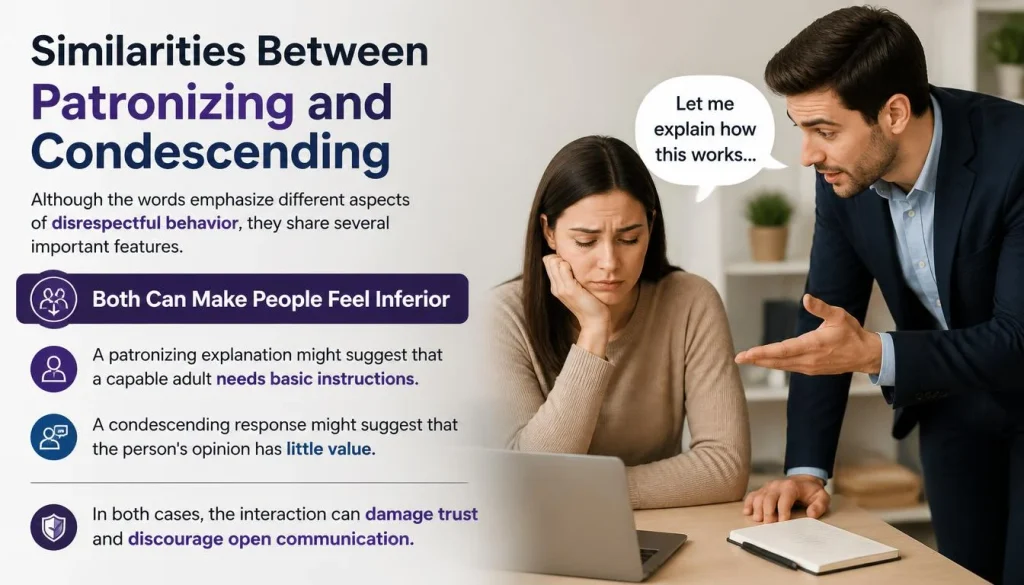
Similarities Between Patronizing and Condescending
Although the words emphasize different aspects of disrespectful behavior, they share several important features.
Both Can Make People Feel Inferior
Patronizing and condescending behavior can make someone feel embarrassed, underestimated, or disrespected.
A patronizing explanation might suggest that a capable adult needs basic instructions. A condescending response might suggest that the person’s opinion has little value.
In both cases, the interaction can damage trust and discourage open communication.
Both Can Be Intentional or Unintentional
A person doesn’t always realize how their words affect others.
Someone might offer excessive praise because they genuinely want to encourage a colleague. Another person might use a blunt tone because they’re distracted or stressed.
However, good intentions don’t automatically prevent a comment from sounding disrespectful. The speaker should consider the situation, the other person’s experience, and the effect of their words.
At the same time, one awkward remark doesn’t necessarily prove that someone has a patronizing or condescending attitude. Look at the broader context and whether the behavior forms a pattern.
Both Depend on Context and Tone
The same sentence can sound supportive in one situation and insulting in another.
For example, “That’s impressive!” is usually a positive statement. When someone says it with exaggerated enthusiasm after you complete an extremely simple task, however, it may sound patronizing.
Similarly, “Let me explain” can introduce a helpful explanation. If the speaker uses it to dismiss your knowledge or embarrass you, it may sound condescending.
Words matter, but delivery and context help determine their meaning.
Patronizing vs. Condescending in Real-Life Situations
Everyday interactions make the difference easier to recognize. Here are several realistic situations that show how each term works.
Patronizing vs. Condescending in the Workplace
Professional settings can bring these behaviors to the surface because employees have different roles, experience levels, and areas of expertise.
Patronizing workplace example:
An experienced employee offers to handle a routine assignment for a qualified coworker, saying, “Don’t worry. I’ll take care of this little task for you.”
The comment may sound patronizing because it assumes the coworker needs help and treats the assignment as something they cannot manage.
Condescending workplace example:
During a meeting, a manager responds to an employee’s suggestion by saying, “Maybe once you’ve been here longer, you’ll understand how these decisions work.”
The manager dismisses the suggestion by implying that the employee lacks the knowledge to contribute.
Both examples undermine professional respect. However, the first emphasizes presumed incompetence, while the second emphasizes superiority.
Patronizing vs. Condescending in Everyday Conversations
Friends and acquaintances sometimes use language that sounds harmless until you consider the circumstances.
Patronizing example:
“You remembered everyone’s name? Good for you!”
If remembering names is a normal expectation in that situation, the exaggerated praise may sound belittling.
Condescending example:
“That’s a cute little theory, but adults understand how things really work.”
This comment dismisses another person’s perspective while suggesting that the speaker has superior knowledge.
A useful rule is to consider whether the speaker is underestimating your ability or dismissing your perspective from a position of supposed superiority.
Patronizing vs. Condescending in Personal Relationships
These behaviors can become especially hurtful in close relationships because they affect trust and independence.
A partner who repeatedly says, “Let me handle the bills. Money is complicated,” may sound patronizing if both partners are equally capable of managing finances.
By contrast, a partner who says, “You wouldn’t understand the financial decisions I make,” sounds condescending because the statement places one person above the other.
Over time, repeated comments like these can create resentment. One person may feel incapable or dependent, while the other appears unwilling to treat them as an equal.
Healthy communication works differently. Partners can share responsibilities, explain unfamiliar topics, and offer advice without assuming that one person is inherently less capable.
Patronizing vs. Condescending in Education
Teachers, tutors, and mentors often need to explain difficult ideas. The challenge is to provide appropriate guidance without making learners feel inferior.
Patronizing example:
A teacher tells an adult student, “You finally got the answer right! See? Even you can do it.”
The exaggerated praise implies that the student was expected to fail.
Condescending example:
A tutor responds to a student’s question by saying, “That’s an obvious point. Anyone who understands the basics would know it.”
The tutor uses the question as an opportunity to display superiority rather than help the student learn.
Good teaching respects the learner’s current knowledge. A supportive teacher explains concepts clearly, welcomes questions, and corrects mistakes without attacking the student’s intelligence.
How to Identify a Patronizing or Condescending Tone
Recognizing these behaviors requires more than looking for specific words. Pay attention to how someone communicates, whether their response fits the situation, and how they treat other people.
Signs of a Patronizing Tone
A patronizing tone may include:
- Exaggerated praise: Treating a routine accomplishment as remarkable.
- Unnecessary simplification: Explaining familiar concepts without considering the listener’s experience.
- Unrequested assistance: Assuming someone cannot complete a task independently.
- Infantilizing language: Using words or expressions that make an adult sound like a child.
- Excessive reassurance: Offering comfort in a way that suggests the other person cannot cope.
For example, a colleague might say, “There you go! You managed to open the file all by yourself.”
If the colleague knows you routinely work with digital files, the comment may imply that they consider you unusually incapable.
Signs of a Condescending Tone
A condescending tone often includes:
- Dismissive language: Treating another person’s concerns as unimportant.
- Unnecessary sarcasm: Using mockery to make someone appear foolish.
- Intellectual superiority: Assuming that one’s own knowledge makes other people inferior.
- Belittling corrections: Correcting minor mistakes to embarrass someone rather than clarify information.
- Disrespectful reactions: Rolling one’s eyes, interrupting, or responding with obvious contempt.
For example, saying, “That’s a fascinating suggestion, if you don’t know anything about the subject,” dismisses the idea while insulting the person who offered it.
How to Distinguish Disrespect From Constructive Feedback
Not every uncomfortable comment is patronizing or condescending. Sometimes, people need to correct mistakes or provide honest feedback.
Compare these examples:
| Constructive feedback | Patronizing or condescending alternative |
| “The report needs more supporting evidence.” | “Let me explain how a proper report works.” |
| “Would you like me to walk you through this process?” | “I’ll do it for you because this is probably too difficult.” |
| “I disagree because the data points in another direction.” | “You clearly don’t understand the data.” |
| “Let’s review the steps where the error occurred.” | “You should have known better than to make that mistake.” |
The difference lies in the focus. Constructive feedback addresses a task, decision, or behavior. Disrespectful communication often undermines the person.
Of course, a single sentence doesn’t always tell the whole story. Tone, timing, and the relationship between speakers matter.
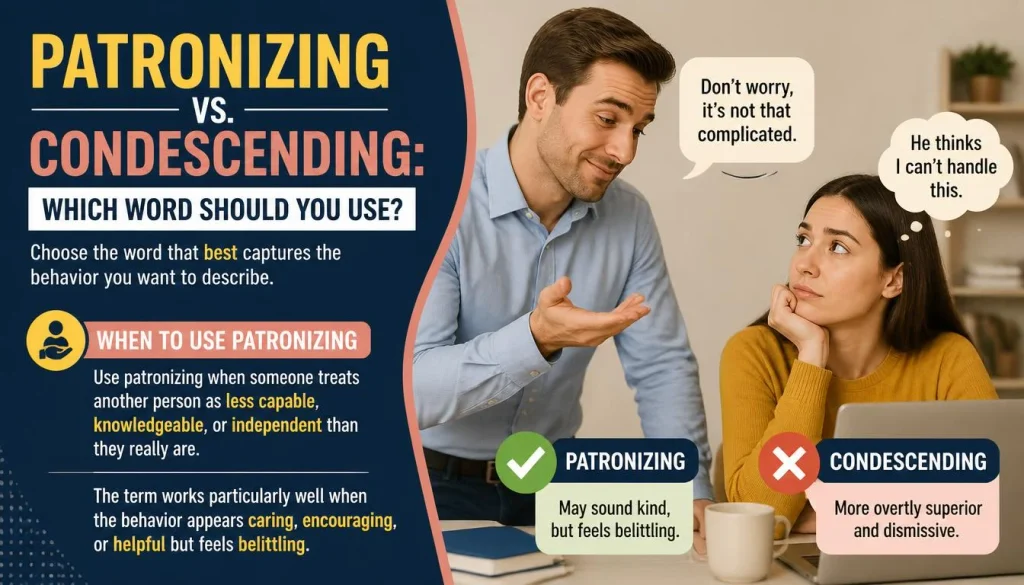
Patronizing vs. Condescending: Which Word Should You Use?
Choose the word that best captures the behavior you want to describe.
When to Use Patronizing
Use patronizing when someone treats another person as less capable, knowledgeable, or independent than they really are.
The term works particularly well when the behavior appears caring, encouraging, or helpful but feels belittling.
Examples:
- “Her patronizing praise made the experienced employee uncomfortable.”
- “He used a patronizing tone when explaining the basic procedure.”
- “The customer disliked the patronizing way the representative answered her questions.”
In each example, the focus is on treatment that underestimates the other person’s ability or maturity.
When to Use Condescending
Use condescending when someone acts superior to another person or communicates as though the other person deserves less respect.
This word is especially useful for dismissive remarks, arrogant responses, and conversations in which someone tries to establish intellectual or social superiority.
Examples:
- “His condescending response discouraged the team from sharing ideas.”
- “She made a condescending remark about her colleague’s experience.”
- “The instructor’s condescending attitude made students reluctant to ask questions.”
Here, the emphasis falls on the speaker’s superior attitude and dismissive manner.
A Simple Test for Choosing the Right Word
Ask yourself what the behavior communicates most clearly.
- Does the person treat someone as less capable than they really are? Patronizing may be the better choice.
- Does the person act as though they are above someone else? Condescending may be the better choice.
- Does the behavior communicate both attitudes? Either term may fit, depending on what you want to emphasize.
For example, if a manager offers unnecessary help because they assume an experienced employee cannot handle a task, patronizing highlights the assumption. If the manager dismisses that employee’s ideas as unworthy of consideration, condescending highlights the superiority.
Synonyms for Patronizing and Condescending
The two words share several related terms, but their synonyms have different shades of meaning. Choosing the right alternative can make your writing more precise.
Synonyms for Patronizing
| Synonym | Meaning | Example |
| Belittling | Making someone seem less important or capable | “His belittling comments embarrassed the new employee.” |
| Paternalistic | Treating others as though you should make decisions for them | “The policy took a paternalistic approach to adult workers.” |
| Condescending | Acting superior to another person | “Her condescending response ended the discussion.” |
| Insulting | Showing disrespect or causing offense | “The insulting remark damaged their relationship.” |
| Infantilizing | Treating an adult as though they were a child | “The infantilizing explanation frustrated the experienced learner.” |
Paternalistic deserves special attention because it often describes behavior that restricts someone’s independence under the appearance of protection or care.
For instance, a supervisor who refuses to let qualified employees make routine decisions may be acting paternalistically. If the supervisor also treats those employees as intellectually inferior, the behavior may be patronizing as well.
Synonyms for Condescending
| Synonym | Meaning | Example |
| Arrogant | Having an exaggerated sense of one’s importance | “His arrogant response alienated his coworkers.” |
| Supercilious | Behaving as though you are superior to others | “She gave him a supercilious look.” |
| Snobbish | Treating others as inferior because of perceived status or taste | “His snobbish attitude made the guests uncomfortable.” |
| Dismissive | Showing little interest or respect for someone’s concerns | “The manager gave a dismissive answer.” |
| Haughty | Displaying proud superiority or disdain | “Her haughty manner discouraged conversation.” |
These words aren’t interchangeable in every situation. Someone can be dismissive without being openly arrogant, and a person can be snobbish because of social status rather than perceived intelligence.
Choose the synonym that captures the specific behavior you want to describe.
Antonyms of Patronizing and Condescending
If you want to describe respectful communication, several words offer a useful contrast.
| Antonym | Meaning | Example |
| Respectful | Treating others with dignity | “The supervisor remained respectful during the disagreement.” |
| Humble | Not acting as though you are superior | “She offered her expertise with a humble attitude.” |
| Considerate | Thinking about other people’s feelings and needs | “He was considerate when answering the beginner’s questions.” |
| Supportive | Helping someone in a positive, encouraging way | “Her supportive feedback helped the team improve.” |
| Approachable | Easy to speak with or ask for help | “The approachable instructor welcomed every question.” |
| Collaborative | Working with others as partners | “The collaborative manager invited everyone to contribute.” |
These qualities don’t require you to hide your knowledge or avoid giving feedback. Instead, they allow you to communicate expertise without undermining someone else’s dignity.
A respectful expert can correct an error, explain a complicated concept, or disagree with an idea while treating the other person as an equal.
How to Avoid Sounding Patronizing or Condescending
You can communicate confidence and expertise without making others feel inferior. The key is to focus on their needs, respect their independence, and choose words that invite conversation rather than shut it down.
Ask Before Offering Help
Unrequested assistance can sound patronizing when it implies that someone cannot manage independently.
Instead of saying, “Here, let me do that for you,” try asking, “Would you like a hand with that?”
The question gives the other person control. It also allows you to offer genuine support without making assumptions about their ability.
Match Your Explanation to the Person’s Knowledge
A beginner may appreciate a step-by-step explanation. An experienced professional may prefer a concise answer.
Before explaining something, consider what the other person already knows. You can also ask, “How familiar are you with this process?” That question helps you choose the right level of detail.
Avoid assuming that someone lacks knowledge because they are younger, newer to an organization, or unfamiliar with one particular subject.
Give Specific and Sincere Praise
Praise works best when it recognizes a real achievement rather than treating ordinary competence as surprising.
Instead of saying, “Wow, you actually handled that correctly,” try saying, “Your explanation made the main issue much clearer.”
Specific praise shows that you paid attention. It also recognizes the person’s contribution without implying that you expected them to fail.
Disagree Without Dismissing the Person
You can challenge someone’s reasoning without attacking their intelligence.
Instead of saying, “You clearly don’t understand the problem,” try saying, “I see it differently because the latest figures suggest another explanation.”
The second response addresses the disagreement directly. It gives the other person a reason to reconsider the idea without turning the conversation into a personal contest.
Listen Before Correcting
Constant interruptions and unnecessary corrections can make a conversation feel like a competition.
If someone makes a minor mistake that doesn’t affect the main point, consider whether correcting it adds value. When an error matters, explain the issue clearly and respectfully.
For example, “There’s one detail we should double-check before moving forward” sounds more collaborative than “You got that wrong again.”
Treat Expertise as a Way to Help, Not a Way to Dominate
Knowledge becomes more useful when you share it without using it to establish superiority.
If you have more experience than someone else, explain what you know, welcome questions, and acknowledge what you don’t know. You don’t need to minimize your expertise to respect another person’s abilities.
The goal isn’t to avoid authority or confidence. It’s to make room for other people to learn, contribute, and disagree without feeling belittled.
FAQs
1. What is the difference between patronizing and condescending?
Condescending behavior shows superiority by talking down to someone or treating them as less intelligent. Patronizing behavior often disguises that superiority as kindness, help, or concern.
2. Are patronizing and condescending synonyms?
Yes, they are near synonyms because both describe behavior that makes someone feel inferior. However, condescending often emphasizes an openly superior attitude, while patronizing often suggests fake kindness or insincere concern.
3. What is an example of a condescending person?
A condescending person might say, “Let me explain this in simple terms because you probably won’t understand it.” This remark suggests that the speaker considers themselves smarter than the other person.
4. What is an example of patronizing behavior?
Someone might say, “Good job! You finally managed to do it all by yourself!” Although the words sound positive, the tone suggests that the speaker expected very little from the other person.
5. Is patronizing behavior always intentional?
No. Some people patronize others without realizing it. They may believe they’re being helpful, but their tone or choice of words can make others feel inferior. The impact of their behavior matters even when they have no harmful intentions.
6. How can you respond to someone who is patronizing or condescending?
Stay calm and address the behavior directly. You could say, “I understand the point you’re making, but I’d appreciate it if you spoke to me as an equal.” This response sets a clear boundary without turning the conversation into an argument.
Conclusion
Understanding the difference between patronizing and condescending behavior helps you recognize disrespect in everyday conversations.
A condescending person often talks down to others and acts superior, while a patronizing person may hide that superiority behind fake kindness or false concern. Although the terms have similar meanings, their subtle differences matter in professional and personal communication.
Pay attention to a person’s tone, word choice, and intentions to understand what they really mean. Whether you’re speaking with a coworker, friend, or family member, recognizing these behaviors can help you respond calmly and communicate more effectively.
Choosing the right word also improves your English vocabulary and helps you describe different attitudes more precisely.


[…] See More : Patronizing vs. Condescending: What’s the Difference? […]
[…] See More : Patronizing vs. Condescending: What’s the Difference? […]