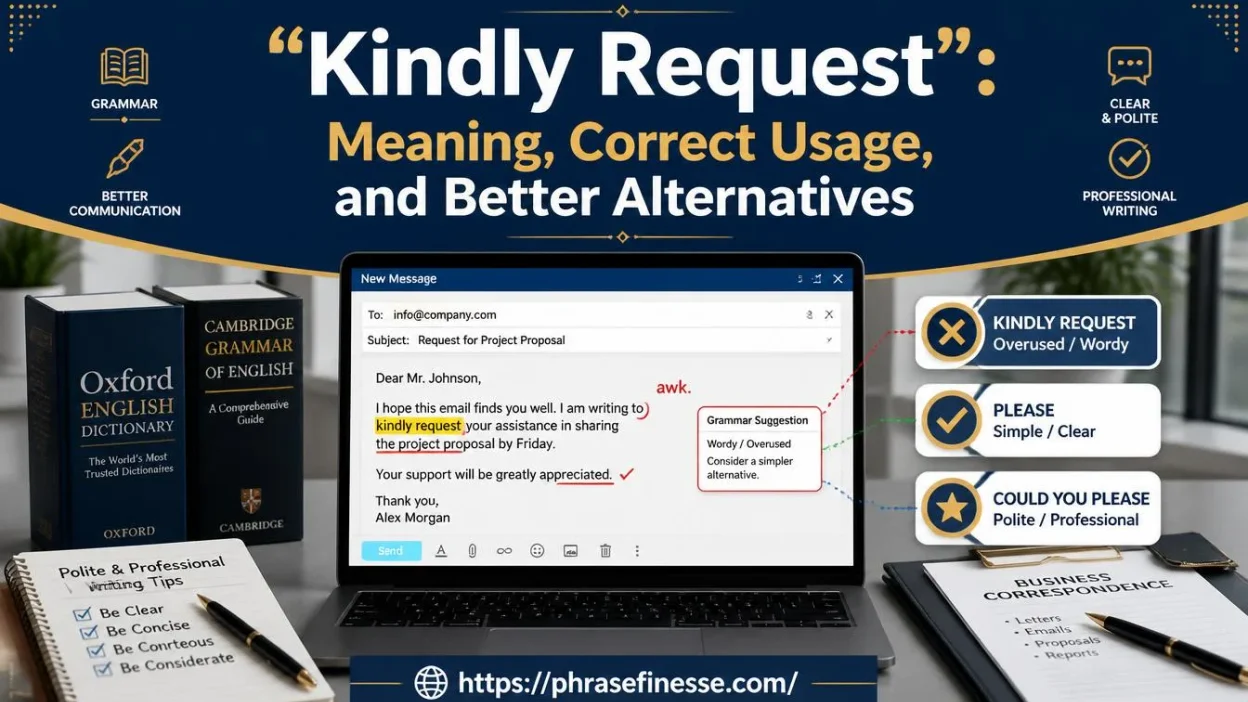
Have you ever paused while writing an email and wondered whether the phrase “kindly request” is actually correct? Many people use it in business communication, customer messages, and professional correspondence, but its grammatical accuracy often raises questions.
In this guide,“Kindly Request”: Meaning, Correct Usage, and Better Alternatives breaks down the phrase in simple terms, helping you understand when it sounds natural, when it may be redundant, and what alternatives work better in different situations.
Understanding proper English usage is essential for clear and effective communication. Whether you are handling formal writing, arranging meetings, managing a calendar, coordinating project management tasks, or sending messages related to online booking, the words you choose can affect professionalism and clarity.
Small language choices also contribute to better consistency, making your writing easier to understand and more persuasive.
This article explores the meaning and correctness of “kindly request,” explains common grammar rules, and provides practical examples you can use immediately. You will also learn how the phrase fits into modern workplace communication, including contexts involving scheduling, time management, broadcasting, and professional correspondence.
By the end, you will know exactly when to use the expression, when to avoid it, and how to communicate your requests with confidence.
Is It Correct To Say “Kindly Request”?
Yes, “kindly request” is grammatically correct.
The phrase combines:
- Kindly (an adverb meaning politely, graciously, or courteously)
- Request (a verb meaning to ask for something formally or politely)
Together, they create a phrase that expresses a polite and respectful request.
For example:
“We kindly request your cooperation during the maintenance period.”
This sentence follows standard English grammar rules and would be considered correct in professional writing.
However, many native English speakers rarely use “kindly request” in everyday conversation because the word request already carries a polite meaning.
Quick Verdict
| Question | Answer |
| Is “kindly request” grammatically correct? | Yes |
| Is it commonly used? | Yes, especially in formal writing |
| Can it sound redundant? | Sometimes |
| Is it wrong to use? | No |
| Are there more natural alternatives? | Often, yes |
The key issue isn’t grammar. It’s style and tone.
What Does “Kindly Request” Mean?
To fully understand the phrase, it helps to examine each word separately.
Meaning of “Kindly”
The adverb kindly means:
- In a kind manner
- Politely
- Courteously
- Considerately
Examples:
- Kindly close the door.
- Kindly provide the required documents.
- Kindly contact customer support.
In formal communication, kindly softens requests and makes them sound more respectful.
Meaning of “Request”
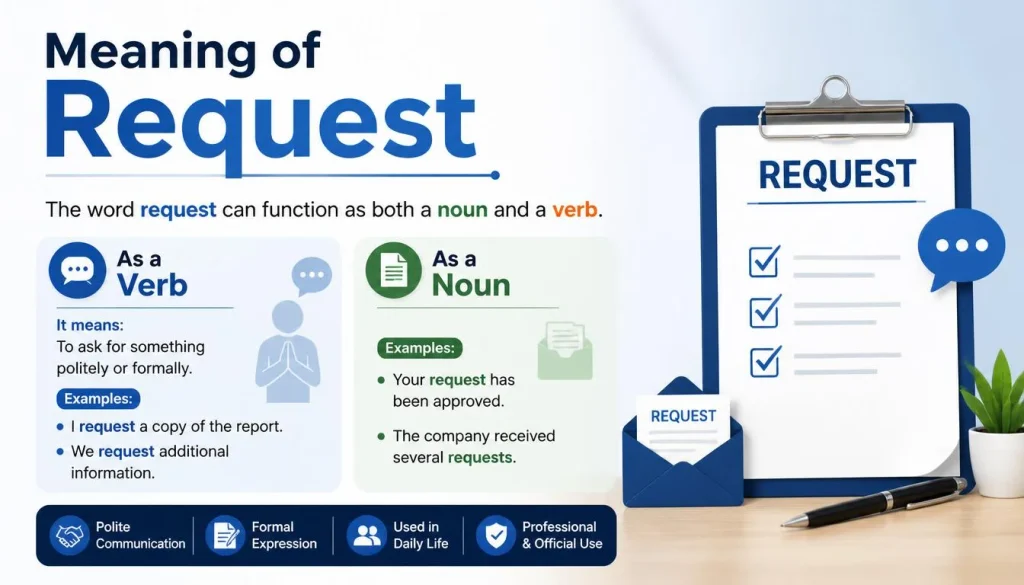
The word request can function as both a noun and a verb.
As a Verb
It means:
To ask for something politely or formally.
Examples:
- I request a copy of the report.
- We request additional information.
As a Noun
Examples:
- Your request has been approved.
- The company received several requests.
Combined Meaning
When combined, “kindly request” means:
To politely and respectfully ask for something.
For example:
“We kindly request your presence at the meeting.”
The speaker is making a formal request while emphasizing politeness.
Is “Kindly Request” Redundant?
This is where grammar discussions become interesting.
Many language professionals argue that “kindly request” contains unnecessary repetition.
Why?
Because the verb request already implies politeness.
Consider these definitions:
| Word | Meaning |
| Ask | Seek information or action |
| Request | Politely ask for something |
Since a request is already polite, adding kindly can feel repetitive.
Think about similar expressions:
| Expression | Why It May Be Redundant |
| Advance planning | Planning already refers to the future |
| End result | Results occur at the end |
| Free gift | Gifts are generally free |
| Kindly request | Request already implies courtesy |
Does Redundancy Make It Wrong?
Not at all.
English contains countless accepted redundant phrases.
People use them because they add emphasis, improve tone, or meet audience expectations.
In many professional settings, phrases like:
- We kindly request…
- We kindly ask…
- Kindly note…
- Kindly review…
remain common and widely accepted.
So while some writers prefer more concise wording, “kindly request” is still considered correct and professional.
Why “Kindly Request” Appears So Often in Business Writing
Formal business communication often prioritizes politeness.
Companies frequently use language that sounds respectful and diplomatic.
Common examples include:
- We kindly request your cooperation.
- We kindly request payment within 30 days.
- We kindly request attendees to register in advance.
- We kindly request that all forms be submitted before the deadline.
These phrases help organizations communicate requirements without sounding demanding.
The Psychology Behind It
A direct command:
Submit the report by Friday.
may feel abrupt.
A softened request:
We kindly request that you submit the report by Friday.
sounds more collaborative.
That’s why businesses often favor this style.
How Native English Speakers Usually Phrase Requests
Although “kindly request” appears frequently in formal writing, many native speakers choose simpler alternatives.
Modern English values clarity and brevity.
Instead of:
We kindly request your attendance.
Many speakers would say:
We’d appreciate your attendance.
Or:
Please join us.
Or:
We hope you’ll attend.
Common Alternatives
| Alternative | Tone |
| Please | Friendly |
| Could you please | Polite |
| Would you mind | Very polite |
| We’d appreciate | Professional |
| We ask that | Formal |
| We request that | Official |
Everyday Examples
Less natural:
I kindly request you to send the file.
More natural:
Could you please send the file?
Less natural:
We kindly request your response.
More natural:
We’d appreciate your response.
The second versions typically sound smoother in modern English.
How To Use “Kindly Request” Correctly
When using the phrase, sentence structure matters.
Basic Formula
Subject + kindly request + object
Examples:
- We kindly request your cooperation.
- I kindly request additional information.
- The committee kindly requests your attendance.
Alternative Formula
Subject + kindly request that + clause
Examples:
- We kindly request that you arrive on time.
- The school kindly requests that parents attend the meeting.
- Management kindly requests that employees update their passwords.
This structure often sounds more natural and grammatically precise.
Examples of “Kindly Request” in Professional Communication
Requesting Information
We kindly request additional details regarding your application.
Requesting Documentation
We kindly request a copy of your identification document.
Requesting Attendance
We kindly request your presence at the annual conference.
Requesting Action
We kindly request that all team members complete the training module.
Requesting Payment
We kindly request payment within fourteen days of receiving this invoice.
These examples commonly appear in business environments.
Is “Kindly Request You To” Correct?
This expression appears frequently in emails written around the world:
We kindly request you to submit the form.
While many people use it, some style guides consider it less natural than other structures.
Preferred Alternative
Instead of:
We kindly request you to submit the form.
Many editors recommend:
We kindly request that you submit the form.
Or:
We ask that you submit the form.
Or:
Could you please submit the form?
Comparison Table
| Less Preferred | Preferred |
| We kindly request you to attend. | We kindly request that you attend. |
| I kindly request you to reply. | Could you please reply? |
| We kindly request you to cooperate. | We request your cooperation. |
The revised versions usually sound smoother and more natural.
See More :Maximal vs. Maximum Difference Explained Helpful Examples
“Kindly Request” vs. “Kindly Ask”
Many people use these phrases interchangeably.
However, there are subtle differences.
| Feature | Kindly Request | Kindly Ask |
| Formality | Higher | Moderate |
| Common in legal writing | Yes | Rare |
| Common in business communication | Yes | Yes |
| Common in conversation | Rare | More common |
| Sounds natural today | Sometimes | Usually |
Example
Formal:
We kindly request your attendance.
Less formal:
We kindly ask you to attend.
The second version often feels warmer and more conversational.
“Kindly Request” vs. “Please”
One of the biggest questions is whether “kindly request” offers any advantage over “please.”
In many situations, the answer is no.
Comparison
| Phrase | Formality |
| Please | Low to Medium |
| Kindly | Medium |
| Kindly ask | Medium |
| Kindly request | High |
| We would appreciate | High |
Example Comparison
Formal:
We kindly request that you complete the survey.
Simple:
Please complete the survey.
Professional:
We’d appreciate it if you completed the survey.
All three work.
The best choice depends on your audience.
When Should You Use “Kindly Request”?
The phrase works best in situations requiring a higher degree of formality.
Good Situations
- Business letters
- Government notices
- Legal correspondence
- Academic communication
- Official announcements
- Customer service messages
Less Suitable Situations
- Casual emails
- Text messages
- Team chats
- Friendly conversations
- Informal workplace communication
Example
Formal:
We kindly request that all visitors sign in upon arrival.
Casual:
Please sign in when you arrive.
The second version feels more natural in everyday communication.
Common Mistakes When Using “Kindly Request”
Even though the phrase is correct, writers often misuse it.
Adding Too Much Politeness
Example:
We kindly and respectfully and humbly request your cooperation.
This sounds excessive.
Better:
We kindly request your cooperation.
Simple wins.
Using It in Casual Conversations
Unnatural:
Hey John, I kindly request you to pass the ketchup.
Natural:
John, could you pass the ketchup?
Context matters.
Using Incorrect Grammar
Incorrect:
We kindly request for assistance.
Correct:
We kindly request assistance.
The verb request does not normally require for.
Making Requests Vague
Weak:
We kindly request action.
Better:
We kindly request that you submit the completed form by Friday.
Specific requests achieve better results.
Real-World Case Study: Customer Service Communication
Imagine two customer support emails.
Version A
We kindly request that you provide your order number so we may assist you further.
Version B
Send your order number.
Both communicate the same request.
However, Version A feels professional and customer-focused.
This explains why businesses frequently use “kindly request” despite concerns about redundancy.
The phrase helps maintain positive relationships while still obtaining necessary information.
Better Alternatives to “Kindly Request”
Many modern writers prefer alternatives that sound natural while remaining professional.
Formal Alternatives
- We respectfully request
- We request that
- We would like to request
- We would appreciate
- We ask that
Examples:
We respectfully request your cooperation.
We ask that all participants arrive early.
Neutral Alternatives
- Please
- Could you please
- Would you mind
- Kindly
- We’d appreciate it if
Examples:
Could you please send the document?
We’d appreciate it if you replied by Friday.
Stronger Alternatives
When a requirement is mandatory, softer language may not be ideal.
Examples:
- We require
- It is necessary that
- Employees must
- Participants are required to
Example:
Employees are required to complete compliance training.
This removes ambiguity.
Professional Email Examples Using “Kindly Request”
Requesting Information
Dear Customer,
We kindly request additional information regarding your account so we can process your inquiry efficiently.
Thank you for your cooperation.
Requesting Documents
Dear Applicant,
We kindly request a copy of your passport and supporting documents to complete the verification process.
Sincerely,
Admissions Office
Requesting Attendance
Dear Team,
We kindly request your attendance at the quarterly planning meeting scheduled for Monday.
Regards,
Management
Requesting Approval
Dear Director,
We kindly request approval for the proposed project budget attached below.
Thank you for your consideration.
Requesting Payment
Dear Client,
We kindly request payment of the outstanding invoice by July 31.
Please contact us if you require any assistance.
Best regards.
What Modern Business Writing Experts Recommend
Modern communication trends increasingly favor simplicity.
Instead of lengthy formal expressions, organizations often choose direct and friendly language.
For example:
| Traditional | Modern |
| We kindly request your cooperation. | Please cooperate. |
| We kindly request that you attend. | Please attend. |
| We kindly request a response. | Please reply. |
This shift improves readability and reduces unnecessary complexity.
Yet formal industries such as law, government, education, and finance still frequently use “kindly request.”
FAQs
1. Is it grammatically correct to say “kindly request”?
Yes, “kindly request” is grammatically correct. However, some style guides consider it slightly redundant because both “kindly” and “request” already convey politeness. In many professional situations, simply saying “request” or “kindly” may sound more natural.
2. Why do some people avoid the phrase “kindly request”?
Some writers avoid it because it can feel repetitive. The word “request” already implies a polite ask, so adding “kindly” may not always add meaning. Many modern business writers prefer clearer and more concise wording.
3. Can I use “kindly request” in a professional email?
Yes, you can use it in professional emails, especially in formal environments. For example: “I kindly request that you submit the report by Friday.” However, alternatives like “I would appreciate it if you could…” often sound more natural.
4. What are some alternatives to “kindly request”?
Common alternatives include:
- I would like to request
- Please
- I would appreciate it if you could
- May I ask
- Could you please
These options are often preferred in modern business communication and formal writing.
5. Is “kindly request” too formal for everyday conversations?
In casual conversations, it may sound overly formal. People usually say “please”, “could you”, or “would you mind” instead. The phrase is more common in professional, academic, or official contexts.
6. Should I use “kindly request” in customer service messages?
Yes, it can work well in customer service communications when a respectful tone is important. However, ensure the message remains friendly and concise. Overusing formal phrases can sometimes make communication feel distant.
Conclusion
The phrase “kindly request” is grammatically correct and widely understood, but it is not always the most natural choice. Because the word “request” already carries a polite meaning, adding “kindly” can sometimes feel unnecessary.
That said, the expression still appears frequently in formal writing, business communication, and professional correspondence where a courteous tone is desired.
The best approach depends on your audience and purpose. For highly formal situations, “kindly request” may be perfectly appropriate.
For modern workplace communication, shorter alternatives such as “please”, “I would like to request,” or “could you please” often provide greater clarity and readability. By understanding the nuance behind the phrase, you can choose the wording that best matches your message and communicate with confidence.